• Required reading for all forum users!!!

    Welcome!
    Register to access the full functionality of the GSResources forum. Until you register and activate your account you will not have full forum access, nor will you be able to post or reply to messages.

    A note to new registrants...
    All new forum registrations must be activated via email before you have full access to the forum.

    A Special Note about Email accounts!
    DO NOT SIGN UP USING hotmail, outlook, gmx, sbcglobal, att, bellsouth or email.com. They delete our forum signup emails.

    A note to old forum members...
    I receive numerous requests from people who can no longer log in because their accounts were deleted. As mentioned in the forum FAQ, user accounts are deleted if you haven't logged in for the past 6 months. If you can't log in, then create a new forum account. If you don't get an error message, then check your email account for an activation message. If you get a message stating that the email address is already in use, then your account still exists so follow the instructions in the forum FAQ for resetting your password.

    Have you forgotten your password or have a new email address? Then read the forum FAQ for details on how to reset it.

    Any email requests for "can't log in anymore" problems or "lost my password" problems will be deleted. Read the forum FAQ and follow the instructions there - that's what we have one for...

  • Returning Visitors

    If you are a returning visitor who never received your confirmation email, then odds are your email provider is blockinig emails from our server. The only thing that can be done to get around this is you will have to try creating another forum account using an email address from another domain.

    If you are a returning visitor to the forum and can't log in using your old forum name and password but used to be able to then chances are your account is deleted. Purges of the databases are done regularly. You will have to create a new forum account and you should be all set.

1983 GS850G - CV Carb Theory and Jetting Question

  • Thread starter Thread starter OldVintage
  • Start date Start date
O

OldVintage

Guest
I made the plunge into the controversial world of air pods. I sprung for some quality K&N pods and installed them on my 1983 GS850G. The bike already had 4-1 exhaust, but I did everything to get a good baseline with the stock airbox (dip cleaned all the carbs and individual parts, new intake orings, slight rejetting). I had things running pretty well before I thew the pods on. Now I've been systematically following the steps outlined in the PPP and CV tuning sticky threads. I'm working on tuning the high end range as best I can and slowing stepping up jet sizes (started with 127.5 and moved up from there). I'm currently on a jet size of 140 (don't ask me how much I've spent on jets so far).

The theory question I have is this...when running in the high RPM range (7-9k) I can top it out at full throttle in 3rd or 4th and when I apply full choke, I can feel the bike surge and increase in RPM 500-1k. From my basic understanding of the Mikuni CV carbs, this would seem to indicate that I'm still too lean. Otherwise the application of the choke shouldn't do anything to the RPM (or even make it so rich to kill the engine). Is this theory correct? Or is there something I'm missing here?
 
I’ve never pulled the choke lever at full throttle because I like to have my hands on the bars right around then, so I can’t speak from experience. I’d think opening the enrichment valve (choke) would have to affect slide position (lower it) because the enrichment valve gets its air from under the diaphragm, so maybe not the best way to tune. An easier way is to tape up 1/2 the pods and see if it gets better or worse.
Btw- I have a lot of lightly used jets sitting in a box as well.
 
Last edited:
I’ve never pulled the choke lever at full throttle because I like to have my hands on the bars right around then, so I can’t speak from experience. I’d think opening the enrichment valve (choke) would have to affect slide position (lower it) because the enrichment valve gets its air from under the diaphragm, so maybe not the best way to tune. An easier way is to tape up 1/2 the pods and see if it gets better or worse.
Btw- I have a lot of lightly used jets sitting in a box as well.
Actually, activating the enrichener system should have very little to do if the throttle is open at all, which it is, if you are riding the bike. The enrichment system relies on high vacuum to pull the fuel through its passage. If you open the throttle above idle, you destroy the vacuum and you don't get the extra fuel. HOWEVER, ... you DO get the extra air. Since it seems to run better with the extra air, there is a good chance that you are actually running too rich and the extra air is leaning it out to a better mixture.

Suggestion: DON'T activate the enrichment system while riding, especially if you are trying to determine jetting. Run at wide-open throttle as long as you can. It does not have to be at high RPM, so you can actually start about 30 MPH in fifth gear and let 'er rip. When you get to the top of your comfort zone, hit the kill switch, pull the clutch lever, coast to a safe spot where you can pull the spark plugs and check the colors.

.
 
Thank you both for the tips. I'll give these a try this weekend and see where I end up. Now if I can just find a use for all of these lightly used jets :)
 
Suggestion: DON'T activate the enrichment system while riding, especially if you are trying to determine jetting. Run at wide-open throttle as long as you can. It does not have to be at high RPM, so you can actually start about 30 MPH in fifth gear and let 'er rip. When you get to the top of your comfort zone, hit the kill switch, pull the clutch lever, coast to a safe spot where you can pull the spark plugs and check the colors.

.


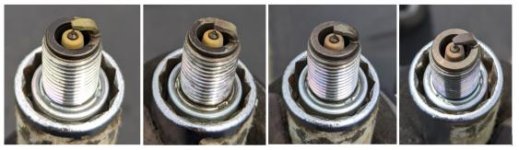
I had some time over the weekend to do this. Got the bike warmed up, used a brass brush to clean the plugs, ran in 5th gear at WOT for roughly 1.2 miles. Here are the results for plugs 1-4 (in order):

Plugs_v2.jpg

I don't have much experience checking plugs, but using some of the comparison charts I've found online and in the Haynes manual it seems to me these fall into the "OK" to "Good" range. Am I off base on this assessment?

Another theory/tuning question I have is around the jet needle. Assuming the main jet is roughly where it needs to be, I wanted to play with the jet need to try to tune out a pretty big flat spot in the mid-range. There's only so much that can be done in terms of raising/lowering the needle since there are no adjustment points. Does anyone have experience experimenting with replacing the jet needle entirely? I found the 4D8 needles for the smaller VM carbs on JetsRUs. The length is roughly the same as the BS32 needle, but the diameter is smaller throughout. I was considering giving these a try to help enrichen the mixture in the mid-range (as I'm assuming this is still quite lean from putting the pods on). Has anyone experimented with this? Is it worth a try or am I just wasting my time there?
 
I see a progression from slightly lean to a but rich, but within spec. I'd work on that #1 carb a bit
 
Isn't a Dynojet stage 3 kit called for?

When I got my 11E, it had V&H 4-into-1 but stock airbox. When I installed pods (APE, half-price copy of K&N), it was barely able to make it around the block. I started with 1/3 of the pods covered with tape, and got to around 90% covered before it ran well. I then paid for the stage 3 kit and the services of a tuner with a Dyno.

I think the stage 3 kit will make your life easier.
 
Here's a "how-to" for adjusting the needle without investing in a Dyno-Jet setup. The Dyno-Jet needles do give more options.


Shimming The Needle
(as explained by Mr. jimfj)

The shimming is acomplished by completely removing the slides from the carb bodies

Inside the top of the slide is a snap ring. Remove the snap ring and the needle will come out. On top of the needle is a nylon washer about 3-4mm thick.

Replace the nylon washer with smaller thickness washers of your choice. This creates a richer mixture or allows more fuel to flow.

Reassemble the slides and install them back into the carb bodies, making sure to align the tab of the rubber diaphram on the top of the carb body.

Put the caps back on the carbs and start her up.

Note: This isn't a substitute for jetting. This is just a way to make the bike run a little richer and take advantage of the full power band. This procedure can be acomplished with the carbs on the bike, no need to remove them.

(as explained by Mr. Steve)

Remove the tops of the carbs. You might be able to just remove the four screws that hold the 'dome' on the top of the carb and lift it off. There is a soft rubber diaphragm right under it with a light-weight spring between it and the cap. Gently remove the diapragm, lift it out of the carb. Look down the center slide, you will see a circlip at the bottom. It takes a very long pair of needle-nose pliers (Sears, $10) or a good set of circlip pliers to remove it. Pull the nylon stem out of the slide, noting its orientation. When the stem is out, you will be able to remove the jet needle. There should be a thick nylon spacer at the top of the needle, then a circlip, then a metal washer, then a spring. The needle position is determined by the thickness of the spacer above it, so go to Radio Shack and get their bag of assorted washers (about $2). The smallest ones work perfectly. Stack up the washers to see how many it takes to equal the thickness of the nylon spacer (usually about 4). Cut that in half, put them on in place of the nylon spacer, put everything back together. When you put the diaphragms back in place, note that there is a tab on one side of the edge, it fits into a shaped area on top of the carb. Snug everything back into place, it should be good to go.
 
I see a progression from slightly lean to a but rich, but within spec. I'd work on that #1 carb a bit

Thanks for taking a look! Carbs #1 and #2 had a bit of black residue that I couldn't scrub off with the brass brush. I think this came from the garage tuning / messing around before I got out on the road. I'll keep any eye on these as I continue working on tuning.
 
Isn't a Dynojet stage 3 kit called for?

When I got my 11E, it had V&H 4-into-1 but stock airbox. When I installed pods (APE, half-price copy of K&N), it was barely able to make it around the block. I started with 1/3 of the pods covered with tape, and got to around 90% covered before it ran well. I then paid for the stage 3 kit and the services of a tuner with a Dyno.

I think the stage 3 kit will make your life easier.

I was hoping to avoid investing in a full Dynojet kit, although admittedly I've spent more on pilot and main jets than a Dynojet kit and am still a ways off from a "tuned" ride. I had the same problem trying to run stock carbs with air pods, would hardly go down the street. I upped the pilots and mains and am sitting at 47.5 pilot and 140 main at the moment. I saw the Dynojet kit comes with 155, 160, and 165 mains along with an adjustable jet needle. I might just invest in the kit and see where it gets me. The kits also had a "Main Air Corrector" for the main air jet. What exactly does this part do? Is it related to A/F ratio? The kit also provides the tools for drilling the slide opening larger. Does this just increase throttle response or is it also somehow related to the A/F mixture?


...Remove the tops of the carbs. You might be able to just remove the four screws that hold the 'dome' on the top of the carb and lift it off. There is a soft rubber diaphragm right under it with a light-weight spring between it and the cap. Gently remove the diapragm, lift it out of the carb. Look down the center slide, you will see a circlip at the bottom. It takes a very long pair of needle-nose pliers (Sears, $10) or a good set of circlip pliers to remove it. Pull the nylon stem out of the slide, noting its orientation. When the stem is out, you will be able to remove the jet needle. There should be a thick nylon spacer at the top of the needle, then a circlip, then a metal washer, then a spring. The needle position is determined by the thickness of the spacer above it, so go to Radio Shack and get their bag of assorted washers (about $2). The smallest ones work perfectly. Stack up the washers to see how many it takes to equal the thickness of the nylon spacer (usually about 4). Cut that in half, put them on in place of the nylon spacer, put everything back together. When you put the diaphragms back in place, note that there is a tab on one side of the edge, it fits into a shaped area on top of the carb. Snug everything back into place, it should be good to go.

This is exactly what I did. I currently have one washer in all of them, so they are as high as they will go. I didn't have time to completely test the mid-range and check plugs again, but I do suspect that it's running quite lean in that range based on the weak and hesitant acceleration. I won't be able to get more detailed results until next week, but I plan to do the same thing I did at WOT and pull the plugs and take a look at them.
 
Back
Top