

***This idea is not my original work. I got the idea from from this project-> http://www.motorcycleproject.com/motorcycle/text/leakdown.html
I started off with the idea I could re-purpose my cylinder compression tester instead of gutting a spark plug, buying a grease hose and, as my air compressor has a means of regulating the air pressure, I wouldn't need the regulator used in the original project as it would have been redundant.
***Note*** you may have to modify what I have shown so that you may use your compression tester, but the basic idea will still be the same.
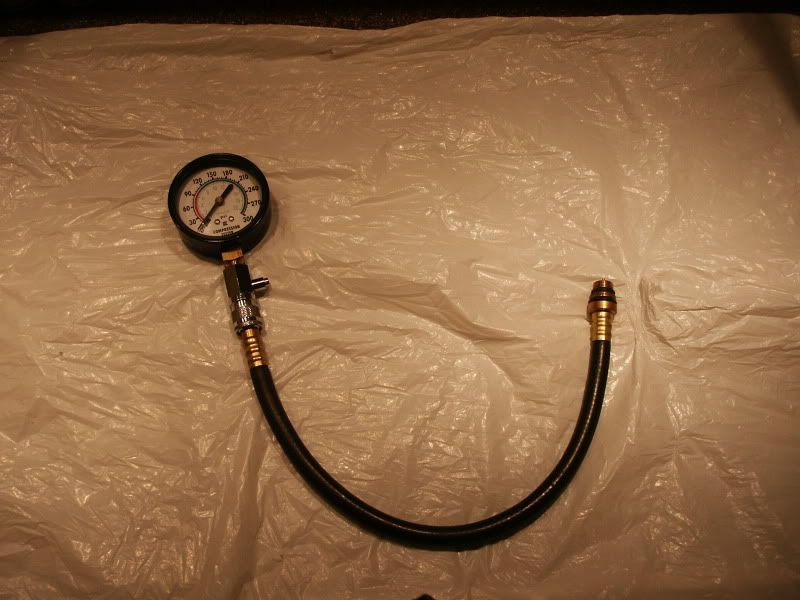
This is the compression tester I used.
___________________________________________________________________
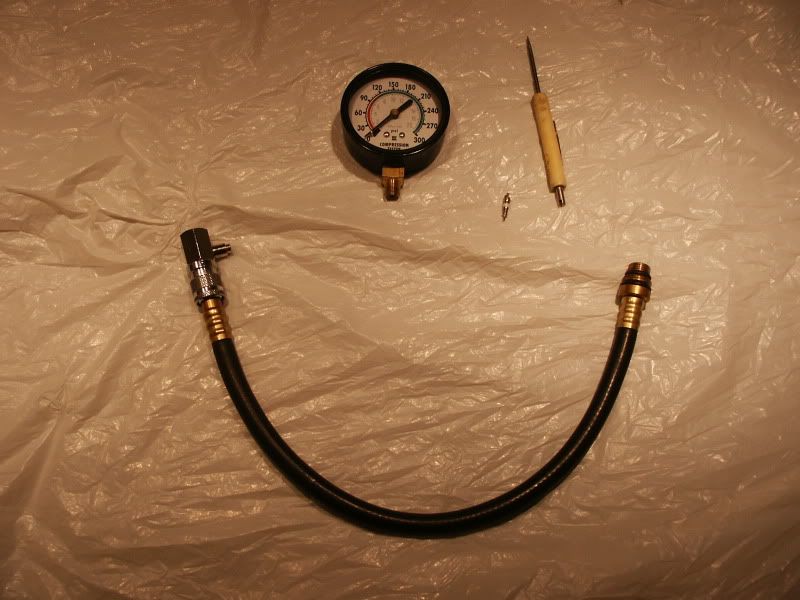
Remove the gauge and the schrader valve from the other end.
***Note** If you don't remove the valve, air will not be able to flow into the cylinder!
____________________________________________________________________
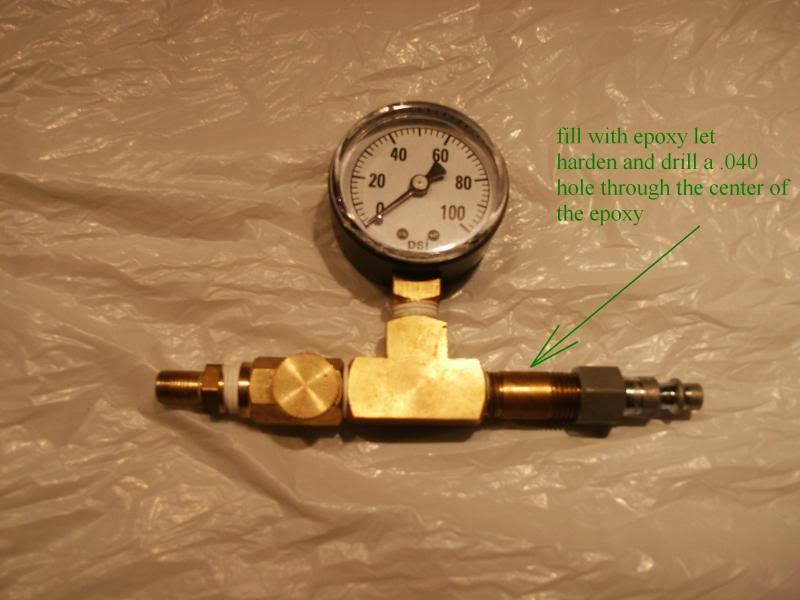
This is the adaptor I made up to use with the hose from my compression tester.
Starting from the right, the components are, the air line fitting so it can be connected to an air hose. a 1/4" brass nipple filled with epoxy that has a .040 hole drilled through the center of the epoxy. a brass tee with an air pressure gauge (you can use the pressure gauge from the compression tester just as well). a shut off valve (very important) and a fitting to connect this to the compression tester's hose assembly.
__________________________________________________________________
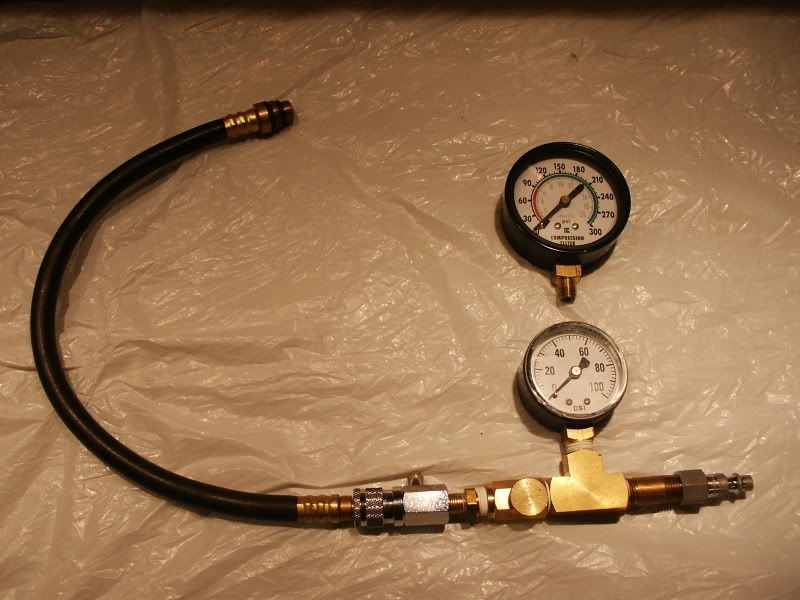
This is what the assembled leak down tester looks like.
***Note*** my compression tester had a quick connect (disconnect) fitting, making
it easier to use by inserting the hose in the spark plug hole, then connecting the 'tester' to the hose.
___________________________________________________________________
How to use the tester.
1) Remove the spark plug
2) position the piston @ top dead center of the compression stroke.
3) thread the compression testers hose into the spark plug hole.
4) close the shut off valve on the 'tester'.
5) connect the tester to an air source.
6) adjust the pressure regulator on the air compressor so the gauge on the tester reads 100 psi.
7) open the valve on the testor and read the pressure indicated.
if the gauge reads 80 psi you have a 20% leakage in the cylinder (100-80=20). if it reads 95, you have 5% leakage in the cylinder and so on...
I hope this gives you some kind of an idea on how you can make use of what you have on hand, instead of going out and buying new.
enjoy!!!
I started off with the idea I could re-purpose my cylinder compression tester instead of gutting a spark plug, buying a grease hose and, as my air compressor has a means of regulating the air pressure, I wouldn't need the regulator used in the original project as it would have been redundant.
***Note*** you may have to modify what I have shown so that you may use your compression tester, but the basic idea will still be the same.
This is the compression tester I used.
___________________________________________________________________
Remove the gauge and the schrader valve from the other end.
***Note** If you don't remove the valve, air will not be able to flow into the cylinder!
____________________________________________________________________
This is the adaptor I made up to use with the hose from my compression tester.
Starting from the right, the components are, the air line fitting so it can be connected to an air hose. a 1/4" brass nipple filled with epoxy that has a .040 hole drilled through the center of the epoxy. a brass tee with an air pressure gauge (you can use the pressure gauge from the compression tester just as well). a shut off valve (very important) and a fitting to connect this to the compression tester's hose assembly.
__________________________________________________________________
This is what the assembled leak down tester looks like.
***Note*** my compression tester had a quick connect (disconnect) fitting, making
it easier to use by inserting the hose in the spark plug hole, then connecting the 'tester' to the hose.
___________________________________________________________________
How to use the tester.
1) Remove the spark plug
2) position the piston @ top dead center of the compression stroke.
3) thread the compression testers hose into the spark plug hole.
4) close the shut off valve on the 'tester'.
5) connect the tester to an air source.
6) adjust the pressure regulator on the air compressor so the gauge on the tester reads 100 psi.
7) open the valve on the testor and read the pressure indicated.
if the gauge reads 80 psi you have a 20% leakage in the cylinder (100-80=20). if it reads 95, you have 5% leakage in the cylinder and so on...
I hope this gives you some kind of an idea on how you can make use of what you have on hand, instead of going out and buying new.
enjoy!!!
Last edited:


