• Required reading for all forum users!!!

    Welcome!
    Register to access the full functionality of the GSResources forum. Until you register and activate your account you will not have full forum access, nor will you be able to post or reply to messages.

    A note to new registrants...
    All new forum registrations must be activated via email before you have full access to the forum.

    A Special Note about Email accounts!
    DO NOT SIGN UP USING hotmail, outlook, gmx, sbcglobal, att, bellsouth or email.com. They delete our forum signup emails.

    A note to old forum members...
    I receive numerous requests from people who can no longer log in because their accounts were deleted. As mentioned in the forum FAQ, user accounts are deleted if you haven't logged in for the past 6 months. If you can't log in, then create a new forum account. If you don't get an error message, then check your email account for an activation message. If you get a message stating that the email address is already in use, then your account still exists so follow the instructions in the forum FAQ for resetting your password.

    Have you forgotten your password or have a new email address? Then read the forum FAQ for details on how to reset it.

    Any email requests for "can't log in anymore" problems or "lost my password" problems will be deleted. Read the forum FAQ and follow the instructions there - that's what we have one for...

  • Returning Visitors

    If you are a returning visitor who never received your confirmation email, then odds are your email provider is blockinig emails from our server. The only thing that can be done to get around this is you will have to try creating another forum account using an email address from another domain.

    If you are a returning visitor to the forum and can't log in using your old forum name and password but used to be able to then chances are your account is deleted. Purges of the databases are done regularly. You will have to create a new forum account and you should be all set.

GS1000 Fusebox Replacement - Upgrade?

  • Thread starter Thread starter Skowinski
  • Start date Start date
S

Skowinski

Guest
Did a search but didn't come up with anything on this. I'm about to totally redo my charging system and do a careful check of the harness, connections, etc. Looking at the old fusebox with it's wonky clips and the old glass tube style fuses makes me want to upgrade. I had a problem on a trip a few years back that was traced to one the clip connections in the fusebox coming apart.

Has anyone done a replacement with a newer style fusebox that accepts the modern blade style fuses? Maybe something from Eastern Beaver, or some similar company?

edit: 1979 GS1000
 
There are several options available.

Fuzeblocks has a 6-position panel with an on-board relay. Each of the fuse positions can be selected for constant power or switched power. Cost is about $84, plus a wiring kit, if you don't want to do your own.

Eastern Beaver has an 8-position panel, you need to supply your own relay, if you do not choose one of their wiring kits. Two fuses are constant power, the other six have switched power. Cost is $55, plus a wiring kit.

Posplayr gave a link to his Solid State Power Box. Several GSers have purchased one from him, I have heard no negative reports, except for the price. Reportedly, the price makes up for the fact that several other electrical problems are taken care of by installing the SSPB.

On my own bike, I chose the Eastern Beaver panel and my own wiring. I have seen one of the kits that EB offers. It is high-quality stuff, but I don't like settling for someone else's idea of how far from the battery the relay should be installed and other 'trivial' stuff. I made my own wiring harness for far less money than one of the pre-made kits, but I am also a bit more comfortable with wiring than many.

I have also seen other, more 'generic' fuse blocks from Blue Sea or something from your local auto parts store, but you will have to figure out how to wire some of the fuses "always hot" and some "switched".
 
There are several options available.

Fuzeblocks has a 6-position panel with an on-board relay. Each of the fuse positions can be selected for constant power or switched power. Cost is about $84, plus a wiring kit, if you don't want to do your own.

Eastern Beaver has an 8-position panel, you need to supply your own relay, if you do not choose one of their wiring kits. Two fuses are constant power, the other six have switched power. Cost is $55, plus a wiring kit.

Posplayr gave a link to his Solid State Power Box. Several GSers have purchased one from him, I have heard no negative reports, except for the price. Reportedly, the price makes up for the fact that several other electrical problems are taken care of by installing the SSPB.

On my own bike, I chose the Eastern Beaver panel and my own wiring. I have seen one of the kits that EB offers. It is high-quality stuff, but I don't like settling for someone else's idea of how far from the battery the relay should be installed and other 'trivial' stuff. I made my own wiring harness for far less money than one of the pre-made kits, but I am also a bit more comfortable with wiring than many.

I have also seen other, more 'generic' fuse blocks from Blue Sea or something from your local auto parts store, but you will have to figure out how to wire some of the fuses "always hot" and some "switched".


The SSPB was designed to optimize power distribution for a non EFI motorcycle and includes "safe power" (i.e. you can short any wire and it shuts down recovering when short goes away). So while you are correct there are a range of options, there are also costs associated with more sophistication. So to a large extent it is a matter of how care and in most circumstances that is a function of how much you know about things electrical.

For example, here is a solution approaching what the SSPB (except no safe power) does using mechanical relays and an Eastern Beaver.
How much much do you think this is costing and requiring in terms of quality workmanship (electrical fab) that a lot of people just do not have?

http://www.thegsresources.com/_foru...ion-Performance-Rebuild&p=2275791#post2275791


If you ask my opinion on the cheapest solution, it is to get a later model 5 position Suzuki fusebox (one with diagonal tabs). Clean it and keep it clean with DeOxit and add a relay to the main battery feed and you will have a better solution that will fit in the stock location (I also hate how far the wires extend on these cheap fuse boxes).

You need the mating connector and the cover would also be nice. You are still looking at $50 by the time you get done unless you have material like relays and connectors laying around.


http://www.ebay.com/itm/Suzuki-GS85...m53ebbbcd64:m:mDTo0Tu_as93kDDYPHlj6Zw&vxp=mtr


Actually even if you have the glass fuse type of fuse box, if you clean and solder the internal crimp connections you will be fine save for any relay requirements.

attachment.php
 
Last edited:
Thanks for all the comments! I like the idea of the solid state device. Also, like the simplicity of just getting an 83 GS750 fusebox. I noticed they are still available new for about $50 (in case you're paranoid about Ebay stuff, cheaper there if you look). But, it appears the connector is part of the wiring harness, so would need to source one of those.
 
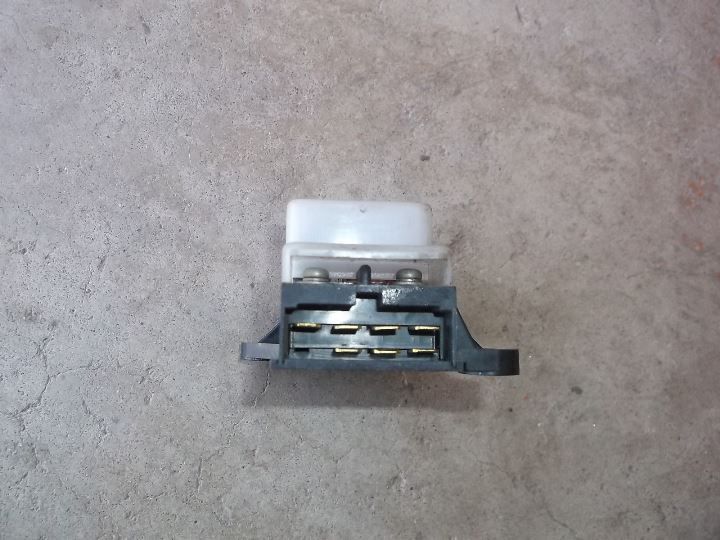
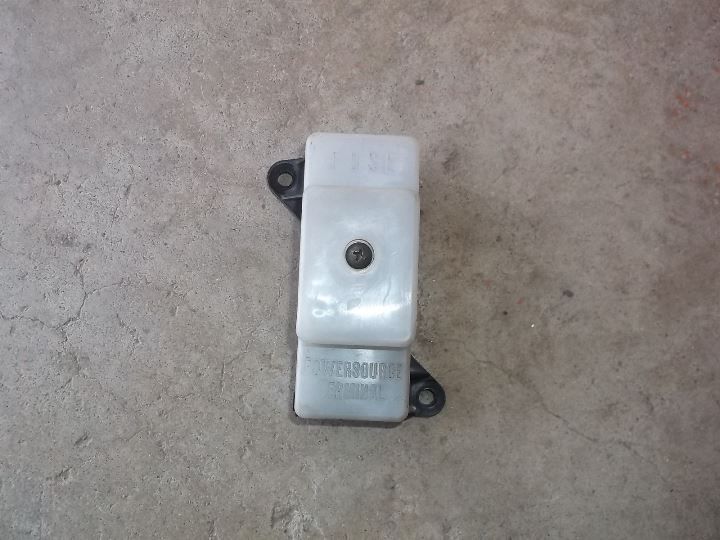
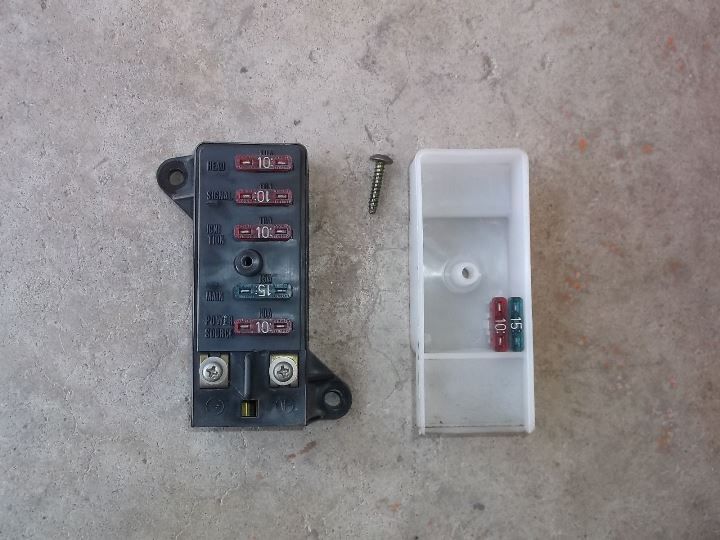
Hi folks - I finally decided to go the cheap route for now, and acquired a used 1983 GS750 fusebox that I'm planning to wire in. I don't have the connector from the wiring harness for this fusebox, but do have an 8-pin connector (from a Vintage Connections kit) that I can build.

My question is - can anyone tell me what wires (or wiring diagram color codes) go to these individual 7 pins on this thing?

Pinouts_zpsjrnlx3lr.jpg


Fusebox_zpsahy5x6od.jpg


Fusebox%20open_zpsxdswd1d3.jpg
 
If you plan on doing this then the first item you need to purchase is a DVM (digital volt meter). That way you can verify your connections in person. Much easier to troubleshoot things if they're not working as expected.
 
If you plan on doing this then the first item you need to purchase is a DVM (digital volt meter). That way you can verify your connections in person. Much easier to troubleshoot things if they're not working as expected.

Thanks. I have a good Fluke multimeter, and am fairly competent with electrical work. I'm sure I could trace wiring and stare at the wiring diagram and figure it out, but thought I'd ask in case someone has gone this route before.
 
See if this helps:
8SSt6r.jpg


That should give you what you need. Wire colors should match. No pin out but a piece of cake to ohm out.
 
^^^ I assume that's the diagram for the 83 GS750, as the GS1000 has the 10A power source at the bottom as a separate unit. I should be able to figure it out using that and tracing continuity from the connector pins and the fuse sockets. Thanks!
 
No disrespect but I don't think you will be improving the system overall by just swapping the fuse box. There is nothing wrong with glass fuses. Just get some new ones. You can clean all the fusebox connections pretty easily too using physical and/or chemical means. I did this on my 1000 and checked for loses with a multi meter and they are very minimal after cleaning everything. By switching the box your harness is going to have a bunch of new crimps. That's not the worst thing in the world mind you but only if you have a set of proper crimping pliers w/terminals that roll over the terminal tangs like the OEM terminals. Simple cush crimps are not as reliable.
 
Last edited:
Thanks Nessism, always open to hear thoughts and advice. The idea of doing this was to bring this old machine in line with all the others in the garage. It's the only one with the old glass fuses. Piles of blade fuses in the spares box, and they are also easily available when travelling.

I have a few of the Vintage Connections kits, and bought the roll-over crimping tool. Used it extensively when we restored the Honda CB500 as numerous connectors needed to be replaced. It makes very secure connections. One of the 8-pin connectors from the kit fits this fusebox perfectly.

I have the wiring for this GS750 fusebox figured out. I'll try to draw a better diagram than the current one scribbled on a grocery list, LOL, and post it up later in case anyone else is interested.
 
Last edited:
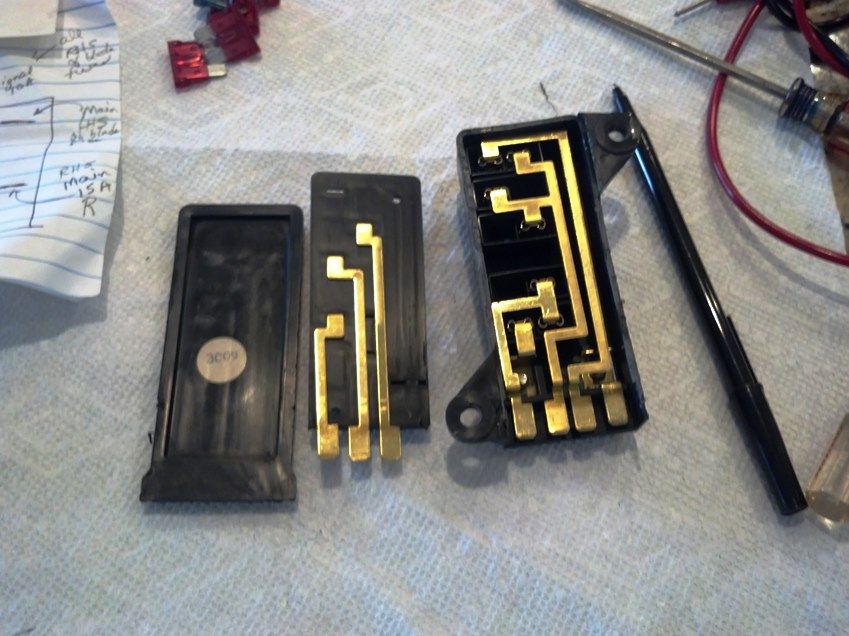
Here is what the GS750 fusebox looks like inside (main body on right, fuse side facing down). It's built up in layers that are held together when you put the back plate (on the left) on. Seeing this makes it clear what wires go to which pinouts, using the diagram posted above by JTGS850GL.

GS750%20Fusebox%20Opened_zpstc6dbf7m.jpg


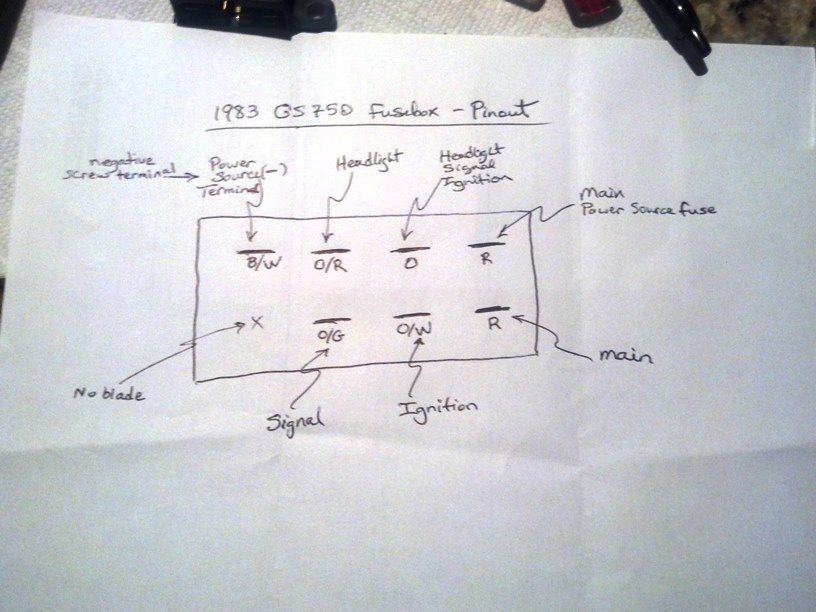
And, this is a drawing of the connector, looking at it from the bottom of the fusebox as in the second photo. The wire color codes and what fuse sockets they go to are indicated. Color codes for the 83 GS750 fusebox and the 79 GS1000 fusebox connections appears to be the same. Added Note: all pins go to fuse sockets except the "power source (-)" which is the screw terminal, and where a pin leads to more than one fuse socket they are listed, e.g. orange wire goes to 3 fuse sockets, headlight signal ignition. Upper right red wire goes to 2 fuse sockets, main and power source.

GS750%20Fusebox%20Pinout%20Diagram_zpsjkikdm2p.jpg


Pinouts_zpsjrnlx3lr.jpg
 
Last edited:
I guess you could reverse "main" and "main power source" and get by with it but I think I would prefer keeping them stock.

And B/W is harness ground as "power source (-)" is dangerously misleading.

Next thing is "what is the power source"?
 
I guess you could reverse "main" and "main power source" and get by with it but I think I would prefer keeping them stock.

And B/W is harness ground as "power source (-)" is dangerously misleading.

Next thing is "what is the power source"?

Sorry, perhaps I could have been more clear. I edited the diagram showing what wires go to which pins, and added some info.

Power source (-) is the screw terminal (can be seen on the last photo above), it is labeled "power source" on the fuse block and has it's own 10A fuse. On the GS1000 wiring diagram this is a separate unit called "output terminal".

All other pins go to fuse sockets. Where more than one fuse socket is connected to a pin I indicated which by listing them. So, e.g. the top right pin on my hand drawn diagram is a red wire which connects to both the main fuse and the power source fuse socket. The other side of the power source fuse socket goes to the positive (+) screw terminal, as shown in the wiring diagram a few posts above.

Hopefully that clears it up? It's early. I need more coffee before I type this kind of stuff, LOL.
 
Last edited:
Back
Top