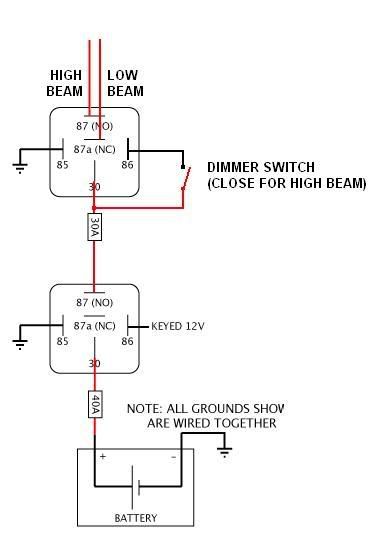
Here ya go.
Installation will be nicely done with two relays. The one closest to the battery can be found at any auto parts store as a fog light relay. The second one needs to be a double-throw relay. Easily found at
Parts Express. Inexpensive, too, and this same relay will work for both positions. They also have sockets available to help with wiring the relays.
In this diagram, the first relay is triggered by turning on the ignition key. The second relay passes current through the NC (normally closed) terminal to the low beam. When you flip the switch (it can be a
sub-mini switch from Radio Shack), the current then goes out the NO (normally open) contacts to the high beam.
I hate to disagree with Steve, but I disagree with most of the above.
First of all, the fuses ... 40 amp !!! WTF !!!
Thats WAY to high. If the headlamp is a 65 watt one, then a 5 amp fuse is right. If you have a bigger headlight (up to 130 watts) then a 10 amp fuse. If you want to be really conservative, then 7.5 or 15 amp above.
If you get a dead short, it won't matter, both a 10 amp and a 40 amp fuse will blow. But if a wire gets worn through, and only a strand or two short out, the difference may matter, with a smaller fuse blowing, and a larger one letting a fire happen.
2nd, why is the 30 amp fuse there at all, it's not needed, just a waste of time, effort, and money.
3rd, why the bottom relay?
nicholascott says he know which wires are for the headlight.
Presumeably that means he knows which wire was the one bringing 12 volts into the original headlight switch. Just use that wire as your 12 volt source. If he was adding higher power lights, which would burn out the ignition switch, then sure ... but to get the OEM lights working, just use the provided switched 12 volt source from the wiring harness.
4th, why the top relay.
Just use a SPDT switch rated at least 5 amps (or 10 amps if your light is more than 65 watts but less than 130)
----
The whole thing is WAY WAY WAY more complicated than it needs to be.
He doesn't need any fuses or relays. Just one switch. Thats all.
Take the switched 12 volt wire that was originally going into the headlight switch, and connect it to the center terminal of a SPDT switch rated at least 5 amps (or 10 amps if your light is more than 65 watts but less than 130).
Connect the high beam wire to one of the outside terminals, connect the low beam wire to the other outside terminal.
Done !!!
Appropriate switches from radio shack appear to be:
Model: 275-603, Model: 275-711, Model: 275-635, Model: 275-652, Model: 275-691, 275-695, Catalog #: 275-636, Model: 275-663
(note, some of these are DPDT. That just means you would have an extra set of terminals on the switch that are not used)
I'm sure Pep Boys or any other auto store has appropriate switches too.
Make sure they say 5 amps and SPDT (numbers bigger than 5 and DPDT are ok too, see above)
---
That gets you lights on whenever the ignition is on. If you want to be able to turn the lights off too, there are 2 options.
1) Instead of using a switch labled as "SPDT" you would use one labled "SPDT - center off" like RS Model: 275-654. You would hook up as above. I don't recommend this option because it would be more difficult to see (or tell by feel) what you have your lighting set to.
2) Take the switched 12 volt wire that was originally going into the headlight switch, and connect it to one terminal of a SPST switch rated at least 5 amps (or 10 amps if your light is more than 65 watts but less than 130).
Connect a wire to the other terminal, and connect the other end of that to the center terminal of a SPDT switch rated at least 5 amps (or 10 amps if your light is more than 65 watts but less than 130).
Connect the high beam wire to one of the outside terminals, connect the low beam wire to the other outside terminal.
So this method adds an on-off switch to the very first description.