• Required reading for all forum users!!!

    Welcome!
    Register to access the full functionality of the GSResources forum. Until you register and activate your account you will not have full forum access, nor will you be able to post or reply to messages.

    A note to new registrants...
    All new forum registrations must be activated via email before you have full access to the forum.

    A Special Note about Email accounts!
    DO NOT SIGN UP USING hotmail, outlook, gmx, sbcglobal, att, bellsouth or email.com. They delete our forum signup emails.

    A note to old forum members...
    I receive numerous requests from people who can no longer log in because their accounts were deleted. As mentioned in the forum FAQ, user accounts are deleted if you haven't logged in for the past 6 months. If you can't log in, then create a new forum account. If you don't get an error message, then check your email account for an activation message. If you get a message stating that the email address is already in use, then your account still exists so follow the instructions in the forum FAQ for resetting your password.

    Have you forgotten your password or have a new email address? Then read the forum FAQ for details on how to reset it.

    Any email requests for "can't log in anymore" problems or "lost my password" problems will be deleted. Read the forum FAQ and follow the instructions there - that's what we have one for...

  • Returning Visitors

    If you are a returning visitor who never received your confirmation email, then odds are your email provider is blockinig emails from our server. The only thing that can be done to get around this is you will have to try creating another forum account using an email address from another domain.

    If you are a returning visitor to the forum and can't log in using your old forum name and password but used to be able to then chances are your account is deleted. Purges of the databases are done regularly. You will have to create a new forum account and you should be all set.

Pilot air/fuel screws?

  • Thread starter Thread starter Drewbis1
  • Start date Start date
D

Drewbis1

Guest
I've done some searching and reading about this topic. I have a '79 GS750 with VM carbs, did a complete disassembly, dip, new o rings from Robert Barr, new intake boot o rings, valve adjustment, lubed all cables, etc. The bike finally got road tested yesterday and seemed to run pretty good. I have no baseline as to how it should run because it was a non-runner when bought a couple weeks ago.

I recorded all air and fuel mix screw settings before the carbs were taken apart. The air screws were uniform at 1 turn out. Fuel was 1 turn out on two of the carbs, and 3.5 turn out of the other two. The plugs that were in the bike indicated 2 very carbon rich cylinders, 1 was perfect, and 1 was lean. This was probably also due to the air intake box seals that were broken (fixed with weather stripping), broken intake boot o rings, and valves out of spec. I didn't go back to those settings for initial carb tuning because there were so many variables that were out of whack originally. I started with needle clip in the same place (2nd notch from the top), the fuel screw I set at 3/4 turns out from light seat, and the air screw 1.5 turns out.

My question is when setting the air screw for highest idle when the engine is warm, it seemed I didn't get engine rev increase until I screwed the air in, to about 3/4 turns from light seat. After checking my plugs, all four were nearly white on the strap, but carbon build up down near the threads. Porcelain is still white.

I've never dealt with carbs before, so this is all a learning experience to me. By the way, this bike is pretty fun. It needs some new rubber as the rear is worn down to the cord in one spot, and the general profile is square. The previous owner must have loved going in a straight line.
 
The screw settings will depend on the intake and exhaust systems.

If you have stock airbox and exhaust installed, the fuel screws (the ones on the bottom) should be 3/4 to 7/8 turn out from lightly-seated. As a rule, you start with the air screws (the ones on the side) double the fuel screw setting.

Of course, this assumes that you have done the full "strip-and-dip" refurb and set the floats and needles to the proper heights.

.
 
Thanks Steve. I did set floats to 25.5mm. Needles are 2nd from the top which is where they were when I disassembled them. I should note that it has a Kerker 4 into 1 system with stock airbox.
 
Specs for your float height should be 23.0 +/- 1.0mm, so you are running lean with your 25.5 setting.

Needles 2nd from the top will be leaner than stock.

Adding a 4-into-1 will lean it a bit at the upper end, what main jets do you have? Stock is 100, with your Kerker, you might need 110s.

For your pipe, increase the pilot screws a bit, maybe to 1 turn on the fuel and 2 turns on the air.

.
 
The mains are 102.5, pilots are 15. Where did you get that float height? In the Clymer it specs my carbs from 25-27mm float height. I did notice a few drops coming out of the overflow from carbs 1 and 4 this morning.
 
Sounds like someone didn't want to buy jets for the pipe, didn't want to learn how he carburetors work, and just turned the fuel screw out so he could say he adjusted something. All of those settings are all screwed up. 102.5 is probably the stock main jet for the '79 750. For that pipe try 112.5 for a first guess.. Use the 15 pilot jets, use 3/4 for the fuel screws and 1 1/2 for the air screws. You MAY want to raise the jet needles a little, by putting the clips in the second position from the bottom, not from the top.
This should get you close enough to start test riding if the floats are set right, if the fuel screw tips are not broken off in the port, and if the internal passages in all of the carburetors are clean.
You will of course need to test and fine tune everything.

As for the riding baseline, it should pull OK from idle, with gradually increasing torque all the way up to about 7,000RPM and then take off like a shot.
 
Where did you get that float height? In the Clymer it specs my carbs from 25-27mm float height.
Sorry about that, you are correct. :oops:

My handy-dandy chart shows specs for a '78, but not a '79. I foolishly assumed they might be the same,
but forgot that they made some drastic changes every year for the first few years.

The factory manual (available on BassCliff's site) also specifies 25-27mm.

.
 
So let me see if I understand carbs... here is my take on carbs 101...

So the pilot system (the combination of pilot jet, fuel mix screw, and air mix screw) are responsible for everything from idle to low rpm ranges, or slight throttle twist.

Then in the midrange (I'm guessing somewhere around 1/4 throttle or 3k rpms) is where the slide needle comes into play.

And the main jets are more in the upper throttle twist and higher rpm ranges.

So in order to test one of those areas, I'd have to read the plugs by doing a throttle chop in each of those throttle ranges?
I will tear into them again and move that clip on the slide to the 2nd from the bottom to richen it up a bit in the midrange. That is where I spend most of the time. I usually find myself cruising around 3-4K. But I did rev it up on an industrial road this morning and that Kerker sounds ridiculous when you get past 6K rpms.

In the meantime, I really need some new shoes, I'm avoiding riding it anymore until I can at least get the rear replaced.
 
Your supposition is close

The cutaway angle on the slide is step 2 in air/fuel/mix

Where that VM chart with the overlapping systems on it?

So, yeah, raise the needles and bigger main jet, fuel screw to 1 is a good start

For new tires, get some Avons in the stock 3.25/4.000 combo, you'll be glad you did. Try Motorcycle Tire and Wheel on NE Alberta

All of your shims got proper clearance now?
 
Thanks Big T. I actually used to live right near the tire shop on Alberta and I've never been in there. At the time I had a new Triumph Bonneville and didn't really need tires. I've had my eye on the Avon AM26 tires.

Yes, the shims are all sorted, everything is in spec. Here's the rundown....
cleaned/oiled air filter, cleaned/sealed airbox, cleaned carbs new o rings, new intake boot o rings, valve clearances in spec, new spark plugs, new oil, fresh ethanol free fuel, cleaned lubed all cables, cleaned/oiled tach and speedo, new vacuum/vent/fuel lines. And for several hours in there I was trying to extract a broken exhaust bolt in the heads that was in the absolute worst area possible. My drill chuck was hitting the frame, knocking the drill bit sideways. Got it.

This bike is pretty fun to ride. I'm surprised with very little carb tuning, it is smooth throughout the rev range and has no hesitation or hickups at all, aside from a small flat spot around 3K
 
So let me see if I understand carbs... here is my take on carbs 101...

So the pilot system (the combination of pilot jet, fuel mix screw, and air mix screw) are responsible for everything from idle to low rpm ranges, or slight throttle twist.

Then in the midrange (I'm guessing somewhere around 1/4 throttle or 3k rpms) is where the slide needle comes into play.

And the main jets are more in the upper throttle twist and higher rpm ranges.

So in order to test one of those areas, I'd have to read the plugs by doing a throttle chop in each of those throttle ranges?
As BigT said, you are very close. :D

The part that I highlighted is where you veered just a bit off-course. :-k

Plug chops are meant to check jetting at throttle openings, not engine speeds.
In fact, to test the main jetting, you will need to hold full throttle.
You might find this rather incredible, but the engine speed will change while doing this. :eek:

.
 
So how long should I hold these throttle positions before cutting the engine and coasting to a stop? A few seconds, minutes? AN HOUR? I tried this earlier on the Aprilia, and I couldn't get the front wheel to stay on the ground. Damn Italians.
 
For the pilot circuit, you might need a minute or two, but that's the easiest one to do. Third or fourth gear, idling through town, or wherever you can hold 1/8 throttle.

For the needle, you might need to find a modest uphill road where you can hold 1/2 throttle in fourth or fifth gear, to prevent running away. Try to get in 30 to 60 seconds, if possible.

For the mains, it's easy, but can get scary. Obviously, you will have to be at full throttle, but that will get you going rather quickly. You might get a long enough run by starting at 20 mph in fifth gear and running it as fast as you dare. One good long run won't take long, but should be good enough.


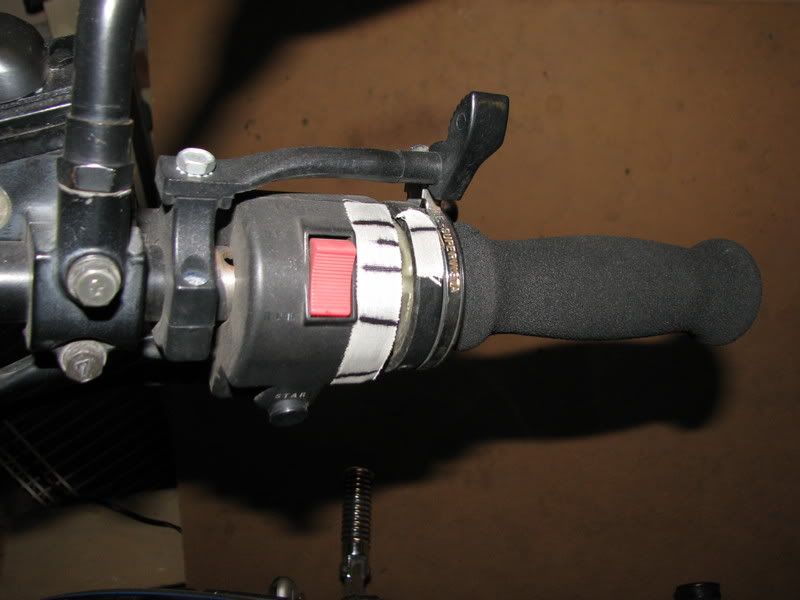
HINT: make marks on the the grip and the housing so you can SEE your throttle setting. Here is how I marked my wife's bike for testing:

IMG_3646.jpg


.
 
One last question... regarding the pilot fuel screws: cylinders 1 and 2 don't seat the tip enough to be seen inside the carb body. Cylinders 3 and 4 can be seen. The tips are fine, lengths are the same. I noticed that 2 of the slide needles were aluminum, and the other 2 were brass. I'm thinking 2 carb rebuild kits were used and maybe the pilot screws aren't 100% the same. Should this matter that I cannot see the tips in the carb body as long as they are turned out the same number of turns?
 
It's most likely that the two tips you can see were over tightened at some time and expanded the seat, allowing the tips to come up higher

You could swap the tips around and see what results
 
You have a Kerker and I assume the packing in it is OK. Does your stock air box have the lid? Are there any "extra" holes cut into the airbox anywhere? If the lid is on and there are no mod's to the box then you shouldn't need more than a 1/2 position richer on the jet needles. That will require some jetting spacers like the DJ stage 3 kit supplies (about .022"). I'd go up two full sizes (10) for the main jets. The stock pilot jets should work fine combined with richer than factory set fuel screw adjustments, about 1/4 turn richer or less. The pipe doesn't effect the pilot circuit like it does the main/needle circuits.
It's not as easy to get accurate plug reads when checking the pilot circuit. Just different vacuum levels can cause reads to be non-uniform. And I know what you mean about the pilot fuel screws protruding at different amounts into the carb bore.
Fine tuning the fuel screws can be difficult considering they were originally set using expensive emissions equipment. Do the best you can. If the carbs are clean, float levels correct, carbs synched and all jets in decent condition, then set them 1 full turn out from lightly seated. Set the side air screws to 2 turns out. Warm up the motor completely and set the idle to NO MORE than 1,100 rpm's using the idle knob adjuster. Start at any air screw and slowly turn in either direction to achieve best idle. Then re-set the idle to the baseline 1,100 rpm's by using the idle knob adjuster. Go to the next air screw and repeat. When done, focus on testing the pilot circuit of the bike. Low speeds only and idling. Check for excessive decel' popping (some is OK and is attributed to the freer flowing pipe). The idle should return smoothly and not hesitate to return (be sure throttle cables are routed and slacked correctly). After idling several seconds, a short, 1/5 blip of the throttle should reveal no dark exhaust coming out. Pulling away should be smooth without any flat spot or bog. If all is good, then check the plugs colors. Do what the plugs/performance say. We can help if you're not sure if you have a rich or lean condition.
What I wonder is if all 4 of your jet needles are the same size? Also, are you sure the factory setting for the jet needle e-clips is position 2 from the top? A pipe only/stock intake combo shouldn't require a full position richer on the needles. The Kerker flows better but is most noticeable at higher rpm's. About 7,000 and above. The main circuit is effected more but there is some overlap effect that I think 1/2 position richer would be right for.
 
Last edited:
Thanks Keith, that is exactly the explanation I needed. I'm new to carburetors, so I'm learning as I go, and reading up on the subjects several hours per day so I feel I have to knowledge to tune this bike.

As far as the intake goes, it is a stock airbox, no leaks. I sealed it all up and cleaned/lightly oiled the air filter. I'll check the insulation on the Kerker. I do have new exhaust gaskets and stainless bolts coming for the headers to motor, so that should seal any leaks that may be coming from the old exhaust gaskets.

When I get my Carbtune on Monday I'll drop the needle to the 2nd richest location (2nd from bottom), fuel screw 1 turn out, air screw 2 turns out, sync carbs and test. I did swap the fuel screws around to see if it was in fact screw that was not being allowed to seat in as far as the others, but same results. I think there is more of an issue with the threads in the carbs, or the tapered seat inside the carb.

As for jetting, it is impossible to buy jets locally. I had to order a set of 110 mains as a test jet, and I grabbed 17.5 pilots just to have on hand. They probably won't be here for another week.

One more thing I have to do is check the points. The bike fires, but I'd like to check the timing and possibly look into a Dyna S ignition, coils, and new plug wires.
 
The needle tips in the pilot circuit are just visible below the hole in the carb body when lightly seated if they haven't been damaged. If you can't see two of them when lightly seated you might need some more cleaning in those passages. If you tweak your pilot needles in slightly so your highest idle adjusts out closer to two turns with the air screws, I think you will be in a better adjustment range. You are too far in when you get a slight stutter at low speeds 1,000-3,000 RPM.
 
OK. Assuming the stock jet needle e-clip position is position 2 from the top, 2 positions richer on the jet needles is way too rich for a Kerker and stock air box. Also, the pipe doesn't effect the pilot circuit enough to change to a larger pilot jet. You'll be too rich at both circuits.
110 mains might work OK if not just right.
 
Back
Top