• Required reading for all forum users!!!

    Welcome!
    Register to access the full functionality of the GSResources forum. Until you register and activate your account you will not have full forum access, nor will you be able to post or reply to messages.

    A note to new registrants...
    All new forum registrations must be activated via email before you have full access to the forum.

    A Special Note about Email accounts!
    DO NOT SIGN UP USING hotmail, outlook, gmx, sbcglobal, att, bellsouth or email.com. They delete our forum signup emails.

    A note to old forum members...
    I receive numerous requests from people who can no longer log in because their accounts were deleted. As mentioned in the forum FAQ, user accounts are deleted if you haven't logged in for the past 6 months. If you can't log in, then create a new forum account. If you don't get an error message, then check your email account for an activation message. If you get a message stating that the email address is already in use, then your account still exists so follow the instructions in the forum FAQ for resetting your password.

    Have you forgotten your password or have a new email address? Then read the forum FAQ for details on how to reset it.

    Any email requests for "can't log in anymore" problems or "lost my password" problems will be deleted. Read the forum FAQ and follow the instructions there - that's what we have one for...

  • Returning Visitors

    If you are a returning visitor who never received your confirmation email, then odds are your email provider is blockinig emails from our server. The only thing that can be done to get around this is you will have to try creating another forum account using an email address from another domain.

    If you are a returning visitor to the forum and can't log in using your old forum name and password but used to be able to then chances are your account is deleted. Purges of the databases are done regularly. You will have to create a new forum account and you should be all set.

1980 GS850GT won't idle

  • Thread starter Thread starter nate875
  • Start date Start date
N

nate875

Guest
I hope there is someone out there who can provide guidance on this one. A friend of mine recently gave me a 1980 GS850G, along with several extra parts. The odometer shows about 33k, and it's been sitting a while. I can get the bike to start, but only with starter fluid, and I can't get it to idle for more than a few seconds. In total, it will run for maybe 20 seconds, but it might just be burning starter fluid.

I have a rebuilt petcock, and I'm missing the boot from the left side of the air box, which I have temporarily remedied by duct taping over the upper chamber opening on the side of the air box, in an attempt to conserve enough vacuum to operate the carbs. In my spare parts collection, I have what I believe to be 4 complete carburetors in varying degrees of disassembly, all from one bike, which was an "L" version of the GS850G. That bike might have been a 1981 model, but I so far believe the carbs are identical. I also have a factory service manual.

Anyone who is smart on these, please chime in. I'm about to begin cleaning and rebuilding my extra set of carbs, but if I'm missing something, and someone has ideas that can get this thing running right without having to do that, I would welcome such suggestions.

Thank you.
 
Welcome to the site.

First off, a link to Cliff's website chocked full of pertinent info...http://members.dslextreme.com/users/bikecliff/

As for the problem at hand, check my signature for a carb rebuild tutorial and a link to the newbie mistakes thread. Both should help you sort out your bike.

Good luck
 
And if you post your location (JEEZ! we should make this mandatory), there may well be a GSR member in your area willing to lend a hand.
 
Welcome Nate,

Everybody wants to jump on and ride but you'll get nowhere if you don't approach the renovation systematically. I have an 850GT also
and while I'm by no means an expert I'm well acquainted with the frustration of getting one of these things into a safe and reliable condition. There's a lot to do!

At this point you know it runs. Now disassemble the carbs and soak them properly, carb spray is not sufficient. BTW it's pretty well accepted around here that it's not a good idea to run these bikes on ether.

After that, check for corroded wiring and connections so you don't have to worry about starting a fire or frying your charging system.

Don't run it for too long before you check valve clearance.

Do these steps in any order you choose but most importantly READ!
Nessism has given you the links.

Best of luck.

Rick
 
1980 GS850GT won't idle

Thanks to everyone who has responded. I now have 4 cleaned and reassembled carbs. I did find a very helpful guide to carb cleaning on bikecliff. I'm almost ready to put them on the bike and give it a go, but I have not been able to find out what the initial throttle adjustment is supposed to be. I found a recommendation, also on bikecliff, to initially set the air screws (apparently also called "pilot screws") to 2 turns out from lightly seated. But how should I initally set up the throttle adjustment?
 
I found a recommendation, also on bikecliff, to initially set the air screws (apparently also called "pilot screws") to 2 turns out from lightly seated. But how should I initally set up the throttle adjustment?

Personally, I think you will be better-off to set the pilot screws to THREE full turns out as a starting point. After you get the bike running and make your jetting adjustments, they might end up back in the 2 to 2 1/2 turn range, but 2 turns might be too lean for decent running, and you will have LOADS of problems trying to sort them out.

For the initial throttle setting, some have suggested two turns in, after the initial contact with the mechanism, but I have not verified that. Your best bet is to be ready with the 'kill' switch when you start the bike, in case it revs too high.

.
 
I personally find that if I start with the fuel mixture screws 2.5 turns out from lightly seated is a good starting point and with the pilot screws firmly seated.
I have no idea how you guys get them to start with the pilot screws turned out. :concern:
 
I have no idea how you guys get them to start with the pilot screws turned out. :concern:

Eric, you, of all people, should know that is the official terminology in the Suzuki manual.

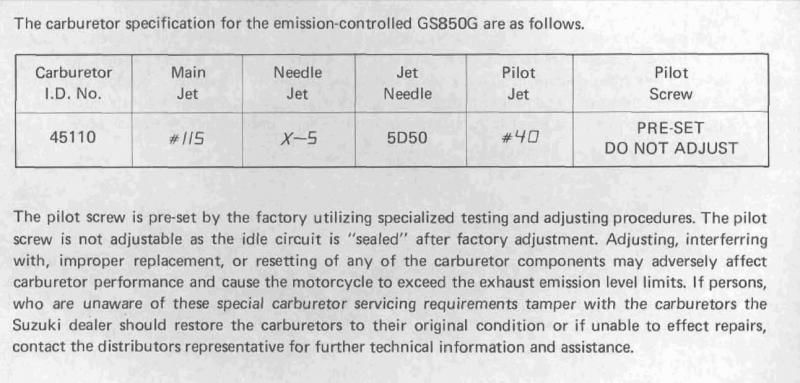
Here it is, straight from page 14-42 of the Suzuki manual, which is page 313 on the pdf file you can get from BassCliff:

GS850carbspecs_zps4ce440c9.jpg


You KNOW there is only ONE item that is "sealed" at the factory, that is the pilot screw.
Yes, we have called it many other things, but let's stick with what Suzuki calls it.
tongue.gif.pagespeed.ce.aK_TK6uv0P.gif


.
 
1980 GS850GT won't idle

Thanks again to all for your contributions.

Here is my update: The clean carbs are on the bike, and I got it to idle pretty well with the fuel petcock in the PRI position, but I'm not done yet. I first started it with the petcock ON, and it stayed running at about 2500 rpm with the choke plunger pulled out (choke actuated). It would not stay running in ON, however, if I let the choke plunger go back in, and it would die right away if I tried to open the throttle with the choke plunger in or out. I actually saw the same behavior in PRI until I let it cool down for maybe 3 minutes. I then started it again in PRI with the choke plunger about halfway out, and it stayed running at about 3000 rpm, even after I let the choke plunger go back in. I let it warm up for maybe 30 seconds like that, and then I adjusted the idle screw down to about 1100 rpm. It idled well like that, and it allowed me to open up the throttle without dying, so I took it up to about 5000 rpm a few times. The throttle response seemed a bit sluggish and I got a couple of backfire-type pops in the exhaust. I let it idle then for about 8 minutes, during which time it ran remarkable smoothly with no perceivable rpm fluctuations. I then shut it off and tried to restart it, but it wouldn't restart with the choke plunger out or in, nor with the petcock in either PRI or ON. I thought maybe it flooded itself, but I didn't smell gas. That is when I decided to seek more knowledge from you fellas.

More facts about this attempt:

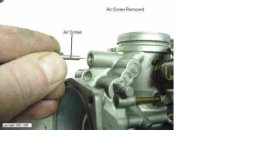
These screws (air or pilot--I'm still not clear on this terminology) are 2 turns out from lightly seated:
air screw.JPG

I just eyeballed the initial throttle adjustment, getting them as even-looking as I could. (I plan to do the synchronizing on these after I get it running better.)

The fuel in my tank has a fair amount of gummout in it. This is left over from when I was messing around with the original carburetors.

I'm using a car battery connected with jumper cables for starting power.


Let me know what you think.

Thanks again.
 
First of all, let's get back to some basics.

1. Have you adjusted the valves yet? Might not help in this situation, but tight valves make the bike hard to start and will eventually cost you LOTS of money to replace parts.

2. Understand the petcock positions and functions. The PRIme position is only necessary to manually fill the float bowls. Yes, it was necessary right after fitting the fresh carbs, but you will probably not need that position again for a long time, especially if you ride the bike regularly. The RUN position is the preferred position, at least until the fuel level in the tank gets low enough to make the REServe position necessary. In RUN and REServe, the petcock is opened by vacuum from the #2 carb, and is closed when the engine stops. PRIme will allow fuel to free-flow. If, for some reason, your inlet valves in the carbs leak, the carbs will over-fill. The only place for the excess fuel to go is down the carb throat, into the intake tract. If the intake valve happens to be open, fuel will flow right into the cylinder. BIG wake-up if you hit the starter button, as that cylinder will hydrolock, possibly bending a rod.

3. "Choke" operation. When you use the "choke", understand that it does not choke off the intake, like an old car carburetor. Instead, it moves a plunger to open up an "enrichener" circuit that provides the richer mixture necessary to start a cold engine. While you are using the "choke", do NOT touch the throttle. The enrichener circuit ("choke") relies on the high vacuum of a closed throttle to work, opening the throttle AT ALL will destroy that vacuum, defeating the system.

4. Car battery with jumper cables. Fine, as long as there is not a running car involved. NEVER use a running vehicle to jump start your bike.

5. Pilot screw setting. Go back, read post #6.

6. Hard to get higher revs. Do you have an airbox attached? Won't get much response above idle if you don't. Air box is super-easy on your bike, so there is no good excuse. However, if you INSIST on trying to run without an airbox, fold a shop rag in half, drape it over the carb intakes. Clamp it to the outer carbs, trying to keep it taut over the inner carbs. This will work well enough for a trip around the block, but is NOT good enough for any jetting checks.

.
 
Thanks again for chiming in, Steve.

From what you're saying, I'm not doing anything too stupid or dangerous, which is good. I do have the air box installed, though without the rubber boot doohicky on the back. (But if I remember right, the opposition to carb vaccuum comes from the filter anyway. I used to have a 1983 GS550, on which I learned some motorcycle-specific stuff.) I was able to get the higher rpms out of it in PRI; it just didn't respond to my twisting the throttle in a snappy fashion. I'm also using a car battery which is not installed in a vehicle. I believe I have a decent grasp on what the petcock and choke/starting system are doing also.

So what I'm thinking I'll do next is take the pilot screws out one more turn and give it another go. If I remember right, it is supposed to be warmed up when performing the valve adjustment, so I'll warm it up and do that.

Here are some questions I have now:

I have vacuum hoses connected to the carb vent tee's, but I don't have anything telling me they are supposed to be connected to anything else; I think they just vent overboard. Is that right?

Also, the o-rings between the carb boots and the engine are not new, and they are not perfect, so I believe I have a tiny amount of leakage there, which would be downstream of any fuel metering. How bad of a situation is that on this powertrain?

I don't think I have any documentation telling me this yet, but I'm gathering that the pilot screws must be the mixture adjustment mechanism. And out must be richer. Is that correct?

--Nate

1980 GS850G
 
So what I'm thinking I'll do next is take the pilot screws out one more turn and give it another go. If I remember right, it is supposed to be warmed up when performing the valve adjustment, so I'll warm it up and do that.
No, NO, NO!!!

Where did you ever get THAT idea?

To do a valve clearance check the engine needs to be STONE COLD.
The manual calls for non-operation for a minimum of 8 hours before checking valve clearances. And don't park the bike outside overnight, then start it up to move it inside to work on it, because it's already too late. If you fire it up AT ALL, you must wait.


I have vacuum hoses connected to the carb vent tee's, but I don't have anything telling me they are supposed to be connected to anything else; I think they just vent overboard. Is that right?
If you look on the back side of the airbox, on the right side, you will see a rectangular loop. Both of the vent hoses are meant to fit in there and just hang in the relatively still air behind the airbox.


Also, the o-rings between the carb boots and the engine are not new, and they are not perfect, so I believe I have a tiny amount of leakage there, which would be downstream of any fuel metering. How bad of a situation is that on this powertrain?
I would put its importance somewhere between "VERY important" and "downright CRITICAL". The o-rings are just a few bucks, I would hate to waste an engine that could have been saved with the purchase of an inexpensive o-ring kit. While you are getting those o-rings, get the ones for the carbs, too, along with the stainless bolts that hold the intake boots to the head.


I don't think I have any documentation telling me this yet, but I'm gathering that the pilot screws must be the mixture adjustment mechanism. And out must be richer. Is that correct?
Yes, you are correct, but that is for the pilot mixture only. The needle that is attached to the diphragm slide handles the mid-range, the main jet handles the upper end. They are adjustable only by changing parts, while the pilot mixture can be fine-tuned with the screw. After a carb rebuild, it helps to start with the screws out about three full turns from lightly-seated. When the bike warms up, you can tweak the screws for best idle. They might end up in the 2 to 2 1/2 turn range, but starting at 3 just richens the mixture enough to add a little bit of "choke" effect to let it start easier.

.
 
I'm happy to report that I now have this bike running reasonably well. It ultimately came down to having a good enough seal on the side of the air box that is missing the rubber sealing boot. I originally had duct tape there for testing, but it proved to be inadequate; electrical tape works much better. So now I need to find a real rubber boot. I'd like to be able to buy just the boot and stick it on to my existing air box, if possible. Would anyone be able to recommend a good source for that? I've shopped on ebay a little, and I'm thinking I can make something out of gasket material and RTV that would be better than the used stuff I see so far.

-Nate.
1980 GS850G
 
Actually, is it a bad idea to install the aftermarket individual air cleaners? I read somewhere that they might not work properly with the OEM main jets in the carbs, which requires re-jetting. Does anyone have experience with this?

--Nate
1980 GS850G
 
Actually, is it a bad idea to install the aftermarket individual air cleaners? I read somewhere that they might not work properly with the OEM main jets in the carbs, which requires re-jetting. Does anyone have experience with this?

--Nate
1980 GS850G

I can tell that you are new. :-\\\

There have been MANY threads started regarding re-jetting for pods.

There have even been a few success stories.

.
 
Back
Top