• Required reading for all forum users!!!

    Welcome!
    Register to access the full functionality of the GSResources forum. Until you register and activate your account you will not have full forum access, nor will you be able to post or reply to messages.

    A note to new registrants...
    All new forum registrations must be activated via email before you have full access to the forum.

    A Special Note about Email accounts!
    DO NOT SIGN UP USING hotmail, outlook, gmx, sbcglobal, att, bellsouth or email.com. They delete our forum signup emails.

    A note to old forum members...
    I receive numerous requests from people who can no longer log in because their accounts were deleted. As mentioned in the forum FAQ, user accounts are deleted if you haven't logged in for the past 6 months. If you can't log in, then create a new forum account. If you don't get an error message, then check your email account for an activation message. If you get a message stating that the email address is already in use, then your account still exists so follow the instructions in the forum FAQ for resetting your password.

    Have you forgotten your password or have a new email address? Then read the forum FAQ for details on how to reset it.

    Any email requests for "can't log in anymore" problems or "lost my password" problems will be deleted. Read the forum FAQ and follow the instructions there - that's what we have one for...

  • Returning Visitors

    If you are a returning visitor who never received your confirmation email, then odds are your email provider is blockinig emails from our server. The only thing that can be done to get around this is you will have to try creating another forum account using an email address from another domain.

    If you are a returning visitor to the forum and can't log in using your old forum name and password but used to be able to then chances are your account is deleted. Purges of the databases are done regularly. You will have to create a new forum account and you should be all set.

#2 cylinder (From the left) getting no fuel?

  • Thread starter Thread starter mrdennis87
  • Start date Start date
M

mrdennis87

Guest
Good morning guys! So I was referred to you by a friend, and told you this is a great place to learn about our bikes. I've spent the last hour searching the forums about my problem, and none of them had solutions, or weren't exactly the problem I am having.

1981 Suzuki GS550L
17,900 miles

So my problem is my #2 cylinder is getting no fuel at all. I bought the bike two days ago and rode it home. When heading home, I noticed the bike would not go over 40 mph. From reading on the forum, this could be a spark plug issue, or fuel issue, so I started my diagnoses..

I switched the plugs, no difference.
I checked spark, and am getting a strong blue spark.
I made sure all of the lines were hooked up. (The previous owner did add an inline valve after the petcock, to shut fuel off, as the petcock only has prime, fuel, and reserve)
I checked to see if the air filter was clogged (Didn't have one in there..)
I removed the carbs, checked everything on the #2 carb compared to the rest.
The #2 carb is a different color, because it hasn't been getting fuel in there. But, the float, and everything looks good. An important note is that I drained all of the bowls, for all four carbs. All of them had gas in the bowls, the same amount also.

I've went on a 10 minute ride, pulled the plug for cyl #2 (From the left), and the plug was clean, looked brand new. I also for a second, touched the exhaust pipes for each cylinder. The cyl #2 pipe, I could hold my hand on it, and it was barely warm. The other cylinders were hot to the touch of course. So my theory is that fuel is getting to the carb in the bowl, just not to the cylinder for some reason.


My questions are:

1) Is their anything specific to Cyl #2 carb (vacuum wise, or other) that I can check? I ask this, because their is a vacuum line going from the petcock to the carb for cyl #2.
2) The carb works by vacuum, which moves the piston up and down inside the carb to pull fuel up and into the cylinder? Is the vacuum coming from the piston in the engine moving up and down, where this could be a no compression on that cylinder issue? (I hope not!) Or is their another source for the vacuum on the carb?

I am going to say I'm mechanically inclined, but not really with carbs :\ So anything I need to learn ,please let me know, thank you!
 
Well it sounds like you need to do what most of us do when we get a new old bike. Go through them, change all the fluids, check and clean connections, adjust the valves, pull and clean the carbs per the tutorial on this website and change the intake O rings which are probably rock hard.

My guess is that the pilot circuit on the #2 carb is plugged. The original gas valve is not functioning thus the reason for the additional shut off valve.

V
 
The vacuum line from petcock to #2 cylinder lets the fuel flow from tank to all 4 carbs. The vacuum piston in each carb has no control over this- it goes up/down depending on throttle position/load and delivers mixture to cylinders.
As mentioned your pilot circuit is likely plugged and is failing to deliver.
The added fuel shut off is unnecessary unless the petcock has failed- which is very likely.
 
The vacuum line from petcock to #2 cylinder lets the fuel flow from tank to all 4 carbs. The vacuum piston in each carb has no control over this- it goes up/down depending on throttle position/load and delivers mixture to cylinders.
As mentioned your pilot circuit is likely plugged and is failing to deliver.
The added fuel shut off is unnecessary unless the petcock has failed- which is very likely.

Thank you for the fast response! I agree, I am going to change the fluids (gas seemed to be dripping from the crankcase vent hose.. was told carb related) and have the carbs off to soak and clean them. I will check the site here for the link on cleaning the carbs, and I believe you guys order the o-rings from cycleorings.com. I am not sure of the type of carbs I have.. If I should order the CV, or the VM rings..? I will definitely have to make sure that pilot circuit is cleaned out. Again, thank you so much for the help guys!

Follow up questions, if you don't mind..

1) So the vacuum line from the petcock provides the vacuum, letting fuel flow from the tank down the other line, into all 4 carbs?
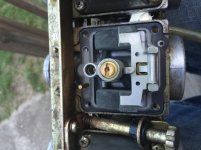
2) The pilot circuit, is the long metal stem, with a very small hole in it reaching to the bottom of the bowl. On the left in the picture.. This is what brings the gas from the bowl, up and into the cylinder?
3) So the no fuel into cylinder #2, is not going to be caused by low or no compression in that cylinder?
4) You mentioned that the petcock has failed, what happens if it fails? do you mean, that the one vacuum line, should control the fuel coming out of the petcock? and the petcock failed pouring fuel out constantly instead of as needed? Forgive my asking questions, I like to learn and understand how things work.

IMG_3632.jpg
 
Last edited:
1. Yes
2. Yes, and maybe
3. Compression could be a factor, but most likely, plugged carb
4. When it fails, the diaphragm inside it breaks, causing fuel to flow down the vacuum line into carb 2, flooding it. It can also create constant fuel flow down the fuel line, which should be held in check by the floats

Simple side test - remove the oil filler cap and smell the oil. Smell like gas and oil?

Look for the Cv carb rebuild on the BikeCliff page
 
Awesome, thank you so much! I've placed the order for the CV carburetor O-rings so I can replace all of those.
I've found the instructions for the carb rebuild also.
I will have to wait until I'm home to check the oil smell, but when the crankcase vent tube was dripping I smelled the liquid and it smelled like gas.
So I'm all set, except for one more thing.. I've got the O-rings ordered, now I need a rebuild kit for the carbs.. or should I just clean them really really good and that should be ok? The other three seem to be great, just the one messing up. I promise this is my last question ;) I will update once I've got them all clean and installed (Hopefully it's not worse putting them back in, getting them out was a pain).
 
Just a thought but there are three things necessary for the cylinder to fire. Compression, spark and fuel. You can open the drain screw on your carb and if gas flows out, perhaps the carb is the culprit BUT if you were going 40 mph, the pilot circuit would not be able to shut off all fuel flow if plugged because the needle jet/jet needle is contributing fuel at this point. That leaves compression. As with any new bike, CHECK COMPRESSION right from the get-go. If you have no compression, the cylinder won't fire. Lack of compression can be from a holed piston, usually caused by air leaks through the carb holder; it can be caused by lack of valve adjustment and then there is the situation where the piston rings can't seal or you have a bent valve or a mechanical problem of this nature.

I personally would not rebuild the carburetor until I checked compression for those reasons. May be the carburetor or may be lack of compression.
 
You don't need rebuild kits- just the o-ring kit from cycleorings: the metal jets don't wear out.
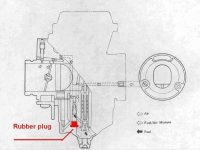
As to your pilot circuit, look at this pic and see the convoluted path gas from bowl has to travel to blend with air and make it to carb throat exit- lots of tiny passages that get gummed up easily and will resist quickee attempts to clean them!
 

Attachments

  • image.jpg
    image.jpg
    52.4 KB · Views: 0
I understand exactly what you mean. I am going to make sure to follow the guide and clean everything twice. I did notice though, when reading through the rebuild guide, my carbs are missing (or don't have?) the plug for the pilot jet. I pulled all of the bowls off last night, and none of them had that plug. Is the purpose of that plug to keep debris from getting into the pilot jet? Everything came apart nice and easy, so I'm thinking they've been apart before..
 
I understand exactly what you mean. I am going to make sure to follow the guide and clean everything twice. I did notice though, when reading through the rebuild guide, my carbs are missing (or don't have?) the plug for the pilot jet. I pulled all of the bowls off last night, and none of them had that plug. Is the purpose of that plug to keep debris from getting into the pilot jet? Everything came apart nice and easy, so I'm thinking they've been apart before..
Yes you must have those plugs. Shop around prices very. I got a set of 4 new 10 bucks on e-bay. Can't remember why they are needed right now, just woke up.
 
Just a thought but there are three things necessary for the cylinder to fire. Compression, spark and fuel. You can open the drain screw on your carb and if gas flows out, perhaps the carb is the culprit BUT if you were going 40 mph, the pilot circuit would not be able to shut off all fuel flow if plugged because the needle jet/jet needle is contributing fuel at this point. That leaves compression. As with any new bike, CHECK COMPRESSION right from the get-go. If you have no compression, the cylinder won't fire. Lack of compression can be from a holed piston, usually caused by air leaks through the carb holder; it can be caused by lack of valve adjustment and then there is the situation where the piston rings can't seal or you have a bent valve or a mechanical problem of this nature.

I personally would not rebuild the carburetor until I checked compression for those reasons. May be the carburetor or may be lack of compression.
Say what! Then what would you suggest?
Sorry read that wrong. Also have your throttle wide open and a warm motor if possible.
 
Last edited:
Yes you must have those plugs. Shop around prices very. I got a set of 4 new 10 bucks on e-bay. Can't remember why they are needed right now, just woke up.

Mike the plugs are needed as there is a hole going between the pilot well and main jet well and the pilot jet in those type carbs draws fuel through the main jet well. And anyone who has a carb that isn't flowing gas at idle and doesn't use new pilot jets is setting himself up for trouble. Cleaning jets with a jet cleaning tool abrades the orifice where gas flows and ruins the chamfer on the inlet where gas is pulled in. Just use new pilot jets... you can often get away with the original main jets. And the jets are brass but while they may not wear, if someone has been using air filtering method that is ineffective, then the needle jet will usually wear quickly and oval and performance and gas mileage will degrade. If the air filter is REALLY bad it will scour the finish off the jet needles and they are toast at that point.
 
Say what! Then what would you suggest?
Sorry read that wrong. Also have your throttle wide open and a warm motor if possible.

Rebuilding the carbs in this case is more of a chore than checking compression and a new owner should baseline the bike anyway. It could turn out that a valve has no clearance. While checking the engine warm is preferable, in this case it won't matter a lot because if the cylinder isn't firing, there is likely to be very little compression in the cylinder... plus if the cylinder isn't firing, it won't get warm anyway.

One last point, never put your pinkies on a headpipe that is hot. Use a spray bottle with water and hit a pipe that is firing, The water vaporizes instantly and if the pipe isn't firing, it will be very hot from being next to the other pipes but the water will spit and sizzle.
 
I'm sure that you realize that it is the rubber plug in this picture that he is talking about.
attachment.php


V
 
Good morning guys! So I was referred to you by a friend, and told you this is a great place to learn about our bikes. I've spent the last hour searching the forums about my problem, and none of them had solutions, or weren't exactly the problem I am having.

1981 Suzuki GS550L
17,900 miles

So my problem is my #2 cylinder is getting no fuel at all. I bought the bike two days ago and rode it home. When heading home, I noticed the bike would not go over 40 mph. From reading on the forum, this could be a spark plug issue, or fuel issue, so I started my diagnoses..

I switched the plugs, no difference.
I checked spark, and am getting a strong blue spark.
I made sure all of the lines were hooked up. (The previous owner did add an inline valve after the petcock, to shut fuel off, as the petcock only has prime, fuel, and reserve)
I checked to see if the air filter was clogged (Didn't have one in there..)
I removed the carbs, checked everything on the #2 carb compared to the rest.
The #2 carb is a different color, because it hasn't been getting fuel in there. But, the float, and everything looks good. An important note is that I drained all of the bowls, for all four carbs. All of them had gas in the bowls, the same amount also.

I've went on a 10 minute ride, pulled the plug for cyl #2 (From the left), and the plug was clean, looked brand new. I also for a second, touched the exhaust pipes for each cylinder. The cyl #2 pipe, I could hold my hand on it, and it was barely warm. The other cylinders were hot to the touch of course. So my theory is that fuel is getting to the carb in the bowl, just not to the cylinder for some reason.


My questions are:

1) Is their anything specific to Cyl #2 carb (vacuum wise, or other) that I can check? I ask this, because their is a vacuum line going from the petcock to the carb for cyl #2.
2) The carb works by vacuum, which moves the piston up and down inside the carb to pull fuel up and into the cylinder? Is the vacuum coming from the piston in the engine moving up and down, where this could be a no compression on that cylinder issue? (I hope not!) Or is their another source for the vacuum on the carb?

I am going to say I'm mechanically inclined, but not really with carbs :\ So anything I need to learn ,please let me know, thank you!
You also must have an air filter in the air box or it will not run right . You will not be able to do proper carb adjustments
 
Rebuilding the carbs in this case is more of a chore than checking compression and a new owner should baseline the bike anyway. It could turn out that a valve has no clearance. While checking the engine warm is preferable, in this case it won't matter a lot because if the cylinder isn't firing, there is likely to be very little compression in the cylinder... plus if the cylinder isn't firing, it won't get warm anyway.

One last point, never put your pinkies on a headpipe that is hot. Use a spray bottle with water and hit a pipe that is firing, The water vaporizes instantly and if the pipe isn't firing, it will be very hot from being next to the other pipes but the water will spit and sizzle.
Thanks for the schooling! Did not know that it was a one cylinder motor. Maybe he should do all the proper maintenance first then check the compression.
 
Thank you everyone for the information and help! I will definitely use a spray bottle of water next time to test the exhaust pipes. I didn't check the compression to match it to the other cylinders, as I didn't have a tester. I planned on getting one to test this, but I think I've got it fixed now :rolleyes: I ended up starting to take the carbs apart last night, and I pulled the pilot jets out of the carb#2, and carb #1. Just to compare them because you guys suggested it was probably plugged, and that is why there was no fuel to that cylinder. Turns out you guys were on the money! The pilot jet for cyl #2, was completely clogged! I used a bristle from a brake cleaning brush, per the rebuild guide, and reopened the hole so I can get fuel now. I put them all back together, and have the carbs on the bike (only took me an hour to put them on :(). I've got to finish putting some little things back together after work today, to get her started, and verify she will go over 40 mph now.

Because of the help here, I've learned so much more about carbs, fixed my bike, and have a home to learn a lot more about my bike.. thank you!
Don't worry, I am definitely changing that oil with a new filter and have to give the rest of the bike a once over. The guy who had it before me didn't seem like he knew what he was doing. He put an led light on the rear for the brake light/signals.. and didn't even have it hooked up, along with the front signals. So when I put the wires together, signals won't flash, and I couldn't find the wire for the brake light, etc (because it's led I believe). I've got a wiring diagram from here and will attempt to get this fixed right :D I'm going to find a store around me so I can get the stock lights and put those on though, unless you guys have a specific place I can support from here by buying them from there.
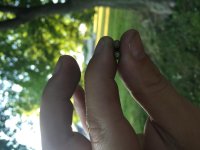
I'm attaching a picture of the pilot jets by the way, I was so excited when I seen it clogged. Now I'm excited to put it all together, and see how she runs!
IMG_3667.jpg
 
I am definitely getting an air filter also. Just got the oil filter, and oil for her. From what I am seeing, these bikes need everything with air, vacuum, etc to be perfect. She's got 18,000 miles on her, and I want to keep her going for a lot more.
 
Welcome to the forum! Definitely look for and/or follow the links and newcomer guides. Do a search for BassCliff's website which has manuals tutorials, etc.

I started wrenching on bikes last year, thanks to this good natured group. I bought a bike in pretty rough shape and having it running pretty good right now, and even took it to a rally to meet some of these guys. It's a great community.

Remember to check for parts in the Classifieds section, and definitely post in the 'wanted' section if you need something - there are a lot of parts around that people will let go for a more than reasonable price.

When you get to the 'Stator Papers' you'll find that LEDs on these bikes are not the best idea until you getreplace the regulator/rectifier with a Series type. The stator makes full electrical power at low RPM and the stock R/R basically just dumps the extra to ground (the frame), causing the stator to run hot. Reducing the electrical load just causes more waste heat to go from the stator to the frame. A couple of turn signals might not make a huge difference, but the power adds up so be careful.
 
Thank you! I've already got BassCliffs website bookmarked, as well as this one.

I don't know a lot about bikes, as I've never messed with them. I had one for a couple months two years ago, rode it for the summer, then sold it. It was in pretty bad shape, and the person I sold it to wanted to fix it all.

I didn't see the classifieds section, I'll have to look for it. I would rather have the stock lights, but the P/O had leds on there instead.

The P/O also stated he replaced the charging system, with a new version? I think he said a digital ignition? Like I said, I don't know a lot, but I am learning :D I'm not sure what the difference is between the two. Someone told me I can maybe add resistors in line from the wire to the led light, to increase the load because the led doesn't have the proper load to activate the flasher. I'm not sure on this though, as I've not messed with that before. I have a lot of resistors, as I work on some electronics (programming microprocessors). But, I'm not sure which resistor I would need. I would think upgrading the flasher would be easier and safer.
 
Back
Top