• Required reading for all forum users!!!

    Welcome!
    Register to access the full functionality of the GSResources forum. Until you register and activate your account you will not have full forum access, nor will you be able to post or reply to messages.

    A note to new registrants...
    All new forum registrations must be activated via email before you have full access to the forum.

    A Special Note about Email accounts!
    DO NOT SIGN UP USING hotmail, outlook, gmx, sbcglobal, att, bellsouth or email.com. They delete our forum signup emails.

    A note to old forum members...
    I receive numerous requests from people who can no longer log in because their accounts were deleted. As mentioned in the forum FAQ, user accounts are deleted if you haven't logged in for the past 6 months. If you can't log in, then create a new forum account. If you don't get an error message, then check your email account for an activation message. If you get a message stating that the email address is already in use, then your account still exists so follow the instructions in the forum FAQ for resetting your password.

    Have you forgotten your password or have a new email address? Then read the forum FAQ for details on how to reset it.

    Any email requests for "can't log in anymore" problems or "lost my password" problems will be deleted. Read the forum FAQ and follow the instructions there - that's what we have one for...

  • Returning Visitors

    If you are a returning visitor who never received your confirmation email, then odds are your email provider is blockinig emails from our server. The only thing that can be done to get around this is you will have to try creating another forum account using an email address from another domain.

    If you are a returning visitor to the forum and can't log in using your old forum name and password but used to be able to then chances are your account is deleted. Purges of the databases are done regularly. You will have to create a new forum account and you should be all set.

Am I ok with Regulator?

suzukigs1100ez

Forum Apprentice
So got the itch upgrade the regulator on my 82 gs1100ez. Hopped on ebay and found Polaris regulator with the bracket and wiring pigtail. For cheap
https://www.ebay.com/itm/OEM-Polari...e=STRK:MEBIDX:IT&_trksid=p2057872.m2749.l2649

Above the one I got. But my question is it a Mosfet? The number on the side says 4016868 which so far found is 3PH, 50A, SERIES, HISPD from partzilla.

Should I run it? I figure worst case I got connectors if do go different route.
 
The term Mosfet is one that I see bandied about, but I still don't have a real clear understanding of what it means. Maybe Jim (posplayr) or someone else can put it in layman's terms for us dummies.


What I can tell you is that is not a genuine series type Shindengen SH775.
s-l1600.jpg


Most of us have had real good results with a genuine series type Shindengen SH775, which looks like this:
s-l640.jpg
 
Yeah I know it not a Shindengen even tho I search using the polaris number for one which when I found this. But the number on the side is not the same I searched.

 
A "MOSFET R/R" is an early attempt to improve on the original SCR based SHUNT topology R/Rs by replacing the SHUNT SCR's with MOSFETS. This only makes the problem with the Stator worse. "MOSFET R/R" is still SHUNT topology just with the more efficient MOSFET.

Now some series R/Rs (e,g, Compufire) will use MOSFETS but they are not considered a "MOSFET R/R" because they use a series topology. This terminology is misleading but follows from Schindigen's product terminology.

In summary a MOSFET semiconductor device dissipates less heat than a SCR (i.e. lower on resistance), but a MOSFET R/R relates only to SHUNT topology R/Rs.

The reason the MOSFET shunt R/R is worse on the stator is because there is more stator power dissipated in the stator with a MOSFET. The mosfet is so efficient, rather that disputing a larger amount of power in the R/R, that heat goes to teh stator. Good for the R/R bad for the stator.
 
So this one said on Partzilla said it was a series so it safe to use?

You are making this far to complicated. Just buy a SH775 as determined by the marking on the side. If it doesn't say SH775 then it is almost guaranteed it is not one.
 
Posplayr can confirm (or refute) this, but I think the term MOSFET was for
"Metal Oxide Semiconductor Field Effect Transistor".

The typical diodes and transistors that were used "back in the day" were usually silicon based. MUCH more efficient than the vacuum tubes they replaced, but they still had some inherent inefficiencies and losses. A MOSFET transistor was able to switch states (ON/OFF) much quicker, which gained efficiency because it spent less time in the transition state, where there was a fair amount of resistance. As Posplayr mentioned, that increased efficiency in the R/R simply meant that the stator had to absorb more of the heat that was due to the current being shunted to provide regulation.

I have not investigated the inner workings of the SH775. There might be MOSFET transistors inside, there might be another type. Whichever is in use does not matter nearly as much as the fact that it is a series-type, rather than shunt-type, regulator. THAT is what makes it a much better R/R.

When shopping for an SH775, you have to watch the wording of the ad carefully. It may be advertised as "replaces SH775" or "fits Polaris RAZR" or some other crafty wording. The thing that you MUST see is a picture with the SH775. If you don't see that, at least look for visual cues that might rule it out.
1. SH775 will be gray.
2. Fins will be transverse, across the connectors.
3. There are round nubs on the second and fourth fins from the front and back, for a total of 8 nubs.
4. The bottom is silver metal. Not sure if it's aluminum or stainless.
5. "SH775" will appear on the back fin, usually followed by AA or BA.
6. eBay ads that show a cheap R/R that "fits" Polaris and is "new" and/or from China are knock-offs.
7. Genuine SH775s on eBay are usually dirty. (They come from wrecked bikes)
8. The easiest way to filter out the fakes is to limit your search to "US vendors" and "used".

.
 
Steve,
At these slow R/R switching speeds the main advantage for the MOSFET is the lower on resistance.
Jim
 
Posplayr can confirm (or refute) this, but I think the term MOSFET was for
"Metal Oxide Semiconductor Field Effect Transistor".

The typical diodes and transistors that were used "back in the day" were usually silicon based. MUCH more efficient than the vacuum tubes they replaced, but they still had some inherent inefficiencies and losses. A MOSFET transistor was able to switch states (ON/OFF) much quicker, which gained efficiency because it spent less time in the transition state, where there was a fair amount of resistance. As Posplayr mentioned, that increased efficiency in the R/R simply meant that the stator had to absorb more of the heat that was due to the current being shunted to provide regulation.

I have not investigated the inner workings of the SH775. There might be MOSFET transistors inside, there might be another type. Whichever is in use does not matter nearly as much as the fact that it is a series-type, rather than shunt-type, regulator. THAT is what makes it a much better R/R.

When shopping for an SH775, you have to watch the wording of the ad carefully. It may be advertised as "replaces SH775" or "fits Polaris RAZR" or some other crafty wording. The thing that you MUST see is a picture with the SH775. If you don't see that, at least look for visual cues that might rule it out.
1. SH775 will be gray.
2. Fins will be transverse, across the connectors.
3. There are round nubs on the second and fourth fins from the front and back, for a total of 8 nubs.
4. The bottom is silver metal. Not sure if it's aluminum or stainless.
5. "SH775" will appear on the back fin, usually followed by AA or BA.
6. eBay ads that show a cheap R/R that "fits" Polaris and is "new" and/or from China are knock-offs.
7. Genuine SH775s on eBay are usually dirty. (They come from wrecked bikes)
8. The easiest way to filter out the fakes is to limit your search to "US vendors" and "used".

.

Thanks for the summary, Steve.

Ed
 
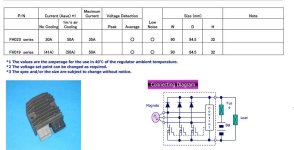
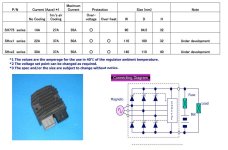
I surmise this from the Shindengen supplied circuit diagrams I have on hand: Shindengens using FETS FieldEffectTransitors) have numbers as in "FH020". Those using SCRs(SiliconControlRectifiers?) will be as in SH775...so it's my understanding that the series typer/rs use SCRs, not FETs or mosFETs

Shindengen.jpg

You can look up FET and mosfet and scr for explanations.
 
Last edited:
I surmise this from the Shindengen supplied circuit diagrams I have on hand: Shindengens using FETS FieldEffectTransitors) have numbers as in "FH020". Those using SCRs(SiliconControlRectifiers?) will be as in SH775...so it's my understanding that the series typer/rs use SCRs, not FETs or mosFETs

View attachment 59988

You can look up FET and mosfet and scr for explanations.


There are a few variation on how to accomplish rectification.

In the FH (shunt topology) R/R, they accomplish rectification in the upper legs with traditional diodes. The lower legs have MOSFETS to combine shunting and dynamic rectification. I assume they mixed diodes and MOSFETS to improve fail safe if one of the MOSFETS were to short. Bipolar parts tend to short OPEN while FET devices fail SHORTED. This would seem to bme the only reason they mixed them.
It is worth noting that if teh diodes were all changed to FETs and by properly controlling the FETs you could turn this into a Series topology R/R.

In the SH (series topology) they used SCRs. They did not need to do this as mentioned above.

Based on measuring the forward drops on the Compufire R/R, I believe they are using a FET based Series design.

Dynamic rectification is very similar to model brushless DC motor control techniques.
 
So searching that number online found some info about 4016868. Found info on Kawasaki Versys Forum that there starting to use this as alternative to the Sh775 due the cost difference. They said that there bikes even being still made today are still running shunt style and burning stators because of it. They did say the 4016868 is largest one Polaris makes for size and amps output. I do know it quite large as I looking for a place to mount it on my bike.

So one rated at 50 amps going cause any issues to the bike?
 
Interesting. On the Shindengen page above, they do mention two that are under development and that was a while ago.
We know there's one 50A appeared on a couple of bikes in recent years, and this looks like another.
If it's genuinely a series type (and if Partzilla are accurate in their description), this looks like a contender with the bonus of sharing the same connectors.
Definitely one that needs to be clamp-metered and its operation seen for sure.
It's cheap enough, anyway.
https://www.partzilla.com/product/polaris/4016868
 
Interesting. On the Shindengen page above, they do mention two that are under development and that was a while ago.
We know there's one 50A appeared on a couple of bikes in recent years, and this looks like another.
If it's genuinely a series type (and if Partzilla are accurate in their description), this looks like a contender with the bonus of sharing the same connectors.
Definitely one that needs to be clamp-metered and its operation seen for sure.
It's cheap enough, anyway.
https://www.partzilla.com/product/polaris/4016868

The foot print look pretty small compared to SH-775 but those fins really stick up! Looks like well over 2" of height. Obviously for a 50 amp device you have much more heat to dissipate, but unneeded for non EFI bike.
 
Physical size for now. 4 1/4 by 4 in. I didn't measure overall height with the fins. The bolt spacing is 3 3/8 on center. I do have a clamp for my meter but I think it only an A/c measuring.

Might be a week or to before I get bike running again to do testing. Currently pulling the carbs down and going thru the wiring.
 
Back
Top