• Required reading for all forum users!!!

    Welcome!
    Register to access the full functionality of the GSResources forum. Until you register and activate your account you will not have full forum access, nor will you be able to post or reply to messages.

    A note to new registrants...
    All new forum registrations must be activated via email before you have full access to the forum.

    A Special Note about Email accounts!
    DO NOT SIGN UP USING hotmail, outlook, gmx, sbcglobal, att, bellsouth or email.com. They delete our forum signup emails.

    A note to old forum members...
    I receive numerous requests from people who can no longer log in because their accounts were deleted. As mentioned in the forum FAQ, user accounts are deleted if you haven't logged in for the past 6 months. If you can't log in, then create a new forum account. If you don't get an error message, then check your email account for an activation message. If you get a message stating that the email address is already in use, then your account still exists so follow the instructions in the forum FAQ for resetting your password.

    Have you forgotten your password or have a new email address? Then read the forum FAQ for details on how to reset it.

    Any email requests for "can't log in anymore" problems or "lost my password" problems will be deleted. Read the forum FAQ and follow the instructions there - that's what we have one for...

  • Returning Visitors

    If you are a returning visitor who never received your confirmation email, then odds are your email provider is blockinig emails from our server. The only thing that can be done to get around this is you will have to try creating another forum account using an email address from another domain.

    If you are a returning visitor to the forum and can't log in using your old forum name and password but used to be able to then chances are your account is deleted. Purges of the databases are done regularly. You will have to create a new forum account and you should be all set.

Are these any good for carb sync/balancing ?

  • Thread starter Thread starter Colin Green
  • Start date Start date
They will work. You don't need the 6mm adapters if you have stock Suzuki parts.

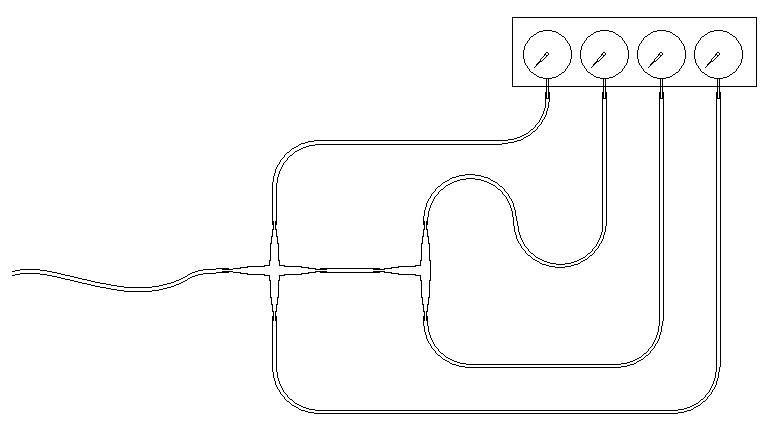
Although they will work, be aware that you will need to fabricate a manifold to calibrate them before using them every time. A simple manifold can be made from a 4-way and a 3-way "T" setup. The idea is that you want to connect all four gauges to the same vacuum source at the same time and adjust them so they all read the same. Now you can remove them from the manifold and connect them to the individual intake tubes for the carb sync.

One other thing about the analog gauges...the needles tend to bounce. A restriction in the tubing helps to minimize this. You can use a wire tie to choke the tubing to a smaller diameter.

vacuumgaugemanifold.jpg

.
 
Last edited:
Steve is right if yours is a 1100G. It will use the 5mm adapters so save some money. Attached is a picture of a 4 way valve that you can use, that I picked up for $4 at the fish/pet store, so you don't have to make one.
My vacuum gauge bounced about 3-4 cm's so I had to take a median point when measuring.
NOTE: Others strongly recommend other types of carb tune products vs vacuum gauges.
 
The four-way manifold that Lurch is presenting will work, but be aware that whenever you change the adjustment on one carb, it affects all the others.
It is much easier to see this change and the resulting balance when you have four gauges and can see all of them at once.

Using a single gauge with a manifold will involve a LOT of manifold valve switching to achieve the same results. :shock:

.
 
I use a set just like those.

You need to recalibrate all 4 dials to 1 cylinder every time you use it.remember that!!, but no mercury is why I went this way.
it takes a little more time but not that much.

they are worth 2X weight in gold.

I got mine from K&L no middle man fee (z1Ent)
regulators stop the bouncing and you'll develop a technique with a little experience you'll have it down pat -- after you DE-tune your bike and then bring it back is what taught me.


it is really easy to make your bike slower BUT when you make a buddy's bike faster and smoother you'll have free beer for a long time
 
I personally would not use any contraption that did not have 4 individual - seperate- dials. 1 per cylinder. each measuring meter completely seperate

yamaha YICS is another beast that you have to isolate the cylinders with a seperate tool

I have 2 sets for cb 1000 and kz 1300 6 cyl. bikes-- no jumping dials from cyl to cyl.

this is a precise tunning tool / procedure. half arssed combined vacuum contraptions are better than tunning by ear but will not get you to perfect.

the difference between accuracy and precision is 2 or 3 decimal points
 
I’ve used round vacuum gauges to sync carbs before, works fine. One extra step is needed as trippivot mentioned; calibrate each gauge to a common vacuum source to make sure the gauges all read the same. If you spend the big bucks and get the factory Suzuki gauges you will need to do this same calibration each time they are used.

A vacuum restrictor of some type is a great help when using this type of gauge in order to damp needle oscillations. My elcheapo mercury gauges have small plastic plugs with a hole in them in the vacuum tubes to serve such a purpose.

And while I agree that four gauges at the same time are better, I certainly wouldn’t fault anyone for using what they have in the garage and give it a go. I used a homemade mercury sync tool for many years since I was too cheap to spend the money on a factory built one. Too bad mercury can not be purchased through retail outlets anymore, making your own sync gauge is very easy.

And speaking of making your own sync gauge, what would stop someone from making their own Carbtune style gauge? Get some hard, clear plastic tubing and some polished steel rods that fit down in the tubes. The clearance between the clear tubes and the rods would be critical, along with the weight of the rods. Seems easy enough…might have to give it a go.
 
Last edited:
half arssed combined vacuum contraptions are better than tunning by ear but will not get you to perfect.

the difference between accuracy and precision is 2 or 3 decimal points

Trust me, I'm not pushing my method over the Carbtune tool, but just sharing my "homemade expirement" with "what can I build from stuff in the garage and that actually works". I would also buy the right tool for $100 if you're planning on doing this stuff regularly.
Someday one of you can come by and check my carb synch readings and see if I got within one cm2 of accurate. It is like night and day for how my bike runs now and when I got it last year. Honestly it is mostly due to the valve adjustments, pilot mixture screw adjustment, and the new intake boot o-rings over the other things I've done.
I'll provide lunch for any takers:-D!
 
If you look in the picture on the link, you can see 4 small white plastic pieces. I believe these are restricters, just put them inline on each hose and turn till the gauge bounce stops.
 
my thoughts on this are that dial type vac guages are a real pita because of the needle flutter, so much so that i threw mine over the hedge years ago & bought a borgan carbtune 2 :-D never looked back & its paid for itself many times over

http://www.carbtune.com/
 
Thanks everyone. I need the bullet/idiot proof one, so think I will look around more

Edit.. besides.. with the cost of delivery to NZ, ($79US for delivery of 2 gaskets and 4 jets from Bike Bandit) I may as well spend a few more $ on one that is easiest to use
 
Last edited:
Thanks everyone. I need the bullet/idiot proof one, so think I will look around more

Edit.. besides.. with the cost of delivery to NZ, ($79US for delivery of 2 gaskets and 4 jets from Bike Bandit) I may as well spend a few more $ on one that is easiest to use

i've used "carbtune"
many people here share good experience with that set
google it up
($100 i think)
 
... I was wondering what the T & X tube looking piece's were for and must be sync'ing
Do those pieces look like they might work like the picture I posted above? :-s
If so, that's how you calibrate all the gauges to each other before connecting them to the individual cylinders.

vacuumgaugemanifold.jpg


.
 
O.K. I got up and looked and took pic

O.K. I got up and looked and took pic

I was off I thought it was an X but I think these plastic pieces are just line restrictors. There is a plastic screw in each plastic piece. Here is a pic of what they sent me. Looks better than the pic I think. Hope this helps.

Gauge calibration instructions as follows "Calibrate the gauges to the average reading by lifting the gauge glass then using a screw driver rotate the screw on the face of the gauge and adjust pointer to position desired."

"Instructions for use: 1. Run Engine until operating temp is reached, Carbs must be adjusted with engine warm and choke fully opened. CAUTION Choke operation may damage gauges 2.Attach bungee cord to the vacuum gauge mounting plate at the holes provided in the upper corners of the plate. Strech the cord around the bottom of the mirror arms, suspending the vacuum gauges suspended above the handlebars.
Tuning procedure: 1. Remove the vacuum attachment plug-screws from the carb flanges or intake manifolds and install the vacuum hose attachment probes into these holes(Long to inside short to outside a drop of oil eases the installition.)A. Start the engine let it idle and check gauges. B.If dampening is desired close valve or valves slightly. (Do Not attempt to adjust valves when not attached to enging.)C.The needle will flutter, but should not oscillate more than one graduation on the gauge faces. D. Sync carbs according to instructions in manufacturs specs of the appropiate shop manual or service bulletin. E. However, Synchronization is a function of relative vacuum between cylinders rather than any specific vacuum readings. Syncronization is obtained when the vacuum is the same on all gauges." Hope this helps
 

good info...picture worth a 1000 words.
I see that the Desmo one had carbs at 21 and 22 cm2, but on the GSs should you adjust so carb 1 and 4 are slightly (1 cm2) higher than 2 and 3?
Other 2 clips looked off too?... but definitely looks easier than a single gauge for adjusting carbs if needed.
 
Last edited:
but on the GSs should you adjust so carb 1 and 4 are slightly (1 cm2) higher than 2 and 3?
thats what the service manual calls for
but the explanation given that the outer cylinders have a "longer intake" just didnt make sense to me so i adjust them all equally 8-[
 
Back
Top