• Required reading for all forum users!!!

    Welcome!
    Register to access the full functionality of the GSResources forum. Until you register and activate your account you will not have full forum access, nor will you be able to post or reply to messages.

    A note to new registrants...
    All new forum registrations must be activated via email before you have full access to the forum.

    A Special Note about Email accounts!
    DO NOT SIGN UP USING hotmail, outlook, gmx, sbcglobal, att, bellsouth or email.com. They delete our forum signup emails.

    A note to old forum members...
    I receive numerous requests from people who can no longer log in because their accounts were deleted. As mentioned in the forum FAQ, user accounts are deleted if you haven't logged in for the past 6 months. If you can't log in, then create a new forum account. If you don't get an error message, then check your email account for an activation message. If you get a message stating that the email address is already in use, then your account still exists so follow the instructions in the forum FAQ for resetting your password.

    Have you forgotten your password or have a new email address? Then read the forum FAQ for details on how to reset it.

    Any email requests for "can't log in anymore" problems or "lost my password" problems will be deleted. Read the forum FAQ and follow the instructions there - that's what we have one for...

  • Returning Visitors

    If you are a returning visitor who never received your confirmation email, then odds are your email provider is blockinig emails from our server. The only thing that can be done to get around this is you will have to try creating another forum account using an email address from another domain.

    If you are a returning visitor to the forum and can't log in using your old forum name and password but used to be able to then chances are your account is deleted. Purges of the databases are done regularly. You will have to create a new forum account and you should be all set.

Best speed/rpm for fuel economy? GS850

93Bandit

Forum Mentor
I'm planning on a fairly lengthy road trip on my GS850L this summer and due to the relatively limited range, I want to travel at the most economical speed. I'm not going to be in a hurry but since it's an 8hr drive in a car, I want to be able to ride as quickly as I can with as few fuel stops as possible. I've read the range for the 850L is about 150 miles, but at what speed?

I understand road grade, wind direction/speed and weight all play a role, but since I can't control road grade and wind, let's eliminate those variables and pretend the whole trip is flat with only a breeze. Note I will be using my removable windshield for the trip. I assume that will help with aerodynamics a little?

So anyways, at what highway speed have you guys noticed the best fuel economy on an 850? 55, 65, 75 mph?

Thanks!
 
Plan on 120 miles for fill ups to be safe. I run pods, and 4-1 exhaust and get around 47 mpg. at 70. Take your bike out and run a couple tanks through it one at 60 the other at the top allowed speed in your state and see what the difference is. Allot depends on the tune of your machine.

V
 
The '82/'83 850L has a larger, 4.5 gallon tank, which easily gives a 150 mile range before REServe. We have found the best speed to be between 65 and 70 wind speed. I have to emphasize "wind speed" because we were on a ride with our Goldwing group that had us doing about 75 for a while, but we were going into a 20-25 mph headwind, so the bike thought we were doing about 95-100. She went onto REServe at about 90 miles, got about 28 mpg. Next tank was only a little bit better, since we had changed direction, mileage went up to 29.5. A few days later, things were a bit calmer and the pace relaxed, we had three consecutive tanks over 55 mpg. Speeds on those tanks were 60-65, so raising speed a bit to 70 would still get you decent range. At those speeds, her mileage is still in the upper 40s.

My 850 has a full touring accessory package. Not sure what it does to aerodynamics, but it is a bit of extra weight. My mileage is usually in the lower 40s, but I have a larger tank. We stop for fuel based on her range, which is usually 2 to 2 1/2 hours, anyway, so it's about time to stop for a break.

.
 
I've found not only wind speed, but altitude also plays a role in fuel economy on my stock 850. That may not matter as much to some folks, but we have quite a range here from around 2,800' up to over 13,000'. MPG can range quite a bit just from that, not to mention all other factors from previous posts. I've noticed the higher elevation means fewer fuel stops in general.

In and around town with a mixture of 75, 55 and slower roads I calculated 46.5 MPG at the last fill up even with big fairing and bags. My highest miles from one tank without running out was 225.
 
The theoretical best RPM is just below the torque peak for the motor.

The reality is that wind resistance is the biggest factor.
 
The theoretical best RPM is just below the torque peak for the motor.

The reality is that wind resistance is the biggest factor.

Hmmmm, I can't see myself running 8k RPM all day on the interstate!
 
Get a white marker pen and draw a line on the throttle grip where it buts up to the bars. Open throttle 100% - draw another line. Then put a line in the middle of those 2 markings and further lines between those. That gives you a visual indication of your throttle position.

Then go ride at 1/4 throttle opening. Whatever revs and speed that gives you (which will go up and down according to wind conditions and inclination) will give you the best mileage.
 
On a bike, of the things you can control speed is virtually the only thing that matters. Slower gets better mpg, faster gets worse. Above a very low speed (~20mph) any increase in speed will yield worse mileage.
 
Correct. Which is why I specified highway speeds.

Thanks for the tips guys!

I guess this brings up another question. Like I've mentioned in other threads, 99% of my experience is in the automotive/HD diesel world where engines don't rev as high as motorcycle engines. So what is a safe rpm limit for cruising long distances? For example, my older V8 cars would spin about 2-2,500 rpms at 75mph. Diesel engines even less. I don't recall exact rpm but my 850 is around 4k @ 55mph. Would it hurt the engine to do 75mph which is likely closer to 5,500 rpm for an extended period of of time? Please forgive my ignorance.
 
Last edited:
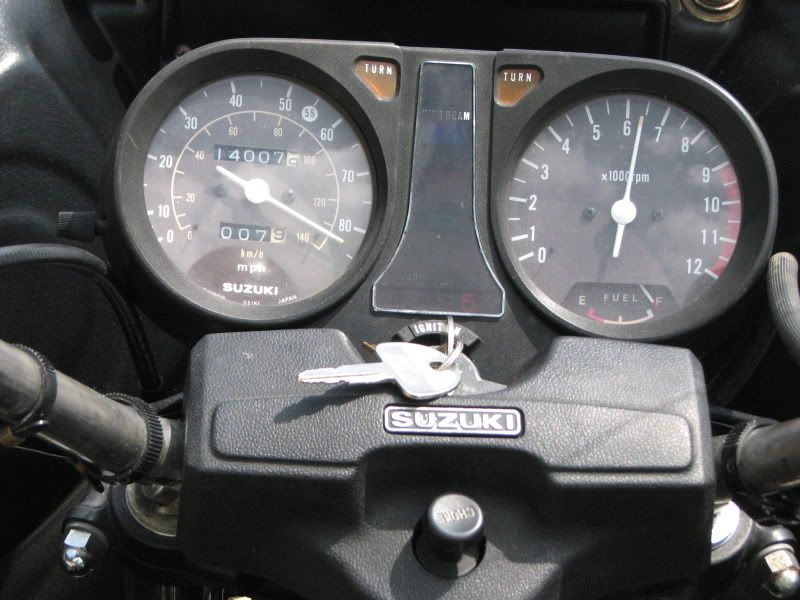
We did not do this all day long, but here is what your engine speed would be when going just a bit faster.

IMG_4303.jpg


Rest assured, I had BOTH hands on the grips. My wife leaned over my shoulder to get the picture.

The engine will be quite happy at anything less than redline. Gas mileage will suck over 5k RPM, but it will do it.

.
 
Correct. Which is why I specified highway speeds.

Thanks for the tips guys!

I guess this brings up another question. Like I've mentioned in other threads, 99% of my experience is in the automotive/HD diesel world where engines don't rev as high as motorcycle engines. So what is a safe rpm limit for cruising long distances? For example, my older V8 cars would spin about 2-2,500 rpms at 75mph. Diesel engines even less. I don't recall exact rpm but my 850 is around 4k @ 55mph. Would it hurt the engine to do 75mph which is likely closer to 5,500 rpm for an extended period of of time? Please forgive my ignorance.

I'll say no, in fact the bike seems to like high revs.
I don't think the guys who made these bikes knew anything much more than how to make them the best they could and it shows.
Think of the weight of the pistons and valves. There is where you start coming up on rev limits.
 
Wind load is an exponential function of velocity. That's why a bike will get progressively worse gas mileage as you increase speed. Keep in mind though that it's not safe to ride at less than the normal flow of traffic otherwise you will have people crawling up your backside all the time and tailgating.
 
A lot of "mileage per gallon" is about "steady state"-otherwise, squirting the throttle, braking, waste gas on any bike. abck in the day, 55mph was taken to be THE fuel-saving speed when everyone had carburretted vehicles...a lot of this idea might have been providing a steady-state speed for ALL vehicles..if everyone goes the same speed, braking and gas-squirting is theoretically reduced...

Steve's picture pretty much describes it for any of my 4 present motorcycles though all are smaller than 850. =5000 to 7500rpm everywhere. IMO,below that and these bikes are close to "lugging" at hwy speeds unless they are going downhill...lugging to me means slow throttle response. It means you are dumping gas into the bike and nothing is happening. CVcarbs help curtail the waste of gas but it's still "lugging" and not good for the engine.

Going UP mountains is going to challenge "steady state" . The speed you want to go uphill (or pass!) will pretty much determine what size motorcycle you need in your life...
 
Last edited:
So anyways, at what highway speed have you guys noticed the best fuel economy on an 850? 55, 65, 75 mph?
A long time ago I was accompanying a friend on a small bike that could only really cruise at 60mph on the motorway (freeway). That was the longest most boring 100 mile journey I've ever had on that 850.
When I refilled the tank and worked out the fuel consumption, I was surprised to find it had done 60+mpg. Which means, on the European tank, it could have done 300 miles. It was never anywhere near that on any journey since.

Would it hurt the engine to do 75mph which is likely closer to 5,500 rpm for an extended period of of time? Please forgive my ignorance.

When the bikes were working for a living, my normal motorway cruising speed was in the mid-80s. More than that was counter-productive, as it just used more fuel and made no difference to journey times, unless I was willing to risk life, limb and licence by doing 120.
 
Last edited:
We did not do this all day long, but here is what your engine speed would be when going just a bit faster.

IMG_4303.jpg


Rest assured, I had BOTH hands on the grips. My wife leaned over my shoulder to get the picture.

The engine will be quite happy at anything less than redline. Gas mileage will suck over 5k RPM, but it will do it.

.

Of course, the normal speedo and rev counter will have both needles pointing straight ahead at that speed in gear, which is a fairly useful symmetry.
 
A long time ago I was accompanying a friend on a small bike that could only really cruise at 60mph on the motorway (freeway). That was the longest most boring 100 mile journey I've ever had on that 850.
When I refilled the tank and worked out the fuel consumption, I was surprised to find it had done 60+mpg. Which means, on the European tank, it could have done 300 miles. It was never anywhere near that on any journey since.


When the bikes were working for a living, my normal motorway cruising speed was in the mid-80s. More than that was counter-productive, as it just used more fuel and made no difference to journey times, unless I was willing to risk life, limb and licence by doing 120.

Interesting. That's quite the range. How confident in your math are you? lol! Just kidding. How does the European tank differ from the US tank? Fuel tank, not war tank in case someone is feeling witty...

Of course, the normal speedo and rev counter will have both needles pointing straight ahead at that speed in gear, which is a fairly useful symmetry.

Oooo, I like how you think Grimly! In my car, when the speedo, tach, fuel gauge and temp gauge are all point north it makes me a little too excited. I don't run it long like that though because straight north on the tach is close to redline lol.
 
On my 82 GS650G I get less than 200 km (125 miles) before reserve is needed. Though it?s a smaller motor hauling my 220 lb ATGATT frame around, so sprinted throttle is often used.
 
How does the European tank differ from the US tank?
The book says it's 22L, but on more than one occasion I've put in 24L when it was running on reserve for a while and I'd hoped to find a petrol station soon.
I suspect the book is being conservative, but that 22L figure is repeated all over the various spec pages on the web and even in the Haynes manual.
Whether Suzuki ever made the tanks a couple of litres larger for the EU market - I doubt if it was worth their while to go to all that extra hassle just for us, so nah.
Otoh, in the early days of having both bikes, the first thing I did was to enlarge the stupidly small breather hole at the top of the filler neck, and that allows a bit extra fuel in with a rapid fill, so perhaps that's it. I suspect the 22L figure is to allow sufficient headspace for expansion in the desert, etc. Not a problem for me, as there are no deserts here, and I always have a journey after filling, even if it's just the journey home, so the bike is never parked up with a totally full tank, there's always a little headspace in it.
 
Back
Top