• Required reading for all forum users!!!

    Welcome!
    Register to access the full functionality of the GSResources forum. Until you register and activate your account you will not have full forum access, nor will you be able to post or reply to messages.

    A note to new registrants...
    All new forum registrations must be activated via email before you have full access to the forum.

    A Special Note about Email accounts!
    DO NOT SIGN UP USING hotmail, outlook, gmx, sbcglobal, att, bellsouth or email.com. They delete our forum signup emails.

    A note to old forum members...
    I receive numerous requests from people who can no longer log in because their accounts were deleted. As mentioned in the forum FAQ, user accounts are deleted if you haven't logged in for the past 6 months. If you can't log in, then create a new forum account. If you don't get an error message, then check your email account for an activation message. If you get a message stating that the email address is already in use, then your account still exists so follow the instructions in the forum FAQ for resetting your password.

    Have you forgotten your password or have a new email address? Then read the forum FAQ for details on how to reset it.

    Any email requests for "can't log in anymore" problems or "lost my password" problems will be deleted. Read the forum FAQ and follow the instructions there - that's what we have one for...

  • Returning Visitors

    If you are a returning visitor who never received your confirmation email, then odds are your email provider is blockinig emails from our server. The only thing that can be done to get around this is you will have to try creating another forum account using an email address from another domain.

    If you are a returning visitor to the forum and can't log in using your old forum name and password but used to be able to then chances are your account is deleted. Purges of the databases are done regularly. You will have to create a new forum account and you should be all set.

Big valve GS1000 head

  • Thread starter Thread starter Crankenstein
  • Start date Start date
C

Crankenstein

Guest
What year did the 1000s switch to the bigger valve head? I picked up a set of flatslide carbs but need to know what head to look for so the ports arent tiny. Plan on doing some porting to free up some more hps as well.
 
All the 8-valve GS1000s share the same valves. They did however use larger intake ports from '80 - on. This was done to match the increased throat size for the BS34SS CV carbs.
 
Ah gotcha, thats what I needed to know. Is there a casting number or way to tell them apart besides measuring the port itself?
 
Ah gotcha, thats what I needed to know. Is there a casting number or way to tell them apart besides measuring the port itself?

I'm not aware of any method besides visual inspection. Others may know of a way.
 
Tempter 650 Valves can work. I think I have a set of 4 in my shop in origanal suzuki wrapping, Mike
 
Tempter 650 Valves can work. I think I have a set of 4 in my shop in origanal suzuki wrapping, Mike


This is interesting, if the valves are interchangeable between temper and the GS that will make it much easier for people doing the GS450/GR650 head swap and overbore, and want to get some high performance valves.
There is much more stuff made and still available for the bigger GS'es, as you all know.
 
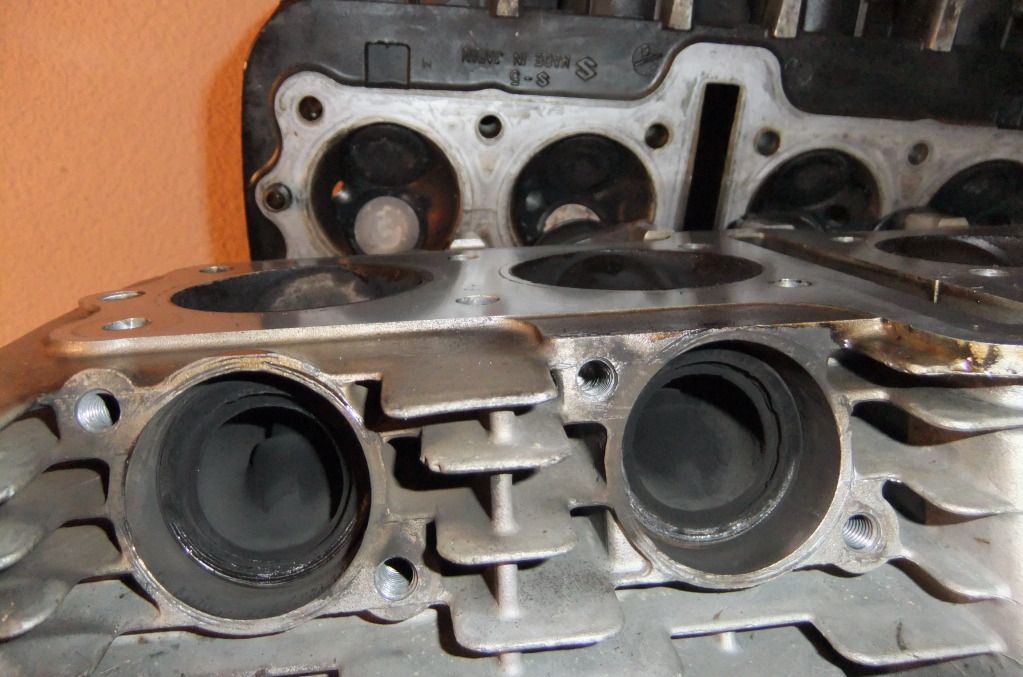
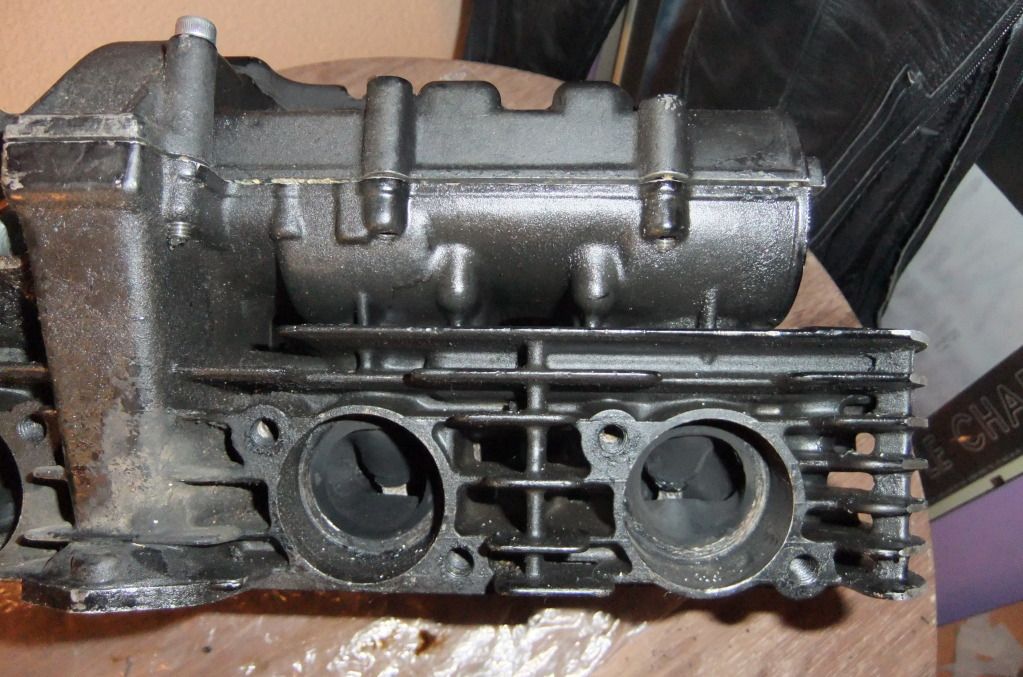
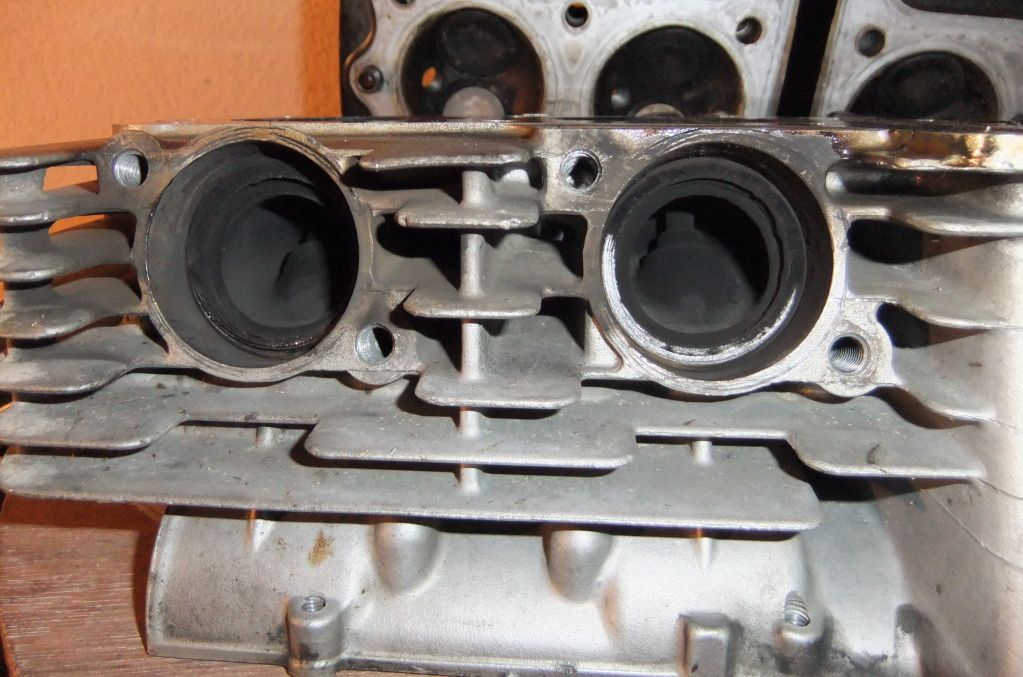
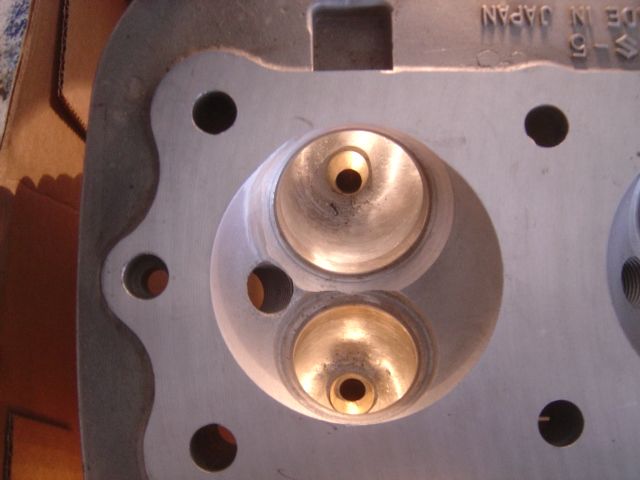
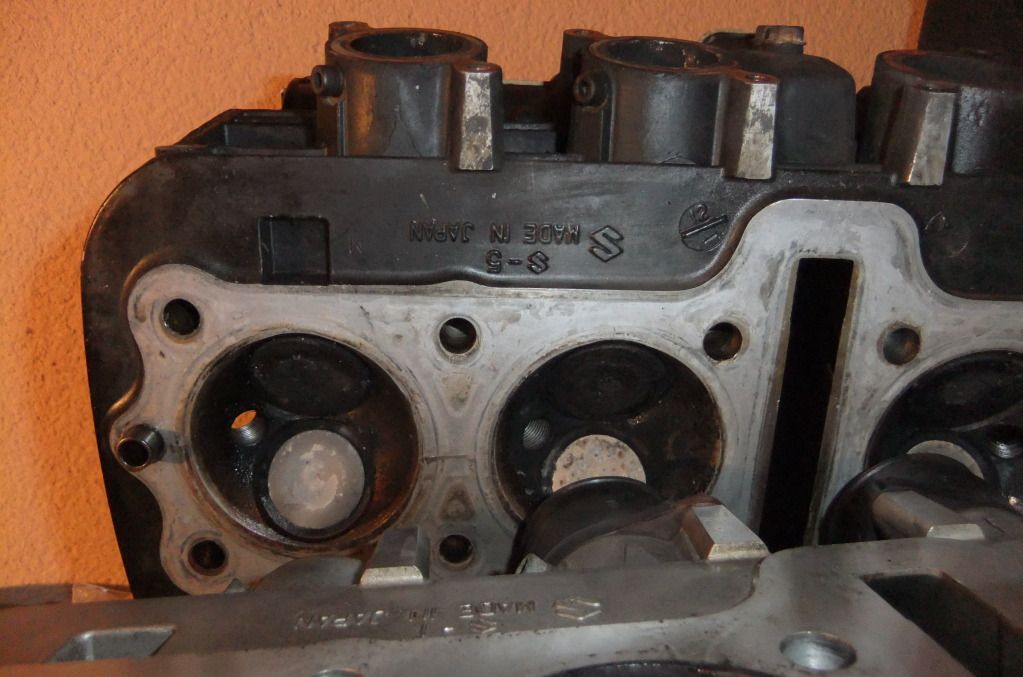
There is a marking under the cylinder head.
S1 is definitely for the VM 26 carbs and S5 is for the GS 1100 version with the D shaped exhaust port. (the black one on the pictures)
I don't know the number for the BS 34 carbs?

CulasseGS1000STvsGS1100006_zpscf6ee656.jpg


CulasseGS1000STvsGS1100005_zpsd41c4ce1.jpg


CulasseGS1000STvsGS1100012_zpsfdc62dcb.jpg


CulasseGS1000STvsGS1100010_zps70807533.jpg
 
Dont take the S marks as gospel.....i have 2 early GS1000 slide carb heads on the bench right now,(without the extra front tunnel bolt) one has S2 on the casting, the other S5.
 
I made some calculus about sizing valves...
valves diameters are good on these motorbikes, for a max power around 9500. If you want a little more, you can first port the valves seats, just to increase a little that diameters, without changing the valve....this is a way of increasing the diameter without changing everything, increasing the max power rpm at 9800 / 10000. You have to ask yourself if a max power range is efficient, regarding the $$$ investment..?
personnaly I was the same before and now I ever try to spend €€ getting more torque as power...
For example I have a gs 550, and i'm working on putting a gs 650 top end and head. I calculated valves diameters, this calculus gives me original valves diameters. So I'll just port valves seats and that's all.... I'll spend my money on smg else :)
 
Bigger port is not better.

Bigger port is not better.

the term of the day is PORT VELOCITY>

big port heads came on GS1100 shaft drives from 82~84 GS1100G and GK..

Now as stated before they came with larger ports with larger carbs -- BUT ALSO a longer stroke crankshaft 66mm compared to 64.8mm of a chain drive GS1000/997cc.

a builder's problem of using this combination is the port velocity flowing thru a larger volume port with LESS displacement and LESS stroke length at lower RPMs' - Your biggest most noticeable difference is going to be at off idle and in the mid range. This difference will produce LESS torque and less power!! This is going to be your problem on the street, worse if you carry a passenger.

you go and port a S-5 all you want - get some Kawasaki intake insulators and flat slide carbs , put 39 or 40mm intake valves and I'm telling you now you are going to go SLOWER make less power and be all disappointed.

the cure to make a big port worth doing and make improvement in power and torque is more displacement like 1240cc NOT 1085cc - get a longer stroke crankshaft - or install a 6 psi turbo and fan cooled oil cooler. I've done all this - and a well modified small port cylinder head will be your best bet for a street engine that lives it's whole life under 8K rpm....

Drag racing you can get away with it but I have done what Byron Hines did to a 2 valve GS and it aint cheap and you have to rev it from 5K to 12K all the time.

A magic number is 88~90CFM @ .460" thru a small port using a 40mm int valve feeding a 310cc cylinder - that will get you very close to a port velocity of 300 feet per second -- try to match that and you'll be a popular engine designer.

here is a example of a big port head S-5 made bigger but guess what I ran into after doing this ? the maximum reasonable limit for GS1000 engines. I quit sold it all and moved on to TSCC design.

http://
DSC05369_zpswrsookat.jpg
[/URL],http://

plenty of room in a small port to make over 140 HP in 1105cc and have a torque level above 70 ft/lbs
 
the term of the day is PORT VELOCITY>


a builder's problem of using this combination is the port velocity flowing thru a larger volume port with LESS displacement and LESS stroke length at lower RPMs' - Your biggest most noticeable difference is going to be at off idle and in the mid range. This difference will produce LESS torque and less power!! This is going to be your problem on the street, worse if you carry a passenger.

OR, you can mill the head .040", run SHORTER duration cams (240-250 @.050 duration!), stock valves, 34 RS Mikunis, & STILL have an 1105 motor that creates good port velocity & drivability at reasonable (as in NOT a race engine) rpm. I've done it & they work well. They pull good two up from 2500-10,000 rpm. I'm still a fan of 16 valve motors though, like Trip, & won't own any 8 valve stuff myself. I'll build them for you though!! ;)
Ray.
 
Last edited:
I'm by no mean an expert on these subjects but having smaller diameter exhaust pipes must help increase the port velocity or am I wrong?
When I installed a Kerker K2 exhaust system on my GS 1000 ST I got the feeling that the engine was far more torquey and responsive?
I'm currently installing a GSXR 750 1991 exhaust header on a GS 1000 and again the diameter of the pipes are much smaller than on the OEM machine.
Must be a good reason for that?
 
can you tell I am not working at the bike shop today?

can you tell I am not working at the bike shop today?

first I love your project gs in gsxr frame..john kat a tuned exhaust is more about sound waves than volume.

now about the skinny pipe john kat has . The exhaust port only needs to flow 60% of what the intake flow is - after that you get no substantial power improvement in larger exhaust diameter. (exception to exhaust percentage being turbo and nitrous engines) basically it is the sound waves at the right time we need to help scavenging - more than a fat 'ol pipe - one mention of reversion - that is when the sound waves reverse and push backwards -don't worry your skinny pipe will work great using a silencer and street riding . top speed at redline maybe leaving a little on the table. but you are getting more good than bad....

Ray's approach is an effective solution... I agree and it may be less expensive than mine, facts be told, the bike we are talking about is slower than a SV 650 coming out of a tight curve no matter what you do. ( except out ride the other guy)

milling .040" and short duration will make more combustion efficiency getting you away from the stop sign-without revving the heck out of it and slipping the clutch but in reality you are just shadowing the slow intake charge velocity at low rpm until pistons get moving faster -then all this rigger-more-all solves itself -yeah until power the shuts off -remember short cam timing? - but this is street bike and you will get a ticket if you try to see what I am talking about . we need dyno sheets to really see what is going on .


my approach will work with any displacement-of N/A GS1000 chain drive - using a small port head, carb size diameter relative to intake valve diameter, light crafty porting , big valves, long duration medium to hi lift cams and 4-1 exhaust relative to exhaust cam timing are just the way I prefer to make things happen from idle to redline.

matching and balancing everything makes a flatter smoother torque line and more horse power is a by product -- torque does the work, horsepower is how fast the level of work can be done.
 
my approach will work with any displacement-of N/A GS1000 chain drive - using a small port head, carb size diameter relative to intake valve diameter, light crafty porting , big valves, long duration medium to hi lift cams and 4-1 exhaust relative to exhaust cam timing are just the way I prefer to make things happen from idle to redline.

matching and balancing everything makes a flatter smoother torque line and more horse power is a by product -- torque does the work, horsepower is how fast the level of work can be done.

I tend to agree with your approach for my application - Roadracing on short circuits. Torque is of primary importance where you don't have the room to wind up to a high top speed. We've used a small port head with OE valves with good results. Then we went to the big port head with big valves...and lost a heap of HP in the midrange to the point where the rider couldn't steer it on the throttle as he had been doing previously.And yes, it was quicker up top - but on our circuits that doesn't mean a lot. Daytona, Philip Island, the IOM, yes maybe for those who go there.
Now we're about to go to one of our biggest local meetings with a small port head fitted with the big valves. I'm optimistic...
Let you know how it works in a couple of weeks.
 
first I love your project gs in gsxr frame..john kat a tuned exhaust is more about sound waves than volume.

matching and balancing everything makes a flatter smoother torque line and more horse power is a by product -- torque does the work, horsepower is how fast the level of work can be done.
Thanks!
That's why I love my 1290 KTM Superduke: no need to rev the engine, it just pulls you out of the bends like there was no end.
On top the gigantic torque has only 210 kg fully gassed to move...
 
This is why I keep telling people that just about NOTHING is as fun as a 16 valve, 1400cc GS street motor! YEEEEHAAAAAAAAA!!!! Lol!!
Ray.

yep ray, new term - " low lift flow " because TSCC is just a sales slogan lol

I'll always like 2 valve GSs' - my next one will be a hard tail chopper - or a methanol burning hill climber. !! big port hemi power!!

greg T - like to hear how it goes,, small port, big valve combination

jon kat - I read the whole thing a few times after I came across a pair of 89 GSXR1100 chassis, thought about a GS / gsxr DOT head hybrid amalgamation - but recently saw the 80's katana with a 1127 -ooo weeee !! those chassis are cheap around here!

I hope we didn't scare the OP out of using one of these, the big port GS head works GREAT on top - Just don't do a lot of cutting - except milling - it's perfect to grow into and you cant hurt it.
 
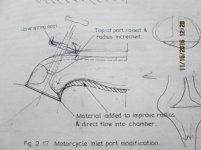
Having ported quite a few of these 2V heads, The large port head should be used for big motors (1200+) and the small port should be used on smaller motors. Although size does matter, as we all know, the shape of the port is most critical. The factory port shape is awful. The short side turn is way too sharp and abrupt. The short side is also too short. Rounding and raising the short side turn in effect lengthens it. The long side can be raised also but is limited by the proximity of the lifter cavity. On drag motors (which is all I ever built) I went all the way into the lifter cavity, but just barely. A machined aluminum washer (now a spring shim) was then JB welded into the lifter bore to seal up any oil getting sucked in. Attached is a pic from my racing days (80's) showing what the end result would look like. I used Manley A&B two part epoxy to raise and contour the short side radius.....Billy
IMG_0520.jpg
To the OP, 38mm/32mm valves are already very generous size, the Kaws had 36/30 valves . And props to A. Graham Bell (Performance Tuning book) for the original illustration that I scribbled all over
 
Last edited:
Back
Top