• Required reading for all forum users!!!

    Welcome!
    Register to access the full functionality of the GSResources forum. Until you register and activate your account you will not have full forum access, nor will you be able to post or reply to messages.

    A note to new registrants...
    All new forum registrations must be activated via email before you have full access to the forum.

    A Special Note about Email accounts!
    DO NOT SIGN UP USING hotmail, outlook, gmx, sbcglobal, att, bellsouth or email.com. They delete our forum signup emails.

    A note to old forum members...
    I receive numerous requests from people who can no longer log in because their accounts were deleted. As mentioned in the forum FAQ, user accounts are deleted if you haven't logged in for the past 6 months. If you can't log in, then create a new forum account. If you don't get an error message, then check your email account for an activation message. If you get a message stating that the email address is already in use, then your account still exists so follow the instructions in the forum FAQ for resetting your password.

    Have you forgotten your password or have a new email address? Then read the forum FAQ for details on how to reset it.

    Any email requests for "can't log in anymore" problems or "lost my password" problems will be deleted. Read the forum FAQ and follow the instructions there - that's what we have one for...

  • Returning Visitors

    If you are a returning visitor who never received your confirmation email, then odds are your email provider is blockinig emails from our server. The only thing that can be done to get around this is you will have to try creating another forum account using an email address from another domain.

    If you are a returning visitor to the forum and can't log in using your old forum name and password but used to be able to then chances are your account is deleted. Purges of the databases are done regularly. You will have to create a new forum account and you should be all set.

Carb issues

  • Thread starter Thread starter radeja12
  • Start date Start date
R

radeja12

Guest
So i just bought a 1980 GS550E and just finished rebuilding all the carbs but when i tested it without the fuel tank it ran but wouldn't rev so i was wondering it need the fuel tank and the vacuum petcock connected for it to run properly. Thanks
 
Not needed to run the bike with tank on. You can use a slave tank ( gravity tank ) as long as you remember to also plug the vacuum line that would normally connect to the back of the petcock. If left open its a huge vacuum leak.

Secondly, you should have CV carbs and thusly they need a little restriction from the stock airbox or something like a shop rag over the opening of the carbs. Lastly, in the stock air box, youll see the boots are actually velocity stacks that stick inside the airbox. try throwing a rag over the carbs and it should improve things. some temp stacks can be made from paper towel tubes or toilet paper tubes temporarily clamped to the carbs as well. lots of ways to skin the cat ...as it were.
 
The diaphrams work on a little air velocity thats sent into the kidney bean shaped duct at the very top of the carb throats. The airs velocity makes pressure that raises or lowers the slides..the faster the air moves the higher the slides go up..and the higher the RPMs go. That make sense to you???
 
Thanks for the help, i appreciate it, ill try it out tomorrow.
 
The diaphrams work on a little air velocity thats sent into the kidney bean shaped duct at the very top of the carb throats. The airs velocity makes pressure that raises or lowers the slides..the faster the air moves the higher the slides go up..and the higher the RPMs go. That make sense to you???
The diaphragms keep the vacuum piston slide down (thanks to spring) . Then,as throttle plate opens, vacuum is applied to top of diaphragm (thru drilled hole in piston) and slide climbs. The kidney shaped hole allows airbox air to flow under vacuum diaphragm to let it move easier up and down .
 

Attachments

  • image.jpg
    image.jpg
    44.6 KB · Views: 0
The diaphrams work on a little air velocity thats sent into the kidney bean shaped duct at the very top of the carb throats.

The kidney shaped hole allows airbox air to flow under vacuum diaphragm to let it move easier up and down .

Silly me. I have always thought that the kidney-shaped opening was just the air inlet for the enrichment system. :oops:

Yeah, it does happen to go under the diaphragm, but it only feeds the port for the enrichement system when the plunger is pulled out.

.
 
Silly me. I have always thought that the kidney-shaped opening was just the air inlet for the enrichment system. :oops:

Yeah, it does happen to go under the diaphragm, but it only feeds the port for the enrichement system when the plunger is pulled out.

.
It would be hard for diaphragm to lift if pressure was not released on other side- sorta like sucking on straw with something blocking other end. If it just fed the enrichment circuit, it could be a simple hole rather than shaped to "encircle" the underside of diaphragm.
 
The diaphrams work on a little air velocity thats sent into the kidney bean shaped duct at the very top of the carb throats.

The kidney shaped hole allows airbox air to flow under vacuum diaphragm to let it move easier up and down .
Chuck's statement gives the impression that air flowing into that hole is what lifts the diaphragm. Your statement only says that it makes movement easier. Yes, it does provide an atmospheric reference that allows the vacuum to work, so that port does do double duty, but it's still not quite accurate to say that the slides are lifted by airflow directed at the ports.

.
 
Its probably a combination of BOTH Steve. I know it doesnt take much air pressure into the front to make the slides go up.
 
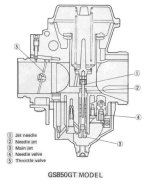
This illistration shows the air flow. looks to me like what comes out of the top is swept down past the tip of the pilot jet where it is mixed with fuel. Then the fuel / air mix is routed thru the pilot screw..and then into the venturi.

Yes opening the butterfly increases the rush of air into the throats of the carbs, but according to what I have read and as shown in this CV carb illustration, the intake speed of the air is actually what actuates the diaphrams. The spring applies resistance which regulates how fast and how high the slides go up in relationship to the force of the intake air. Least that has always been my understanding from reading and looking at diagrams like this one.

Mikuni_BS28b.jpg
 
I've been studying this subject recently as well since it's related to my issue with returning a DJ stage 3 carb back to stock. In the stage 3 configuration the hole at the base of the slide is drilled larger then stock. I wondered what effect this would have on slide performance and that's where this thread and mine connected.

What's shown but not clearly identified in the above drawing is the location of that drilled opening into the slide. What I've been able to conclude is that the means for the slide to move up is due to lower pressure below the slide in the venturi area. The low pressure area is transmitted to the area above the diaphragm through that port. With low pressure above the diaphragm, and higher atmospheric pressure surrounding it, The diaphragm is pulled upwards toward the low pressure area and thus moves the slide up. The spring provides a calibrated resistance and returns the slide back into position as the low pressure rises. The size of the opening determines how quickly the change in pressure is transmitted to the diaphragm.

Edit: One other side note is that the pilot air jet is a little out of place in this diagram. The pilot air jet is not located between the diaphragm high pressure side and the pilot circuit as shown in that illustration even though it's not directly identified. As most here know, the pilot air jet is located at the inlet side of the carb face directly across from the main air jet. I think they drew it that way because it was easier and less confusing to implement it. The area above the diaphragm does feed the starter circuit though.
 
Last edited:
The hole at the top is like a port to equalize pressure. Just as you blow into a straw, the air thats already inside the straw has to go somewhere....right??? Well, as the sir rushes into the intake port in the throat it too has to displace something...right? Where is the air at the top gonna go if there isnt a relief port...nowhere. What does this do to the slide....locks it in place because its more or less vapor locked.

Now, with the hole at the top air can be expelled or taken in relative to the position of the slide and the diaprams. And as the illustration shows, there is some intake air routed down to the pilot jet to be mixed with fuel. The hole at the top acts in the same manner as the bowl vents do. If there is no equalization of atmospheric pressure to the bowls they too lock up and fuel wont get sipped out. Sort of like if you sucked all the air out of a pop bottle and put your tounge over the hole. The bottle collapses and becomes a vacuum chamber

And you can only suck so much air out of the bottle till you are unable to get any more out no matter how hard you try. This is why there has to be some form of pressure equalization for the bowls to be able to keep feeding fuel and for the slides to move freely.
 
Last edited:
I think the diagram is your basic generic representation of a BS series carb. I have googled many many Mikuni searches and read a lot of their factory articles and explantions of carb operation theory. The basic principles of air equalization apply both to the VM and CV carbs.
 
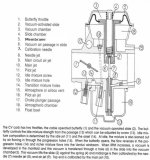
Yes, both vm and cv carbs work thanks to venturi principle . But the cv carb relies on vacuum to move the slide up . Here's another diagram with decent explanation. This is why upgrading to pods is so much fun!
 

Attachments

  • image.jpg
    image.jpg
    71 KB · Views: 0
So basically what i have read and the way I have understood it is reverse? the kidney bean shaped area is actually supplying the equalization air for the bottom of the diaprams so the vacuum can suck them up..right???
 
Now you have it right. The hole (number 6 in the diagram above) is exactly the one that I was referring to. That's the hole that supplies vacuum to the top side of the diaphragm through the slide. It's the passage that is enlarged when using the DJ stage 3 kit. The large opening at the front of the carb supplies atmospheric reference to the area below the diaphragm. There's also a smaller passage that leads from the area below the diaphragm to the throat (engine side) of the venturi path and another that feeds the air to the starter circuit. Not exactly sure what the purpose of the passage that leads back to the venturi does. Maybe used to meter the response of the slide.
 
Just for completeness, I took another look at that drilled passage that comes from the area under the diaphragm and into the area between the engine and the throttle plate. Seems like it's the passage used for the starter circuit. Air enters the passage through the oval shaped opening at the front of the carb. It then moves to the drilled passage under the diaphragm. When the start circuit path is opened the air moves down through that passage and then is mixed with fuel as the plunger is pulled out. The air/fuel mixture then exits into the venturi passage AFTER the throttle plate. Now it makes sense why opening the throttle, when you have the choke on, screws up the mixture.
 
Back
Top