• Required reading for all forum users!!!

    Welcome!
    Register to access the full functionality of the GSResources forum. Until you register and activate your account you will not have full forum access, nor will you be able to post or reply to messages.

    A note to new registrants...
    All new forum registrations must be activated via email before you have full access to the forum.

    A Special Note about Email accounts!
    DO NOT SIGN UP USING hotmail, outlook, gmx, sbcglobal, att, bellsouth or email.com. They delete our forum signup emails.

    A note to old forum members...
    I receive numerous requests from people who can no longer log in because their accounts were deleted. As mentioned in the forum FAQ, user accounts are deleted if you haven't logged in for the past 6 months. If you can't log in, then create a new forum account. If you don't get an error message, then check your email account for an activation message. If you get a message stating that the email address is already in use, then your account still exists so follow the instructions in the forum FAQ for resetting your password.

    Have you forgotten your password or have a new email address? Then read the forum FAQ for details on how to reset it.

    Any email requests for "can't log in anymore" problems or "lost my password" problems will be deleted. Read the forum FAQ and follow the instructions there - that's what we have one for...

  • Returning Visitors

    If you are a returning visitor who never received your confirmation email, then odds are your email provider is blockinig emails from our server. The only thing that can be done to get around this is you will have to try creating another forum account using an email address from another domain.

    If you are a returning visitor to the forum and can't log in using your old forum name and password but used to be able to then chances are your account is deleted. Purges of the databases are done regularly. You will have to create a new forum account and you should be all set.

Charging system hasn't failed, should I mess with it?

93Bandit

Forum Mentor
Asking this question will likely open a box of worms, but I'm going to ask anyways. As the title states, last time I checked, (6 months ago?) my factory charging system is functioning properly on my 83 850L. I haven't cleaned the connections yet or eliminated the headlamp loop which I will do. Other than that, should I replace the R/R with the newer one everyone recommends? I'm planning on a 1,000+ mile road trip this coming May and I really don't want to be stranded because of a charging issue. However, it's working fine and I'm on a fairly tight budget right now so I think the money would be better spent elsewhere on the bike. I have read multiple accounts of people on GSR who still have the factory system and haven't had any issues. If it matters, my bike has ~26,000 miles on it. I've always been one to leave something alone if it works, "if it ain't broke, don't fix it."

What do you guys think?
 
Nope.
For feeling secure during your trip, buy replacement R/R and stator & pack those with your tool kit. RTV gasket silicone will suffice until you get home and order a new gasket.
Lately I've been buying OEM salvaged R/R and stators on ebay, because I think they're built better & last longer that new aftermarket stuff.
 
I seem to remember (but my memory sometime fail) that it may not be recommenced to eliminate the headlamp loop unless you first install a series type RR like a SH-775. I could be wrong.
 
I seem to remember (but my memory sometime fail) that it may not be recommenced to eliminate the headlamp loop unless you first install a series type RR like a SH-775. I could be wrong.

Removing the loop would stress the stator more, but the amount depends on which OEM R/R you have. Could be 1/3 more. But removing the loop will reduce chance of melting connectors.
 
I seem to remember (but my memory sometime fail) that it may not be recommenced to eliminate the headlamp loop unless you first install a series type RR like a SH-775. I could be wrong.

I'm unsure as to why that would be necessary? The loop only consists of extra wire and a few connections. Yes, this wire and connections add a slight amount of resistance but if they're clean it should be minimal, therefore I don't see how removing the loop would have much negative effect on the factory R/R. All you're doing is removing potential failure points. Unless I'm wrong????
 
Removing the loop would stress the stator more, but the amount depends on which OEM R/R you have. Could be 1/3 more. But removing the loop will reduce chance of melting connectors.


If it will stress the stator more to remove the loop, should I only clean the connections?
 
Asking this question will likely open a box of worms, but I'm going to ask anyways. As the title states, last time I checked, (6 months ago?) my factory charging system is functioning properly on my 83 850L. I haven't cleaned the connections yet or eliminated the headlamp loop which I will do. Other than that, should I replace the R/R with the newer one everyone recommends? I'm planning on a 1,000+ mile road trip this coming May and I really don't want to be stranded because of a charging issue. However, it's working fine and I'm on a fairly tight budget right now so I think the money would be better spent elsewhere on the bike. I have read multiple accounts of people on GSR who still have the factory system and haven't had any issues. If it matters, my bike has ~26,000 miles on it. I've always been one to leave something alone if it works, "if it ain't broke, don't fix it."

What do you guys think?

The replace series R/R is to prrtect yoru stator.

I would do some non-invasive measurements first.

Do the Quick test
Do the A.) leg to leg and B.) leg to ground stator tests at 5K RPM

The do preventive inspection:

Remove the stator cover to inspect stator for evidence of overheating.


As a bare minimum I would get some Naval Jelly (to clean all contacts/connector) and Deoxit (to protect) between the battery and R/R including the headlamp loop and stator leads. Dielectric grease would also be a good idea if you don't want to be back in here in a couple of years.

As a matter of interest, you can do the Stator pages Phase A voltage drop tests as well both before and after the maintenance to see the results of the effort.
 
The replace series R/R is to prrtect yoru stator.

I would do some non-invasive measurements first.

Do the Quick test
Do the A.) leg to leg and B.) leg to ground stator tests at 5K RPM

The do preventive inspection:

Remove the stator cover to inspect stator for evidence of overheating.


As a bare minimum I would get some Naval Jelly (to clean all contacts/connector) and Deoxit (to protect) between the battery and R/R including the headlamp loop and stator leads. Dielectric grease would also be a good idea if you don't want to be back in here in a couple of years.

As a matter of interest, you can do the Stator pages Phase A voltage drop tests as well both before and after the maintenance to see the results of the effort.

When I last checked the system, I did the quick test and all voltages fell within the acceptable range. Wouldn't these results negate the need for further testing/inspection? I will be cleaning all the connections regardless and I will add dielectric grease for good measure. Also, I'll be sure to do the quick test again once the weather warms up to see if anything has changed.
 
When I last checked the system, I did the quick test and all voltages fell within the acceptable range. Wouldn't these results negate the need for further testing/inspection? I will be cleaning all the connections regardless and I will add dielectric grease for good measure. Also, I'll be sure to do the quick test again once the weather warms up to see if anything has changed.

The quick test is only for a quick triage to inform a next step in diagnosis. Those limits you suggest that all all "OK" are actually the range of voltages for doing diagnosis. Without it I see little information in you informing the board "all is good".

The primary reason for a series R/R upgrade is stator health. The quick test does provide clues if there is something amiss in the stator, but it is primarily to inform a next step. The next step is that what i have outlined.

You said you wanted to save money by avoiding replacement parts, do you also want to avoid doing work? I though you wanted to improve confidence for a pending 1000 mile trip?


Note, when I describe cleaning electrical contacts, I'm talking about chemical cleaning where mechanical (e.g. brushing/sand papering) cleaning only aids in getting rid of large crude not actual chemical stripping and treatment of contacts.
 
Last edited:
The quick test is only for a quick triage to inform a next step in diagnosis. Those limits you suggest that all all "OK" are actually the range of voltages for doing diagnosis. Without it I see little information in you informing the board "all is good".

The primary reason for a series R/R upgrade is stator health. The quick test does provide clues if there is something amiss in the stator, but it is primarily to inform a next step. The next step is that what i have outlined.

You said you wanted to save money by avoiding replacement parts, do you also want to avoid doing work? I though you wanted to improve confidence for a pending 1000 mile trip?


Note, when I describe cleaning electrical contacts, I'm talking about chemical cleaning where mechanical (e.g. brushing/sand papering) cleaning only aids in getting rid of large crude not actual chemical stripping and treatment of contacts.

Once the weather here warms up, I will perform the quick test and provide the results, in case there is any doubt that the system is functioning properly.

As to your question, there are several bike expenses I have to pay for to get ready for this trip: new tires, change all fluids, install a phone charger, brakes, purchase some riding gear etc. Yes, not having to do the "work" to update the R/R would save me a little time to put towards the other things that need to be done, but my main concern is the added expense of fixing something that isn't broken. All of the things I listed add up and will be stretching my budget. If it needs, to be done, fine. But if it doesn't, or can at least wait until I return from my trip and can save more cash, it would great if I can do it later.
 
Once the weather here warms up, I will perform the quick test and provide the results, in case there is any doubt that the system is functioning properly.

As to your question, there are several bike expenses I have to pay for to get ready for this trip: new tires, change all fluids, install a phone charger, brakes, purchase some riding gear etc. Yes, not having to do the "work" to update the R/R would save me a little time to put towards the other things that need to be done, but my main concern is the added expense of fixing something that isn't broken. All of the things I listed add up and will be stretching my budget. If it needs, to be done, fine. But if it doesn't, or can at least wait until I return from my trip and can save more cash, it would great if I can do it later.


" install a phone charger" I would say this shoudl be your highest priority, so if you break down you can call someone.


"if it aint broke don't fix it"

There; now you can feel confident in rationalizing doing nothing on the electrical system (arguably the worst part of GS bikes). What is the worst thing that can happen? You fixit it on the road. But then again you will have a fully charged cell phone. Maybe put on a range extender for increased cell coverage in desolate areas.
 
" install a phone charger" I would say this shoudl be your highest priority, so if you break down you can call someone.


"if it aint broke don't fix it"

There; now you can feel confident in rationalizing doing nothing on the electrical system (arguably the worst part of GS bikes). What is the worst thing that can happen? You fixit it on the road. But then again you will have a fully charged cell phone. Maybe put on a range extender for increased cell coverage in desolate areas.

Clearly I've struck a nerve. I had no intentions of doing so. Thank you for the input and advice.
 
If it will stress the stator more to remove the loop...........?
I think not, UNLESS the loop is connected to an on/off headlight switch that early 1979-80 models had. Later, when "Driving light" became a legality, the loop was retained in the harness , but shorted at the multiconnector. That said, taking it off the wiring and simply plugging stator into the regulators 3 sockets, saves a length of wire in the harness. I re-purpose these as convenenient paths forward from the rear.

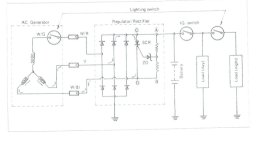
The old switch was part of a rather unusual but clever simple regulation circuit than most bikes used...only one leg (twards the headlight) was actually regulated, I think.

I surmise when the headlight switch was off , the two legs remaining in circuit were UNREGULATEDand could not alone overcharge the battery... this explains the colour coding of the wires too, -a bit unusual among alternators-which somewhat supports my idea, I think.

I wish I had an old one to test, and prove it but ..so many died for whatever reason.

so ,with their bad record, whatevr the theory, I'd pack a spare- make it plugnplay in a pinch...Test it-even install IT and keep your old as spare...I still like the ol Honda SH232, 238? shunt-types from so many of the era. They are cheap... but you need to find a place to splice the "voltage sense" wire in- just to any live + works fine.
 
Last edited:
Breaking down out in Bugtussle is part of the adventure and knowing you can overcome problems builds a lot of confidence no doubt but can be quite expensive. Here's my experience on charging system issues.

Everything I own straps to my bike and I wander around the country during the warmer months. Last year I rehabbed my bike knowing that any repairs or maintenance where going to happen where and when ever they needed to happen.

Took off with a working stock charging system. It tested and worked well until it didn't, the R/R went out near a small town in rural West Virginia about three months later. Luckily I was close to a Polaris ATV dealer and was able to order a SH775 to replace it which meant I paid full retail price, probably three times the cost of a good used one.

After consulting the board I decided that my stator would probably be "good enough" although it was suggested that I carry one "just in case" This would add weight and bulk so I decided against it. At the beginning of this last September it finally went and again I was left buying one where I could find one paying full retail! All they had access to was one costing $150 so I bit the bullet, had no other choice.

Moral of the story? If you KNOW something is liable to leave you broke down and having to pay the highest possible cost to fix it then don't pay attention to those that have more experience than you.
 
I've always been one to leave something alone if it works, "if it ain't broke, don't fix it."

What do you guys think?
I think you have the wrong attitude there. :-k
That should read: "If it ain't broke, fix it until it IS." :-\\\


I seem to remember (but my memory sometime fail) that it may not be recommenced to eliminate the headlamp loop unless you first install a series type RR like a SH-775. I could be wrong.

I'm unsure as to why that would be necessary? The loop only consists of extra wire and a few connections. Yes, this wire and connections add a slight amount of resistance but if they're clean it should be minimal, therefore I don't see how removing the loop would have much negative effect on the factory R/R. All you're doing is removing potential failure points. Unless I'm wrong????
You are not wrong. :clap: :clap:
You have to remember that wherever you see a connector, there are actually THREE interfaces, each of which is a potential corrosion point. The first interface is from the wire to the brass terminal inside the connector. The second interface is from one brass terminal to another one inside the joined connector. The third interface is from that second brass terminal to the next wire. From the stator, there is a connector that goes into the main harness. Another connector under the tank that leads to the loop-back. Back through that connector on another set of terminals, then finally through the connector to the R/R. Four connectors, for a total of 12 possible corrosion points. Bypassing that loop leaves you with one connector, only three corrosion points. No extra strain on the R/R, it can be done with a stock R/R safely.


I re-purpose these as convenenient paths forward from the rear.
I have done that, as well. It involves a bit of re-wiring in the terminal under the tank, but it's VERY convenient and a clean way to re-purpose that wire.


The old switch was part of a rather unusual but clever simple regulation circuit than most bikes used...only one leg (twards the headlight) was actually regulated, I think.

I surmise when the headlight switch was off , the two legs remaining in circuit were UNREGULATEDand could not alone overcharge the battery... this explains the colour coding of the wires too, -a bit unusual among alternators-which somewhat supports my idea, I think.
You are close, but not quite there. :-k
Yes, only one leg was regulated, but it was one of the two that was still connected when the headlight was turned off. The third stator leg went to the headlight switch, which had two sets of contacts. One set actually controlled the 12 volt current to the headlight, the other set was the AC current from the stator to the R/R. Since the output of that one phase of the stator was close to the draw of the headlight, they were turned on and off together to prevent overpowering the stock regulator when the headlight was turned off. The US adopted the "headlight on" law, most of the rest of the world still had a functioning switch, so the main harness was left intact, only the sub-harness to the left handgrip was changed. US models got the loop-back, the rest of the world had wires going to the headlight switch.

.
 
If the bike is in good shape otherwise.. the thing to most likely let you down is the electrics. Cleaning all the connectors & grounds & spending $50 on a series RR would be well worth it in my opinion. The trouble with the GS electrics is that they are fine... until they ain't.

You could clean it all up & take the chance, but it may be tough to get a replacement RR & stator on the road.
 
Yes, only one leg was regulated, but it was one of the two that was still connected when the headlight was turned off.
thanks for reading, Steve. I've yet to find anything here on the original R/R that came with many (not all though?-the GSX400s for sure!...).and have been "making it up"from this diagram from the 250-350 shop manual (same reg on a gsx400 and I'm guessing others up-to the running light law....

Closeup-SuzukiRR-ShopManual-250-300.jpg
Um, your comment is a little hard to get but I'm only into the first coffee....explain?
 
Here is a SH775 for $40.50 shipped. You can attach wires to it using standard spade terminals and then fill up the cavity with low acid RTV (safe for electrical parts.) At that price point there is no reason not to make the conversion.

https://www.ebay.com/itm/SEADOO-4-T...be6030c:g:aLQAAOSwfDtdYTOF&LH_ItemCondition=4

Is that a "real" one? I know there's many fakes out there and I'm not entirely sure how to tell a real one from a fake one.

For $40 I should probably do it. When I've looked in the past, I couldn't find any for less than $100.
 
Last edited:
Back
Top