• Required reading for all forum users!!!

    Welcome!
    Register to access the full functionality of the GSResources forum. Until you register and activate your account you will not have full forum access, nor will you be able to post or reply to messages.

    A note to new registrants...
    All new forum registrations must be activated via email before you have full access to the forum.

    A Special Note about Email accounts!
    DO NOT SIGN UP USING hotmail, outlook, gmx, sbcglobal, att, bellsouth or email.com. They delete our forum signup emails.

    A note to old forum members...
    I receive numerous requests from people who can no longer log in because their accounts were deleted. As mentioned in the forum FAQ, user accounts are deleted if you haven't logged in for the past 6 months. If you can't log in, then create a new forum account. If you don't get an error message, then check your email account for an activation message. If you get a message stating that the email address is already in use, then your account still exists so follow the instructions in the forum FAQ for resetting your password.

    Have you forgotten your password or have a new email address? Then read the forum FAQ for details on how to reset it.

    Any email requests for "can't log in anymore" problems or "lost my password" problems will be deleted. Read the forum FAQ and follow the instructions there - that's what we have one for...

  • Returning Visitors

    If you are a returning visitor who never received your confirmation email, then odds are your email provider is blockinig emails from our server. The only thing that can be done to get around this is you will have to try creating another forum account using an email address from another domain.

    If you are a returning visitor to the forum and can't log in using your old forum name and password but used to be able to then chances are your account is deleted. Purges of the databases are done regularly. You will have to create a new forum account and you should be all set.

Charging system help

  • Thread starter Thread starter Qumodo
  • Start date Start date
Q

Qumodo

Guest
Hello to everyone, thank you for having me as a new member. I'm coming to you all this evening in frustration and seeking help. I have a 1982 GS 850GL that is not charging. I came across this site and more specifically the stator papers. After reading those; I decide to replace the stator and R/R. I've got the new components installed and I'm only getting 3.5volts out of the new R/R. I'm getting 26volts from the stator at about 2K rpm...what is left to check and or replace??? Is there another GS charging phantom that I'm not aware of? What is the likelihood of the stator rotor failing?

Thank you all in advance for your time and expertise!

-Evan
 
Rewire the charging system; send the stator wires straight into the R/R, bypassing the factory wiring. Then send the + output from the R/R to the red bullet connector feed into the harness and fuse box, and take the negative from the R/R and route it to the battery.
 
First,


I'm getting 26volts from the stator at about 2K rpm...
Most of us don't have a clue whether that is good or not. The book calls for a test a 5k, where it should be 75+ VAC.

What R/R did you install? Was it new or used?

Regardless of its age, it should be wired as Nessism suggests. Before 1979, Suzuki had a headlight switch on the left side of the handlebar. Federal regulations called for the headlight to always be ON, so the switch was eliminated. Since other countries still allowed the switch, the main harness was not changed, only the sub-harness that went to the left handgrip. One of the wires from the stator was routed to the headlight switch, which had two sets of contacts. When the headlight was turned OFF, one of those contacts was opened up, so the output of the stator was reduced, preventing the R/R from working so hard. When the switch was removed, the sub-harness was changed to place a loop to route the stator wire back to the R/R. Since all that wire, with all those connectors are a great potential for a problem, we simply bypass the stock wiring and run all three stator wires directly to the R/R inputs.

When measuring the output, the R/R must not be connected. Run the engine at 5,000 RPM, measure the AC voltage across all three pairs of wires. Voltage should be 75+, but more importantly, should all be relatively equal.

.
 
The open circuit leg to leg stator voltages are typically proportional to RPM. So we can guess that if you have 26V at 2K RPM then you would have 65 VAC = (5K/2K)*26V. Of course this may not be that accurate if your RPM is off and whatever error is multiplied by 5/2. Run it up to 5K as suggested.

If you want more help, a picture of your setup and some Quick Test results would help.

https://www.thegsresources.com/_for...rging-System-QUICK-TEST&p=1272192#post1272192
 
Everyone, thank you for your replies! Pictures of my wiring will be posted tonight, however I currently have it wired as follows. The stator is plugged directly into the R/R, the positive wire from the R/R is connected to the positive post of the battery, the negative R/R lead is grounded to frame. When I tested the stator it was disconnected from the R/R. all three leads were giving me approx 26V at 2K rpm. I will reconduct this test tonight at 5K as suggested.

Thanks!
 
I too found this site after buying my GS and having electrical issues. You'll find many experienced members with helpful.

With your R/R grounded through the frame, it may not have a strong connection with the battery. I just want to mention the term single point ground (SPG). The idea is to physically attached all the grounds together so they're not dependent on being connected through the frame. This includes the R/R negative, battery negative, and B/W ground wire from the harness. I think I'm forgetting another important ground though.
 
..... I think I'm forgetting another important ground though.

to ground bolt at back top of engine. A long bolt that runs through the top engine case toward the right side near the back of the starter motor cover. At least I think most GS's have a ground bolt there.
 
Everyone, thank you for your replies! Pictures of my wiring will be posted tonight, however I currently have it wired as follows. The stator is plugged directly into the R/R, the positive wire from the R/R is connected to the positive post of the battery, the negative R/R lead is grounded to frame. When I tested the stator it was disconnected from the R/R. all three leads were giving me approx 26V at 2K rpm. I will reconduct this test tonight at 5K as suggested.

Thanks!

as a general rule nothing should be connected to the battery positive without a fuse. The starter solenoid is the only exception. Generally a direct connection of r/r (+) to battery (+) even with z fuse is a poor choice. Nessism told you the correct way.
 
Kevin Q,

Welcome to THeGSR.

.............. I'm getting 26volts from the stator at about 2K rpm...what is left to check and or replace??? ............................ What is the likelihood of the stator rotor failing?
...........

How about at 4 (or5) k rpm....?
Meter on AC Volts.....?
As Steve says, at 4k rpm (or 5K), the stator open circuit voltage (not connected to r/r) should be about 75 VAC across each of the three possibility of two leads.

Not much likelihood of rotor loosing its magnitism.
Good that you are thinking along those lines. Speaking of which; be sure you got a 18 pole stator (for 80 and after) and not a 12 pole stator (for prior to 80) so that your stator is compatible with the rotor.
 
Latest update. I just got home and have rerun the tests and made some changes as suggested here. I retested the stator output, all three phases are putting out 45V AC at 6K rpm (Brand new stator)albeit an eBay special. With the stator connected directly to the R/R I get 3.5V DC @ 6k RPM out of the R/R (again new but eBay) I'm beginning to think the R/R may be bad even though it is new; and as Redman asked, it is an 18 pole stator. As for adding a fuse inline from the R/R to the battery I intend to do so, this is how it was wired when I got it. What fuse do you all suggest? I would prefer an inline for its ease. Again thank you all for the help, I'm hoping to solve the issue soon...
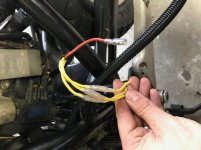
IMG_3581.jpg stator wire connected directly to R/R
 
Last edited:
Your stator output is definitely too low.

New stator or not, you need another stator. My personal preference is Caltric. Have had no failures with them, and they are inexpensive, to boot. They also have an inexpensive gasket. Not sure how well it works, but the price <might> be OK.

I would highly suggest a different R/R, as well. Many of us have upgraded to a series-type R/R that is commonly-found on Polaris off-road machines or Sea-Doo watercraft. It is made by Shindengen, the model is SH775. They are rather expensive if purchased new, but are a bit more affordable used. Fortunately, they are removed from damaged machines, and the R/R still works quite well. The problem encountered when shopping is that the seller says their (fake) unit is "for Polaris" or that it "replaces SH775", but it is a cheap, Chinese knock-off. They look pretty close, but there are details that can tell you it's a fake. Genuine units can be found for about $50.

.
 
Good evening everyone, I have news... I replaced the brand new R/R the was giving me only 3.5 V with the original R/R. I am now getting 10V DC from the original R/R. This leads me to believe that the R/R is fine and I do in fact need another new stator...any thoughts from the group?
 
I got an Ebay Caltric, about 35 bucks. Works fine. I cannot remember ever personally seeing an alternator feed wire back to the battery that was fused. Mine are not. Unless you are running a very small wire, I can't see a problem. Somebody I know who is an electrical engineer by trade backs me up on that.
 
Good evening everyone, I have news... I replaced the brand new R/R the was giving me only 3.5 V with the original R/R. I am now getting 10V DC from the original R/R. This leads me to believe that the R/R is fine and I do in fact need another new stator...any thoughts from the group?
Have you checked the AC voltage coming from the stator?

If this is still the same stator that was giving you 26 volts, yeah, you need a stator.

.
 
I got an Ebay Caltric, about 35 bucks. Works fine. I cannot remember ever personally seeing an alternator feed wire back to the battery that was fused. Mine are not. Unless you are running a very small wire, I can't see a problem. Somebody I know who is an electrical engineer by trade backs me up on that.

Every GS has a fuse coming directly off the battery even if it is contained in a multi fuse box. Even the R/R is fused (with the same fuse) as they can short. The only thing that is not used is the starter solenoid but then I mentioned this already.

If you want the possibility of your bike to burnup, then connect things to the battery without fusing.
 
Last edited:
Let me correct myself. I have never used a fuse in the feed wire from the R/R to the battery. I've also never had any problem with that. A lot of stuff I have done over the years was chopperesque & custom. The wiring from GM alternators has no fuse back to the battery, I've used a lot of those on car, truck, tractor conversions. Say what you will, I damn sure won't worry about something that's never happened. I'm 71, and I have never seen a fried motorcycle from anything but a fuel leak.
 
Let me correct myself. I have never used a fuse in the feed wire from the R/R to the battery. I've also never had any problem with that. A lot of stuff I have done over the years was chopperesque & custom. The wiring from GM alternators has no fuse back to the battery, I've used a lot of those on car, truck, tractor conversions. Say what you will, I damn sure won't worry about something that's never happened. I'm 71, and I have never seen a fried motorcycle from anything but a fuel leak.

Well anybody familiar with GS systems know that shorted R/Rs are a fairly common (certainly not uncommon) occurrence. That means that the R/R's internally short between the RED and Black wires.
If the main GS fuse was not there, then you would have a direct short between the battery, R/R through the R/R ground wire. The result would be a glowing orange wire from battery to ground through your harmness till your R/R ground wire fried. If you have improved grounding then you might have to burn through 14 or 16 awg wire which would take even longer.

Anybody familiar with electricity knows that fuses are intended to protect wiring by limiting the current through the wire to design levels. When any battery is shorted to ground it will deliver very high amounts of currents (100+ amps) and will turn any battery into a welder. This is why it is especially important to not draw current from a battery without having an inline fuse.

I will clarify that you do not need to fuse the power coming from the R/R (that is only about 15 amps), but you do need to protect against the R/R shorting and pulling massive power from the battery. That is what the main fuse is for.

Apparently Wymple has magic powers or little guardian angels looking over him :wink:; for the rest of us we should always make sure there is an inline fuse somewhere in any lead coming from a battery in case that wire somehow gets shorted :eek:.
 
Last edited:
There is also a big difference in automotive alternators, but there is still a BIG fuse in the fusebox. At least there is in mine. I have a 150 amp "fusible link" as the first item in the box from which everything else branches off.

An alternator regulates its output by varying the strength of the magnetic field. A stock GS R/R momentarily shorts the output of the stator to ground to reduce any excess. If it stays stuck in "short" mode, you have uncontrolled current straight from the battery to ground. In the stock wiring, that is protected by the MAIN fuse.

.
 
"That is what the main fuse is for." I am not unfused in the end, then, am I? Is my 12 gauge wire going to get that hot and the main fuse doesn't blow with all that?
 
Back
Top