• Required reading for all forum users!!!

    Welcome!
    Register to access the full functionality of the GSResources forum. Until you register and activate your account you will not have full forum access, nor will you be able to post or reply to messages.

    A note to new registrants...
    All new forum registrations must be activated via email before you have full access to the forum.

    A Special Note about Email accounts!
    DO NOT SIGN UP USING hotmail, outlook, gmx, sbcglobal, att, bellsouth or email.com. They delete our forum signup emails.

    A note to old forum members...
    I receive numerous requests from people who can no longer log in because their accounts were deleted. As mentioned in the forum FAQ, user accounts are deleted if you haven't logged in for the past 6 months. If you can't log in, then create a new forum account. If you don't get an error message, then check your email account for an activation message. If you get a message stating that the email address is already in use, then your account still exists so follow the instructions in the forum FAQ for resetting your password.

    Have you forgotten your password or have a new email address? Then read the forum FAQ for details on how to reset it.

    Any email requests for "can't log in anymore" problems or "lost my password" problems will be deleted. Read the forum FAQ and follow the instructions there - that's what we have one for...

  • Returning Visitors

    If you are a returning visitor who never received your confirmation email, then odds are your email provider is blockinig emails from our server. The only thing that can be done to get around this is you will have to try creating another forum account using an email address from another domain.

    If you are a returning visitor to the forum and can't log in using your old forum name and password but used to be able to then chances are your account is deleted. Purges of the databases are done regularly. You will have to create a new forum account and you should be all set.

Charred alternator wires

  • Thread starter Thread starter Anonymous
  • Start date Start date
A

Anonymous

Guest
This is for a 1980 GS850L

While taking my alternator cover off, and then unplugging the alternator wires, I noticed that there was some definite charring around the three plugs and the rubber insulation around the plugs. On one plug, the rubber insulation had burned a hole.

I take it these are signs that I may need to replace my stator? Or, maybe its the residue of a previous electrical problem that a previous owner already fixed. Yeah, right, sure. :wink:
 
Test the stator as per The Stator Papers, and if it's good, solder these connections.

It's very common to find some frightening charring on these connections, but it doesn't necessarily mean the stator is bad. It does mean you should check things out carefully, though.
 
yep, get rid of those plugs!
the connectors used on these bikes are borderline to begine with, throw in some corrosion on the connectors and they over heat and fry trying to pass the current the stator puts out, you then end up with a fried stator and, or regulator.

the stator and regulator are not the weak spot so commonly pointed to with these bikes, the connections are!

you solder the stator to reg./rect. wires or use high quality connectors (I use gold plated copper) and then run a ground wire dirrect from the regulator ground to battery ground, and from the regulator output to the battery positive post and you will have a very reliable charging system.
 
Sounds like the connections are bad in the plug. This causes them to get hot, and the rest you can figure out. This may have caused damage to the stator. If you need to test the stator coils, try this: The most common method is with a multimeter. The first test is for continuity, do you have three circuits?

Use the meter to check the resistance of the coils in the stator. Your manual may have the acceptable resistance listed. Don't be surprised if your readings are slightly lower than what is stated. Modern digital multimeters offer greater accuracy than the older type analogue units. What you want to see here is even readings. For the three coils (three phases) you might expect 10% variation. This will tell you if you have three circuits.

Step two is to check between the phases and the metal body of the stator. Your looking to have a very high resistance here.

Step three is to dertermine if you have shorted turns in your coils. If you have a motor winding shop nearby, one that does small motors like pool pumps or saw bench motors. Take it to them and get them to check it with an internal growler. There are other tools that can do this, like a surge tester. But your alternator will be too small for it.

Most guys get along without this step. You can measure the AC voltage coming from the stator when the engine is running. See if they are even. Put some load on the system, such as turn the low beam on. Visually if something is really wrong you might be able to see scorch marks around the coils. Where they go through the stator core (short to earth), and in between the seperate phases (phase to phase short). If you see that some of the coils are darker than the others (shorted turns in a phase) then that is also a problem. In all of these cases your options are either bin it and get another, or get it rewound.

Aromatically, if you pull it apart and all the coils are crumbly and black and stink to high heaven... g'luck :D
 
focus frenzy said:
you solder the stator to reg./rect. wires or use high quality connectors (I use gold plated copper) and then run a ground wire dirrect from the regulator ground to battery ground, and from the regulator output to the battery positive post and you will have a very reliable charging system.

Hey Leon, do you by chance have a diagram for wiring up the R/R to the battery? My Clymer's is a bit unclear as to where each wire goes. I'd really like to get things fixed before it's needed.

Thanks
Brad tt
 
Honda Rider said:
Use the meter to check the resistance of the coils in the stator. Your manual may have the acceptable resistance listed.
.5-2ohms check between all three wires (1 to 2, 2 to 3, 3 to 1)
Step two is to check between the phases and the metal body of the stator. Your looking to have a very high resistance here.
on most decent meters you want to see "OL" on the display, or no continuity at all

Most guys get along without this step. You can measure the AC voltage coming from the stator when the engine is running. See if they are even. Put some load on the system, such as turn the low beam on. Visually if something is really wrong you might be able to see scorch marks around the coils. Where they go through the stator core (short to earth), and in between the seperate phases (phase to phase short). If you see that some of the coils are darker than the others (shorted turns in a phase) then that is also a problem. In all of these cases your options are either bin it and get another, or get it rewound.
:D
you want to see over 60 volts AC for all three wires from the stator at 5 thousand RPM, make sure meter is set for AC and you check from one wire to the next, red test lead on 1, ground test lead on 2, the red on 2 and black on 3, then red on three and black on 1.
 
Aww gee Leon, you coulda saved me all that typing if you'da wrote that earlier :P :D
 
bradleymaynar said:
focus frenzy said:
you solder the stator to reg./rect. wires or use high quality connectors (I use gold plated copper) and then run a ground wire dirrect from the regulator ground to battery ground, and from the regulator output to the battery positive post and you will have a very reliable charging system.

Hey Leon, do you by chance have a diagram for wiring up the R/R to the battery? My Clymer's is a bit unclear as to where each wire goes. I'd really like to get things fixed before it's needed.

Thanks
Brad tt

Brad I had written it all out and then my dumb wireless broad band decided to hickup and it didn't get posted!!! :evil:
I will draw the modifications out on a standard digram so you can see it.
I hope to have it done before I go to work tomorrow at 2pm.

Sorry HR, you got to him before I did. :wink:
 
Roger all that folks. I'm glad to hear that the connectors are possibly/likely to be the problem.

Thanks for all the clarification and diagnostic information. Back to work on the bike!
 
Is there some place particular I should look for gold plated copper connection, or will they be available at a regular parts/hardware store?

Thanks.
 
A T said:
Is there some place particular I should look for gold plated copper connection, or will they be available at a regular parts/hardware store?

Thanks.
I got mine at O-riely auto parts, I think I have also seen them at Autozone.
 
bradleymaynar said:
focus frenzy said:
you solder the stator to reg./rect. wires or use high quality connectors (I use gold plated copper) and then run a ground wire dirrect from the regulator ground to battery ground, and from the regulator output to the battery positive post and you will have a very reliable charging system.

Hey Leon, do you by chance have a diagram for wiring up the R/R to the battery? My Clymer's is a bit unclear as to where each wire goes. I'd really like to get things fixed before it's needed.

Thanks
Brad tt

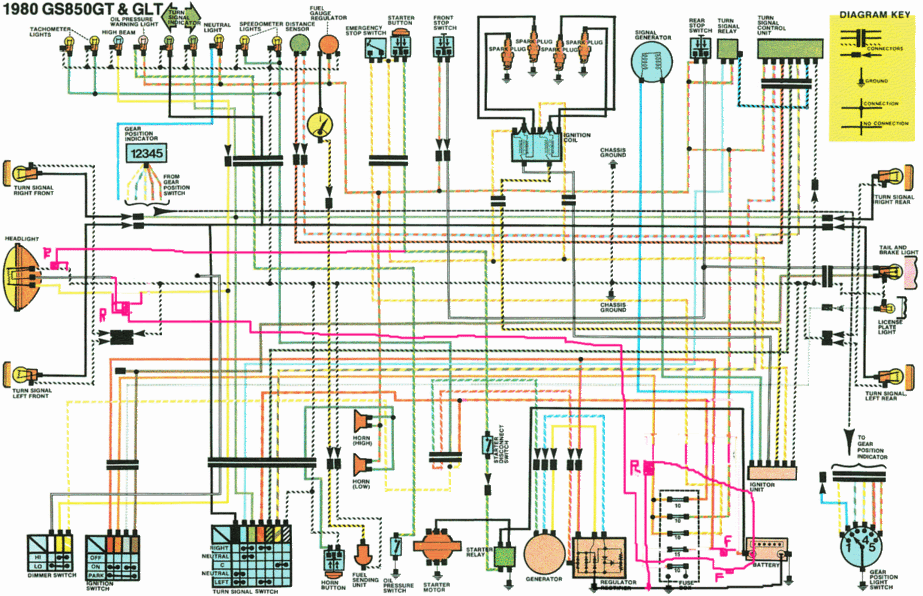
here is the modified wiring diagram, it is a 80 850 diagram but the 850 diagram is very close to the 1000G's
the changed wiring is in bright pink R= relay, F= fuse

1980_GS1000GTmod.gif
 
A T said:
Is there some place particular I should look for gold plated copper connection, or will they be available at a regular parts/hardware store?

Thanks.

The baggy pants "boom car" crowd loves the extra bling of gold plated connectors, so ask around at a car audio shop.
 
Back
Top