• Required reading for all forum users!!!

    Welcome!
    Register to access the full functionality of the GSResources forum. Until you register and activate your account you will not have full forum access, nor will you be able to post or reply to messages.

    A note to new registrants...
    All new forum registrations must be activated via email before you have full access to the forum.

    A Special Note about Email accounts!
    DO NOT SIGN UP USING hotmail, outlook, gmx, sbcglobal, att, bellsouth or email.com. They delete our forum signup emails.

    A note to old forum members...
    I receive numerous requests from people who can no longer log in because their accounts were deleted. As mentioned in the forum FAQ, user accounts are deleted if you haven't logged in for the past 6 months. If you can't log in, then create a new forum account. If you don't get an error message, then check your email account for an activation message. If you get a message stating that the email address is already in use, then your account still exists so follow the instructions in the forum FAQ for resetting your password.

    Have you forgotten your password or have a new email address? Then read the forum FAQ for details on how to reset it.

    Any email requests for "can't log in anymore" problems or "lost my password" problems will be deleted. Read the forum FAQ and follow the instructions there - that's what we have one for...

  • Returning Visitors

    If you are a returning visitor who never received your confirmation email, then odds are your email provider is blockinig emails from our server. The only thing that can be done to get around this is you will have to try creating another forum account using an email address from another domain.

    If you are a returning visitor to the forum and can't log in using your old forum name and password but used to be able to then chances are your account is deleted. Purges of the databases are done regularly. You will have to create a new forum account and you should be all set.

Coil relay question

pdqford

Forum Mentor
Past Site Supporter
Okay guys. Just too COLD here to go out in the garage and finish the carb set up on my 1980 GS750ET.
Beautiful sunshine, but it was only 21* here this morning.

So ever since I cleaned ALL the connections in my fuse box/harness-T/connectors/grounds/etc a few years ago and picked up nearly 1.5 volts at the coils, it is slowly slipping backward. I?m beginning my plan for installing an ignition relay (when the weather improves).

I?ve been reading the various relay write ups that have been circulating through the forum the past few days. (Many thanks!). My question has to do with the power supply for the ignition unit. Seems all write about supplying the relayed power to the coils, but what about the power supplied to the ignition unit? It seems to be on the same circuit as the coils, so should it also get relayed power? Or is its current draw minimal and should continue to be supplied by the original or/wh wire?

What say you?
Many Thanks...."
Jim
 
I'm sure others with more experience will chime in but generally speaking the ignition unit sends a low power signal telling the coil to fire. The ignition box itself doesn't supply the power to make the coil create a spark, it merely tells the coil it's time to make a spark.
 
Agreed with LAB3. :encouragement:

Have you by chance checked the voltage at your headlight? How about the horns and turn signals? :-k

Why just upgrade one circuit when they ALL might need it?
dunno.gif


It might make more sense to use ONE relay to power the fusebox, instead of sending all the current through the ignition key.

.
 
I'm sure others with more experience will chime in but generally speaking the ignition unit sends a low power signal telling the coil to fire. The ignition box itself doesn't supply the power to make the coil create a spark, it merely tells the coil it's time to make a spark.
Maybe I’m outta my league here, but I was under the impression that the ignition box provided a ground for the coil circuit which allows current to flow through the coil circuit, energizing the coil. When the ignition box “ungrounds” the coil circuit, the collapsing field causes the coil to fire.
I get the thing about running wire from pin 87 of the relay to the + side of the coils. So what I’m asking is should I also run a wire from pin 87 of the relay to the ignition box (in place of the orange/white wire that currently supplies power to the ignition box)?
 
Agreed with LAB3. :encouragement:

Have you by chance checked the voltage at your headlight? How about the horns and turn signals? :-k

Why just upgrade one circuit when they ALL might need it?
dunno.gif


It might make more sense to use ONE relay to power the fusebox, instead of sending all the current through the ignition key.

.
I haven’t checked the voltage at the lights/horn/signals in a few years. I noticed that my coil voltage has been deteriorating as I wired in a small digital voltmeter to display voltage coil up by the instrument cluster.

I’m not sure I’m up to upgrading all those circuits. I was thinking “baby steps” and hoping to get a small success first.

I like the way you think, Steve, re: ONE relay. I’m gonna have to spend some time in the corner and see if I can wrap my head around the fuse box verses the ignition switch idea. Many Thanks.

But to my original question, is there any advantage to supply better voltage (via pin 87 of an ignition relay) to the ignition box, or does it have sufficient voltage in the stock wiring scheme of things?
 
... I was under the impression that the ignition box provided a ground for the coil circuit which allows current to flow through the coil circuit, energizing the coil. When the ignition box “ungrounds” the coil circuit, the collapsing field causes the coil to fire.
You are very correct with your impression. :encouragement:

It only switches the current, it does nothing to create a stonger spark. The term "ignitor" is a bit misleading, making one think that it provides, or generates the spark.

There is no need to enhance the power wire running to the ignitor.

Have you checked voltage at the other points that were mentioned?

.
 
There is no need to enhance the power wire running to the ignitor.
.
Okay, thanks Steve, that’s what I was wondering about.


Have you checked voltage at the other points that were mentioned?

.
No, I haven’t checked the voltages at the other points since I cleaned up the harness a few years ago.
It was 19* here this morning! Supposed to get into the forty’s this weekend. Maybe I will be able to do it then.

I spent some time last night studying the wiring diagram. I almost figured out what you were pointing out about ONE relay providing power to the fuse box. Also how so much power must pass through that ignition switch! And I see where taking voltage readings at the fuses will shed light on which circuits are dropping voltage under load.

As I recall, when I cleaned up the wiring a few years ago I picked up a good portion of my voltage that was being dropped across those glass fuses and their clips. Are those blade fuses more efficient?
 
No- blade fuses are not more "efficient". A good contact is a contact without any resistance and that is not new. Glass fuses served us very well in the olden times. BUT a good glass fuse is getting harder to find...they are pretty odd-looking now with tiny fusible soldered to tinned endcaps and they don't make em as well as they used to, I think-they are prone to rust on the ends etc...... especially, to find a good one in the non-service gasbar on the road.

The blade fuses are much easier to handle, cheaper to manufacture reliably with today's processes (I guess) and store as well, but a cheapo blade fuse is still worse than a quality (old) glass fuse.

I like to think on whatever weakness a relay is intended to fix. Generally these larger Suzukis that have fuse panels do use a lot of wire running backnforth along the length of the bike..to wit:
1)battery to main fuse,
2)then main fuse all the way up to key,
3)from key all the way back to fusebox !
4)then fusebox out to the three or four individually fused circuits...
BUT none of this matters if the connections are good and the wire gauges beyond-sufficient to carry the wattage.

Still, if the key was back at the fusebox that'd save a lot of wire...Other makers might be thinking of this with fuse panels at the dash, but it might just be for convenience too.

You might think "relay" back at the fusebox but bear in mind the relay is only as good as its contacts-it need be pretty chunky and reliable to replace the Suzuki key switch......and they need power to hold themselves closed , so ask yourself if the power required to hold their contacts closed is greater than the voltage drop you are expecting to cure...If your key switch has "had it" then a relay is a fix.
Relays become a maintenance item of themselves- they don't last forever-not many relays can be taken apart to fix.So,when you have a "problem" you must now add the relay as a possible fault too.
 
Last edited:
Have you checked voltage at the other points that were mentioned?
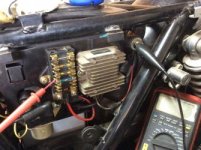
Okay. Got some voltage readings this afternoon
Just for reference, I had the black voltmeter lead connected to the chassis ground.
And touched the red voltmeter lead to the brass clips that hold the glass fuses.
I took these readings with the ignition and the lights on.

With the load applied the battery read 11.9V.
Going into the 15A main fuse was 11.6V.
Coming out of the main fuse was 11.4V.
(So the glass fuse and clips was dropping 0.2V)

After the electrons took the trip up to the ignition switch and associated connectors, we were reading 10.0V going into the lighting 10A fuse, and into the signals 10A fuse, and into the ignition 10A fuse.
(So that round trip is shedding 1.4V).

Coming out of the lighting fuse is 9.7V.
( That fuse is dropping 0.3V).

Coming out of the signals fuse is 9.9V.
Coming out of the ignition fuse is 9.9V.

And my small digital voltmeter at the instrument cluster was reading 9.8V at the coil connection.
(After cleaning ALL connections/fuse box(inside and outside) etc. a couple of years ago when I installed the voltmeter it was reading right around 11.2 volts at the coil connection.)

And, finally, after turning the ignition (and lights) off, the battery was reading 12.2V
 

Attachments

  • 5F8EB877-92B6-440A-BA8F-B6513AFC906D.jpg
    5F8EB877-92B6-440A-BA8F-B6513AFC906D.jpg
    20.5 KB · Views: 0
Thanks for the measurements. :encouragement:

First of all, your battery is weak. Even with the load, it should still be over 12 volts.

Next, you are dropping half a volt by the time you come out of the MAIN fuse. That is not very good.

After the trip to the ignition switch and back, you are dropping a full two volts by the time you get out of the IGNITION fuse, yet only another one tenth of a volt from there to the coil.

The only measurement that was missing was the battery voltage at the end, with the load still applied. That will show how much the battery dropped during the test.

As you have seen from these measurements, the coils are not the only components that will benefit from full voltage. Once you get full spark to the plugs, you will be begging for more light, so you will want a headlight relay mod. Then, you will want to be sure that others can see and hear your signals (brakes, turn signals and horn), so you will do a signal light relay mod.

I think it's been mentioned a time or three before, consider a relay to power the entire fuse box. In fact, I can heartily recommend changing the fuse box, too. You will get fresh connections that are fed by a relay, and you will also have the options of having more circuits, depending on the fuse box selected. My favorite is from Eastern Beaver. It's $60, but worth every penny to me.

.
 
I think it's been mentioned a time or three before, consider a relay to power the entire fuse box. In fact, I can heartily recommend changing the fuse box, too. You will get fresh connections that are fed by a relay, and you will also have the options of having more circuits, depending on the fuse box selected. My favorite is from Eastern Beaver. It's $60, but worth every penny to me.
.
I’ve been pondering your posts, and I’m liking the idea more and more about a relay to power the fuse box. There’s not a whole lot of space under the side cover where the current “glass” fuse box lives. I suspect the “side loaded” ATO fuse boxes will require a fair amount of space with the push-on’s radiating out from either side of the box.

I have found a “bottom loaded” ATO fuse box with four circuits that should be pretty efficient space wise, but I have yet to verify if it is low enough to fit under the side cover. (The reason I am space conscious is that I acquired a SH 775 R/R and it’s connector that will be a real space hog under that same side cover.) Hopefully I can find a place under the seat for the relay that will power the fuse box. :-)

A couple of quick questions come to mind:

- Since the batt + feed to the relay pin 30 and out pin 87 will go right to the three fuses for lights/signals/ignition, do I need to put a fuse between the batt + and pin 30 of the relay?

- Looks like I’ll have to cut the stock harness wires where they are soldered into the stock fuse box. For those that have swapped out fuse boxes, do you typically have to butcher the stock harness or lengthen some wires to make the swap?
(I like to keep my bike as unmolested looking as possible, but . . . . . )
 
If you think your wire is using current, and dropping voltage, add another wire in parallel and see if it helps. It should. Also, the grounds. ...

generally speaking the ignition unit sends a low power signal telling the coil to fire. The ignition box itself doesn't supply the power to make the coil create a spark, it merely tells the coil it's time to make a spark.
actually, I think the only path to ground for the coil's primary, is THROUGH the ignition box.....
 
I documented an install just over seven years ago and posted it here.
Click HERE to see the thread.
.
Many thanks Steve. After studying your install I have enough confidence that I actually ordered a bunch of electrical parts. Parts and pieces add up fast!
 
Back
Top