• Required reading for all forum users!!!

    Welcome!
    Register to access the full functionality of the GSResources forum. Until you register and activate your account you will not have full forum access, nor will you be able to post or reply to messages.

    A note to new registrants...
    All new forum registrations must be activated via email before you have full access to the forum.

    A Special Note about Email accounts!
    DO NOT SIGN UP USING hotmail, outlook, gmx, sbcglobal, att, bellsouth or email.com. They delete our forum signup emails.

    A note to old forum members...
    I receive numerous requests from people who can no longer log in because their accounts were deleted. As mentioned in the forum FAQ, user accounts are deleted if you haven't logged in for the past 6 months. If you can't log in, then create a new forum account. If you don't get an error message, then check your email account for an activation message. If you get a message stating that the email address is already in use, then your account still exists so follow the instructions in the forum FAQ for resetting your password.

    Have you forgotten your password or have a new email address? Then read the forum FAQ for details on how to reset it.

    Any email requests for "can't log in anymore" problems or "lost my password" problems will be deleted. Read the forum FAQ and follow the instructions there - that's what we have one for...

  • Returning Visitors

    If you are a returning visitor who never received your confirmation email, then odds are your email provider is blockinig emails from our server. The only thing that can be done to get around this is you will have to try creating another forum account using an email address from another domain.

    If you are a returning visitor to the forum and can't log in using your old forum name and password but used to be able to then chances are your account is deleted. Purges of the databases are done regularly. You will have to create a new forum account and you should be all set.

Converting blinkers to be running lights also

  • Thread starter Thread starter mnferwerda
  • Start date Start date
M

mnferwerda

Guest
Now that it is getting dark, I wanted a way to figure out how to have running lights via the turn signals on my '83 GR650 stay on so that riding at night, drivers have a better perception on my space.

I'm assuming that standard fare for bikes that came this way have bulbs with 2 filaments, a "running" one, and one for the blinking action with the appropriate sockets and wiring. I really didn't want to retrofit the blinkers and the associated wiring so I was trying to find another solution. Then I thought "Why not have the blinkers on all the time and when I switch the turn signal, have them turn "off" and "on" vs "on" and "off". So then I needed to find a way to set the default setting of the blinkers to be on.

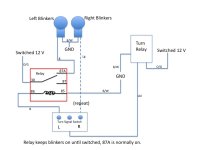
After looking at the wiring diagram I think I have a solution. I can insert 2 SPDT (single pole, double throw) relays in between the switch and each of the 2 turn signals . I'll use terminal 87A which is normally on (reverse of terminal 87). This way the blinker is always on until switched. The turn signal relay will then drive terminal 86 through the switch to get the "off/on" action.

Because the lights will always be on, I'm considering replacing the blinker bulbs with LEDs to minimize the current draw, but I'm not sure that is really necessary.

Anybody see a problem with this or any concerns?

I've attached a drawing of what the wiring would be.
Slide2.jpg
 
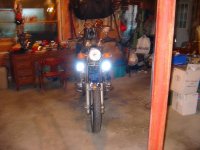
Make it essy on yourself- just get a pair of lights (sized to your bike) connect to horn's hot lead and have a simple solution. Here's my setup "on" whenever ignition is "on": despite looks of pic,mine are just daytime running lights, you might want more
 

Attachments

  • image.jpg
    image.jpg
    89.6 KB · Views: 0
Clever idea. I assume you are going to control all 4 blinkers with the two relays?
A couple of comments. iirc an I condescend bulb comes in either 25w or 35w so you are going to be over 100w if you leave them on all the time. LED is definitely the way to go; figure about 1/8 the current/power.
with LED you also have single or double filament types but they both have the same number of LED emitters so if you tie both filiments together an 1167 looks just like an 1166.
since the signal relay is only switching the blinker relay you will need a electronic non load dependent type.
there are mini relays that would work well to go this mod.

also remember in condescend bulbs are generally brighter than LED so you will have to weigh that in your visability consideration. I did an LED comparison video a while back; I'm sure it will pop up with a search.
http://www.thegsresources.com/_forum/showthread.php?232654-2015-LED-5050-Emitter-Bulb-Roundup
also check your local to see if this type of running light is legal.
 
Last edited:
I see a few potential problems:
1. Quite simply, extra circuitry and connections that might fail.

Are you adding just the front or all four signals?
2. If you are doing just the front, the front and rear signals will blink alternately.
3. If you are doing all four, you will have to convert the rear lenses to red, as constant yellow lights are not allowed on the rear.

Most 'regular' turn signal lights, like the ones that would be used on our bikes, are available in a 27 or 32 candlepower (real close to watts in this case) configuration.
4. Adding just the two front lights will be the same as adding a headlight (55 watts).
5. Adding all four lights would be like adding TWO headlights.

Considering the marginal charging abilities of our bikes, that is simply too much load.

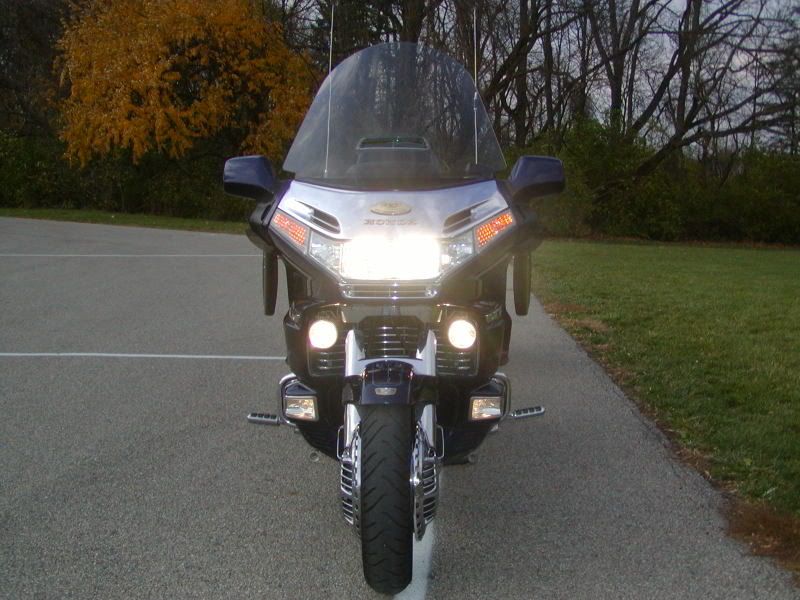
If you want to maintain a rather stock look by converting the front signals, new signals are available from Parts n More for $23 each that are dual-filament. If you don't mind some extra lights, a pair of LEDs can be fitted. Tom203 showed a picture of his setup. A triangle of lights will give oncoming traffic a better perception than converting the turn signals. If you have case savers around the engine, placing them lower gives a better triangle. Those lights might not do much to light up the road ahead of you, but they WILL help others to see you better.

Honda chose that approach on the Goldwing. The lower lights are the standard "position" lights, the ones just below the fairing are additional driving lights that enhance the high beams. A GS won't handle them, but my Wing has no problem with its 95-amp alternator.
eek.gif


PB134220.jpg


.
 
Steve unless the OP is looking to add low filament running lights which on my bike at least came stock, then any other combination would be adding 50w + (two lights)and that is getting to the point of maxing out whatever reserve the charging might have. The power issue would push the solution into the LED category for which the Dual filament provides little to no benefit.

If it is illegal to run constant amber in the rear then the OP should figure out what he wants to do there; is a replacement lens available for is lights or does he just stick to front running lights.

Personally, from my recent LED testing the front blinkers are hard to see with a bright headlight making a single filament running light of marginal visibility and in fact compromises the blinker because there is much less difference ON to OFF.

Except for the anti phase blinking between front and back, this appears to be a good solution for a running light in the front using LED. The LED is on brightest all the time and goes off when the blinker is active. I'm assuming of course that whether the front light are dual or single filament the LED is run at full power. That means for a 1167 style (dual filament) he would parallel up both wires.

Two small relays would not substantially reduce the reliability of the blinker system. This would also work with the TSCU mod and a LED electronic relay.
 
Last edited:
Thanks for all your posts!
My intent was to run each side (front and back) on a relay. So if going that route, I'll investigate LEDs more fully. I will check to see what Marlyand's laws are regarding amber lights in the rear. I've also recently pick up some case guards so that might be an alternate option to provide a place for running lights.
I've recently replaced the R&R (to a series) and stator so the charging system is up to snuff. The battery is getting old though, so I need to replace that soon. Specs call for a 14AH battery. Would it be worth it to step up to some thing higher? Theoretically that would take longer to recharge but if the R&R is not always charging the battery (which seems to be the issue with the original shunt R&R sending excess current back to the stator) then there would be sensibly some extra capacity to charge a higher capacity battery. Does that sound reasonable? I would have a bit more reserve capacity this way.


I'll repost when I come up with a final solution.
 
Steve unless the OP is looking to add low filament running lights which on my bike at least came stock, then any other combination would be adding 50w + (two lights)and that is getting to the point of maxing out whatever reserve the charging might have. The power issue would push the solution into the LED category for which the Dual filament provides little to no benefit.
In his first post, he did mention he was thinking of converting the stock turn signals and not purchasing and additional lights. Yeah, that would mean turning on 50+ watts of lights that are not usually on. If he also did the rear signals, that would be another 50+ watts.

If it is illegal to run constant amber in the rear then the OP should figure out what he wants to do there; is a replacement lens available for is lights or does he just stick to front running lights.
I have seen red lenses for Hondas and Yamahas, but have never noticed any for a Suzuki. However, if you use a red LED 'bulb', it will shine through a yellow lens and will actually appear red, not orange.

Personally, from my recent LED testing the front blinkers are hard to see with a bright headlight making a single filament running light of marginal visibility and in fact compromises the blinker because there is much less difference ON to OFF.
I saw that comparison video, it was GREAT. As nice as the LEDs are, there are times when incandescent is just better. Now, ... put the LEDs in a fixture that was designed for them, the tables are turned. It's simply a case of matching the bulb to the housing.

Lights are harder to see when they are grouped, which is why the triangle that was suggested earlier works so well. Even if they are spread out in a wider line (think "Harley" there), it helps, but it's still just a "line". Three points of line will define a "plane" (just like geometry), which the human eye can relate to a bit better. Next time you are sitting at a railroad crossing, take a look at the oncoming engine, it has lower "running lights", too, so you get a better sense of proximity.


I've recently replaced the R&R (to a series) and stator so the charging system is up to snuff.
The new stator and R/R will be good, but they still have a limit on charging ability. The benefit of the series-style R/R is that it avoids the constant "full-current all the time" situation that happens with the shunt-style units. It will keep your stator cooler and will help it last longer.

The battery is getting old though, so I need to replace that soon. Specs call for a 14AH battery. Would it be worth it to step up to some thing higher?
Unless you "upgrade" to some sort of exotic battery like a lithium, you are not going to get any higher capacity battery to fit in your existing battery box. The only time you will be able to take advantage of that extra capacity is when you are pushing on the starter button, so just keep the bike in tune, your stock battery will do just fine.

Theoretically that would take longer to recharge but if the R&R is not always charging the battery (which seems to be the issue with the original shunt R&R sending excess current back to the stator) then there would be sensibly some extra capacity to charge a higher capacity battery.
It would only take longer to recharge if you dragged it down farther than you do now. As long as the engine is spinning fast enough (above about 2500 RPM), the charging system is generating more than the bike needs and it will be charging the battery. The "excess" that gets shunted back through the stator happens when everything else is satisfied. Since the bike is running over 2500 RPM most of the time (except sitting at a stop light), the battery is getting charged most of the time. That "extra capacity" will only help if you spend a LOT of time sitting at lights.

.
 
I've finished reversing the action of my blinkers. They are now normally on and now when I turn on the blinkers. they now blink "off". I swapped all the incandescent bulbs to LEDs. Here is a short video.
 
I like it. It is also a very good option when running LEDs as the two filiment style LEDs do not have much visual difference between HI and LO. This mod can be done with a 1156 single filament or by wiring both filaments together a 1157 style blinker can be converted. I would not wire two 1157 Incandescents together how ever as it will pull a lot of current. In fact this mod should only be done with LEDs, otherwise you will pull way too much power.
 
I like it! Not too long ago I sought the very same thing for my bike...now I have a direction!
 
As Steve mentioned, it might not be a bad idea to check State, County and local vehicle codes for cycles, and see if that's ok to run like that. There may be States, Providences or other areas that won't, but if you can- being seen even a little better is a wonderful thing!
I look for any excuse to stop by our local PD's lobby and drool over their retired '37 Plymouth sedan sitting in there....it's not a '40, but it's still cool.
 
Hhmm... first day I had the Vetter fitted I was nearly pulled out in front of by a dizzy bint in a hurry. Reason was because I'd wired the Vetter indicators to come on as running lights (5 and 21W filaments in them), the running lights being the 5w ones. Said dozy bint saw my left side running light and thought I was turning down into the side street.
Beware of dopey brunettes.
 
I have checked the state regulations and saw nothing to prohibit running amber lights. Doesn't necessarily mean that it is OK, but I'm willing to take that risk.
 
Hhmm... first day I had the Vetter fitted I was nearly pulled out in front of by a dizzy bint in a hurry. Reason was because I'd wired the Vetter indicators to come on as running lights (5 and 21W filaments in them), the running lights being the 5w ones. Said dozy bint saw my left side running light and thought I was turning down into the side street.
Beware of dopey brunettes.

She was in a "hurry"...wouldn't have mattered if you had a guy waving a signal flag next to you...and I was always leary of blondes back in the day {quite a few actually}...red heads were the ones that distracted "me"...still are.
 
I have checked the state regulations and saw nothing to prohibit running amber lights. Doesn't necessarily mean that it is OK, but I'm willing to take that risk.

I'm lucky in that aspect I guess...step father is now a retired state police officer, have a few friends who work for different PDs and two friends who work for different county departments.....asking questions was always a given for me.
 
The state rules that I have looked into are pretty lax compared to the federal new-vehicle regs. But some state require that you meet the federal regs.


If you need to, or want to, meet the federal rules, K&S has some nice LED turn signals that are DOT & E-marked.
Available in chrome or black. Available in 2-wire or 3-wire (for turn & running lights).
http://www.kandstech.com/productreleases/newprod200.pdf


Another option is the Blinker Genie from CustomLED.
It works with existing 2-wire turn signals & turns them into the equivalent of 3-wire turn signal/running lights.
http://www.customled.com/products/blinker-genie


Both of these solutions don?t have the big current draw that would be a problem for a lot of our bikes.
They also address the federal reg on light intensity (brake light & turn signals are to be brighter than marker lights).


I would be concerned about running bright marker lights in the rear for a different reason. I suspect that it would make it less noticeable that you?ve got the brakes on & might increase the odds of you getting rear ended.
 
Myself, there's been a lot of times while driving the car, that I gain on something that has one tail light..."is that a car with a tail light out or a cycle?"...getting a car length away on some of the unlit roads reveals either one...that's why I'd like to let them know it's a cycle well in advance. Out in the sticks, it's the lil old ladys driving mach 3 that can barely see over the wheel - I want them to see it's a cycle well in advance.

Concerning brightness, the running lights should always be on the dimmer/lower side of a dual filament bulb...I doubt it would over power the brake lights large filament in proper configuration.
 
Concerning brightness, the running lights should always be on the dimmer/lower side of a dual filament bulb...I doubt it would over power the brake lights large filament in proper configuration.

1157 style LED's don't have difference between High and Low. Also here is a comparison of various LED's to an incandescent. If you are running LED's I would run them on HI only if ON.

http://www.thegsresources.com/_foru...50-Emitter-Bulb-Roundup&highlight=LED+roundup
 
I bought some aftermarket factory look alike front turn signal/running lights for my 750. Bolt on and plug in is all I had to do. The running light wiring was already included in the harness.
 
Thanks for the links. I wasn?t aware of videos comparing the stock turn signals to those same turn signals with various LED bulbs.


I have the K&S LED turn signals that I mentioned. They are for a GT550 cafe project and have not yet been installed.
Just did a quick comparison of it to a spare BikeMaster replacement turn signal for a Honda CB650, and the LED turn signal was brighter.
When I have some time & the weather is cooperating, I?ll compare the K&S turn signal to a stock one on one of my bikes.


I mentioned the use of bright marker lights in the context of the original post.
If you use rear turn signals as marker lights, then:
1) the red tail light is dimmer then your turn-signal marker lights
2) the red stop light is close to the intensity of your turn-signal marker lights
If a driver doesn?t notice you apply the brakes, then all he sees is a bunch of similarly bright lights & he may briefly think you don?t have the brakes on.
 
Back
Top