Required reading for all forum users!!!
Welcome!
Register to access the full functionality of the GSResources forum. Until you register and activate your account you will not have full forum access, nor will you be able to post or reply to messages.
A note to new registrants...
All new forum registrations must be activated via email before you have full access to the forum.
A Special Note about Email accounts!
DO NOT SIGN UP USING hotmail, outlook, gmx, sbcglobal, att, bellsouth or email.com. They delete our forum signup emails.
A note to old forum members...
I receive numerous requests from people who can no longer log in because their accounts were deleted. As mentioned in the forum FAQ, user accounts are deleted if you haven't logged in for the past 6 months. If you can't log in, then create a new forum account. If you don't get an error message, then check your email account for an activation message. If you get a message stating that the email address is already in use, then your account still exists so follow the instructions in the forum FAQ for resetting your password.
Have you forgotten your password or have a new email address? Then read the forum FAQ for details on how to reset it.
Any email requests for "can't log in anymore" problems or "lost my password" problems will be deleted. Read the forum FAQ and follow the instructions there - that's what we have one for...
If you are a returning visitor who never received your confirmation email, then odds are your email provider is blockinig emails from our server. The only thing that can be done to get around this is you will have to try creating another forum account using an email address from another domain.
If you are a returning visitor to the forum and can't log in using your old forum name and password but used to be able to then chances are your account is deleted. Purges of the databases are done regularly. You will have to create a new forum account and you should be all set.
The voltage regulator is the short and yes that short might be a small voltage (less than 0.5V) but that is why the R/R gets hot
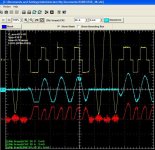
here...View attachment 48473 and yes I did assume V would have to be theoretically infinite but in real life with wire in a field I expect it doesn't really happen.
I must be misreading it. I don't find it easy. Ideally it should be 0 according to the general take on series regulation . I assume this pdf attempts to show how it works in detail. Nothing is perfect... the blue line squiggles above and below the line. It is 0 whenever it does and the average is near enough 0 ...coincidentally when the yellow voltage line does take a nearly square" hike".The light blue is the current(see the legend).There is no place where the current has a vertical segment terminating or starting from zero.
Well no, my kindergarten electronics don't see it that way when the shunt is the only load in the circuit ...It must have a higher vdc.
Simplistically,and with wild assumptions as to proportion, Pretend the ground potential is 14vdc and the shunt is shunting ALL the stators output.
My idea says the RR portion is say 6vdc@15 amps. Thats 90 watts consumed. (The stator's would be 8vdc@15amps) That would be warm to the touch with a pretty good heatsink !
Your idea seems to say the RR portion is 0.5vdc@15 amps. That's 9 watts. I can't think of much that could ever burn out with 9 watts if it was encased in an aluminum heat sink. I don't think it could be felt with a touch.
of course amperage varies per stator and what loads are also on the bike...headlight, battery charging etc etc
his law is also called Kirchhoff's second law, Kirchhoff's loop (or mesh) rule, and Kirchhoff's second rule.
The principle of conservation of energy implies that
The directed sum of the electrical potential differences (voltage) around any closed network is zero, or:More simply, the sum of the emfs in any closed loop is equivalent to the sum of the potential drops in that loop, or:The algebraic sum of the products of the resistances of the conductors and the currents in them in a closed loop is equal to the total emf available in that loop.
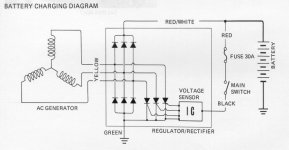
View attachment 48487I am thinking of this...but part of my analysis would involve placing a finger on the heatsink of an operating shunt R/R
. I get that it can ideally be, but if not, it might be just something less than 6 ohms . Somewhere around full-conduction there are halfway stages that are making them hot. Why else invent a mosfet type? Your model of 0.05 ohms suggests that as your stator burns, a shunt type regulator is colder than the wires attaching it- not impossible; connections ARE often cited- (see 850combat's post?) but anecdotally, how many replace the stator while the R/R is perfectly fine? I think not many. They seem to fail as a pair, or the R/R fails first...Assume the short is a simple resistor with about 0.05 ohms
.. I get that it can ideally be, but if not, it might be just something less than 6 ohms . Somewhere around full-conduction there are halfway stages that are making them hot. Why else invent a mosfet type? Your model of 0.05 ohms suggests that as your stator burns, a shunt type regulator is colder than the wires attaching it- not impossible; connections ARE often cited- (see 850combat's post?) but anecdotally, how many replace the stator while the R/R is perfectly fine? I think not many. They seem to fail as a pair, or the R/R fails first...
anyways, I've got to get back to the rocket I was building![]()
^ you have a serious inferiority complex
More proof that you are overcomplicating and overthinking this extremely simple system. And maybe obsessed.
The sh 775 goes bad at least just as often as any other reg rec and the gs issue is the suzuki regrec.
Stators don't care how much power they put out. They either can or can't keep up and they couldn't care less either way. The bulk of the power distribution and management is handled by the reg/rec.
shunt regrecs have been working since the time of cave men. except suzuki shunt regrecs.
Bye now.
I don't know where to start...
So has any one here had a sh 775 fail? I replaced two regulators in three years and this spring installed a 775 with good results. Granted I only put on about 4500 miles this summer.
Not had an SH775 fail, but when I installed it two 1/2 years ago, I deliberately left in a slightly-cooked stator that wouldn't normally last the summer with a shunt RR.
Guess what? With the 775, it's still working fine - 14.5V peak, 14.1V at 3K, all the lights are better than ever and the bike's running smooth.
I expect it will fail sooner or later (the stator, not the RR) and I'm ready for it, as it will have proved something, to me at least.
I did the same with my Compu-Fire. The blackened stator lasted exactly one year before it gave up. Installed a new stator and it has been working fine for years. Nothing over-complicated about that except an over-opinionated mouth.Not had an SH775 fail, but when I installed it two 1/2 years ago, I deliberately left in a slightly-cooked stator that wouldn't normally last the summer with a shunt RR.
Guess what? With the 775, it's still working fine - 14.5V peak, 14.1V at 3K, all the lights are better than ever and the bike's running smooth.
I expect it will fail sooner or later (the stator, not the RR) and I'm ready for it, as it will have proved something, to me at least.