• Required reading for all forum users!!!

    Welcome!
    Register to access the full functionality of the GSResources forum. Until you register and activate your account you will not have full forum access, nor will you be able to post or reply to messages.

    A note to new registrants...
    All new forum registrations must be activated via email before you have full access to the forum.

    A Special Note about Email accounts!
    DO NOT SIGN UP USING hotmail, outlook, gmx, sbcglobal, att, bellsouth or email.com. They delete our forum signup emails.

    A note to old forum members...
    I receive numerous requests from people who can no longer log in because their accounts were deleted. As mentioned in the forum FAQ, user accounts are deleted if you haven't logged in for the past 6 months. If you can't log in, then create a new forum account. If you don't get an error message, then check your email account for an activation message. If you get a message stating that the email address is already in use, then your account still exists so follow the instructions in the forum FAQ for resetting your password.

    Have you forgotten your password or have a new email address? Then read the forum FAQ for details on how to reset it.

    Any email requests for "can't log in anymore" problems or "lost my password" problems will be deleted. Read the forum FAQ and follow the instructions there - that's what we have one for...

  • Returning Visitors

    If you are a returning visitor who never received your confirmation email, then odds are your email provider is blockinig emails from our server. The only thing that can be done to get around this is you will have to try creating another forum account using an email address from another domain.

    If you are a returning visitor to the forum and can't log in using your old forum name and password but used to be able to then chances are your account is deleted. Purges of the databases are done regularly. You will have to create a new forum account and you should be all set.

Electrical Connector Source

  • Thread starter Thread starter RJ
  • Start date Start date
R

RJ

Guest
http://www.vintageconnections.com/ Great source for connectors and other electrical stuff. The terminal extractor tool works great and allows you to rearrange the wires in a connector so you can adapt non-GS switches and other components to your bike.
 
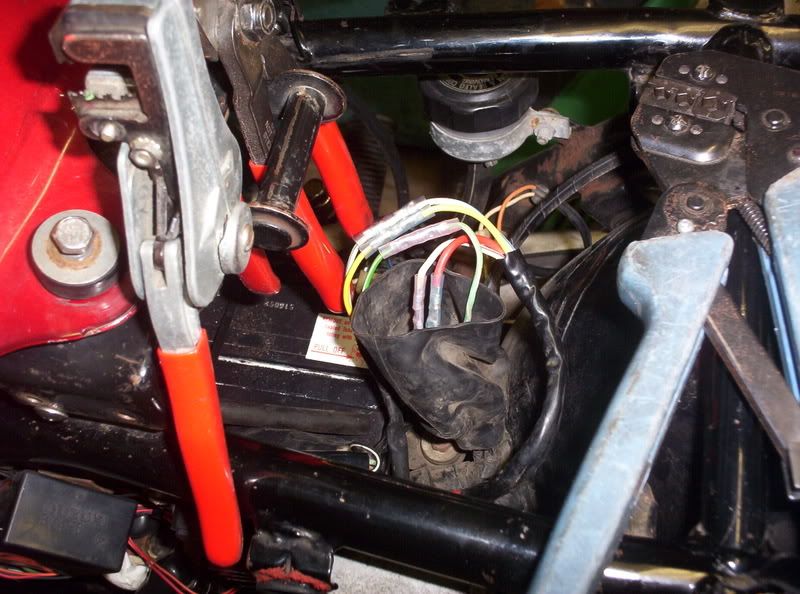
That $35 crimping tool is almost a must. The pliers type crimpers (auto parts store) can cut the wires and cause bad connections. If you dont have the right crimper I would recommend soldering your connections. The tool I have was over $100.

2002.jpg
 
Just had a quick peek at their site as I'm going to have to do something with my wiring loom once I get to that point and noticed they had an interesting point:

Please note that soldering the terminals, rather than crimping them, will destroy the vibration/fatigue resistance which crimped terminals are designed to reduce. Such vibration resistance is especially critical in high-revving applications and in old vibration prone bikes like the Honda CL72 and CL77.

When I used to do things like putting a new stereo in my car (can't be bothered these days), I always soldered rather than using crimp connectors and was thinking the same thing on the wiring loom on the 450, but now I may have to rethink...
 
I'd really like to hear some more opinions on this matter. IMO a soldered connection is pretty darn resistant to vibration. I've been giving serious thought to eliminating alot of the crimp connectors on my bike by soldering the wires together instead. My rationale being that it would eliminate corrosion problems associated with connectors. Again, just my opinion and I welcome the opinions of others.
Thanks.
Willie in TN
 
The reason the soldered connections aren't resistant to vibration is because solder is rather brittle - compared to a crimped connection. What can happen is with high vibs the connection can develop cracks in the solder joint resulting in a "cold solder joint" and a bad connection. With a crimp connection there is friction between the wire and connector and is less prone to failure by vibration. I was taught to do both. In our industrial applications I crimp and solder all pins in the cables I make. I've never had a failure due to a bad connection in 10 years of doing this. Keep in mind that soldering can promote corrosion because of the heat. Not an issue so far for me but it can happen. Always use rosin core solder, never acid core.
 
When I solder connections on the Honda Regulator Kits I offer I crimp first. The soldering is merely icing on the cake for a good connection, but crimping is better than you would imagine.

I use a good steel tool made by Klien, not the cheap crimp/strip tools that come with contact kits.
 
I do a fair amount of soldering at work, but am by no means an "expert", but IMO solder would only be less "vibration resistant" if it were solidly mouted to the frame, such as a ground strap or terminal block. Any free hanging stiff (like the wires crimped together in the pic above) should be fine, I mean how much vibrational force could be applied to a hanging wire? Not enough to break a solder joint.

This also applies to stereo installs.

A properly done solder joint should last forever. Also, if you do solder, make sure not to use too much, it will wick down the wire and make it stiff for quite a ways under the sheath, this could cause issues related to vibration. But in reality this is an improperly done solder joint and should only be compared to an improperly done crimp.

Also a "cold solder" joint isn't just when it breaks loose, its when one of the 2 parts being soldered together isn't heated enough for the solder to bond with it, so the solder is just "around" it and it breaks loose quite easily.

I would say if crimp and then use a proper amount of solder that you get the best of both worlds.
 
Last edited:
Always good to see that someone agrees with my opinion, especially with regard to cold solder joints and free hanging soldered connections. I'd be curious to know if wiring harnesses on factory race bikes have as many connectors for the non-replaceable components as street bikes do. Seems to me that they'd prefer continuous runs or soldered connections rather than crimp connectors. Whenever possible, when I've used a crimp connector, I add solder. Icing on the cake as duaneage put it. FWIW, IF I were to replace any connectors with soldered joints, I'd either tin the wires before soldering them together or twist them together before soldering. Either way, they'd be solid and protected with heat shrink tubing afterwards.
Those posi-locks look impressive. Thanks Houdini for posting that link.
Willie in TN
 
Sounds like all of the above posts bring up valid points. However I can't think of a single connection that is soldered from the factory. That may simply be an ease of assembly issue or that there is no significant benefit to soldering everything. Also the small size of a 6 or 9 pin connector precludes any type of soldering as the wire/pin assembly would be too big to push into the connector.
 
When I used to replace the stereo, I changed to soldering because of the issues I had with crimping, although I will say that I did have one of those cheap crimpers, not a high quality one.

It was also after I started going to college and learned how to solder, and I actually found it much easier.

I think I'll take the safe road as suggested, get a decent crimper and solder also.

I do recall having issues fitting connectors into the nylon blocks after soldering, but found if I was careful, twisted the wire as tight as I could, and put just enough solder on to hold solidly, then it was ok.
 
In humid areas, soldering has the huge benefit of sealing the copper from the air, thus preventing copper decay. Here in Indiana, crimps that look good at the beginning can go bad in a few years.
 
If soldering makes the pin too big to fit back in the connector, you used too much solder.

And I think that assembly lines use crimp ons purely due to it being easier and in most cases, good enough. You can design a machine to crimp, or at least a jig to do many at once, soldering has a few steps that make that harder.

I am going to go over my whole bike this winter and add a dab of solder to everything, I live in a VERY humid area, and water gets in everything. The stock fuse holder on my bike is crimped perfectly but if you wiggle it it loses contact, it wont if I solder it, enough said I think.
 
Back
Top