• Required reading for all forum users!!!

    Welcome!
    Register to access the full functionality of the GSResources forum. Until you register and activate your account you will not have full forum access, nor will you be able to post or reply to messages.

    A note to new registrants...
    All new forum registrations must be activated via email before you have full access to the forum.

    A Special Note about Email accounts!
    DO NOT SIGN UP USING hotmail, outlook, gmx, sbcglobal, att, bellsouth or email.com. They delete our forum signup emails.

    A note to old forum members...
    I receive numerous requests from people who can no longer log in because their accounts were deleted. As mentioned in the forum FAQ, user accounts are deleted if you haven't logged in for the past 6 months. If you can't log in, then create a new forum account. If you don't get an error message, then check your email account for an activation message. If you get a message stating that the email address is already in use, then your account still exists so follow the instructions in the forum FAQ for resetting your password.

    Have you forgotten your password or have a new email address? Then read the forum FAQ for details on how to reset it.

    Any email requests for "can't log in anymore" problems or "lost my password" problems will be deleted. Read the forum FAQ and follow the instructions there - that's what we have one for...

  • Returning Visitors

    If you are a returning visitor who never received your confirmation email, then odds are your email provider is blockinig emails from our server. The only thing that can be done to get around this is you will have to try creating another forum account using an email address from another domain.

    If you are a returning visitor to the forum and can't log in using your old forum name and password but used to be able to then chances are your account is deleted. Purges of the databases are done regularly. You will have to create a new forum account and you should be all set.

Engine dies randomly while riding

  • Thread starter Thread starter mcquillr
  • Start date Start date
I switched them out with 7mm Dynatek Copper plug wires.
The plug wires I installed are apparently suppression plug wires
so I'm assuming you really mean copper wires with a suppression plug CAP ? and that should be fine with any spark plug. this bike uses....

I'm not sure about this coil setup either but since it mostly runs fine I'm still wondering if your new setup is really the issue... ...you said it happens
while cruising or while moving slow. Sometimes when the bike is hot and sometimes after it has just warmed up.
Being able to start it right back up again makes it hard to trouble shoot... you could maybe attach some kind of indicator across the coil primary supply from the black box and see if that "signal" stops flickering while the bike dies..a pocket oscilloscope? haha... the dwell is going to be ..35 degrees or so so the flicker is about 1/6th of every ignition... I wonder if a digital Voltmeter or 12v led would react fast enough at anything above idle speeds? but something that did would confirm that it's electrical... and after you rechecked everything you can connection and power supply, you'd have to send the thing back.
Fuel still comes to mind...temporarily running out..the level in the bowl falling below where the jets can get it... when you stop and restart it recovers. Not sure what your exact process is to rrestart and since you've already tried "prime" on the tap , another way to test fuel while it's dying would be pulling choke-enricher ...if your carbs are the same as ours(ConstantVelocity) its tube goes deep in the bowl and would suck some gas up right away even if the float needles or the CV slide was hung up...
 
Thanks for these ideas. This past weekend I popped resistor plugs into my bike (NKG BR8ES) and miraculously the bike has not died yet, but I will give it a nice long test ride this weekend to see what happens.

I will keep you all updated.
 
Good news! Thanks for reporting back.mcquillr. I'm a twin owner too so I'm particularly interested in your progress against the day my ol' "black box" dies.
 
Thanks for these ideas. This past weekend I popped resistor plugs into my bike (NKG BR8ES) and miraculously the bike has not died yet, but I will give it a nice long test ride this weekend to see what happens.

I will keep you all updated.

This is a stretch, but a resistor plug presumably slows the discharge from the coils, which would mean during the cycle on recharge it might not have as far to go.

Basically, the voltage across a coil decays exponentially like in the link. It starts recharging at 1- exponential when the power is reapplied.

The fastest part of the curve is what generates the spark. That is right at Time=0 when the current path in the coil is broken.

After the spark jumps the gap, the rest of the curve is doing nothing but losing energy. If you can slow the process down, but still jump the gap you are retaining more power in the coil for the next cycle.

You are at the hairy edge if this is the reason and you need two coils.

https://en.wikipedia.org/wiki/Exponential_decay
 
hmm. a field collapse will resist a new field being created I guess the "dwell" is the important thing and where it all happens 32 degrees or so? so roughly 1/6 of the cycle is "discharge". at 5000 rpm that's be x2 for a 180 just to start..well I'm not in the mood for the math but that's not much time ...so yes maybe this is always a charged coil and never goes to zero. I guess it's true of two coils too but they'd have more time, I suppose.
 
Last edited:
hmm. a field collapse will resist a new field being created I guess the "dwell" is the important thing and where it all happens 32 degrees or so? so roughly 1/6 of the cycle is "discharge". at 5000 rpm that's be x2 for a 180 just to start..well I'm not in the mood for the math but that's not much time ...so yes maybe this is always a charged coil and never goes to zero. I guess it's true of two coils too but they'd have more time, I suppose.

Similar to an AC transformer. If you open the secondary circuit, then no current can flow in the primary even though it is a closed circuit. In effect, the impedance in the secondary is affecting the current flow of the primary. This is for AC sinewaves, but it generalizes to arbitrary waveforms based on the physics governing the mutual inductance of the coil.

You slow the secondary, you slow the primary which apparently is just enough to keep the field collapse at a high enough rate that there is a spark to jump the gap.

Mathematically dropping for delta T from 12 volts, produces a much secondary higher voltage than dropping for delta T from 6 volts. It is twice as much.

I think the whole point of the resistor plugs is to reduce the ringing in the secondary that then kicks back into the primary and can stress the ignitor and create radio frequency interference (RFI)
 
Yes,I'm with you per the rfi..the rest is a little deep though I sort of get he must be getting the top of the voltage curve for his spark- a good thing... but as to the symptom...if the wrong setup causes such a peculiar failure...
well,I'm still not sure if you (mcquillr) have resistor CAPS plus the resistor plugs (BR8ES--the R on these denotes 'resistor-type" I see from my NGK chart)...it's going to be an important point if anyone else gets this ignition system and has the same symptoms

What do you think ? 10k ohm total per lead? with 2 leads that's 20k ...but we don't know the coil secondary's resistance...I am just wondering if maybe there's an "ideal proportion" leads' resistance to coil and if the manufacturer is more specific about this? If the wrong sum has already caused heating of a component, that would be a worry- so one hopes the blackbox cut out as a "safety" and nothing is permanently damaged.

oh well :)
 
I think I am following all this, but I'm not sure we are all on the same page about how the EIS functions.

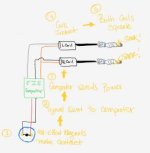
They way I am understanding it is as show in my drawing here: https://imgur.com/a/o6U6aYJ

No matter whether you have 1 or 2 coils in this EIS they will always be sparking the same amount of times in a repetitive cycle and the net sparks per unit time is always the same since in the 2-coil configuration shown in my drawing the 2 coils will always spark together. You can also see this in the YouTube video in this link: https://www.youtube.com/watch?v=CVY4EYRwIno

In this way, it wouldn't matter if you had 1 or 2 coils right?


I'm not trying to be dense, I'm just trying to make sure I'm understanding this correctly.
 

Attachments

  • Image-1.jpg
    Image-1.jpg
    8.6 KB · Views: 0
Last edited:
I'm still not sure if you (mcquillr) have resistor CAPS plus the resistor plugs (BR8ES--the R on these denotes 'resistor-type" I see from my NGK chart)...it's going to be an important point if anyone else gets this ignition system and has the same symptoms

I am currently running resistor caps PLUS resistor plugs.

Prior, I was running resistor caps with NKG B8ES plugs when the problem was occurring.
 
I think I am following all this, but I'm not sure we are all on the same page about how the EIS functions.

They way I am understanding it is as show in my drawing here: https://imgur.com/a/o6U6aYJ

No matter whether you have 1 or 2 coils in this EIS they will always be sparking the same amount of times in a repetitive cycle and the net sparks per unit time is always the same since in the 2-coil configuration shown in my drawing the 2 coils will always spark together. You can also see this in the YouTube video in this link: https://www.youtube.com/watch?v=CVY4EYRwIno

In this way, it wouldn't matter if you had 1 or 2 coils right?


I'm not trying to be dense, I'm just trying to make sure I'm understanding this correctly.


According to the manual you posted before,

If there are two different wires to two different coils from the EIS then they are firing at different times (i.e. 1/2 speed).

In the single coil configuration, it shows two wires from the EIS powering the coil which means it is firing twice as fast and the coil must recover twice as fast.
 
I think I am following all this, but I'm not sure we are all on the same page about how the EIS functions.

They way I am understanding it is as show in my drawing here: https://imgur.com/a/o6U6aYJ

No matter whether you have 1 or 2 coils in this EIS they will always be sparking the same amount of times in a repetitive cycle and the net sparks per unit time is always the same since in the 2-coil configuration shown in my drawing the 2 coils will always spark together. You can also see this in the YouTube video in this link: https://www.youtube.com/watch?v=CVY4EYRwIno

In this way, it wouldn't matter if you had 1 or 2 coils right?


I'm not trying to be dense, I'm just trying to make sure I'm understanding this correctly.

In that video it looks like both coils are in series so I guess they will fire at the same time LOL!!!!
 
According to the manual you posted before,

If there are two different wires to two different coils from the EIS then they are firing at different times (i.e. 1/2 speed).

In the single coil configuration, it shows two wires from the EIS powering the coil which means it is firing twice as fast and the coil must recover twice as fast.

But how? The computer doesn't know at which point in the combustion cycle the engine is in at any given moment so how would it know when to fire if it's only input is contact between two magnets?
 
But how? The computer doesn't know at which point in the combustion cycle the engine is in at any given moment so how would it know when to fire if it's only input is contact between two magnets?

there are a whole lot of things that are possible using two pickups well beyond what this simple device can probably do. That said I suspect it fires once per pulse or once for every pass of a magnet just like I said before two sparks per revolution.

two sparks per revolution with one coil is twice as fast as the coil wants to run.
 
Right but then that means there’s not difference between having 2 coils versus 1 double output coil right?

Uh No......................


How are you supposed to fire a single coil sperately on either output?
 
But how? The computer doesn't know at which point in the combustion cycle the engine is in at any given moment so how would it know when to fire if it's only input is contact between two magnets?
Especially the issue if you have a “180 degree” crank.
Does that Triumph Tiger have a 180/540 degree power pulses or does it have one pulse every 360 degrees?
If it has a power pulse every 360 degrees then then that EIS is acting like a waste spark ignition system as the “wasted spark” is on the exhaust stroke.
If it has 180/540 pulses, my head hurts trying to figure out what stroke each cylinder is on during the 540 portion!

And running those two coils in series, isn’t that going to cut the voltage in half?
 
You need to get two test lights. Put one on each EIS output wire (one white one black to the coil). Figure it out from there.
Those wire should alternatingly power your test lights.


This picture shows quite clearly that there are two 180 degree opposed pickups on the crankshaft output.
The diagram shows both white and black wired-AND to discharge the dual output coil.
This is a single coil but with double output like a 1-4 coil.

The wired-AND will fire that single coil twice per revolution of each 180 degree when there is a new pickup. Either one is low fires the coil off.

https://en.wikipedia.org/wiki/Wired_logic_connection
attachment.php
 
Last edited:
Okay I contacted Boyer-Brandsen and they responded quite quickly:

?Dear Boyer-Brandsen,

I am still unclear on one thing: What would be the difference between hooking up the EIS with one or two coils? In a 2-coil configuration would both coils always fire at the same time making it analogoues to a single coil onfiguration or are the two coils sparking out of phase in a 2-coil setup?

Thanks?

Boyer?s Response:

?Thank you for your enquiry, the dual coil or two single coil will operate the same way. The ignition uses the wasted spark principle for both cylinders.

Regards,
B.B. Tech?
 
You did not ask them anything! Of course the EIS operates the same. It only looks at the pickup and doesn’t know about anything else about coil configuration. You would have to ask specifically about the coil you are using and whether it will run twice as fast. Of course it is not their voil so they won’t answer that.
 
Back
Top