• Required reading for all forum users!!!

    Welcome!
    Register to access the full functionality of the GSResources forum. Until you register and activate your account you will not have full forum access, nor will you be able to post or reply to messages.

    A note to new registrants...
    All new forum registrations must be activated via email before you have full access to the forum.

    A Special Note about Email accounts!
    DO NOT SIGN UP USING hotmail, outlook, gmx, sbcglobal, att, bellsouth or email.com. They delete our forum signup emails.

    A note to old forum members...
    I receive numerous requests from people who can no longer log in because their accounts were deleted. As mentioned in the forum FAQ, user accounts are deleted if you haven't logged in for the past 6 months. If you can't log in, then create a new forum account. If you don't get an error message, then check your email account for an activation message. If you get a message stating that the email address is already in use, then your account still exists so follow the instructions in the forum FAQ for resetting your password.

    Have you forgotten your password or have a new email address? Then read the forum FAQ for details on how to reset it.

    Any email requests for "can't log in anymore" problems or "lost my password" problems will be deleted. Read the forum FAQ and follow the instructions there - that's what we have one for...

  • Returning Visitors

    If you are a returning visitor who never received your confirmation email, then odds are your email provider is blockinig emails from our server. The only thing that can be done to get around this is you will have to try creating another forum account using an email address from another domain.

    If you are a returning visitor to the forum and can't log in using your old forum name and password but used to be able to then chances are your account is deleted. Purges of the databases are done regularly. You will have to create a new forum account and you should be all set.

Fuel system check: 77 GS750

hannibal

Forum Mentor
I picked up a 1977 GS750 with 23k miles a few weeks ago. I immediately had some electrical issues so I tackled those first by rewiring the positive side, installing a new blade type fuse, and a creating a single grounding point. I plan to add some relays and create 3 separate circuits (ignition, lights, and signals) but before I spend effort on that, I wanted to take a look at the fuel system.

I quickly found my petcock was only working occasionally, and when it wasn't working, it was letting fuel run into the carbs. I've since pulled the tank and removed the petcock, and I'm currently awaiting a new one from Z1 (shipped out today!).

I glanced inside my tank and found rust. I'd say it looks like "day 3" in this pic:
http://www.mopedarmy.com/mediawiki/images/5/54/Five_day_vinegar_tank.jpg

So my plan for this weekend is to try rust removal by electrolysis. I've never done anything like this before but I've read some good links on the subject. I also plan to pull the carbs off and begin cleaning them. I'll also take note of the jet sizes, as the bike came with pods and I have little confidence that it's been jetted correctly. After cleaning, I'll bench sync them. I also have a carb sync tool on the way so I can vacuum sync after reinstalling. I'll also take a look at the boots and O rings. Any other parts of the fuel system need to be looked at? Between the tank, petcock, and carbs, I think I'm covered.

My last goal for the weekend is to change the oil (assuming it's full of fuel; haven't look) and check valve clearances. Again, a very new concept for me (the Nissans I used to work on all had hydraulic adjusters) but I've read many write ups and threads on the subject. So hopefully by Monday I can order any necessary carb parts (jets, O rings, etc) and shims.

I'm taking the MSF riding course in three weeks, after which I'll be able to get a license. My goal is to have the bike up and running with all the basic maintenance items checked off by then. I know there's a lot more to be done, but I want to at least do a compression check and stator and R/R check before putting any more time and effort into this thing.
 
I picked up a 1977 GS750 with 23k miles a few weeks ago. I immediately had some electrical issues so I tackled those first by rewiring the positive side, installing a new blade type fuse, and a creating a single grounding point. I plan to add some relays and create 3 separate circuits (ignition, lights, and signals) but before I spend effort on that, I wanted to take a look at the fuel system.

I quickly found my petcock was only working occasionally, and when it wasn't working, it was letting fuel run into the carbs. I've since pulled the tank and removed the petcock, and I'm currently awaiting a new one from Z1 (shipped out today!).

I glanced inside my tank and found rust. I'd say it looks like "day 3" in this pic:
http://www.mopedarmy.com/mediawiki/images/5/54/Five_day_vinegar_tank.jpg

So my plan for this weekend is to try rust removal by electrolysis. I've never done anything like this before but I've read some good links on the subject. I also plan to pull the carbs off and begin cleaning them. I'll also take note of the jet sizes, as the bike came with pods and I have little confidence that it's been jetted correctly. After cleaning, I'll bench sync them. I also have a carb sync tool on the way so I can vacuum sync after reinstalling. I'll also take a look at the boots and O rings. Any other parts of the fuel system need to be looked at? Between the tank, petcock, and carbs, I think I'm covered.

My last goal for the weekend is to change the oil (assuming it's full of fuel; haven't look) and check valve clearances. Again, a very new concept for me (the Nissans I used to work on all had hydraulic adjusters) but I've read many write ups and threads on the subject. So hopefully by Monday I can order any necessary carb parts (jets, O rings, etc) and shims.

I'm taking the MSF riding course in three weeks, after which I'll be able to get a license. My goal is to have the bike up and running with all the basic maintenance items checked off by then. I know there's a lot more to be done, but I want to at least do a compression check and stator and R/R check before putting any more time and effort into this thing.

Sounds like you have the right attitude about maintenance. Wanting to get it all working right first is smart. Electrolysis works, it takes some time and effort but it makes for a clean tank.
As far as the compression test, don't worry about it for now. Tight valves will cause low compression, as will sitting a long time. Adjust the valve clearances, ride it a few thousand miles, then the compression will probably be OK. 23,000 miles isn't enough to wear anything out unless it's really been abused.

Another thing to look at is the cam timing, it only takes a few minutes to check if you have the valve cover off already. I have found a lot of these bikes with one or both cams off by a tooth or even two. It will run, even run OK at certain RPMs, but it won't be right. As a new rider you probably wouldn't notice until you ride one with the cams set properly.

Speaking of timing, your '77 has contact points type ignition. Is it working correctly? Ignition timing correct? They are very reliable but they do take a little time and effort occasionally.
 
Will check the cam timing when i do valves. Thanks for the advice. I have not looked at the ignition at all. I don't think I've seen a write up on checking ignition timing, only how to line it up before removing cam chain. I'll certainly search and look over bassclif's site but if you know of a good thread I'd appreciate the link.

I bought this bike to ride not wrench on. I enjoy working on cars and such but didn't intend for this to be project. But this is what i got and if it takes work to make enjoyable, then that's what i gotta do.
 
I bought this bike to ride not wrench on. I enjoy working on cars and such but didn't intend for this to be project. But this is what i got and if it takes work to make enjoyable, then that's what i gotta do.

A ten year old bike would take a lot less work. Still more than a car but a lot less. Cheaper too, faster, all of that.
 
But just like an old car, youre gonna be doing a lot of fixing the previous owners "fixes" and such..right?? And checking all the parts and doing maintenance..right? So whats different about getting ahold of an old bike? I fail to see why your complaining.
 
What Chuck said. Once everything is fixed, a few hours once a year and a few minutes once every few months to change the oil is all it takes.
It's fixing decades of neglect that takes so much time and effort. Which is where the ten year old bike comes in. It can only have ten years of neglect to repair.
 
Last edited:
As always, thanks for the replies.
What Chuck said. Once everything is fixed, a few hours once a year and a few minutes once every few months to change the oil is all it takes.
It's fixing decades of neglect that takes so much time and effort.
This is the approach I'm taking. The bike was advertised as ready to ride, but I quickly learned it was not. As I said before, this is my starting point and if the bike needs work to be decently reliable, then that's what I'll do.

I got the carbs off the bike this morning, but having trouble getting the mounting plate off. I'm following the guide from bikecliff's site: http://members.dslextreme.com/users/bikecliff/images/vm_carb_rebuild.pdf

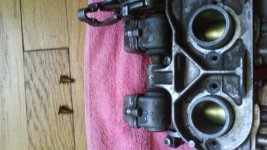
It says to remove the 8 screws holding the carbs to the mounting plate, them pull the plate off. But the throttle shaft runs through guides on the mounting plate so I can't just pull the plate off. I removed the throttle shaft stopper tab and took off the rubber grommets on the ends of the throttle shaft, but I can't slide the shaft out because the throttle pulley (where the throttle cable attaches) obviously can't fit through the carb bodies. Am I missing something here??
attachment.php


The pic shows the mouthing plate and the throttle shaft guide between carbs 3 and 4.
 

Attachments

  • 20150628_092813.jpg
    20150628_092813.jpg
    98.3 KB · Views: 0
Got it. Had to pull the tops of the carb out and remove hex bolt from each carb. Also removed a screw on the throttle pulley and it slides right out.
 
What Chuck said. Once everything is fixed, a few hours once a year and a few minutes once every few months to change the oil is all it takes.It's fixing decades of neglect that takes so much time and effort. Which is where the ten year old bike comes in. It can only have ten years of neglect to repair.

Never truer words spoken! I'm 'fighting' with a bike ridden off the street into a garage and parked for 20+ years. If just a modicum of preventative putting-away maintenance had been done I would not have to have rebuilt/replaced the brake systems, changed the fork seals and replaced the (rotted) air filter. And I haven't even looked at what the inside of the carbs look like!!

It's a labour of love, though.
 
So I got most of the carb separated. Had to get a small screwdriver to get the pilot fuel screws out. One of the springs for this screw is stuck in the carb body. I've sprayed some cleaner in there but can't seem to get it out. Any harm in soaking the body with the spring stuck inside? I'm hoping a good soak with loosen it.

I've never opened up a carb before and I'm amazed at how simple, yet complex these things are. I get that the slide acts like a throttle plate, but I'm baffled by the insides of the slide assembly. The bolt on the arm seems to move the slide up and down, like a fine tuning adjustment. I haven't removed the innards of the actual slide yet. Anybody care to explain what's going on in there?

Thank you much!
 
Last edited:
The screws on top of the slldes are what you use to bench sync them and what you adjust with the gauges when its running and youre doing the vacuum sync.

Bench syncing is just seeing ( visually from the engine side ) that all the slides are about the same gaps from the bottom of the slides to the rim of the carbs bore. Just touch the idle knob to the throttle linkage and then go in about 1 1/2 turns on the idle knob. Now use the adjuster to set the gap about 20 thousands or so across all 4 slides. This is now a bench synced set of carbs.

When you mount them and are doing the actual final gauge sync, all youre doing is moving each individual slide up or down a tad till all 4 gauges are reading the same vacuum draw across all 4 cylinders. Once all 4 are the same you snug down the jam nut and
pout the covers on.
 
Chuck, thanks for the tip on the springs and description of the slide adjusters and syncing.

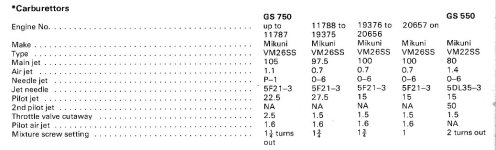
I found 110 main jets in the carbs. Stock size is 100 according to this chart I found in another thread. My engine number is 30xxx.
attachment.php


They appear to be aftermarket (no Mikuni marking) so I'm guessing they were added along with the pods. I also found stock 15 pilot jets. I ordered new O rings from Robert Barr and hoping to get those before the weekend. I've been soaking one carb at a time each night then spraying with cleaner and poking through each passageway and jet.

I balked on cleaning the tank last weekend because I couldn't find a rod to fit past the filler opening. I'm going to try bending a hanger to fit. With such a small diameter, I imagine it will be saturated with rust fairly quickly. If I change this out twice a day over the weekend, I'm hoping it'll get the job done. I can always find another hanger to shove in there.

I got 3 of the 4 carb to head boots off but cylinder 1 is pain. Hit it with some PB blaster so I'm hoping for better luck this afternoon. I don't own an impact driver so if this doesn't work, I'll have to cut a big slot with a Dremel and give that method a shot. The boots look decent (still pliable), but the big 32mm O rings behind them are hard and flat so I have those coming from Mr. Barr as well.

Thanks again...
 

Attachments

  • GS750 carb specs.jpg
    GS750 carb specs.jpg
    73.5 KB · Views: 0
Last edited:
With pods they tend to run lean so the PO went up one on the mains...should be about right. The color of the plugs is whats gonna tell the story here. Whitish grey mean that cylinder is lean. Black and sooty means its rich. You can adjust the side mixture screws to a pointb if the needed adjustment isnt drastic. Turning them in will RICHEN the cylinder and out will LEAN a cylinder.
 
The plug were all dry and black originally but I had a leaky petcock. Putting in new plugs when it goes back together.

Just a quick update...
I've reassembled the carbs with new O rings and gaskets. Hoping to get them back on the mounting plate and bench synced this week.

I went in to check valve clearances. I was pretty intimidated by the process, but it turned out to be quite straight forward. Here are my clearances:
Cyl 1 EX .102mm, IN less than .038mm

Cyl 2 EX .076, IN .102

Cyl 3 EX .051, IN .127

Cyl 4 EX .127, IN .051

My feeler gauge sizes are .038, 051, 063, 076, 102, 127, 152. The size listed above is the largest that fits. Is it odd to have so many clearances on the "too big" side? I thought clearances typically decrease over time (still not sure why that is). I'm also concerned about Cyl 1 IN. My smallest feeler (.038mm) didn't fit so this valve is very tight and it already has a 255 shim. All other shims are 265-275.

Two other concerns: On cyl 1 exhaust valve, when I dropped the shim back in the bucket and lightly centered it with my finger, lots of oil came up from below the bucket and there was a bit of a puddle of oil in the cylinder head next to the cam. Any ideas what caused this? Hope it's not a bad valve seal.

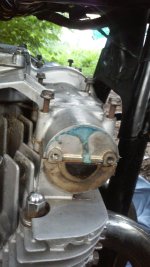
On the cyl 4 side of the head, I found this blue gunk behind the cam shaft "cap". I also noticed some blue gunk on the cyl 3 header right where it goes under the bike. Is this just a bad sealing job with some kinda of liquid gasket?
attachment.php
 

Attachments

  • 20150707_191738.jpg
    20150707_191738.jpg
    94.8 KB · Views: 0
I've got the carbs bench synced as described by Chuck and the rebuild writeup. After installing on the bike, the writeup says to set idle to 1100 rpm and turn each pilot air screw to achieve the highest idle then reset idle to 1100 and move on to the next screw. Is it correct to set idle with this method before hooking up my Carbtune and adjusting the slide heights to vacuum sync as Chuck described above?
 
The side screws are generally at about 2 out..the manual states set them at 1 1/4 out..if i recall right. Get the bike running with the screws at about 1 1/2 to 2 out and vacuum sync the carbs. the RPMs will change as you do this as youre moving the slides a little. Be ready to adjust the idle again as you go along. start the initial RPMs at around 2,000 with the big idle knob in the center..gauges set up and start the balancing process and adjust the idle back to 2,000 as it changes.

Once thats done THEN you can fiddle with the side screws...you dont adjust with the bottom pilot screws at all. But to save you the time, I find that all my bike tend to be best at about 1 3/8 out so set them there.

And check the timing also at some point.
 
Last edited:
Back
Top