• Required reading for all forum users!!!

    Welcome!
    Register to access the full functionality of the GSResources forum. Until you register and activate your account you will not have full forum access, nor will you be able to post or reply to messages.

    A note to new registrants...
    All new forum registrations must be activated via email before you have full access to the forum.

    A Special Note about Email accounts!
    DO NOT SIGN UP USING hotmail, outlook, gmx, sbcglobal, att, bellsouth or email.com. They delete our forum signup emails.

    A note to old forum members...
    I receive numerous requests from people who can no longer log in because their accounts were deleted. As mentioned in the forum FAQ, user accounts are deleted if you haven't logged in for the past 6 months. If you can't log in, then create a new forum account. If you don't get an error message, then check your email account for an activation message. If you get a message stating that the email address is already in use, then your account still exists so follow the instructions in the forum FAQ for resetting your password.

    Have you forgotten your password or have a new email address? Then read the forum FAQ for details on how to reset it.

    Any email requests for "can't log in anymore" problems or "lost my password" problems will be deleted. Read the forum FAQ and follow the instructions there - that's what we have one for...

  • Returning Visitors

    If you are a returning visitor who never received your confirmation email, then odds are your email provider is blockinig emails from our server. The only thing that can be done to get around this is you will have to try creating another forum account using an email address from another domain.

    If you are a returning visitor to the forum and can't log in using your old forum name and password but used to be able to then chances are your account is deleted. Purges of the databases are done regularly. You will have to create a new forum account and you should be all set.

Getting ready for synchronizing the carbs

JTGS850GL

Forum Sage
Past Site Supporter
Here's my rendition of an auxiliary gas tank:
f098.jpg


kj0g.jpg


wnrd.jpg


z34n.JPG


Still need to add a cutoff valve and fuel lines but you get the idea.
 
There are so many ways to make a gravity tank. I have seen some way cool things from soda bottles to now PVC pipe. Mans gotta do what his wallet says...which is usually " hey dude..your broke so get to inventing something so we can hook this biitch up".
 
I'm in the same boat.

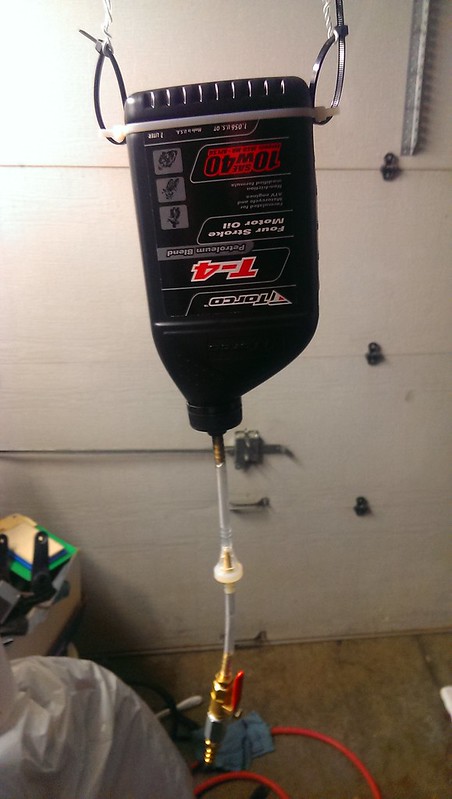
Here is my stab at it.

9685217576_c38df3cfd5_c.jpg


re-purposed an old oil bottle.

Went to harbor freight and picked up some brass air fittings and on/off valve.

Also grabbed a cheap clear fuel filter that I had laying around.


The fittings go from a 1/4 opening (fuel filter) to roughly a 3/8 hose barb to accommodate bike fuel line.

Flows good... fuel-tight when valve is closed.

$5 bucks well spent I say.


~GSJohnny
 
The fittings go from a 1/4 opening (fuel filter) to roughly a 3/8 hose barb to accommodate bike fuel line. ... $5 bucks well spent I say.
Might need to spend another couple of bucks. :-k

Your stock fuel line will never fit on a 3/8" hose barb. :-\\\

Stock line is 7mm, which is smaller than 5/16". If you use a 5/16" hose barb, you will be able to stretch the fuel line onto it, hope it doesn't damage it.

.
 
Below is my alternate/temporary tank setup.

The coolant reservoir was ~$9 at the auto parts store. I got the one with the metal frame. Has 5/16 outlets and comes with vinyl tubing and clamps that will work as fuel line for carb synch (for longer use, use real fuel hose).

The 5/16 shut-off if from a small engine (lawnmower) repair shop ~$5. Also came with spring clamps.

I hang it from the handle bars for engine work and can take it for 15 mile rides like an actual temp tank bungied to the frame like in this picture. (tank is being redone)


IMAG0554_zps56517b53.jpg
 
Just remember that, when using your temp tank, don't raise it any higher than the gas would normally be in the main gas tank. :-k

Hydraulic pressure increases with head height, so the higher you raise the tank, the harder it is for the float valves in the carbs to control the flow. :-\\\

.
 
Just remember that, when using your temp tank, don't raise it any higher than the gas would normally be in the main gas tank. :-k

Hydraulic pressure increases with head height, so the higher you raise the tank, the harder it is for the float valves in the carbs to control the flow. :-\\\

.

where does the hydraulic pressure come from?????? it is atmospheric pressure acting on the fuel, which will be the same if the temp. tank is 2 inches above the carbs or 2 feet!
 
Actually, the pressure comes from the weight of the fluid, not the difference in air pressure.

Connect a pressure meter to your tank, hold the meter a couple of inches below the gas level, note the reading. Raise the tank (or lower the meter), note the difference. It is substantial enough to make a difference, especially if questionable float valves are in the picture.

.
 
Actually, the pressure comes from the weight of the fluid, not the difference in air pressure.

Connect a pressure meter to your tank, hold the meter a couple of inches below the gas level, note the reading. Raise the tank (or lower the meter), note the difference. It is substantial enough to make a difference, especially if questionable float valves are in the picture.

.
but its not hydraulic! and those temp tanks hold way less than a stock GS tank :confused:
 
but its not hydraulic! and those temp tanks hold way less than a stock GS tank :confused:
Would you be more comfortable calling it "head pressure"? :-k

Gasoline (petrol) quantity has nothing to do with it. You could raise a half-pint container up six feet and overpower the float valves. Or, ... you could have a hundred-gallon tank at normal tank height and have no problems at all.

.
 
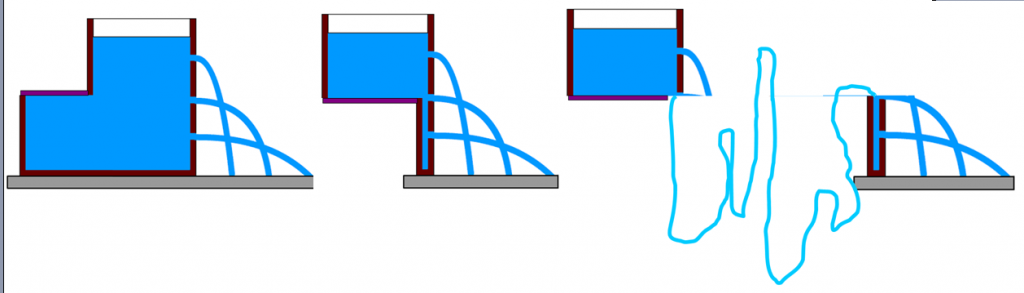
Steve is right on this one. The amount of fluid above a specified point determines the pressure exerted by that fluid. Think of it as diving down into a pool of water. The deeper you go the greater the pressure exerted by the water above you. The air pressure exerted on top of the water is the same. In the case of the gas tank, the coulomb of fluid is equivalent to the depth of the water. The more fluid above the point you're measuring, the greater the "depth" and the higher the pressure that is exerted by that fluid. It’s all about the weight of the fluid and not the air pressing down on the fluid from above. Here's a pic that might clear it up:

rv0.gif
 
Last edited:
i was just saying it is fluid under atmospheric pressure, it is NOT hydraulic!

not quite...

This explanation uses the term fluid but is also relevant for gas just the pressure differences are much less in gas due to its density - just think of the fluid as a gas that is heavier than the surrounding atmospheric gas (so it actually stays in the container)

What one is concerned with is the height difference between the top of the fluid/gas and the point of where it exists. I like to think of it as "how much stuff is above where it comes out. You will notice the higher you raise the top (by raising the tank or by filling it up more) the more pressure you get at the bottom.

This relative difference is independent of the path the hose takes between the top of the fluid and the exit. (please ignore the special case where the exit hose goes above the top of fluid in the reservoir)

This is also independent of the volume at any certain height - a large reservoir on top and a small hose on bottom or large reservoir on bottom with a hole in it and a tall hose that is filled going into this large reservoir.

gastankpressure_zps7495bf73.png
 
The weight of the fluid in the column going from the tank to the carburetors is the issue. A 6 inch column of fuel weighs considerably less than a 6 FOOT column of fuel.
 
The weight of the fluid in the column going from the tank to the carburetors is the issue. A 6 inch column of fuel weighs considerably less than a 6 FOOT column of fuel.

that is a no brainer, the point is a 6 inch column of fuel to the carbs weighs the same if it is positioned 2 inches above the carbs or 2 foot above the carbs. which was my point in the first place, if you care to read it properly! :)
 
Steve is right on this one. The amount of fluid above a specified point determines the pressure exerted by that fluid. Think of it as diving down into a pool of water. The deeper you go the greater the pressure exerted by the water above you. The air pressure exerted on top of the water is the same. In the case of the gas tank, the coulomb of fluid is equivalent to the depth of the water. The more fluid above the point you're measuring, the greater the "depth" and the higher the pressure that is exerted by that fluid. It?s all about the weight of the fluid and not the air pressing down on the fluid from above. Here's a pic that might clear it up:

rv0.gif

that picture proves nothing when referring to a temp. tank as the outlet at the bottom will be in the same place, wherever you mount the tank!
 
i was just saying it is fluid under atmospheric pressure, it is NOT hydraulic!

Atmospheric pressure has a net zero effect in this case. It's Rho-Gee-H -- density times gravity times height. It's why divers need special gear and techniques -- so the pressure doesn't kill them, either on the way down or up. It's why submarines have to be built to extraordinary stength -- and even then, the deeper they go, the greater the risk of hull failure.

In fact, pressures are often expressed in terms of height of a column, rather than PSI or kPa -- as in, inches of mercury.

The scientist Pascal (the P in kPa) used to stage demonstrations of this by blowing up wine casks by filling a tall, thin tube attached to the cask with a very small volume of wine -- A liter, maybe. Very wasteful of wine, if you ask me.
 
that is a no brainer, the point is a 6 inch column of fuel to the carbs weighs the same if it is positioned 2 inches above the carbs or 2 foot above the carbs. which was my point in the first place, if you care to read it properly! :)

Your point is understood but still incorrect... The one factor that you're neglecting to take into account is the coulomb of fluid that is in the tube connecting the tank to the carbs. This is a closed system. The higher you place the fluid the longer the coulomb of fluid and the more "weight" the fluid represents. If you move the tank from 2" to 2' you extend the coulomb of water by 1'10" and increase the pressure by the amount of wieght that that coulomb of fluid at that height represents.

I like to take things to extremes to make the concept clearer. If you take that container of gas that's connected to the carbs and move it below the carbs you will create negative pressure and siphon the fluid out of the carbs. If you take that same container and now raise it above the carbs the gas will return back to the carbs and refill them due to positive pressure. If you raise that same container of gas to hundreds of feet up you will raise the pressure of that fluid (Pounds per Square Inch) at the carbs to the point of over riding the float bowl seats and flood the floor with gas.
 
Back
Top