• Required reading for all forum users!!!

    Welcome!
    Register to access the full functionality of the GSResources forum. Until you register and activate your account you will not have full forum access, nor will you be able to post or reply to messages.

    A note to new registrants...
    All new forum registrations must be activated via email before you have full access to the forum.

    A Special Note about Email accounts!
    DO NOT SIGN UP USING hotmail, outlook, gmx, sbcglobal, att, bellsouth or email.com. They delete our forum signup emails.

    A note to old forum members...
    I receive numerous requests from people who can no longer log in because their accounts were deleted. As mentioned in the forum FAQ, user accounts are deleted if you haven't logged in for the past 6 months. If you can't log in, then create a new forum account. If you don't get an error message, then check your email account for an activation message. If you get a message stating that the email address is already in use, then your account still exists so follow the instructions in the forum FAQ for resetting your password.

    Have you forgotten your password or have a new email address? Then read the forum FAQ for details on how to reset it.

    Any email requests for "can't log in anymore" problems or "lost my password" problems will be deleted. Read the forum FAQ and follow the instructions there - that's what we have one for...

  • Returning Visitors

    If you are a returning visitor who never received your confirmation email, then odds are your email provider is blockinig emails from our server. The only thing that can be done to get around this is you will have to try creating another forum account using an email address from another domain.

    If you are a returning visitor to the forum and can't log in using your old forum name and password but used to be able to then chances are your account is deleted. Purges of the databases are done regularly. You will have to create a new forum account and you should be all set.

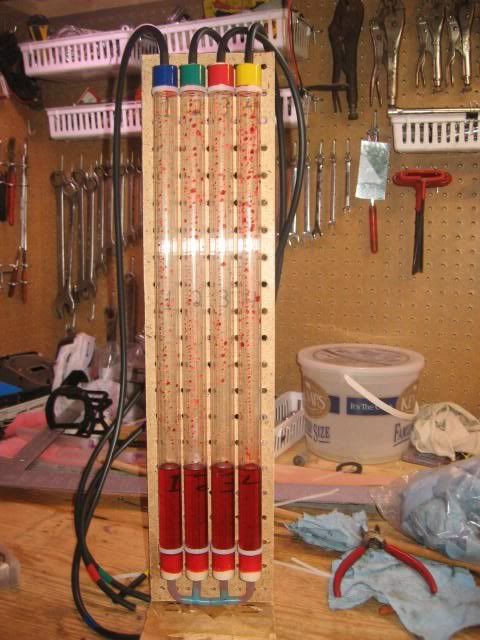
ghetto manometer!

  • Thread starter Thread starter seuadr
  • Start date Start date
Ghetto Mano

Ghetto Mano

If you use four tubes stuck into a can of oil be sure that you have several feet of vertical tubing above the oil can.
The reason you need so much length is because the oil or water that you will be using is much lighter than mercury.
I think that an inch of mercury is equal to a foot of water, which is heavier than oil. So if you see 3 or 4 inches on mercury on your carb stix you would be seeing 3 or 4 feet of water and slightly more if you use oil. It is very good to see all four at one time, but for me it works fine to compare 3 to 1, 3 to 2 and 3 to 4.
Here's an old link:
http://www.vfrdiscussion.com/forum/l...hp/t16200.html

Whatever you do, be ready to hit the kill switch to avoid pulling the liquid into the engine. It is possible though not very likely to lock the engine and cause serious damage to the rods, crank, etc.
 
well, got to ride it today, and also got to test the vaccume with a traditional mercury setup, it was very very close, so yay for that. one thing i didn notice though is its still a bit lean. i guess it's time to ajust the needles in the top of the carbs.
 
If you use four tubes stuck into a can of oil be sure that you have several feet of vertical tubing above the oil can.
The reason you need so much length is because the oil or water that you will be using is much lighter than mercury.

Not necessary if the oil can is not vented.
 
i'd rather save 80 dollars and buy the parts myself :)
Not downing anyone here, so don't take it that way, but frequent attendance at the School of Hard Knox has taught me that (unless you're Smokey Yunick) cobbling together home-brewed equipment usually results in predictable results, such as;
a) equipment doesn't work properly
b) equipment is improperly calibrated, if applicable
c) equipment takes up huge amounts of time and energy to construct
d) equipment ends up costing more to construct properly than purchased, professionally assembled equipment
Case in point; the last bit of shop equipment I constructed was a remote fuel tank to hang over my lift for synching carbs with the tank off. I did a beautiful job constructing one out of PVC pipe with a high quality brass shutoff valve, even painted it red to give it a more professional appearance. It looks good, works well, and in the end cost me $10.00 more to construct than a commercially available product...not including my time and energy. Yeah, we all get off on doing it ourselves and that whole thing, but sometimes we're not saving anything but our own delusions. Still, if anyone wants to have a go at it, be my guest!
I ask myself this; do my customers want to see homemade equipment, or commercially available tools used on their machines?
 
Not downing anyone here, so don't take it that way, but frequent attendance at the School of Hard Knox has taught me that (unless you're Smokey Yunick) cobbling together home-brewed equipment usually results in predictable results, such as;
a) equipment doesn't work properly
b) equipment is improperly calibrated, if applicable
c) equipment takes up huge amounts of time and energy to construct
d) equipment ends up costing more to construct properly than purchased, professionally assembled equipment
Case in point; the last bit of shop equipment I constructed was a remote fuel tank to hang over my lift for synching carbs with the tank off. I did a beautiful job constructing one out of PVC pipe with a high quality brass shutoff valve, even painted it red to give it a more professional appearance. It looks good, works well, and in the end cost me $10.00 more to construct than a commercially available product...not including my time and energy. Yeah, we all get off on doing it ourselves and that whole thing, but sometimes we're not saving anything but our own delusions. Still, if anyone wants to have a go at it, be my guest!
I ask myself this; do my customers want to see homemade equipment, or commercially available tools used on their machines?

This method has been in use longer than the fancy equipment commonly in use today, it is accurate. And cheap. There is no calibration, no errors.

It's a basic water level, like the ancient Egyptians used. Tested technology.

My little tank for synching carbs cost me...Nothing!
It's not made out of cheap ass PVC either.

Maybe your not much of a cobbler.
 
next time you want something for fuel, use a 2litre with a hole drilled to accept a barb fitting the same size as your fuel hose. i found as long as you drill it straight and use tefflon tape, it doesn't leak, and the bottle is totally disposable, just re-use the cap :)
 
when syncing carbs i hung a gas can from the ceiling above the bike and stuck a hose in it, started it siphoning and quickly hooked it to the carbs. cost nothing but i can see where one might consider that less than professional.

if i can remember to buy the tubing someday i'm definitely making my own vac gauge. my old honda 750 shop manual has directions on making one. never did it yet cuz a friend let me borrow his mercury gauges.
 
if you had 4 cheap vacuum gauges, couldnt you just hook one up to each carb and do the synch that way???
 
Maybe your not much of a cobbler.

Wrong. My problem is, I'm TOO much of a cobbler. I refuse to accept anything less than professional and perhaps carry it a bit too far. Being a professional mechanic by trade, I expect precision and perfection from others and assume they expect it from me.
The YICS blanking tool I built for my '81 Seca is nothing short of professional. In fact, I've sold several of them to others and received high praise for them.
The remote fuel tank I built is probably better than the one sold by Motion Pro. In fact, I'd bet my paycheck on it.
You all are quite correct in assuming a home-brewed apparatus will suffice for the occasional home tuner working on his own machine. My point was, when people are paying you to work on their machines, they expect a little more than aquarium tubing and tranny fluid, and quality and precision is not that expensive at under 100 bucks. A couple of carb synchs for friends and aquaintances will easily pay for a good set of carb sticks, with a ColorTune thrown in, to boot. However, I don't want to hijack your thread, so I'll bow out quietly and leave you all to it.
(Click on YICS blanking tool for larger view)
 
Wrong. My problem is, I'm TOO much of a cobbler. I refuse to accept anything less than professional and perhaps carry it a bit too far. Being a professional mechanic by trade, I expect precision and perfection from others and assume they expect it from me.
The YICS blanking tool I built for my '81 Seca is nothing short of professional. In fact, I've sold several of them to others and received high praise for them.
The remote fuel tank I built is probably better than the one sold by Motion Pro. In fact, I'd bet my paycheck on it.
You all are quite correct in assuming a home-brewed apparatus will suffice for the occasional home tuner working on his own machine. My point was, when people are paying you to work on their machines, they expect a little more than aquarium tubing and tranny fluid, and quality and precision is not that expensive at under 100 bucks. A couple of carb synchs for friends and aquaintances will easily pay for a good set of carb sticks, with a ColorTune thrown in, to boot. However, I don't want to hijack your thread, so I'll bow out quietly and leave you all to it.
(Click on YICS blanking tool for larger view)

I agree with your sentiments. However, many of our members are on tight budgets, so the chance to fathom out ways of fabing up cheap alternatives to recognised tuning tools is appealing.
I must admit, that in my early days of engine tuning, I would also try methods that were unconventional. There were a lot of heart aches and waisted hours and dollars (or pounds in those days) along the way, but I did learn what parameters that one needed to work within. This learning experience can't really be gained out of books, but is never forgotten through personal triumph or failure.
 
Wrong. My problem is, I'm TOO much of a cobbler. I refuse to accept anything less than professional and perhaps carry it a bit too far. Being a professional mechanic by trade, I expect precision and perfection from others and assume they expect it from me.
The YICS blanking tool I built for my '81 Seca is nothing short of professional. In fact, I've sold several of them to others and received high praise for them.
The remote fuel tank I built is probably better than the one sold by Motion Pro. In fact, I'd bet my paycheck on it.
You all are quite correct in assuming a home-brewed apparatus will suffice for the occasional home tuner working on his own machine. My point was, when people are paying you to work on their machines, they expect a little more than aquarium tubing and tranny fluid, and quality and precision is not that expensive at under 100 bucks. A couple of carb synchs for friends and aquaintances will easily pay for a good set of carb sticks, with a ColorTune thrown in, to boot. However, I don't want to hijack your thread, so I'll bow out quietly and leave you all to it.
(Click on YICS blanking tool for larger view)
thats the difference between me home brewing a manometer for my personal use and you. of course if i were getting PAID to do it, i'd buy the best manometer i could afford.:-D
 
Just found this post on another forum. Guy has a 4 page .doc file on how to build a carb sync. for 4 carbs. Looks GREAT and easy to build. I'll be building mine tomorrow.

http://www.venturerider.org/forum/showthread.php?t=14076

Here's how it looks:

fourcarbsync.jpg
 
Last edited:
Now that is a manometer

Now that is a manometer

Bigger is better right?:-D
Well it appears the guy(do gals do this type of thing?) that designed it knew something about engineering.

Based on the volume of ATF, he probably gets good "averaging" of the intake pulses and you would have to rev to 10K RPM to suck that amount of fluid from the tubes.

Is this a marketable product??? Probably not. It does probably work better than most manometers.

Pospalyr
 
....
Based on the volume of ATF, he probably gets good "averaging" of the intake pulses and you would have to rev to 10K RPM to suck that amount of fluid from the tubes.

...

Pospalyr

The volume would help with the pulsing, but not with keeping the fluid in the manometer. When calculating how high a fluid can be lifted with suction (or pressure, of course), the diameter of the tube falls out of the equations. I worked out similar problems at school. Height, density, and pressure difference are the only relevant variables.
 
Dogma

Dogma

Well technically you are correct that the steady state levels of the fluid in the tube are only based on the pressure differential and the amount of head produced by the column height differential (i.e. density of the fluid and height). However in the case of usability, if you blip the carbs, it will take longer to evacuate that larger volume over the ATV than if the tube was narrower and so you have longer to react (i.e. back off the throttle). With narrow tubes, it is virtually impossible (ask me how I know). :oops:

I worked out the equations recently and basically the ratio of volume in the standing tube to area of hose represents the electrical equivalent of capacitance (If I remember correctly; I'll post the results if i can find it) and given this works against some flow resistance in the line there is the equivalence of a RC filter which provides the dampening but also will delay the rise in the column according to the same linear filter theory.

Taking this to the extreme with a simple example, should make the effect more clear. If you basically have two large several cubic feet of air space above each column of ATF, yes the ATF level will approach the level required to balance the pressure above the fluid, but restrictions in the flow of either ATF fluid between the tubes and or air above the fluid in exhanging through a small tube will create the RC filter effect I have described and so it takes a while for pressures to equalize even though the ultimate levels are independent(your initial point) of the capacitance.

You will note that the fluid tubes and tee's below the manometer are much smaller than the standing tubes as well as the size of the vacuum hoses above the fluid. I suspect this has very good damping properties due to both forms of capacitance.

Posplayr
 
Last edited:
Rocket science again.
You guys.
Take a simple and functional concept and turn it into Something that hurts my head.
Let's see some equations.
 
Back
Top