• Required reading for all forum users!!!

    Welcome!
    Register to access the full functionality of the GSResources forum. Until you register and activate your account you will not have full forum access, nor will you be able to post or reply to messages.

    A note to new registrants...
    All new forum registrations must be activated via email before you have full access to the forum.

    A Special Note about Email accounts!
    DO NOT SIGN UP USING hotmail, outlook, gmx, sbcglobal, att, bellsouth or email.com. They delete our forum signup emails.

    A note to old forum members...
    I receive numerous requests from people who can no longer log in because their accounts were deleted. As mentioned in the forum FAQ, user accounts are deleted if you haven't logged in for the past 6 months. If you can't log in, then create a new forum account. If you don't get an error message, then check your email account for an activation message. If you get a message stating that the email address is already in use, then your account still exists so follow the instructions in the forum FAQ for resetting your password.

    Have you forgotten your password or have a new email address? Then read the forum FAQ for details on how to reset it.

    Any email requests for "can't log in anymore" problems or "lost my password" problems will be deleted. Read the forum FAQ and follow the instructions there - that's what we have one for...

  • Returning Visitors

    If you are a returning visitor who never received your confirmation email, then odds are your email provider is blockinig emails from our server. The only thing that can be done to get around this is you will have to try creating another forum account using an email address from another domain.

    If you are a returning visitor to the forum and can't log in using your old forum name and password but used to be able to then chances are your account is deleted. Purges of the databases are done regularly. You will have to create a new forum account and you should be all set.

Grrrr. another jetting post...

  • Thread starter Thread starter keman
  • Start date Start date
One more resource, taken from Factorypro.com. It is meant for CV carbs, but, the same principles may be applied to our carbs as well. Hope this helps:


  • [SIZE=+1]1. Top end (full throttle / 7.5k to redline -[/SIZE]

    Best Main Jet must be selected before starting step 2 (needle height)!
    • To get the best, most even top end power (full throttle/after 7500 rpm), select the main jet that produces the hardest pull at high rpm.
      • If the bike pulls harder at high rpm when cold and less hard when fully warmed up, the main jet is too large. Install a smaller main jet and retest until you find the main jet that pulls the hardest at high rpm when fully warmed up. This must be done first - before moving on to the other tuning ranges.
      • If the bike doesn't pull well at high rpm when cold and gets only slightly better when fully warmed up, the main jet is too small.
        • In order to properly tune the midrange and low rpm carburetion, THE MAIN JET MUST FIRST BE PROPERLY SELECTED after 10 to 15 minutes of hard use!

          • Do not pay too much attention to the low-end richness when you are changing main jets - you still need to be using the main jets that produce the best power at high rpm. You will deal with the low-end / cruise later - after step 2.
  • [SIZE=+1]2. Midrange (full throttle /5k-7k)[/SIZE]

    Step 1 (Best Main Jet) must be selected before starting step 2!
      • [SIZE=+1]Select best needle clip position[/SIZE]
    • To get the best power at full throttle / 5k-7k rpm, adjust the needle height, after you have already selected the best main jet.
      • If the engine pulls better or is smoother at full throttle/5k-7k in a full throttle roll-on starting at <3k when cool but soft and/or rough when at full operating temperature, it is too rich in the midrange and the needle should be lowered.
      • If the engine pulls better when fully warmed up but still not great between 5k-7k, try raising the needle to richen 5k-7k.
      • If the engine pulls equally well between 5k-7k when cooler as compared to fully warmed up, the needle height is probably properly set.

        • Do not pay too much attention to the low-end richness when you are changing needle clip positions - you still need to be using the clip position that produces the best full throttle / 5k-7k power in conjunction with the main jets (Step 1) that produce the best power at high rpm. You will deal with the low-end / cruise next.
  • [SIZE=+1]3. Low end (full throttle / 2k-3k)[/SIZE]

    Step 1 (Best Main Jet) and Step 2 (needle height) must be selected before starting step 3!
      • [SIZE=+1]Float height (AKA fuel level & how to..)[/SIZE]
    • To get best low-end power, set float height (fuel level) so that the engine will accept full throttle, without missing or stumbling, in 2nd gear from 2.5k to 3k rpm at minimum.
      • Float heights, unless otherwise specified in the installation guide, are measured from the "gasket surface" of the carb body to the highest part of the top of the float - with the float tang touching but not compressing the float valve spring.
      • If the engine has a "wet" rhythmic, soggy area at full throttle / 3k-4k rpm, that gets worse as the engine heats up, lower the fuel level by resetting the float height 1mm greater (if the original was 13mm - go to 14mm). This will lower the fuel level, making full throttle / 2k-3k rpm leaner.
      • If the engine is "dry" and flat between 2k to 3k rpm, raise the fuel level.
      • Example: change float height from 15mm to 14mm to richen up that area.
      • REMEMBER, since the main jet WILL affect low speed operation, the MAIN JET has to be within 1 or 2 sizes of correct before final float setting.
        • Warning: If the engine is left with the fuel level too high,, the engine may foul plugs on the street and will be "soft" and boggy at part throttle operation. Adjust Floats to raise/ lower the Fuel Level.
          • Base settings are usually given if a particular application has a history of fuel level criticalness. The Fuel level height in the float bowl affects full throttle/low rpm and, also, richness or leanness at cruise/low rpm.
        • Reference: a bike that runs cleanly at small throttle openings when cold, but starts to show signs of richness as it heats up to full operating temperature, will usually be leaned out enough to be correct if the fuel level is LOWERED 1mm. Check out and RESET all: Suzuki (all), Yamaha (all) and Kawasaki (if low speed problems occur). Needless to say, FUEL LEVEL IS EXTREMELY IMPORTANT!!!
      • If there are low-end richness problems, even after lowering the fuel level much more than 1.5mm from our initial settings, check for needle wear and needle jet (part of the emulsion tube). See Worn Needle and Worn Needle Jet diagram. It is VERY common for the brass needle jets (in the top of the "emulsion tube") in 36mm, 38mm and 40mm Mikuni CV carbs to wear out in as little as 5,000 miles. Check them for "oblong" wear - the needle jet orifice starts out round! Factory Pro produces stock replacement needle jets / emulsion tubes for 36mm and 38mm Mikuni carbs. Click here
  • [SIZE=+1]4. Idle and low rpm cruise[/SIZE]
      • [SIZE=+1]Fuel Screw setting (AKA mixture screws)[/SIZE]
        • There is usually a machined brass or aluminum cap over the fuel screws on all but newer Honda. It's about the diameter of a pencil. Cap removal details. Newer Honda carbs have no caps, but use a special "D" shaped driver, usually supplied in the carb recal kit. We do have them available separately, too. 800 869-0497 to order -
      • Set for smoothest idle and 2nd gear, 4k rpm, steady state cruise operation. Set mixture screws at recommended settings, as a starting point. For smoothest idle, 2nd gear 4000 rpm steady state cruise , and 1/8 throttle high rpm operation. (pj tuning information)
      • Pilot fuel mixture screw settings, float level (but, you've "fixed" the fuel level in Step 3 - which you have already done!) AND pilot jet size are the primary sources of mixture delivery during 4000 rpm steady state cruise operation.
        • If lean surging is encountered, richen mixture screws (turn out) in 1/2 turn increments. Alternative pilot jets are supplied when normally required.
        • Pilot fuel mixture screw settings, float level and pilot jet size also affect high-rpm, 0 to 1/8 throttle maneuvers. Too lean, will cause surging problems when the engine is operated at high rpm at small throttle openings! Opening the mixture screws and/or increasing pilot jet size will usually cure the problem.
          • NOTE: A rich problem gets worse as the engine heats up.
            • If the throttle is lightly "blipped" at idle, and the rpm drops below the set idle speed, then rises up to the set idle speed, the low speed mixture screws are probably set too rich: try 1/2 turn in, to lean the idle mixture.
          • NOTE: A lean problem gets better as the engine heats up.
            • If the throttle is lightly "blipped" at idle, and the rpm "hangs up" before dropping to the set idle speed, and there are no intake leaks and the idle speed is set at less than 1000 rpm, the mixture screws are probably too lean: try 1/2 turn out, to richen mixture. Be sure there are no intake leaks and the idle speed is set at less than 1000 rpm!


Wait a minute... this flipps what i thought about jetting completly upsidedown (litterally) i thought you are supposed to start at the idle circuit and pilot jet and work your way up to the higher circuits... also what confuses me is that this way subscribes to the thought that RPMs actually make a difference as to what circuit the carbs are using at WOT.

Is this with just CV/BS carbs or is it also with the VMs?

Sorry to add to your confusion Keman,

Nicholas Ryan Rasmussen
 
Only applies to BS/CV. VMs are all separate circuits whereas the pilots are fed through the main in CV type
 
I did much searching and researching. read umpteen million confusing posts on jetting, Best I can figure out is the 4>1 will need me to go up 2 on the mains. My BS32SS carbs are factory with 115, so I need 120 jets....

Yet I post that I am going to do this on another bike forum and am told I will end up with no top end, and a drunk rich bike... WTF...??? ...
On my son's 850 (see picture in my sig), the baffle is installed, but unwrapped. The design of the baffle is such that it is not straight-through, so all the exhaust has to go through the perforated pipe twice, making it a bit restrictive (compared to a straight-through design), but relatively quiet. Stock airbox with K&N insert. The bike came to us with 120 main jets installed, I left them in. To be honest, I have not done the proper plug chops :oops:, but the bike feels great and returns decent gas mileage when you are not whipping on it.
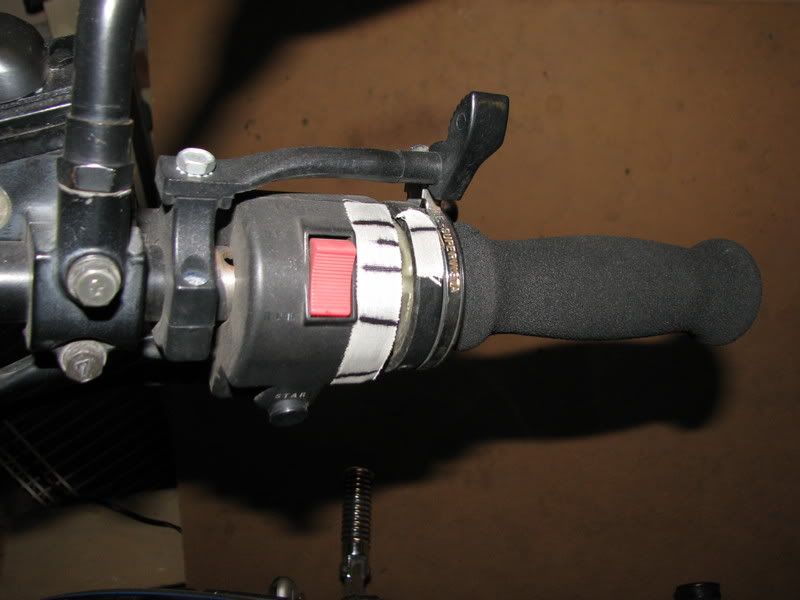

The carbs are broken down into different circuits. Marking off your throttle with tape in 1/4 throttle increments is a big help in figuring out where its having trouble. ...
Here is one way to do that:
IMG_3646.jpg


One more resource, taken from Factorypro.com. It is meant for CV carbs, but, the same principles may be applied to our carbs as well.
Don't look now, but most of our bike have CV carbs. :eek:

Please note that "CV" is a type of carb, not a model name.
The letters stand for "Constant Velocity" which is basically what happens in the variable venturi in the space under the slide.
The model name for our carbs is BS series, then the diameter. In his case, BS32.


Wait a minute... this flipps what i thought about jetting completly upsidedown (litterally) i thought you are supposed to start at the idle circuit and pilot jet and work your way up to the higher circuits ...
You tune the VM-series carbs in one direction and the BS-series (CV-style) carbs in the other.

.
 
I've been working on these bikes since 1978, always had the carb work done by a close friend who was a carb GURU, (I swear the guy ate his wheaties out of a float bowl) After he passed away last year I have been on my own trying to learn about carbs from scratch. I know these bikes inside and out, this is a new trick for me. Thanks for all of your inputs.

Steve, if ya want change for your two cents on this one, you aint gonna get it. I need every penny I can get when it comes to carbs. ;)
 
Steve, if ya want change for your two cents on this one, you aint gonna get it. I need every penny I can get when it comes to carbs. ;)
In that case, you had better ask some more questions, 'cause I ain't tossin' no more pennies. :p

.
 
Just talked to Mikael from Dynojet on the phone. Nice guy. He designed the dynojet kit for the Suzuki GS bikes.

According to him, with my Kerker 4>1 with packing in the baffle, to run the stage three kit, I will need to use their smallest main jet from their kit (155), AND pods on my bike. I really don't like the idea of running pods. I like the look of pods, but I have heard too many stories about how they make the bike inconsistent.

What if I design and fabricate a manifold without the air box for a single stock shaped K&N that has a longer set of tubes leading into the carbs?? Ideas???

I am thinking experamental... or just mental...
 
Last edited:
Jetting

Jetting

Many moons ago when I had absolutely no idea what a jet was (playing around with old CB350's), I chose to learn about jetting through experimentation. Which basically meant, starting with factory jetting, going for a ride and marking off my throttle in increments, and noting where I was having problems (bogging, flat spots, etc.) There were times where I would buy main/pilot jets all the way up and down the board.

Sure, it may have been a waste of money, but, it taught me that no two bikes were the same (I had three CB350's, on top of the 360's, 400's, CX500's, etc.), and that just because the carbs were duplicate to each other, using a certain main jet in one bike, may not run the same in another of the same bike.

So, I think about guys using the Dyno kits and figure it might be worth it to save on the hassle of learning how to jet the carbs based off what you already know (how the bike should run). Don't get me wrong, we get impatient and want to get out and ride and take some shortcuts, but, I really think learning how to jet is a skill-set that will come in handy if you ever intend on having more bikes down the road. I'm younger, and definitely plan on riding with an engine strapped to my wheelchair. So, I actually have clear tackle boxes for each bike full of jets.

Sometimes I get a little pocket money (hardly with a wife and daughter), and decide to splurge on some K&N pods on a certain bike, or whatever. Well, you can do that with $10 in jets, or you can do it with a $100 Dyno kit. I vote for the $10 in jets, and having the experience of learning how to jet properly.
 
Many moons ago when I had absolutely no idea what a jet was (playing around with old CB350's), I chose to learn about jetting through experimentation. Which basically meant, starting with factory jetting, going for a ride and marking off my throttle in increments, and noting where I was having problems (bogging, flat spots, etc.) There were times where I would buy main/pilot jets all the way up and down the board.

Sure, it may have been a waste of money, but, it taught me that no two bikes were the same (I had three CB350's, on top of the 360's, 400's, CX500's, etc.), and that just because the carbs were duplicate to each other, using a certain main jet in one bike, may not run the same in another of the same bike.

So, I think about guys using the Dyno kits and figure it might be worth it to save on the hassle of learning how to jet the carbs based off what you already know (how the bike should run). Don't get me wrong, we get impatient and want to get out and ride and take some shortcuts, but, I really think learning how to jet is a skill-set that will come in handy if you ever intend on having more bikes down the road. I'm younger, and definitely plan on riding with an engine strapped to my wheelchair. So, I actually have clear tackle boxes for each bike full of jets.

Sometimes I get a little pocket money (hardly with a wife and daughter), and decide to splurge on some K&N pods on a certain bike, or whatever. Well, you can do that with $10 in jets, or you can do it with a $100 Dyno kit. I vote for the $10 in jets, and having the experience of learning how to jet properly.
Dynojet or Factory Pro jet kits are not shortcuts. The needles are designed for pods and extra air from aftermarket pipes. The stock needles are not.
 
Chef-

Sorry about the confusion, I just meant the short-cuts we take in-general as bike owners. Not jetting, I understand what dyno jets do.
 
Back
Top