• Required reading for all forum users!!!

    Welcome!
    Register to access the full functionality of the GSResources forum. Until you register and activate your account you will not have full forum access, nor will you be able to post or reply to messages.

    A note to new registrants...
    All new forum registrations must be activated via email before you have full access to the forum.

    A Special Note about Email accounts!
    DO NOT SIGN UP USING hotmail, outlook, gmx, sbcglobal, att, bellsouth or email.com. They delete our forum signup emails.

    A note to old forum members...
    I receive numerous requests from people who can no longer log in because their accounts were deleted. As mentioned in the forum FAQ, user accounts are deleted if you haven't logged in for the past 6 months. If you can't log in, then create a new forum account. If you don't get an error message, then check your email account for an activation message. If you get a message stating that the email address is already in use, then your account still exists so follow the instructions in the forum FAQ for resetting your password.

    Have you forgotten your password or have a new email address? Then read the forum FAQ for details on how to reset it.

    Any email requests for "can't log in anymore" problems or "lost my password" problems will be deleted. Read the forum FAQ and follow the instructions there - that's what we have one for...

  • Returning Visitors

    If you are a returning visitor who never received your confirmation email, then odds are your email provider is blockinig emails from our server. The only thing that can be done to get around this is you will have to try creating another forum account using an email address from another domain.

    If you are a returning visitor to the forum and can't log in using your old forum name and password but used to be able to then chances are your account is deleted. Purges of the databases are done regularly. You will have to create a new forum account and you should be all set.

GS750/1000 Carb Swap

  • Thread starter Thread starter RobNeal4
  • Start date Start date
R

RobNeal4

Guest
My GS 750 is now fitted with Wiseco pistons taking capacity up to 810cc. Had big problems getting the carb settings right and have got it running but still not perfect. After much messing about with jets etc I think that the carb chokes may be too small for the increase in capacity so thinking of fitting either GS850 or 1000 carbs. Does anyone one know if the centre spacing of the inlet ports for these engines is the same as the 750 ie would the carbs from the larger engines simply bolt on? If so does anyone have any ideas on jet sizes as a starting point? Thanks. Rob
 
The early 750/850/1000 all used the same carbs, although the jetting was slightly different.
 
Rob,

I believe your theory about the carbs being too small is blown up by the same carbs being used on much larger bikes.

I'm assuming this is an older (pre 80) 750 with VM carbs?

Rejetting can be a pain, an art and a science

Why don't you tell us more about what problems you are having?
 
It's not just the jets that differed - the needles and slides weren't all the same. The carb sticky post will reveal all that.

Are you running with the standard airbox and exhaust?
 
At least on my 750s and 1000s, the slides were the same, the needles and jets were different. The throttle and choke mechanism was different, but it's easy to swap anyway.

Between the 850 and 750, they are almost exactly the same, jetting and everything.
 
At least on my 750s and 1000s, the slides were the same, the needles and jets were different. The throttle and choke mechanism was different, but it's easy to swap anyway.

Between the 850 and 750, they are almost exactly the same, jetting and everything.

Depends on the 750 - their carb specs wobbled about quite a bit. Plus the one that can catch people out is the position of the clip on the needle. I think it's position 3 on a 750 and 2 on the 850 (or it might be the other way round, I can't remember for sure). I think that the 750 was at least consistent here but I might be wrong.
 
Not sure, usually the needles are sized so that position three is the stock setting, but I don't know about all models. Maybe. The early 750s were a little different.
 
The 1977 GS750 carbs differ significantly from the 1978/79 GS750 carbs. The slides are smaller and thinner and the pilot fuel passages appear to be different.

I picked up a junk rack of '77 carbs and was surprised at how different they are from mine.
 
Rob,

I believe your theory about the carbs being too small is blown up by the same carbs being used on much larger bikes.

I'm assuming this is an older (pre 80) 750 with VM carbs?

Rejetting can be a pain, an art and a science

Why don't you tell us more about what problems you are having?
Big T. History is as follows: bike bought as a 1980 unit, in a complete mess. Engine completely rebuilt, carbs u/sonically cleaned (many times!). Carbs set with standard jets, std airbox, 4-2 Jarma exhaust,810 cc conversion/re-bore, float height set to std 22.5mm.. Engine difficult to start, running massively rich. Finaly got it running reasonably well reducing the fuel mix by blocking parts of the pilot fuel system, reducing main jets to 95 and pilots to minimum available size, fitting K&N pod filters, new carb/cylinder inlet stubs and new exhaust gaskets used. No obvious air leaks. Carbs do not flood or overflow. Fuel tank cleaned, fuel tap/cock cleaned and refitted along with in line fuel filter. No sign of debris in the fuel or carb bodies. Carbs are Mikuni VM22.choke mechanism set up as per workshop manual. Now starts reluctantly on choke, quickly runs without choke. Once running motor pulls really well, ticks over OK and seems to run fine but spark plugs still indicate rich running. Also restarts from hot ok. Hence my query as to if another carb type would improve things
 
Big T. History is as follows: bike bought as a 1980 unit, in a complete mess. Engine completely rebuilt, carbs u/sonically cleaned (many times!). Carbs set with standard jets, std airbox, 4-2 Jarma exhaust,810 cc conversion/re-bore, float height set to std 22.5mm.. Engine difficult to start, running massively rich. Finaly got it running reasonably well reducing the fuel mix by blocking parts of the pilot fuel system, reducing main jets to 95 and pilots to minimum available size, fitting K&N pod filters, new carb/cylinder inlet stubs and new exhaust gaskets used. No obvious air leaks. Carbs do not flood or overflow. Fuel tank cleaned, fuel tap/cock cleaned and refitted along with in line fuel filter. No sign of debris in the fuel or carb bodies. Carbs are Mikuni VM22.choke mechanism set up as per workshop manual. Now starts reluctantly on choke, quickly runs without choke. Once running motor pulls really well, ticks over OK and seems to run fine but spark plugs still indicate rich running. Also restarts from hot ok. Hence my query as to if another carb type would improve things

Wow. This just makes my head hurt. I'll try to unpack your carb settings though.

The 1980 GS750 had CV carbs, so that can't be right. Earlier VM carbs won't fit the 1980 head. Carbs should be Mikuni VM26 or BS32. VM22 are for the GS550. I will assume you have VM26. If you have BS32, ignore everything here, as those new-fangled CV carbs confuse my feeble brain.

22.5mm is way too low for float height, so it's no wonder the bike ran massively rich. Surprising that it didn't flood. Stock float height for 78-79 GS750 and the earliest GS850 (which used VM26 carbs) is 24mm. Float height affects the mix in all circuits, so everything else you did seemed to overcompensate a bad float height setting. Such as . . .

You blocked part of the pilot system . . . and added pod filters . . . and reduced the main jets??? :eek:

Um, that makes no sense. With pod filters, you have more air, so you need to increase the mains and other jets (once you have a good float height).

Not sure what effects that aftermarket 4-2 pipe has. Is it freer flowing than the stock 4-2? Akin to the 4-1 pipes? If so, then you should approach the jetting like the typical pods/pipe crowd (we aren't all clowns :cool:).

Those specs are close but not identical. You will find them here.

The stock jetting for the VM26 carbs for a 750/850 are:

Main 100/102.5
Pilot 15/15
Stock needle setting was either 3d or 2d from top.

With pods and a more open pipe, you need to add fuel to the mixture. You might be able to get the pilot right with stock 15s and some adjustment to the screws, but pick up some 17.5 pilots in case you run out of adjustment range.

You needle will need to go up (richer). Start with it in the 4th slot down. You may need to shim it more, but I doubt you'll end up in the 5th slot.

For mains, you will need to go up a few sizes from stock. Start with jets in the 117.5 range (so grab some 115, 117.5, 120 and maybe 122.5). Be prepared to swap up or down.

Before you begin the jetting saga, strip and dip the carbs and put in fresh o-rings for the screws, choke assemblies, etc. Rob Barr has a complete set for you. Also, clean and re-oil (lightly) those K&N pods. If you got the bike to run at all with those jets, I wager those pods are smothered in oil.

Bored out to 810, I suspect your jetting baseline is in the same neighborhood as my 750/850. For reference, after LOTS of trial-and-error (mostly error :p), I am reasonably pleased with my jetting, as follows:

Pilot 17.5
Fuel Screw - 7/8 to 1 turn out
Air Screw - 2 turns out
Needle - 4th slot + 4 #3 washers for a tiny shim.
Mains - 117.5

The only part I am not certain about in my jetting is the mains, because city riding does not put me in WoT enough to be sure.
 
BikeCliff website

http://www.motorcyclecarbs.com/carbs101.pdf

http://www.factorypro.com/tech_tuning_procedures/tuning_carbtune,CV,high_rpm_engines.html

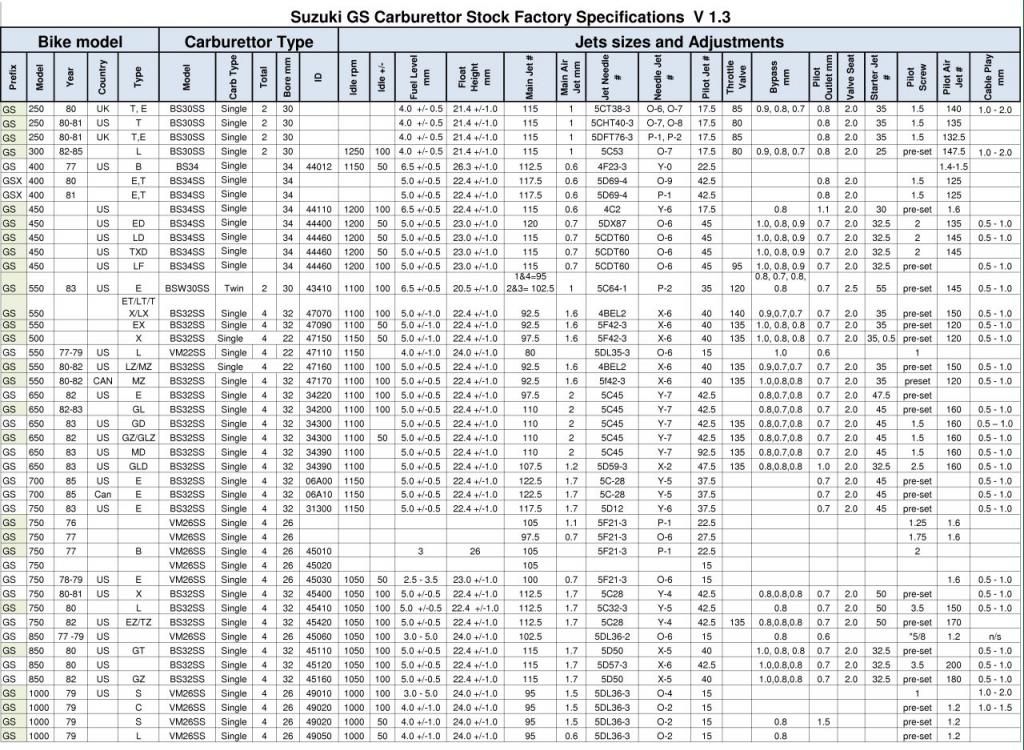
SuzukiGSCarburetorSettingDatabase_1_zps5e5754c5.jpg


All links I have found on various threads on the GS resources.
A lot more where they came from, these are some I saved.

I hope this will not confuse you with the great input by mrcinders.

Chart might help you identify carbs better as was a change between
77-79 vm26ss and 80-81 bs32ss carbs I don't know what you have.
Id # in chart to compare with what is stamped on carb body and the carbs will look different.

Hope chart and the links help.
 
Wow! Thanks so much for all the advice and the time you've taken over this. Much appreciated. Even though the weather is getting colder now here in the UK I'll be in the garage soon to try out the suggestions.
Kind regards.
Rob
 
Really useful chart. A bit of a strain on an older set of eyes but damn useful, thanks.

Regards

Rob
 
I forget who posted that I am 41 with 20/20 and it is still small. Its a JPEG so you should be able to resize in any paint-photo editing software.

Just lets you know what was in as stock.

Have read that when changing to pods will need to re-jet and the chart will not help you.

That is where the advice from people like mistercinders who has converted comes into play.

Here is some more info gleaned from this site about jets.

Keihin, Dynojet, Mikuni Jet Size Cross Reference

All Hole Diameters Are in Inches

Hole Dia?---Keihin # -- DynoJet # -- Mikuni #
0.0350---- 92.5--------- 92----------- 86.3
0.0360---- 95----------- 94----------- 88.1
0.0370---- 97.5--------- 96----------- 90
0.0380---- 100---------- 98----------- 91.9
0.0390---- 102.5------- 100---------- 93.8
0.0400---- 105--------- 102---------- 95.6
0.0410---- 107.5------- 104---------- 97.5
0.0420---- 110--------- 106---------- 99.4
0.0430---- 112.5------- 108--------- 101.3
0.0440---- 115--------- 110--------- 103.1
0.0450---- 117.5------- 112--------- 105
0.0460---- 120--------- 114--------- 106.9
0.0470---- 122.5------- 116--------- 108.8
0.0480---- 125--------- 118--------- 110.6
0.0490---- 127.5------- 120--------- 112.5
0.0500---- 130--------- 122--------- 114.4
0.0510---- 132.5------- 124--------- 116.3
0.0520---- 135--------- 126--------- 118.1
0.0530---- 137.5------- 128--------- 120
0.0540---- 140--------- 130--------- 121.9
0.0550---- 142.5------- 132--------- 123.8
0.0560---- 145--------- 134--------- 125.6
0.0570---- 147.5------- 136--------- 127.5
0.0580---- 150--------- 138--------- 129.4
0.0590---- 152.5------- 140--------- 131.3
0.0600---- 155--------- 142--------- 133.1
0.0610---- 157.5------- 144--------- 135
0.0620---- 160--------- 146--------- 136.9
0.0630---- 162.5------- 148--------- 138.8
0.0640---- 165--------- 150--------- 140.6
0.0650---- 167.5------- 152--------- 142.5
0.0660---- 170--------- 154--------- 144.4
0.0670---- 172.5------- 156--------- 146.3
0.0680---- 175--------- 158--------- 148.1
0.0690---- 177.5------- 160--------- 150
0.0700---- 180--------- 162--------- 151.9
0.0710---- 182.5------- 164--------- 153.8
0.0720---- 185--------- 166--------- 155.6
0.0730---- 187.5------- 168--------- 1575
0.0740---- 190--------- 170--------- 159.4
0.0750---- 192.5------- 172--------- 161.3
0.0760---- 195--------- 174--------- 163.1
0.0770---- 197.5------- 176--------- 165
0.0780---- 200--------- 178--------- 166.9
0.0790---- 202.5------- 180--------- 168.8
0.0800---- 205--------- 182--------- 170.6
0.0810---- 207.5------- 184--------- 172.5
0.0820---- 210--------- 186--------- 174.4
0.0830---- 212.5------- 188--------- 176.3
0.0840---- 215--------- 190--------- 178.1
0.0850---- 217.5------- 192--------- 180
0.0860---- 220--------- 194--------- 181.9
0.0870---- 222.5------- 196--------- 183.7
0.0880---- 225--------- 198--------- 185.6
0.0890---- 227.5------- 200--------- 187.5
 
I forget who posted that I am 41 with 20/20 and it is still small. Its a JPEG so you should be able to resize in any paint-photo editing software.

Just lets you know what was in as stock.

Have read that when changing to pods will need to re-jet and the chart will not help you.

That is where the advice from people like mistercinders who has converted comes into play.

Yes, the chart just shows the stock jetting. Since few if any of us are the original owners of these bikes, the chart helps figure out what "par" is when tearing down the carbs and discovering what some PO did to them over the decades. Typical PO sins include:

- mixing pilot jet sizes
- changing the main jets in an attempt to sort out all manner of mixture issues (e.g., "it won't idle well. Guess I better go up 7 sizes on the mains")
- blindly replacing OEM jets (mains, pilots, screws) with rebuild kit parts ("so shiny, must be better than those grimy old jets").

To address the changes needed for pods/pipes, the chart at least tells you where to find par, even if you cannot return the bike to stock and get it running there before modding the fuel/air system (which is the best approach).
 
Wow! Thanks so much for all the advice and the time you've taken over this. Much appreciated. Even though the weather is getting colder now here in the UK I'll be in the garage soon to try out the suggestions.
Kind regards.
Rob

Post a pic of the bike and carbs, we can at least ID which carbs you have (VM or BS)
 
I definitely have VM carbs. Another issue with the bike is that the original engine was in such a poor state that I sourced a second one that was taken from a USA import (to UK) as a part out. I just like to make life difficult for myself!! Anyway, I'll source a second set of VM26 carbs and re-build using the advise everyone has provided. Thanks guys for the all of the very detailed info. It's going to make for a very interesting winter project in the garage.

Rob
 
Rob - if you're running with the standard airbox and she's rich I would suggest having a look at the needles. The carbs might be from an 850 - they'll look exactly the same but they'll have 5DL36-2 needles and you won't see them unless you take them out (it's stamped on them - you'll need bloody good eyes or a magnifying glass to see).
 
Rob - if you're running with the standard airbox and she's rich I would suggest having a look at the needles. The carbs might be from an 850 - they'll look exactly the same but they'll have 5DL36-2 needles and you won't see them unless you take them out (it's stamped on them - you'll need bloody good eyes or a magnifying glass to see).

Just clarifying, the -2 is the clip position. You will just see the first part of the number if you've got good light, with a young set of eyes or a magnifying glass.:)
 
Just clarifying, the -2 is the clip position. You will just see the first part of the number if you've got good light, with a young set of eyes or a magnifying glass.:)

Good point - don't waste time looking for the '2' - it's not there!
 
Back
Top