• Required reading for all forum users!!!

    Welcome!
    Register to access the full functionality of the GSResources forum. Until you register and activate your account you will not have full forum access, nor will you be able to post or reply to messages.

    A note to new registrants...
    All new forum registrations must be activated via email before you have full access to the forum.

    A Special Note about Email accounts!
    DO NOT SIGN UP USING hotmail, outlook, gmx, sbcglobal, att, bellsouth or email.com. They delete our forum signup emails.

    A note to old forum members...
    I receive numerous requests from people who can no longer log in because their accounts were deleted. As mentioned in the forum FAQ, user accounts are deleted if you haven't logged in for the past 6 months. If you can't log in, then create a new forum account. If you don't get an error message, then check your email account for an activation message. If you get a message stating that the email address is already in use, then your account still exists so follow the instructions in the forum FAQ for resetting your password.

    Have you forgotten your password or have a new email address? Then read the forum FAQ for details on how to reset it.

    Any email requests for "can't log in anymore" problems or "lost my password" problems will be deleted. Read the forum FAQ and follow the instructions there - that's what we have one for...

  • Returning Visitors

    If you are a returning visitor who never received your confirmation email, then odds are your email provider is blockinig emails from our server. The only thing that can be done to get around this is you will have to try creating another forum account using an email address from another domain.

    If you are a returning visitor to the forum and can't log in using your old forum name and password but used to be able to then chances are your account is deleted. Purges of the databases are done regularly. You will have to create a new forum account and you should be all set.

Gs850g stage 3 re-jet settings please

  • Thread starter Thread starter chrisbock
  • Start date Start date
C

chrisbock

Guest
I have an '81 850G, stage 3 rejet (yes, K&N pod filters, 4-1 exhaust. And, no, Ive no time for negative responses, i.e. ''You should have left it stock!...grumble grumble...loud pipes!...grumble grumble" Information please, not opinions)
I decided to try out 6 Sigma Racing. No phone # and they are very vague in their email responses.
Does ANYONE have any experience rejetting an '81 850G w/pods & 4-1 manifolds at sea level? Any rejetted settings I can start from?
Everything is in great shape, new o-rings, intake mani's, good petcock, clean carbs, strong spark.
The 6 Sigma instructions have me moving the needle clip down one (toward the pointy end). This puts it on the third clip down. No mention of changing out nylon washer on top of needle. Also, they have me turning out the pilot jets 4 1/2 turns. They only have 5 turns on them.
Now, for more fun. The PO had put on the pods and exhaust mani, and said he "rejetted" the carbs. It turns out, all he did was drill out some aftermarket 160's. No needle or pilot adjustments.
Stock jets are numbered by fuel flow. Aftermarket, by jet opening diameter. I was sent a few different sizes, the largest at 135. WAY smaller then the jets the PO had put in, the bike would hardly run. I was sent 170's, which had my bike roaring, but too rich.
After messing with pilot settings, and re-installing the carbs, I had flooded my crankcase by leaving the petcock on prime by accident.
OK, oil and filter change. Now its not even starting. So.... you can see why rejetted carb settings would help. Thanks a bunch.
 
Also, Ive been trying to find this info on the GSR for months now. Sorry if I missed it. I wasn't being lazy, maybe just ignorant.
 
Hi,

"Turning out the pilot jets"????

If you have to back out the idle mixture adjustment screws (sometimes called "pilot screws") that much then it's time to go up a size on the pilot jets.

As a general rule, with pod filters and a free-flowing 4-n-1 exhaust you'll have to go up on the mains anywhere from 4 to 6 sizes from stock. Then you might have to go up one size on the pilot jets. You will also have to move the needles up a notch or two to fatten up the midrange. Each adjustment has to be tested by performing "plug chops" and reading the spark plugs. There are a few links on my little website that address these issues. There are no "hard and fast" numbers because every bike is different.

Vance & Hines Jetting Recommendations (PDF-600k)

Shimming The Needle

For CV Carb jetting, see the very informative article at Factory Pro. Also see the carb jetting tips at Motorcyclecarbs.com, Inc.

Plug Chops and Idle Mixture Adjust Methods
(by Mr. koolaid_kid,Mr. tkent02, Mr. psyguy)

Spark Plugs, How to Read

You will also find conversion information between the Mikuni and DJ mains. Yes, the stock mains use flow rate (cc's per minute) and the DJ uses the actual diameter. The Dynojet Stage 3 kit has always been highly recommended for this type of modification. It takes out most of the guesswork.


Thank you for your indulgence,

BassCliff
 
Last edited:
Thanks for the info. Ive been checking out the different links on your awesome site, but am not having luck. I had a running bike in good condition, if a little lean, before I re-jetted. Now I have a very heavy paperweight. I've been trying out any adjustment I can think of just to get it running again. I have adjusted the floats from 22.4mm to 23.4mm as per instruction. I've tried pilot settings from 4 1/2 turns out, as instructed, to 2 1/2 turns out. Mixture screws from 2 1/2 to 3 1/2. The jets I was sent were the proper number, if they were Mikuni, but would stall my bike out and were 2/3 the size of the jets the PO put in, which were just a little lean.
During one of my carb swap outs, I had left the petcock on prime and flooded the crankcase. I had changed the oil and filter, now it wont start up. It'll turn over, but not fire.
Basically, I'm at a dead end, and need some more experienced insight.
 
Hi,

I've tried pilot settings from 4 1/2 turns out, as instructed, to 2 1/2 turns out. Mixture screws from 2 1/2 to 3 1/2.

Please clarify. I'm confused. :-k

You have an '81 with Mikuni BS32SS carbs (CV style), right?


Thank you for your indulgence,

BassCliff
 
Yup, '81 GS850G with Mikuni BS32SS carbs. The jet kit instructions from 6 Sigma Racing said to turn out the Pilot Jet's 4 1/2 turns, and have not addressed my inquiries about the settings. They have no phone number and take a few days to get back to you by email. I'm thinking that I should have gone with another kit, or ordering OEM myself. They did tell me how to make a balancer, though. Woohoo...
 
The Pilot jets are what I was told to adjust. not the mixture screws. I know that these can be confused, and I know the difference. What I do not know, is, are you s'posed to mess with the pilot jets. Are they meant to seat fully? Or, is there a normal setting I can work from. I've done a lot of work on my bike, but have little experience with carbs and tuning. Thanks a bunch for your input.
 
The Pilot jets are what I was told to adjust. not the mixture screws. I know that these can be confused, and I know the difference. What I do not know, is, are you s'posed to mess with the pilot jets. Are they meant to seat fully? Or, is there a normal setting I can work from. I've done a lot of work on my bike, but have little experience with carbs and tuning. Thanks a bunch for your input.

Stock pilot screws (the ones that had an aluminum plug over the hole) are 2 1/2 turns out from lightly seated for BS32s and fine tune from there. This should help too. It is for a setting Idle mixture tutorial.
 
On the Mikuni BS32SS carbs there are only TWO adjustable items:
1. Float height. Should be 22.4 +/-1.0mm. Setting it to 23.4 would lean it out.
2. Mixture screws. We are suggesting three turns as a starting point.

ALL the brass jets (main, pilot fuel and pilot air) should be installed snugly. They are NOT "adjustable" unless you change them for a different size.

My son's '81 850 (see the picture in my sig) has a 4-into1 header (manufacturer uncertain) and a K&N filter in the stock airbox. Because it's the stock airbox, it doesn't need quite the jetting change as yours, but we are running 120 mains and about 2 1/4 turns out on the mixture screws. We have not changed the needle height. For your case, possibly raise the needle a bit and use 127.5 mains.

When you finally decide where you want to start, please use a structured method for checking the various circuits. Check one circuit, get it right, move to the next circuit. There are only three circuits involved, so it won't take long to do the checking. The part that takes the longest is waiting for any replacement jets to arrive.

.
 
Holy smokes! This whole time I've been trying to fiddle with the pilot jet because of the wording in the jet kit instructions. So the pilot jet (in the float bowl) is fully seated? I knew the pilot mixture screws should start out at around 2 1/2 turns. Also, when I bench synced the carbs, I didn't open up the butterfly's. They are fully closed. They should have a slight gap in them, correct? Thanks for connecting the dots for me. I knew there was something off, but couldn't quite see it
 
Hi,

You will find these tips on my little website also.

Bench Sync Your CV Carbs


Synchronize Carburetors
(With the Morgan Carbtune)​

Yes, all fuel and air jets are fully snugged into their respective receptacles. Adjust only the float height, mixture screws, and vacuum balance screws as shown in the sync guides.

Thank you for your indulgence,

BassCliff
 
Last edited:
Holy smokes! This whole time I've been trying to fiddle with the pilot jet because of the wording in the jet kit instructions. So the pilot jet (in the float bowl) is fully seated?
Yep, as I mentioned earlier, there are only TWO adjustable items, and the pilot jet is NOT one of them. (It's not the other one, either. :p)


I knew the pilot mixture screws should start out at around 2 1/2 turns.
There are many opinions on what setting works best, and the originator of each of those opinions will have their own reason for doing it that way.

My personal reasoning is that you usually do this tuning after the carbs have been apart, usually for a full rebuild, so tuning settings are basically unknown. By setting the mixture screws out three full turns, you are providing a richer mixture, which helps start the cold engine. If your mixture screws are not out quite far enough, when you remove the "choke" and the engine stumbles, you will not know what is causing it. By turning out the mixture screws, you may discover that it's the screw settings, so I just start with them plenty rich to run better. With the cold engine (and the short time you will be doing this), there is very little chance that you will foul a plug. Once the "choke" is off, it will warm up a bit quicker, but the rich pilot mixture is still providing a "half-way richer" mixture to keep it going. When the engine is running reliably without the "choke" is a good time to do your carb sync (with gauges). After the carbs are synched and the gauges are still connected, adjust your mixture screws while looking for the highest vacuum level in all four cylinders. The engine will run best (fastest) when it has the best mixture, and that higher speed (with no change in throttle opening) will provide more vacuum. You may end up with the screws at about 2 1/2 turns, but because you just set them by watching the gauges, you will KNOW that that is the correct setting.


Also, when I bench synced the carbs, I didn't open up the butterfly's. They are fully closed. They should have a slight gap in them, correct?
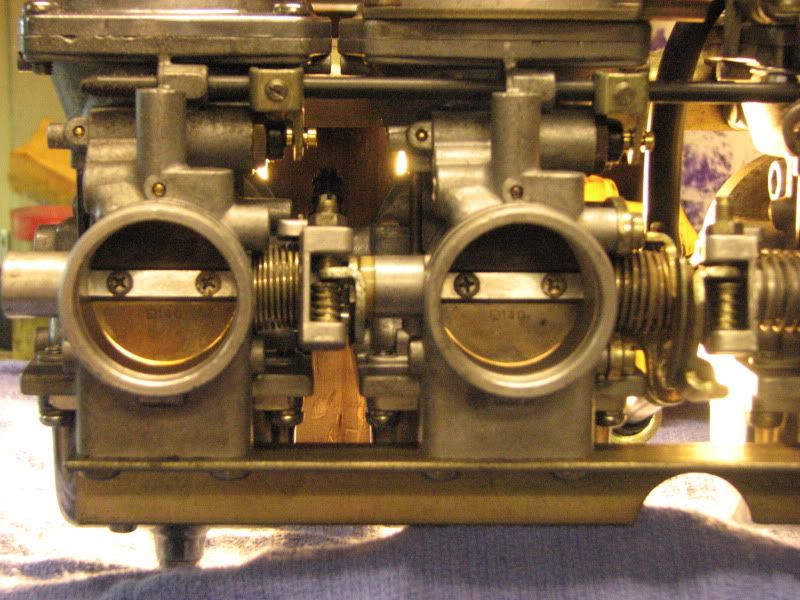
If you adjusted them so they all hit that "fully closed" point at exactly the same time, you just did a bench sync. Some will use a paper clip (why are paper clips made of metal? :-k) or a small drill bit to gauge the opening of the throttle butterflies, but I prefer to shine a light on the other side of the carbs and compare the sliver of light behind the butterfly. You will have to have them slightly open if you expect the engine to start and run, though.

IMG_3451.jpg


.
 
re-did re-jet, still not starting.

re-did re-jet, still not starting.

Thanks for the responses. I have sent back the 6 Sigma jet kit, and bought Mikuni jets ($19, after shipping) sizes 130 and 127.5 (outer and inner, respectively) just so I know what size I'm actually dealing with. I have reset my floats at 21.4 (to richen)
I've done another bench sync, with a paperclip this time and 1 1/2 turns in on the throttle adjuster, for slight opening of butterflies. I've turned the mixture screws out 3 turns. I have new spark plugs, with strong spark (tested against the engine block)
Just before this project, my bike was running great, if a little lean. I've had my valves adjusted, and had a tune up. I've thrown in a new stator and R/R, and put in a new clutch. I've a new gel battery also. I have completely dipped, cleaned, and re-assembled my carbs (thanks to the carb cleaning guide, and rebuild tutorial)
My bike is still not starting.
Before all of your guys input, I had been trying , after various adjustments and different jets, to start my bike up. I had gotten it running poorly a couple of times. All of my attempts had the pilot jet turned out. Could that have caused any damage that would effect startup? Thanks
 
Nope, no damage. If you used a paper clip, be prepared to turn down the center idle screw after you get it running. It will probably rev up to around 3k, at least that has been my experience.
 
I am still at a loss as to why its not even starting up.
Even with different main jets, shouldn't it start up at idle? I've tried with or without choke.
After using the paper clip to bench sync, I turned out the idle screw until completely closed, then turned it back in 1 1/2 turns.
Also, I forgot to mention that I also have new intake manifold boots and o-rings, and K&N filters.
Any ideas?
 
Last edited:
Well,
With a full boat set up like that (pods, pipe) the main jet sizes aren't really going to be your biggest problem. I mean, yes you'll need to install larger ones, but the problem you're going to run into here is the needles. The stock needles aren't going to work very well. Which is why a jet kit (and I'd suggest one from the usual suspects as they've done the research and put out a proven product vs whomever this 6Sigma company is. I've read a bit on them, no one seems to be very satisfied with the product. My guess? Some guy with a bench top lathe decided he could make some money turning down some needles most likely based on a jet kit he may have had...I dunno though)

There are quite a few reputable jet kit companies out there. Dynojet of course, along with factory pro. Both have good products, accurate instructions, and generally good results, provided you've followed said instructions. Most are not quite "plug and play" but darn close. All of these that I have ever used include different needles because on most of these bikes that's the major part of the problem when swapping to pods and/or a pipe. The needle dictates the amount of fuel passing through the emulsion tube into the carb throat (which is all fed by the main on these particular carbs). The fatter and slower of taper the needle is, the less fuel that gets by it. Most of these lots contain not only adjustable needles (adjusted by moving the needle clip up to lean the mix, down toward the point to richen it) but needles of an entirely different shape/taper speed. Generally they're very quick in taper, and most are nearly hypodermic needle sharp at the end. This is to allow more fuel to pass more quickly. You've increased the air flow, these increase the fuel flow. The air/fuel ratio for an ideal burn is a fairly small window. Main jets alone will help, but if the needle is still too fat and blunt to allow fuel past, you're not really doing much to increase fuel flow until you're solely on the main jet, which isn't really happening all that often as the main only comes on by itself at the last maybe 1/8-1/4 of throttle opening. Meaning that I'd say 85% of your riding is done on the needle, with 10-12% being on the pilot, and only 3-5% on the main. These are just guesses of course but you see what I'm saying.

So without those needles, even with bigger mains, your bike is going to run pretty much like crap in the rev range/throttle position that you're using most...

Anyway; on to your current issue. The bike only needs the pilot circuit to start and idle and even operate up until about 1/4 throttle or so. (get the habit of associating throttle position and RPMs out of your head as they don't necessarily go hand in hand) so if you know it's got CLEAN carbs on it. And I stress knowing it has CLEAN carbs as in disassbled and rebuilt carbs on it. If not, you need to start there or you'll be chasing your tail from now until you give up and sell it. (Not trying to be snarky, but facts is facts) If you know this, you've got a good baseline to start from. Start with the basics. Pilot adjustment (mixture) screws at 2.5-3 turns out from lightly seated (don't crank em closed or you can snap off the tiny little tips and then you're in big trouble). Close the idle speed knob and then open it till just a sliver or so of light comes through the butterfly valves.
Assuming your float levels are set correctly after your rebuild (22.4mm) and you've got the rubber plugs in your pilot jet ports like they should be (inside the float bowls) and you're still using the stock pilot jets, if it still doesn't start, check the spark plugs for wetness. If they're getting fuel, that's good, if they're dry, might be an issue. Check for spark, if no spark, you have other issues that aren't related to carbs.

Not trying to be negative, but this is yet one of the many reasons I've always suggested, until your are fairly familiar with these bikes, bikes in general or cumbustion engines/air cooled engines, it's always a good idea to attempt to get that barn find or project running in as close to stock form as possible before deciding on air and fueling changes. That way you have a good idea of how it's supposed to run, what it's supposed to sound like, etc. starting from zero is tough enough. Having no "map" or any idea of what it's SUPPOSED to be like makes it even tougher...
 
Thanks for the info. I had gotten this bike after the PO had added pipes and pods and "re-jetted", so I'm not sure where stock is. It has been very well maintained, and ran good before I started the re-jet.
I have completely cleaned and re-assembled the carbs. I'm not sure if it is the stock needle, but it is adjustable (has a clip) and I have moved it one position down (toward the point).
The plugs do seem to be slightly wet, and they do have a strong spark.
I had adjusted the floats to 21.4, as jetting instructions suggest, to richen. Would that have any bearing on the bike not starting? With the floats at that hight, should I adjust the mixtures screws out further than 3 turns?
I have flooded the crankcase by leaving the petcock on prime while distracted. I've change the oil and filter since, and am weary now about the prime function. I only leave it on for about 10-15 sec's. Should I allow for more time? Would they eventually fill as I am cranking the engine, or would that be the culprit in my non-starting issue?
 
Last edited:
Well, the 21.4 float levels, I can't say whether or not that would have much to do with it or not, but I can say that in all the times I've re-jetted my carbs, and it's been more than a few but less than a lot of times, (and I've been where you are too By the way, and learned the hard way by being stubborn and thinking I could "hand re-jet" a set of these CV carbs without a kit) I've never had to adjust the float levels at all from stock to get my bikes to run about as perfectly as you can get a carbureted and fetted with bike to run...snappy through the whole rev range and idling smoothly...
So, for sake of having more than one unknown factor, were it me, I'd put those back to stock. (Another lesson I've learned the hard way; doing to many things at once only results in half of them getting done right, and when you try to do this, you've no idea when something wasn't working, which one of those things either hindered or helped...)
Then, these carbs are easiest when you take things in steps to eliminate them from the equation. Tune from the "top down" meaning from the main to the pilot. (Of course I realize, in order to do that the bike needs to start and run first ;) )
I'd not worry about the needle, as its not required to start. In fact, these will start and idle without even having the slides in them..
So then, all you need to worry about are your float levels, making sure the rubber plugs are in the bowl pilot jet ports, and your mix screw setting. Put them all to stock (2.5 or three turns out. That's full 360 degree turns) and she should start with the choke on (try half choke, full choke and everywhere in between until it trys to fire...they all have their own sweet spot). The prime setting usually takes about 30 seconds or so to fill the bowls if they're bone dry. When you crank, don't try to open the throttle as this will defeat the choke...

Try it, and report back :)
 
Still not firing. I set the floats at 22.4 mm, I double checked the plug gaps at .029 in. and primed the carbs for 30 secs. As I was holding down the starter button, I tried the choke at various levels. My mixture screws are at 3 turns out. Should I turn out the mixture screws drastically? The 6 sigma jet kit (which I sent back) had the screws at 4.5 turns out. Would a turn and a half really keep the engine from firing? Conversely, would turning them in to 2.5 from 3 have that much of an effect? Just wondering before I go meddling with the only other adjustment I can think of.
 
Back
Top