• Required reading for all forum users!!!

    Welcome!
    Register to access the full functionality of the GSResources forum. Until you register and activate your account you will not have full forum access, nor will you be able to post or reply to messages.

    A note to new registrants...
    All new forum registrations must be activated via email before you have full access to the forum.

    A Special Note about Email accounts!
    DO NOT SIGN UP USING hotmail, outlook, gmx, sbcglobal, att, bellsouth or email.com. They delete our forum signup emails.

    A note to old forum members...
    I receive numerous requests from people who can no longer log in because their accounts were deleted. As mentioned in the forum FAQ, user accounts are deleted if you haven't logged in for the past 6 months. If you can't log in, then create a new forum account. If you don't get an error message, then check your email account for an activation message. If you get a message stating that the email address is already in use, then your account still exists so follow the instructions in the forum FAQ for resetting your password.

    Have you forgotten your password or have a new email address? Then read the forum FAQ for details on how to reset it.

    Any email requests for "can't log in anymore" problems or "lost my password" problems will be deleted. Read the forum FAQ and follow the instructions there - that's what we have one for...

  • Returning Visitors

    If you are a returning visitor who never received your confirmation email, then odds are your email provider is blockinig emails from our server. The only thing that can be done to get around this is you will have to try creating another forum account using an email address from another domain.

    If you are a returning visitor to the forum and can't log in using your old forum name and password but used to be able to then chances are your account is deleted. Purges of the databases are done regularly. You will have to create a new forum account and you should be all set.

Head is painted, how do I remove paint from fin edges?

  • Thread starter Thread starter koolaid_kid
  • Start date Start date
K

koolaid_kid

Guest
I have painted the head for my GPz. The fin edges were a natural/polsihed metal. How do I remove the paint on just the edges, keeping the other paint intact?
I have a finish sander (the vibrating type), I can get a sanding disc attachment for my electric drill, and I have a dremel tool. I guess I would also like to polish the edges?
My first time to do this, so any constructive ideas are welcome.
Thanks.
 
First thing I do is get a fine flat file and files the edges. If you think you might get close to something you dont want bare then put some masking tape over it.

Then I clean up the head and paint it. If your is already painted then you will just have to clean up more stuff.

Finally with my nice clean edges, it is easy to go over with some 400 grit sandpaper and a sanding block to git a nice satin finish in contrast to the paint.

If the sanded areas are large then maybe even go 800 grit and put a little polish over it.
 
The head is already painted. The file is a good idea to remove the paint, since it is a bit thick and would clog up sandpaper pretty quickly. I'll get some new flat bastard files today for that. My finish sander is an electric substitute for a sanding block, and I have emory cloth/black sandpaper from 320 grit up to 2000 grit.
I need to polish the edges on my GS fins as well, this will be good practice in preparation for that task.
 
I just took some 80 grit paper and sanded it off gently.

DSC_0011-11.jpg


Depending on what kind of finish you want, just use finer grit.
 
Last edited:
The head is already painted. The file is a good idea to remove the paint, since it is a bit thick and would clog up sandpaper pretty quickly. I'll get some new flat bastard files today for that. My finish sander is an electric substitute for a sanding block, and I have emory cloth/black sandpaper from 320 grit up to 2000 grit.
I need to polish the edges on my GS fins as well, this will be good practice in preparation for that task.
you do not need bastard files unless you want to file away your head! as stated, get a sanding block and use it wet. make sure the paint has properly dried first and you will be good. finish it off with 600 800 then 1000 grit paper for a polished finish
 
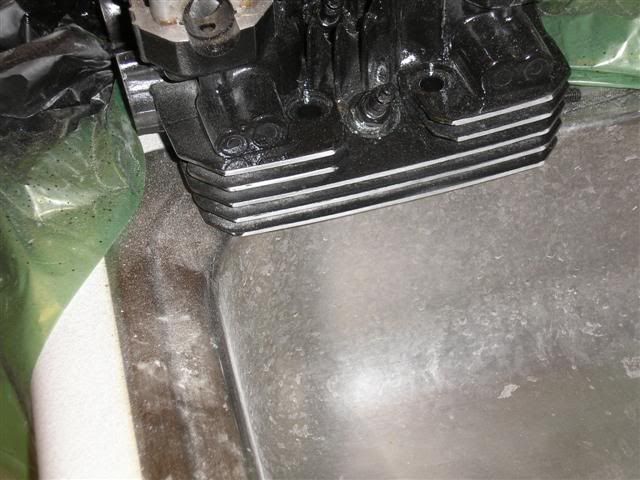
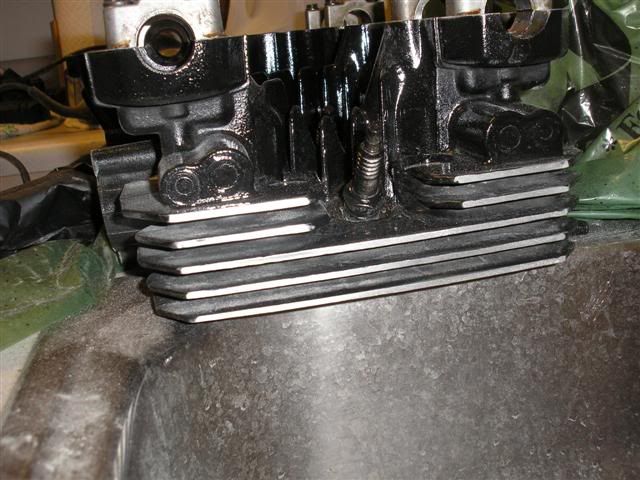
I started today with 320 grit on my finish sander. That is when I discovered the imperfections in the fins. They were not even, so I had bright shiny spots intermingled with black paint. Looked kind of like an Apaloosa.
I wonder if a sanding block would do better, or if I would do better if I started with 80 grit instead. I have 320, 400, 600, 1000 & 2000. But until those black bits are gone, I see no use in going forward.
You have the look I want, Mindless.
 
I agree with the sanding block. Wet sand after the paint has cured.

Of course you could use a hand grinder with a 3.5 inch heavy duty grinding wheel to really grind it down...hell you could just smooth away all the fins that way too, be easier to paint next time.

:D
 
I used files on the two engines I have done so far. Didn't take very much off, but most of the fins had a casting line.
I just took that down to a flat edge. :o

I learned from the mistakes on the first one and filed the edges first, then painted, then scraped the paint off the edges.

.
 
Actually, I did some prep work using a file first to get the fins flat, but that was before I painted the engine. The casting on the fins isn't perfect so they will be a bit rough around the edges if you just sandpaper them.
 
I agree with the sanding block. Wet sand after the paint has cured.

Of course you could use a hand grinder with a 3.5 inch heavy duty grinding wheel to really grind it down...hell you could just smooth away all the fins that way too, be easier to paint next time.
:D
I vote for Al's method. Mind if I do it in your garage? Smartaleck. ;)
 
Actually, I did some prep work using a file first to get the fins flat, but that was before I painted the engine. The casting on the fins isn't perfect so they will be a bit rough around the edges if you just sandpaper them.
This is what I am seeing. I went ahead and repainted the edges because they looked so bad. Not sure what to do now, they look better all black than splotched.
 
you do not need bastard files unless you want to file away your head! as stated, get a sanding block and use it wet. make sure the paint has properly dried first and you will be good. finish it off with 600 800 then 1000 grit paper for a polished finish

The file is to actually cut down the fin to give it a uniform edge. The GS1100E heads are rough cast and the edge is pinched down irregular.

After I looked at a HD up close and realized how deeply they machined the fins I had at it.

Once the fin is filed down, and sanded with 400, I paint over it and after the paint hardens the 400/Block Sanding takes the paint right off leaving a very nice surface

I would not use an electic sander it is to big and you will likely run it across some other painted surface you dont intend.
 
The file is to actually cut down the fin to give it a uniform edge. The GS1100E heads are rough cast and the edge is pinched down irregular.

After I looked at a HD up close and realized how deeply they machined the fins I had at it.

Once the fin is filed down, and sanded with 400, I paint over it and after the paint hardens the 400/Block Sanding takes the paint right off leaving a very nice surface

I would not use an electic sander it is to big and you will likely run it across some other painted surface you dont intend.
i just thought a bastard file sounds a bit drastic
 
Please note, this is a finish sander, a Makita B04550 4"x4" vibrating sander. It is a small hand-held, but can't do wet sanding for obvious reasons.
From my initial results, it sounds like I need to use the file (or borrow Al's grinder) ;) ). Hmmm.
 
i just thought a bastard file sounds a bit drastic

Not really you might need to take 1/8" off the end of the fin to get a uniform flat surface. The HD are machined with something and I bet thay take off more like 5/32" or more.

I use a fine tooth and take my time. :)
 
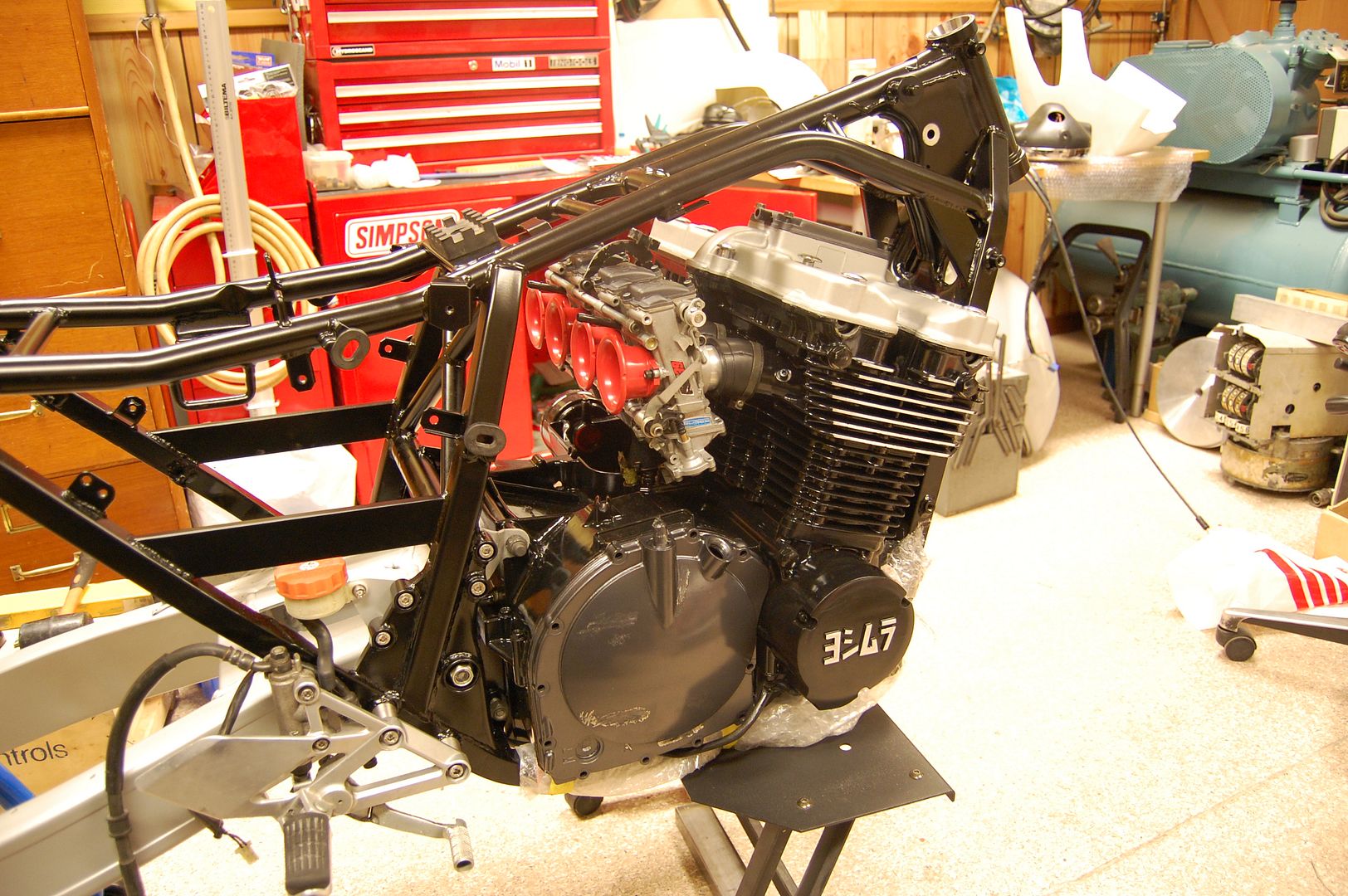
Pics, we need pics. Unless I see pics I will figure it is a figment of your imagination. Or maybe a GPZ shaftie? :p ;)
 
Pics, we need pics. Unless I see pics I will figure it is a figment of your imagination. Or maybe a GPZ shaftie? :p ;)
If you insist:

Before I started working on the bike:
P6080064.jpg


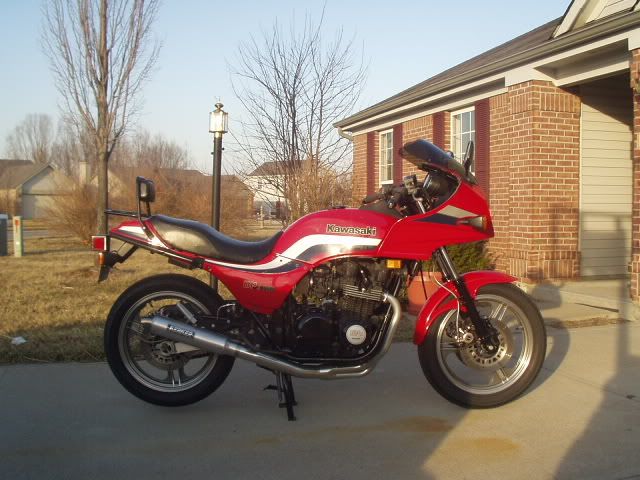
After I have done most of the improvements:

P1010183.jpg


The last one is an actual pic of the GPz prior to going under the knife.
 
Try using a piece of sandpaper 8 x10 (your choice grit really depends on how much to be removed) tape or staple it to a piece of 3/4 good one side plywood...yes use the good side.....viola you got a big "file" and easier to create a flat surface if needed you can make it smaller and even cut handles into the plywood. Be sure to secure the head a woodworking vice works very well with wood in the jaws to protect the head. You could too finish with wet paper around 400 grit and a little oil it'll be a very smooth matte surface.This should give you a great result! I use a similar technique on gasket surfaces on a surface table shows up where you put the screwdriver (pry bar).....not that you used one!!

Randy
 
I used a Dremel tool with an 80-grit flapper wheel. This is an '82 Honda FT500 Ascot head.

I had bead-blasted the original black paint off, then used the dremel wheel first to make the fin edges smooth and 'brushed'. Then painted head using rattle-can high-heat engine paint in semi-gloss black. Then, hit again with the Dremel tool. If you keep a steady hand, and a fairly low speed on the tool, it works great.

Kirk

Copyof005.jpg
 
Update

Update

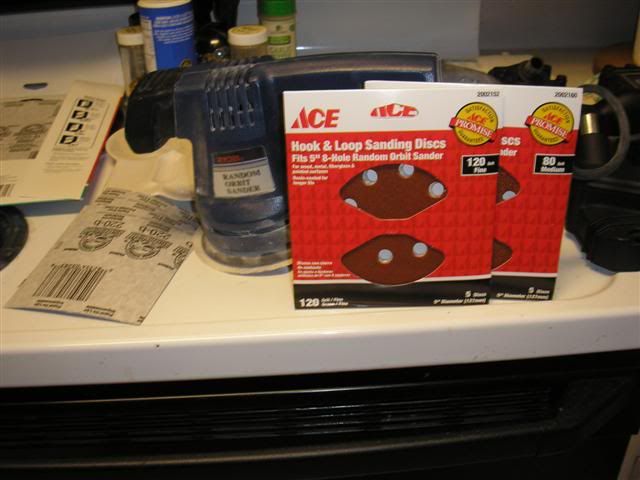
Using ideas from members, I finally came up with a solution. Most did not work for this head, so I set it aside while I took care of other things. Today, I was at the hardware store staring at the sandpaper wall. The wetordry paper was too fine, only going down to 220 grit. I kept looking at the wall, trying to find something in the 80 grit arena. I spied some round ones that looked familiar. I went home and searched through my power tool boxes (I try to always get a boxed unit so I can keep them organized without cords all over the place). Sure enough, I came across a Ryobi Orbital sander I had purchased years ago to sand a counter top prior to painting. I purchased a pack of 80 and 120 grit and went to town.

sander.jpg


As I carefully ground down the paint trying to even everything out, I discovered that the casting was very uneven, not only on each individual fin but as a set of fins. I ended up actually filing metal off the head. I used the 80 grit for the rough work, then moved to the 120 grit to get the small cavities ground down.
This is the result of just the orbital work:

sideview1head.jpg

head.jpg


All of the palamino pits are gone. I am now in the process of using the wetordry on a sanding block to polish it smooth and get rid of the grooves left by the orbital sander. Results with the 220 are looking good, and I'll then move to 600 and finally 1500 to get the mirror finish I want.

I want to thank everyone who contributed their ideas for getting me through this issue.

p.s. I'm single, so I am allowed to do this kind of work in the kitchen. ;)
 
Back
Top