• Required reading for all forum users!!!

    Welcome!
    Register to access the full functionality of the GSResources forum. Until you register and activate your account you will not have full forum access, nor will you be able to post or reply to messages.

    A note to new registrants...
    All new forum registrations must be activated via email before you have full access to the forum.

    A Special Note about Email accounts!
    DO NOT SIGN UP USING hotmail, outlook, gmx, sbcglobal, att, bellsouth or email.com. They delete our forum signup emails.

    A note to old forum members...
    I receive numerous requests from people who can no longer log in because their accounts were deleted. As mentioned in the forum FAQ, user accounts are deleted if you haven't logged in for the past 6 months. If you can't log in, then create a new forum account. If you don't get an error message, then check your email account for an activation message. If you get a message stating that the email address is already in use, then your account still exists so follow the instructions in the forum FAQ for resetting your password.

    Have you forgotten your password or have a new email address? Then read the forum FAQ for details on how to reset it.

    Any email requests for "can't log in anymore" problems or "lost my password" problems will be deleted. Read the forum FAQ and follow the instructions there - that's what we have one for...

  • Returning Visitors

    If you are a returning visitor who never received your confirmation email, then odds are your email provider is blockinig emails from our server. The only thing that can be done to get around this is you will have to try creating another forum account using an email address from another domain.

    If you are a returning visitor to the forum and can't log in using your old forum name and password but used to be able to then chances are your account is deleted. Purges of the databases are done regularly. You will have to create a new forum account and you should be all set.

If you know GS Carbs. Please help

  • Thread starter Thread starter pearljam724
  • Start date Start date
P

pearljam724

Guest
I bought a 87 GS450L about a month ago. Bike ran great. Being the bike is 25 years old however. I thought it would be a good idea to tear apart the carbs for a visual inspection and possible clean up. Did that, reassembled. At first I had a vacuum leak as a result of old o rings on the manifold boots. Fixed that, no vacuum leak. The bike is now running well. Easy start up, good idle and throttle response. It is however running a tad on the rich side due to a slight gas smell and minimum exhaust popping. I never touched any exterior air fuel mixture screw. Which leaves me baffled to why it would be running rich. Did I turn in one of the pilots incorrectly too far to create this problem ? I was thinking I could easily fix the rich situation by adjusting air/fuel mixture screw. However, after looking at a dozen manuals, schematics, etc. I can't quite pinpoint where exactly my a/f mixture screw is. I know it's covered by a metal cap that needs to be drilled out first. But, I have several of those on the exterior. One manual shows it's near the only vaccum line. Once again, I have a few caps showing there. Which one is it ? And do all of the caps have a screw under them ? Just incase I drill out the wrong cap. If someone is uncertain, I could post a pic of my carbs later. Any further suggestions about the rich scenerio would also be appreciated.
 
Last edited:
One of the 450 guys will pinpoint the hidden mixture screw. But check petcock operation to make sure sure fuel isn't dribbling down vacuum line and making that carb too rich.
 
One of the 450 guys will pinpoint the hidden mixture screw. But check petcock operation to make sure sure fuel isn't dribbling down vacuum line and making that carb too rich.

Thanks Tom. I did that, petcock is working perfectly fine. No dribble, when the lines are removed. Good suggestion.
 
The 450s came with two different style carbs, I believe the newer style started in '83, so that should be what you have. The earlier carbs were strange little creatures that had jets screwed into the float bowl, the newer ones were much like the carbs on the 1100s, much easier to deal with.

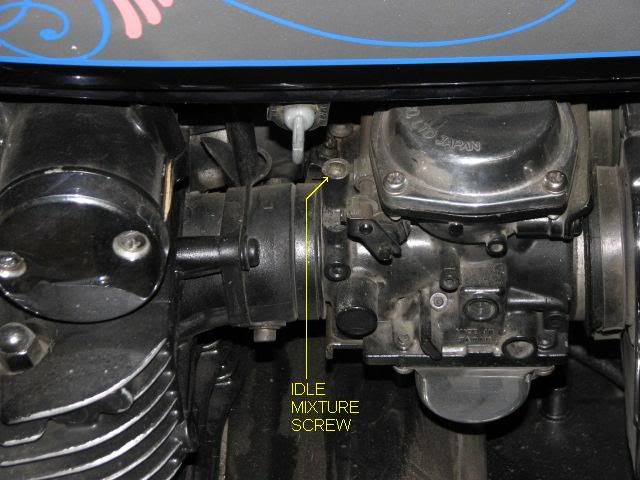
Here is where your mixture screws are hidden:
IMG_2958.jpg


All of the jets inside the carburator should be installed snuggly, there is no adjustment to them, other than replacing them with a different size.

.
 
The 450s came with two different style carbs, I believe the newer style started in '83, so that should be what you have. The earlier carbs were strange little creatures that had jets screwed into the float bowl, the newer ones were much like the carbs on the 1100s, much easier to deal with.

Here is where your mixture screws are hidden:
IMG_2958.jpg


All of the jets inside the carburator should be installed snuggly, there is no adjustment to them, other than replacing them with a different size.

.

Thanks a lot guys. But, correct me if I'm wrong. Steve the mixture screws you pointed out are idle mixture screws that synch both carbs. It's not an Air Fuel mixture screw. Unless, I'm confused. All of the manuals and schematics show the Air fuel mixture screw being on the right side carb, right by the vacuum hose nipple. Are idles screws sometimes described as Air Fuel mixture screws ?
 
To be really sure, put clear vinyl hose on petcock vac fitting and suck- many (like my old one) won't dribble till suction is applied.

Thanks Tom, I'll don't like to suck. But, this time I'll make an exception. :D
 
Thanks a lot guys. But, correct me if I'm wrong. Steve the mixture screws you pointed out are idle mixture screws that synch both carbs. It's not an Air Fuel mixture screw. Unless, I'm confused. All of the manuals and schematics show the Air fuel mixture screw being on the right side carb, right by the vacuum hose nipple. Are idles screws sometimes described as Air Fuel mixture screws ?
OK, I will try to correct you. :o

Why would they have a mixture screw on just the right carburetor? :-k

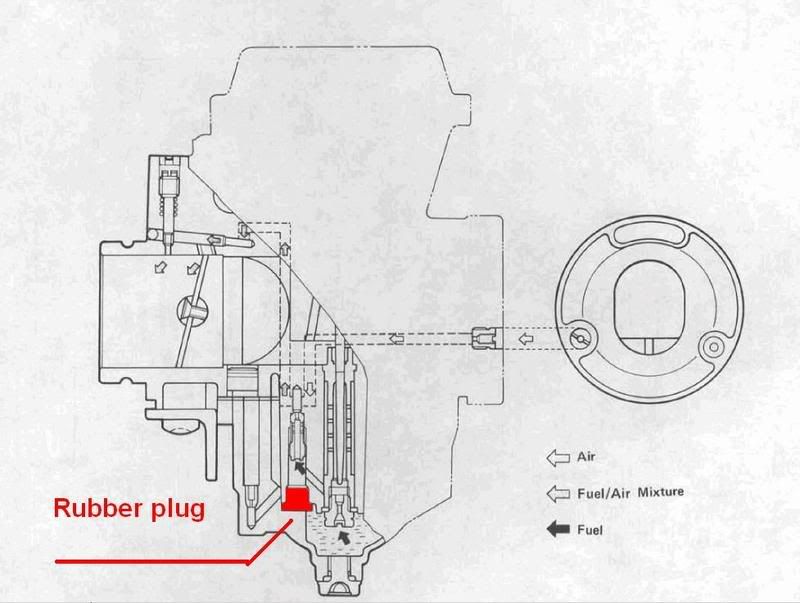
It also helps to have proper terminology going here. The terms "idle mixture screw" and "air fuel mixture screw" are somewhat interchangable here. The actual mixture is controlled by the pilot air jet that lives in the intake throat, and the pilot fuel jet, that lives down in the bowl, next to the main jet. Together, they make a pre-set mixture that is admitted to the airstream through three small holes. If you look into your carbs from the engine side, you will see two holes right at the top of the throttle butterfly. One should be showing with the throttle closed, the other will be uncovered with a very small opening of the butterfly. Those two holes are able to provide some of that preset mixture whenever they can. The one that is always open is not quite enough to supply the needs of the engine at idle, so there is another hole that you will see directly under the "idle mixture adjustment screw" (official Suzuki terminology). Adding a bit of mixture through that port will handle the needs of the engine at idle. As you start to open the throttle for some low-speed running, that hole that is just behind the top of the butterfly is now open to the airstream, and also provides some mixture. Now you have THREE ports that are providing fuel to the engine. They usually handle the job until the throttle is opened up just a bit more and the needle jet starts kicking in.

If you refer to this cutaway from the manual, you can see the three ports in the idle circuit:
CarbRubberplug.jpg


Look at the diagram, you can see the pilot fuel jet just above the rubber plug. Fuel mixture then goes up, just to the left of the pilot jet, goes above the carb throat, and you can see the three ports where it can enter the airstream.


If you look between the carbs, just to the left of where the throttle cable attaches to a pulley (on #2 carb), you will see the sync adjuster. It is a setscrew and locknut assembly. There is only ONE of them on your bike. It will adjust the point where the two carbs open in relation to each other, synchronizing their opening point. That adjustment has NOTHING to do with fuel mixture.

And the mixture screws have NOTHING to do with carb sync.

.
 
Under my circumstance explained earlier. What should I do ? The bike is running pretty well. Infact, I took it for a 100 mile ride today. It is running A TAD on the rich side. It barely pops. So, minimal that it actually sounds like a low sounding " Pup " if you know what I mean. It does not pop at idle or above 4.5k rpm's. It's consistent enough however between 2 - 4.5k. I understand that under this circumstance it's not a severe problem. But, I am very anal about this stuff. Plus, I am determined to get it right as I want to learn how to fine tune carbs on my own. I never replaced the o rings, knowing it's the right thing to do. But, the interior was in mint condition. O rings included. My understanding is. I would have to turn in both adjustment screws on each carb that you pointed out until the bike starts stalling. At that point, turn them both equally to 1 1/4 - 2 turns out. Then reset the idle adjustment screw directly beneath both carbs. Is this right ? And is this what needs to be done ? The biggest thing that has me baffled. If I never changed the exhaust, air filter and put everything back as I found it. Why is it running rich when it didn't to begin with and I never adjusted any mixture settings to begin with ?
 
Last edited:
If you are truly anal, you'd like the carb cleaning procedure.And 28 year old o-rings might have lost their flexibility. Things can look "mint" but there are tiny passages that can clog rather easily. IF you didn't have any running issues, consider yourself lucky and just ride. But since you are posting about a problem, it sounds like you'd like to correct it.
The idle air mixture screw is set individually for each carb, then the two carbs (in your case) are synched together, so they both share the load.

You describe "popping" and a smell of gas- to me, this sounds like a spark plug fouling in some rpm range. Just removing and openning the carbs might have disturb them. Plus who knows what maintenance has actually been done on this new to you bike.
 
If you are truly anal, you'd like the carb cleaning procedure.And 28 year old o-rings might have lost their flexibility. Things can look "mint" but there are tiny passages that can clog rather easily. IF you didn't have any running issues, consider yourself lucky and just ride. But since you are posting about a problem, it sounds like you'd like to correct it.
The idle air mixture screw is set individually for each carb, then the two carbs (in your case) are synched together, so they both share the load.

You describe "popping" and a smell of gas- to me, this sounds like a spark plug fouling in some rpm range. Just removing and openning the carbs might have disturb them. Plus who knows what maintenance has actually been done on this new to you bike.

Changed plugs as soon as I noticed the popping. As I thought the same as you. Correct Gap. This bike is in absolute mint condition. Plus, I did all of the things that should be done to a bike since owning it. With the exception of checking the valves. I'll do that over the winter. What you are describing Tom is synching the two carbs. I need to know how to correct the A/F mixture.
 
Last edited:
"I need to know how to correct the A/F mixture. "

You can increase/decrease this for idle/low speed with the idle air mixture screw on each carb. BUT this only works at very low throttle settings.You can't adjust for typical running as the carb design (jet size, needle, those tiny holes, etc.) left Japan optimized for the stock intake and exhaust on your bike. Review Mr. Steve's description of low speed carb function- the carb is very busy here and any clogs could muck things up and overrichen the mixture in certain RPM ranges. A fouled spark plug will send unburned mixture down the exhaust and if you have a crossover pipe connecting left and right mufflers, this unburned stuff can ignite (pop).
Check that petcock for suction leaks to rule it out as the culprit- mine failed this way and produced popping at low throttle settings.
 
Changed plugs as soon as I noticed the popping. As I thought the same as you. Correct Gap. This bike is in absolute mint condition. Plus, I did all of the things that should be done to a bike since owning it. With the exception of checking the valves. I'll do that over the winter. What you are describing Tom is synching the two carbs. I need to know how to correct the A/F mixture.


Sounds to me like your meticulous nature is getting in the way of seeing the big picture. You're not the first and definitely not the last to search for that elusive nugget of wisdom to solve this very hard to figure out issue, when you have already (most likely) solved your own problem.


Mint condition might be better associated with exterior appearance, in this case, until you completely tear down your carbs, soak 'em good, then while they're soaking, adjust the valves. THEN you'll be closer to mint condition, and at the same time you'll have eliminated many unforseen and unfixable unknowns that are likely causing what's going on.
 
The bike normally would be a little lean if the intake o-rings were leaking air. Maybe someone in the past made some adjustment to account for that. Then, when you corrected the o-ring problem, the bike began to run rich. Maybe your needles have been shimmed if it's running rich at a throttle opening of more than a 1/4 turn.
 
In my experience your better off having the bike run slightly rich. Cold start ups are easier, and there is a smoother transition to the needle circuit. You don't really want the bike to "Pop" as that is really lean running, your "PuP" is what you want to hear on deceleration. If you rev up the bike and it goes right back to idle without hanging (lean), or dipping below idle (rich) then your spot on. Also if the bike is too rich it will stumble on accelleration if it has been idling for a while like at a long red light. Rich symptoms get worse the hotter it is outside, lean get better. I hope that helps.
 
The bike normally would be a little lean if the intake o-rings were leaking air. Maybe someone in the past made some adjustment to account for that. Then, when you corrected the o-ring problem, the bike began to run rich. Maybe your needles have been shimmed if it's running rich at a throttle opening of more than a 1/4 turn.

Good point which was the case, before I ordered new n installed. Until then the problem was much worse. Was acting as if it was running on 1 cylinder which is no longer the case since I changed them. Good point about some someone adjusting something prior as well
 
Last edited:
The bike normally would be a little lean if the intake o-rings were leaking air. Maybe someone in the past made some adjustment to account for that. Then, when you corrected the o-ring problem, the bike began to run rich. Maybe your needles have been shimmed if it's running rich at a throttle opening of more than a 1/4 turn.

all of you made great points which I'll take into account and appreciate.
 
Bike Is running pretty damn good right now. The cool weather made a huge difference. I'm going to leave it alone.
 
Bike Is running pretty damn good right now. The cool weather made a huge difference. I'm going to leave it alone.

So it IS in fact running a tad rich. There are a few conditions that would make a CV carb run rich in the RPM range that you mention.

1. Shimmed jet needles
2. Air mixture screw adjustment as Steve pointed out and nicely illustrated.
3. Hard and shrunken 25-year old internal carb O-rings allowing fuel past the metering points.
4. Dirty or over oiled air filter.

Take your pick of the four I mention OR...better yet, check the jet needle height position (visual inspection) it should be in the third notch down from the top or up from the bottom. The middle position...

Lightly seat your mixture screws and then back them out about 2 turns.

Replace the o-rings in the carbs as those of us who have provided you with all this "anal relief", have ALL done this several times in the past and may just know a thing or 4500 things, about the carbs on these bikes.

Either replace your air filter if it needs it and or clean and lightly oil your filter if you have a K&N drop in, like I do.

Good luck
 
Back
Top