• Required reading for all forum users!!!

    Welcome!
    Register to access the full functionality of the GSResources forum. Until you register and activate your account you will not have full forum access, nor will you be able to post or reply to messages.

    A note to new registrants...
    All new forum registrations must be activated via email before you have full access to the forum.

    A Special Note about Email accounts!
    DO NOT SIGN UP USING hotmail, outlook, gmx, sbcglobal, att, bellsouth or email.com. They delete our forum signup emails.

    A note to old forum members...
    I receive numerous requests from people who can no longer log in because their accounts were deleted. As mentioned in the forum FAQ, user accounts are deleted if you haven't logged in for the past 6 months. If you can't log in, then create a new forum account. If you don't get an error message, then check your email account for an activation message. If you get a message stating that the email address is already in use, then your account still exists so follow the instructions in the forum FAQ for resetting your password.

    Have you forgotten your password or have a new email address? Then read the forum FAQ for details on how to reset it.

    Any email requests for "can't log in anymore" problems or "lost my password" problems will be deleted. Read the forum FAQ and follow the instructions there - that's what we have one for...

  • Returning Visitors

    If you are a returning visitor who never received your confirmation email, then odds are your email provider is blockinig emails from our server. The only thing that can be done to get around this is you will have to try creating another forum account using an email address from another domain.

    If you are a returning visitor to the forum and can't log in using your old forum name and password but used to be able to then chances are your account is deleted. Purges of the databases are done regularly. You will have to create a new forum account and you should be all set.

Large Valve Clearances

  • Thread starter Thread starter Dreef1999
  • Start date Start date
Actually, I'd imagine that a problem with the cam caps would not affect the clearances like that -- basically, in measuring position, the cam lobe is not pushing down against the valve spring. The positions of nearby valves could affect this, but I'd have to open up my engine and sit down with a beer and stare at it a while to ponder this.

Also, just to be contrary, I've never found a difference in valve clearances between following the Suzuki procedure exactly and simply rotating the engine until the cam lobe for the valve I want to check is in the right position. Some folks have. FWIW, YMMV, etc. I expect violent disagreements to erupt over this heresy...

To be fair, I haven't repeated this experiment (Suzuki Way vs. My Way) on every engine I've encountered, but usually I just set the #1 exhaust lobe to point straight away from the cylinder head, then do the same to #2, #3, #4, etc. and then do the intakes in the same order. It's easier in my mind to simply rotate the engine more times than to risk getting disorganized.


ANYWAY... back to the OP's problem:

It really sounds like either the engine has had work done in the past, and whoever was in there last just did the best they could with the commonly available shims. If the valve seats have been re-cut, many builders will grind the ends of the valve stems to match, and they may have gone a wee bit overboard. Not a problem if you can find shims large enough, and it sounds like you can. (Can you post which shims are in there now?)

The other possibility is that carbon buildup on the valves is propping them open. This is pretty uncommon, but I guess it's a possibility. How has the bike been running? Are the plugs black and gross, or are things pretty good mixture-wise?

And, um, the engine was room temperature (not run for at least 12 hours) when you measured the clearances, right?


So here's what I'd do, assuming it's running well:

Button it up, ride the living snot out of it for another 500 - 1,000 miles, and re-check the valves. If it was carbon buildup, the carbon will get hammered out of the way and you'll get the "true" clearances.

If it's just big clearances (they're all about the same as previously), drop in a larger shim on the #2 intake and don't worry about the others.


There's nothing at all wrong with using inch feeler gauges. I used them for years until I finally found a set of metrics. It's just a little easier mentally to work in mm. I dunno about you, but my mind needs all the help it can get. :D Also, the metric set has more feelers in this size range -- mine has one for every .01mm from .03 to .15. So there.
 
Good point on checking those bolts as I hadn't even thought of that.

ANYWAY... back to the OP's problem:

It really sounds like either the engine has had work done in the past, and whoever was in there last just did the best they could with the commonly available shims. If the valve seats have been re-cut, many builders will grind the ends of the valve stems to match, and they may have gone a wee bit overboard. Not a problem if you can find shims large enough, and it sounds like you can. (Can you post which shims are in there now?)
2x 2.75, 2x2.80, 2x2.85, 2x2.90 although I would have to check my sheet at home to tell you which shim was in which valve. My math was telling me to buy 2x2.95s and rotate the other shims to get everything in tolerance.

The other possibility is that carbon buildup on the valves is propping them open. This is pretty uncommon, but I guess it's a possibility. How has the bike been running? Are the plugs black and gross, or are things pretty good mixture-wise?
Had dipped the carbs, got it running very rich then dialed back to jsut slightly rich. Was noticing that cylinder 4 seemed to be more lean than the others and decided that I was wasting effort until I knew the valve clearances were ok.

And, um, the engine was room temperature (not run for at least 12 hours) when you measured the clearances, right?
Engine was a few days cold when i measured.

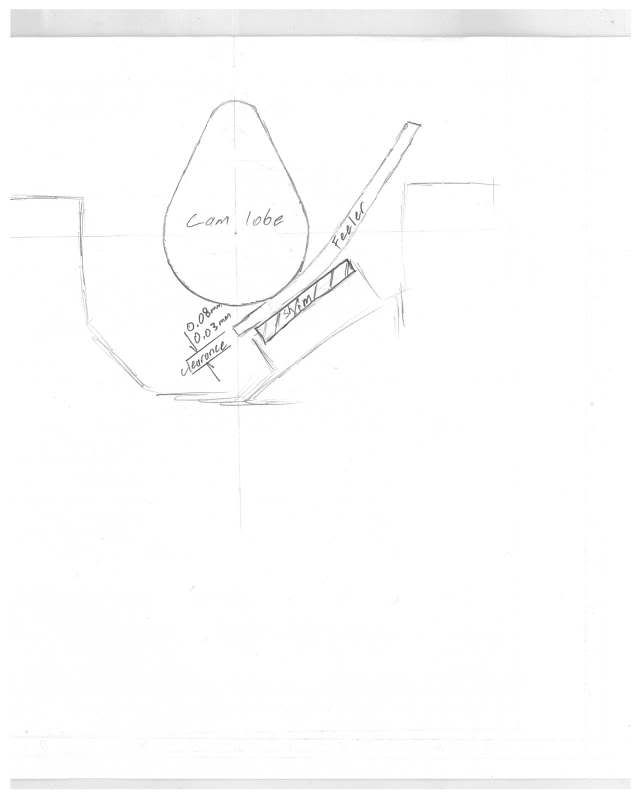
For clarification this is a sketch of how I am checking clearances. Camera is away so no pictures for now so hopefully this will help somebody explain how I can be messing this up.

CamLobe.jpg
 
Last edited:
I have no doubt that your measurement are fine. I would chalk it up to a previous owner, re-shim to the proper clearances, button it up and go for a ride. Most of my shims had no numbers to read and I had to use a micrometer incremented in inches to read them. I then converted to mm. It's all good. I don't think Z1 would offer a fat shim if there wasn't a call for one now and again.
 
Hey, with a "sketch" like that, if you feel you missed your calling as a mechanic, I think you will make it as an artist. :clap:

.
 
I don't understand why you are not measuring per the suzuki method. Please explain your logic.
 
Ed, I don't think he knows the Suzuki method, probably going by the manual (some spec that way) or by common practice I guess....

Not sure where that link is to the Suzuki manual page, you got it anywhere?

Dan :)
 
I don't understand why you are not measuring per the suzuki method. Please explain your logic.
This in reference to me or bwringer?

I just set the #1 exhaust lobe to point straight away from the cylinder head, then do the same to #2, #3, #4, etc. and then do the intakes in the same order. It's easier in my mind to simply rotate the engine more times than to risk getting disorganized.

This is ultimately how I ended up measuring. I was pulling shims and recording thicknesses and just found it clearer to work through methodically. The clymer shows the measurement with the lobe pointing up so I hadn't thought that it would be 'wrong'.

For comparison. My lack of method is identical at
Exhaust #2 & #4
Intake #1 & #3(?)

I could believe that the other half of the measurements are 'skewed'. But, the 4 which were by the suzuki method were all over tolerance as well :confused:. Although the largest clearance WASn't by the suzuki method so I can try re-measuring.

For some more information
Cylinder==>Current Shim ==> proposed shim
#1 Exhaust=>2.90mm==> 2.95mm
#1 Intake => 2.75mm => 2.80mm
#2 Exhaust => 2.85mm => 2.90mm
#2 Intake ==> 2.75mm => 2.80mm worst clearance
#3 Exhaust => 2.85mm => 2.90mm
#3 Intake ==> 2.80mm => 2.85mm
#4 Exhaust => 2.90mm => 2.95mm
#4 Intake ==> 2.80mm => same

Also if I understand this correctly. I should be able to differentiate between OEM shims and replacement shims? I don't recall any bevels so maybe I am in the clear and the PO just went over big on my clearances.
 
The suzuki method positions the cams in a way such that both adjacent valves are on the base circle - you adjust valves in pairs. This way is best since the adjacent valve is not pushing up on the cam and skewing it within the journal clearance.
 
The suzuki method positions the cams in a way such that both adjacent valves are on the base circle - you adjust valves in pairs. This way is best since the adjacent valve is not pushing up on the cam and skewing it within the journal clearance.
Yeah. Half of my measurements still satisfied that condition though. I can remeasure but because of the consistency of my measurements being over tolerance I don't think that can be all of the answer :(
 
I don't understand why you are not measuring per the suzuki method. Please explain your logic.

This The clymer shows the measurement with the lobe pointing up so I hadn't thought that it would be 'wrong'.
The Suzuki method is probably also the Clymer method, but I don't have a book in front of me to verify.
Using the Suzuki method, one of the two cam lobes on one side of the cam will be pointing UP. The other will be pointing forward or backward, depending on whether you are working on the exhaust or intake cam. When the lobes are in this position, you can measure BOTH valves under THAT cam without moving anything. Rotate the crank 180 degrees (using the 19mm nut on the right end of the crank), check the next pair of valves. Rotate another 180 degrees, check another pair. It is very easy to determine which pair valves are ready to be measured as neither lobe will be pushing on a valve. The hardest part is following a pattern. If I remember correctly, I do Exhaust 1&2, Intake 1&2, Exhaust 3&4, then Intake 3&4. Just checked the Suzuki manual, that is the correct order.

.
 
The Suzuki method is probably also the Clymer method, but I don't have a book in front of me to verify.
Using the Suzuki method, one of the two cam lobes on one side of the cam will be pointing UP. The other will be pointing forward or backward, depending on whether you are working on the exhaust or intake cam. When the lobes are in this position, you can measure BOTH valves under THAT cam without moving anything. Rotate the crank 180 degrees (using the 19mm nut on the right end of the crank), check the next pair of valves. Rotate another 180 degrees, check another pair. It is very easy to determine which pair valves are ready to be measured as neither lobe will be pushing on a valve. The hardest part is following a pattern. If I remember correctly, I do Exhaust 1&2, Intake 1&2, Exhaust 3&4, then Intake 3&4. Just checked the Suzuki manual, that is the correct order.

.
That is all understood. It is clear to me how the suzuki method works.
I have one point though.

Half of my measurements still satisfy the suzuki method where neither lobe is pressing on a valve and one is pointing up. Those 4 measurements shouldn't be called into question based on the method and all 4 were large, though not the largest.

The possibility that the other 4 measurements are skewed is ok with me but it unfortunately doesn't help explain all of my clearances.
 
I had a similar experience with my 850. I've just done the first valve adjustment in hopes it would fix my inconsistent firing problem on #1. I still think I have a pilot circuit issue I haven't gotten to the bottom of yet. However, when I took the cover off and took cold measurements all my exhaust side clearances were huge. The largest was 0.28mm - yes I said 0.28mm. All were around 0.2mm but in order were 1-0.20mm, 2-0.18mm, 3-0.28mm and 4-0.23mm. The intake side were all within tolerance, all four intakes having 2.75 shims.

I understand this should be a reason for further investigation but there is some confounding information that leads me to suspect the previous "person" may have been doing what he could with what he had at the time.

- by looking at the numbers on paper it could be the exhaust clearances were adjusted to be centered on 0.20mm, all four that far out and around the same number... hmmm?

- shims I wound up with exhaust side are: 1-2.80, 2-2.70, 3-2.85, 4-2.75 so on the large side but machine only has 30k on the clock. Sound about right?

- 7 out of 8 shims were 29.0mm diameter not 29.5mm (indicates the quality of the last valve adjustment me thinks!)

- three out of the four cylinders run really well at all speeds

- when pulling at anything above pilot circuit rev's #1 comes in and the engine performs really well to red line

- all the plugs look ok

Only thing I haven't done is a compression test, I don't possess a device to measure it with but I will get that done. Frankly, I don't expect to find anything awry there I think I'd get worse performance with poor compression.

If I've missed something drastic here someone please shout up so I can avoid more heartache. Other than that, I figured I'd continue with the #1 pilot circuit diagnosis whilst running the machine for a few miles then check the clearances again.
 
... shims I wound up with exhaust side are: 1-2.80, 2-2.70, 3-2.85, 4-2.75 so on the large side but machine only has 30k on the clock. Sound about right?
...
It does not really matter whether your shims are 2.30 or 3.10, as long as the clearances are correct.


... 7 out of 8 shims were 29.0mm diameter not 29.5mm (indicates the quality of the last valve adjustment me thinks!)
...
That tells me a lot about why your clerances are so large. Somebody that either did not know or did not care about the different shim diameter would stand a good chance of not knowing how to do the job correctly.


... when pulling at anything above pilot circuit rev's ...
There is no such thing as "pilot circuit revs". The different carb circuits depend on throttle position, not engine speed.


... I figured I'd continue with the #1 pilot circuit diagnosis whilst running the machine for a few miles then check the clearances again.
I don't remember seeing where you have cleaned the carbs yet. No sense in fighting it when you can simply remove the carbs and check it out in a matter of a couple of hours.

.
 
I have had valve clearance open up for me, on my 78 GS750. The vast majority of the time they will close up over time, though. I don't know why, and I really don't care. If your bike was running reasonably well before, I doubt if any valves are bent. Swap out the shims necessary to bring everything into spec, and enjoy the rest of your riding season. I would probably recheck the valves over the winter if I were you. I used to do that every winter when I had my 78, just so I wouldn't have to take off riding time for maintenance during the riding season.
 
Steve,

That tells me a lot about why your clerances are so large. Somebody that either did not know or did not care about the different shim diameter would stand a good chance of not knowing how to do the job correctly.

That's exactly the conclusion I came to!

There is no such thing as "pilot circuit revs". The different carb circuits depend on throttle position, not engine speed.

Quite right, my mistake, I meant throttle position. When open more than slightly cracked #1 comes in full steam and the machine takes off. If I bumble around the subdivision constantly just off idle #1 is in and out all the time.

I don't remember seeing where you have cleaned the carbs yet. No sense in fighting it when you can simply remove the carbs and check it out in a matter of a couple of hours.

Dude, I've had these carbs off the machine as much as on it in the last six months. First time was over the winter, before that I don't remember any issue with the performance that's why I think it's a carb issue (someone better than me at this may have been able to mask it though). Anyway, I spent time over winter, stripped them all, dipped everything overnight, installed new o-rings (carbs and intakes), reassembled with new gaskets. Inspected the intake boots while I had them off but didn't replace them because they seemed ok but this is a question. Ed was kind enough to supply me with a couple of brass parts that were missing.

After that, 3 of the 4 were leaking from around the bowl gasket. Can't remember who sussed that but it was someone here, maybe renobruce. Whoever it was asked the magic question if it was only while the machine was on the side stand. Evidence round the bowls supported that so I took the carbs off once more to replace the boogered bowl screws with new ones I could tighten better. While they were off, I went through all four again, redipping and cleaning (the bowls needed it anyway). I paid particular attention to the pilot circuit on #1 and am sure all those passages are clear. I posted high res pictures from our microscopy lab of the float needles and seats. HampshireHog was impressed with the pictures but reckoned they were too close up to tell if the needles were worn. I decided to set the floats again to spec then before fitting the rack on the machine I connected the fuel line and checked the gas height in the bowls using a clear piece of aquarium air tube shoved into each bowl drain plug. Bit messy but it showed me the level was within spec so I convinced myself the needles and seats were good. Been proved so now I guess, no more leaking from the bowl gaskets.

Used my manometer I'd gotten from that Irish mob for the first round and synched them on the machine. Used the highest revs method to set the air screws and found another difference. #1 has highest revs when only 1/4 turn out from seated. I also got a colortune so I used that and easily set #'s 2, 3 and 4 but could never get #1 rich enough for the flame to turn yellow.

Another thing I've noticed is the header on #1 is cold enough to hold whilst starting on choke. I get burnt after a few seconds with the other three. Soon as the choke is off, #1 starts to warm.

Been messing with it ever since, the next step was to do the valve clearances.

I figured my best bet now was to get a spare set of carbs and start swapping parts. I wonder if the passage the air screw sits in has been damaged by the bent screw but guessing. Been chasing up Pablo for the set he has, have dibs I think but haven't heard anything from him since.

In the end I just want to get her running like I know she can but I'm running out of ideas.

EDIT: Forgot to mention I also cleaned, painted and sealed the airbox and installed new airbox boots over the winter as well.
 
Last edited:
OK, you might have mentioned the carb work in another post, I just didn't see it mentioned here. :o

If it were my bike, I would pull the carbs (again) and look very closely at the cleanliness of the 'choke' pickup tube and the pilot circuit in #1. Along with the 'choke' tube, check the passage in the float bowl that it fits into. If the exhaust pipe remains cold when using the 'choke', it makes me think that it's not getting fuel, so look for an obstruction in the supply. If #1 remains cooler than the others when the 'choke' is turned off, it sounds like the pilot circuit is plugged. Since you cleaned the carbs quite well rather recently, you might get away with spraying some cleaner through the passages against the normal flow. Remove the mixture adjustment screw, cover the outlet holes in the carb throat and spray into the hole where the adjustment screw came out. If you are able to pressurize the flow a bit, you might be able to flush whatever is blocking the line.

.
 
No worries, that's cool. Wanted to post up here so our mate that started the thread knew it's possible to have large valve clearances and probably have nothing to worry about.

Not trying to hijack the thread here but I really am all ears for some useful suggestions on what I can try next. I'm pretty sure all those choke pipes, pickups and passageways are clear in #1. I was real particular because I knew it wasn't working right, in fact that was one of the reasons I stripped them in the first place. I ran a guitar string through all the places I could like the pick up tube then sprayed cleaner through. Always possible I missed one I suppose, I didn't go to the length of comparing it with another working one to see if spray came out of somewhere in a working one and not in the duffer.

I've also swapped the plug and HT supply with #4 with no change so I'm still back with a fuel issue somewhere.
 
No worries, that's cool. Wanted to post up here so our mate that started the thread knew it's possible to have large valve clearances and probably have nothing to worry about.
And I do appreciate the info.
I went in to check my shims because #4 was running noticeably more lean(light plugs, slow to warm up) than the other 3 cylinders. Turns out #4 was the closest to 'spec' with intake within tolerance and exhaust just a bit out.

Hopefully shuffling things closer to spec all around will help.
 
Back
Top