• Required reading for all forum users!!!

    Welcome!
    Register to access the full functionality of the GSResources forum. Until you register and activate your account you will not have full forum access, nor will you be able to post or reply to messages.

    A note to new registrants...
    All new forum registrations must be activated via email before you have full access to the forum.

    A Special Note about Email accounts!
    DO NOT SIGN UP USING hotmail, outlook, gmx, sbcglobal, att, bellsouth or email.com. They delete our forum signup emails.

    A note to old forum members...
    I receive numerous requests from people who can no longer log in because their accounts were deleted. As mentioned in the forum FAQ, user accounts are deleted if you haven't logged in for the past 6 months. If you can't log in, then create a new forum account. If you don't get an error message, then check your email account for an activation message. If you get a message stating that the email address is already in use, then your account still exists so follow the instructions in the forum FAQ for resetting your password.

    Have you forgotten your password or have a new email address? Then read the forum FAQ for details on how to reset it.

    Any email requests for "can't log in anymore" problems or "lost my password" problems will be deleted. Read the forum FAQ and follow the instructions there - that's what we have one for...

  • Returning Visitors

    If you are a returning visitor who never received your confirmation email, then odds are your email provider is blockinig emails from our server. The only thing that can be done to get around this is you will have to try creating another forum account using an email address from another domain.

    If you are a returning visitor to the forum and can't log in using your old forum name and password but used to be able to then chances are your account is deleted. Purges of the databases are done regularly. You will have to create a new forum account and you should be all set.

Mechanical advancer

  • Thread starter Thread starter J Mac
  • Start date Start date
You may continue to join the multitude that think it's a "CDI", but you will still be as wrong as they are.

I'm outta this thread.
.
It's quite sad that people are arguing that because their Suzuki doesn't have CDI, then the Kawasaki guys can't either. Jealous much?

You can continue to think I'm wrong that's alright. I know you don't know how CDI actually works so I don't mind if your lack of understanding challenges my understanding.

It's a shame you're bowing out of the thread on this account. I would show you the capacitor in that schematic but you're not going to be here to see it anyway.

That said, as others have said, this thread is about mechanical advancers on/for Suzuki. Kawasaki and CDI are irrelevant.
 
I would show you the capacitor in that schematic but you're not going to be here to see it anyway.

I'm interested in learning so explain to me. As mentioned earlier and as detailed in the link provided, a CDI should have both a pulse generating/trigger coil and an exciter/charge coil, but the GS/KZ ignition systems do not have a exciter/charge coil which charges the capacitor. How can these systems be a CDI type when they don't have this element?

GS ignition.jpg
 
I'm interested in learning so explain to me....How can these systems be a CDI type when they don't have this element?

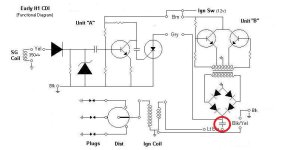
You're focusing on a very specific design and not the operational principle of CDI itself. CDI can be implemented a number of ways. Regardless of how it's implemented a CDI always has the commonality that a capacitor is used to store a higher than conventional amount of energy and deliver it to the spark plug upon firing. This energy can take the form of a higher voltage (hotter) spark or a multi-strike spark. The capacitor for the H1 schematic in question is circled in red below.

cdih1e.jpg

For more information on CDI, consult wikipedia, your nearest library, or even the world wide web.
 
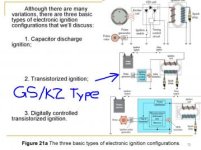
Now that I'm at home I can upload a proper functional diagram of the different types of ignition systems from that link I provided earlier. After reviewing these it's clear that the GS and KZ bikes do not have a CDI system, regardless of an ignition coil being in the system or otherwise. Judge as you will beyond that...

ignition by nessism, on Flickr
 
You never answered the question.
You answered it with your own diagram..."Although there are many variations" - like I said you're focusing too specifically.

Is a GS not a motorcycle because it doesn't have a V-Twin single pin crank like a Harley-Davidson? It has two wheels, the usual controls, and everything else like a "motorcycle" but it doesn't have V-Twin propulsion so it must not be a motorcycle?
 
... a CDI always has the commonality that a capacitor is used to store a higher than conventional amount of energy and deliver it to the spark plug upon firing. This energy can take the form of a higher voltage (hotter) spark or a multi-strike spark. The capacitor for the H1 schematic in question is circled in red below.

View attachment 58242

For more information on CDI, consult wikipedia, your nearest library, or even the world wide web.
Like many others on this forum, I am old enough to remember when CDI hit the market as an aftermarket option.

In your diagram, I see a capacitor on the output of a bridge rectifier. The filtered output feeds the low-voltage side of a coil. It is the output of that coil that is then directed to the spark plugs via a distributor. From that diagram, I can't say whether that is a storage capacitor or a smaller filter capacitor. The input to that bridge rectifier seems to come from a transformer circuit, so there appears to be higher voltage there. That does fit the model of a CDI system, but that is not the system that Suzuki used in the GS.

It should also be noted that the coil that is used in a CDI system is not the same as the coil in the GS. Our coils are high inductance, as they store the magnetic field, then release it when triggered. The coil in a CDI system is low inductance, as it is only used as a transformer to raise the voltage.

Bottom line: There may be other bikes that do use a true CDI system, but none of them has "GS" on the side cover.
 
...In your diagram....That does fit the model of a CDI system, but that is not the system that Suzuki used in the GS.
That is NOT my diagram but one posted earlier of a supposed kawasaki CDI. The earlier post postured that the schematic for a Kawasaki H1 CDI was not a real CDI because of the presence of an ignition coil.

You're right, I'm aware of no 80's era GS that implements a CDI. I've also made no such claim that any Suzuki's have CDI.

What other's can answer for me is why the hang up on CDI? What does it matter if it is or it isn't a CDI? Why does it matter if anyone is mistaken on if it (any given bike) actually has CDI? A spark is a spark in my book. That's ultimately what I seek in an ignition system.
 
What other's can answer for me is why the hang up on CDI? What does it matter if it is or it isn't a CDI? Why does it matter if anyone is mistaken on if it (any given bike) actually has CDI? A spark is a spark in my book. That's ultimately what I seek in an ignition system.

For one simple basic reason - accuracy. If you are going to refer to something that doesn't exist why shouldn't you be told it doesn't exist. The original point here was to point out that the Suzuki GS series does not use CDI and therefore the person was incorrectly using the term. It was for educational purposes so they would be able to provide the correct information and receive the correct advice for their issue. Shouldn't I be corrected if I said I had an alternator on my bike when in reality it's called a stator? Both provide the ultimate electrical ability to recharge the battery during use but our bikes don't use alternators.

I'm still lost as to why you chose to make it into the argument with everyone here that tried to point out the difference to you.
 
For one simple basic reason - accuracy. If you are going to refer to something that doesn't exist why shouldn't you be told it doesn't exist. The original point here was to point out that the Suzuki GS series does not use CDI and therefore the person was incorrectly using the term. It was for educational purposes so they would be able to provide the correct information and receive the correct advice for their issue. Shouldn't I be corrected if I said I had an alternator on my bike when in reality it's called a stator? Both provide the ultimate electrical ability to recharge the battery during use but our bikes don't use alternators.

I'm still lost as to why you chose to make it into the argument with everyone here that tried to point out the difference to you.

On the flip side; If someone asks you for a Kleenex and you hand them a Puffs brand it's still the same thing. ???
 
For one simple basic reason - accuracy..... Shouldn't I be corrected if I said I had an alternator on my bike when in reality it's called a stator? Both provide the ultimate electrical ability to recharge the battery during use but our bikes don't use alternators.

I'm still lost as to why you chose to make it into the argument with everyone here that tried to point out the difference to you.

It'd be more helpful if when people tried to give accurate information, they had correct information to begin with.

I'm not even going to touch that charging bit. I can already see, based on this thread, how it would wind out. I'm just going to say one thing, Alternators have stators.

If you go back, I was not in a argument over the difference. I pointed out Steve was incorrect with what he thought was accurate and educational information. When you say you're trying to educate those that don't know or are confused, you do want them to have truly accurate information right? and not just whatever information you believe to be true right? With that in mind, I find that picture of the three types of ignitions utterly stupid. Someone writes KZ on top of it and that writes it in stone that a KZ can't possibly have any other ignition than whats outlined? And we old Suzuki experts are qualified to make that assertion about Kawasakis? That puzzles me when correct and accurate information is the supposed goal.
 
from a book, (http://ridersofvision.net/) by Dave "Leather"Draper, concisely:
TCI collapses an already charged coil by disconnecting it (TCI switches off briefly). These systems generally use a higher resistance type coil and
are known as an "induction" or "Kettering" ignition systems.
[note: "points" are the original Kettering system ?]
CDI sends a brief high (200+) voltage pulse to an uncharged coil which act like a transformer and multiplies it even higher. The step up is
normally around 100:1. These systems tend to use low resistance or "racing" oils.

I'm not sure about kawasaki or Yamaha but Hondalikes cdi ...There are really important differences...cdi is independent of the battery so when your stator ,regulator or battery fails , cdi still works....another might be : the author above points out that CDI can Kill!
 
It'd be more helpful if when people tried to give accurate information, they had correct information to begin with.

I'm not even going to touch that charging bit. I can already see, based on this thread, how it would wind out. I'm just going to say one thing, Alternators have stators.

If you go back, I was not in a argument over the difference. I pointed out Steve was incorrect with what he thought was accurate and educational information. When you say you're trying to educate those that don't know or are confused, you do want them to have truly accurate information right? and not just whatever information you believe to be true right? With that in mind, I find that picture of the three types of ignitions utterly stupid. Someone writes KZ on top of it and that writes it in stone that a KZ can't possibly have any other ignition than whats outlined? And we old Suzuki experts are qualified to make that assertion about Kawasakis? That puzzles me when correct and accurate information is the supposed goal.

I can see that you won't be long for this place. Your condescending attitude won't fit in here. You have made acquisitions that other members here don't know what they are talking about but you have not provided any meaningful technical information yourself.

10 minutes spent looking at the factory Suzuki manual (free download on Basscliff's website) will explain that GS bikes use an "ignitor" not a "CDI" so it's somewhat exasperating when we get so many newbies here that haven't done any research before posting. Steve, and myself, have corrected many newbies on this seemingly meaningless error, but it's something that should be corrected because it will help the person in question fix their bike.

And in case you didn't know, which clearly seems to be the case, Kawasaki KZ bikes were built in the same era as the GS Suzuki's. I made no reference to Kawasaki bikes in general, before or past the KZ era. And just like GS bikes KZ bikes use an ignitor not a CDI.
 
I can see that you won't be long for this place...

I think you're right. I try to pass on good information but my join date and "Forum Newbie" apparently means I'm a dimwit and can't possibly know something you don't know. The ignorance is to such a degree that you still have not read the entirety of my posts. Why should you, knowledge is obtained by having an older join date and not through actual learning here. So I apologize to everyone entirely for spreading false science instead of repeating true religious belief. That schematic that Steve showed is in fact NOT a CDI ignition of ANY sort. It's just a plain old igniter just like our GS because it's not possible for it to be any other way.

I just feel sorry for the newer members that come here seeking good information; not because there is no good information to be found here, but because it's apparent no one cares if the information they pass on is actually good.
 
Actually many new members who come here WITH AN OPEN MIND and don't try to be an arse recognize what we tell them is the truth based on how they see things work afterwards. I don't know how many times we see folks say, "you guys were right and i only wish I had listened the first time; it would have saved me X hours of work"
 
Houses of the holy...................meh.
Mindless pedantry and a sense of superiority on the part of the guys taking a crap of this new subscribers. He is essential correct as all the systems dump an electrical charge held by a capacitor.

Childish nonsense by anyone who wants to differentiate soley on the basis of school M'armish attitude.
 
Last edited:
He is essential correct as all the systems dump an electrical charge held by a capacitor.
I see we are continuing with mis-information. :-k

CDI systems do have a capacitor that holds a charge. When triggered, it is then dumped into a low-inductance coil that steps up the voltage to 20,000+, which then gets sent to the spark plugs.

As has been mentioned many times in this thread and elsewhere on the forum, the GS ignition system does NOT use a capacitor to hold a charge. It uses a high-inductance coil, which generates a substantial magnetic field while current is going through it. When the current stops, the magnetic field collapses and the secondary windings inside the coil capture that collapsing field and convert it to the high voltage that goes to the spark plugs. Up through the 1979 model bikes, the current through the coils was controlled by mechanical points. Starting with the 1980 models, the current was controlled by a box of transistors that Suzuki called an "ignitor". Nothing fancy in there, just some transistors that switched the current on and off. No capacitors.
 
Back
Top