• Required reading for all forum users!!!

    Welcome!
    Register to access the full functionality of the GSResources forum. Until you register and activate your account you will not have full forum access, nor will you be able to post or reply to messages.

    A note to new registrants...
    All new forum registrations must be activated via email before you have full access to the forum.

    A Special Note about Email accounts!
    DO NOT SIGN UP USING hotmail, outlook, gmx, sbcglobal, att, bellsouth or email.com. They delete our forum signup emails.

    A note to old forum members...
    I receive numerous requests from people who can no longer log in because their accounts were deleted. As mentioned in the forum FAQ, user accounts are deleted if you haven't logged in for the past 6 months. If you can't log in, then create a new forum account. If you don't get an error message, then check your email account for an activation message. If you get a message stating that the email address is already in use, then your account still exists so follow the instructions in the forum FAQ for resetting your password.

    Have you forgotten your password or have a new email address? Then read the forum FAQ for details on how to reset it.

    Any email requests for "can't log in anymore" problems or "lost my password" problems will be deleted. Read the forum FAQ and follow the instructions there - that's what we have one for...

  • Returning Visitors

    If you are a returning visitor who never received your confirmation email, then odds are your email provider is blockinig emails from our server. The only thing that can be done to get around this is you will have to try creating another forum account using an email address from another domain.

    If you are a returning visitor to the forum and can't log in using your old forum name and password but used to be able to then chances are your account is deleted. Purges of the databases are done regularly. You will have to create a new forum account and you should be all set.

Melted SPG = R/R failure?

hannibal

Forum Mentor
I retorqued my cylinder head bolts yesterday following reassembly in May. It started and warm up nicely, much better than it had recently (my head bolts were super loose). I rode about .5 mile and came to a red light. As I pulled away from the light, it felt a bit sluggish so I gave it a little more throttle. In the middle of the intersection, the motor died and I lost all power (lights and gauges). I also saw a big puff of smoke come out from both sides under the tank.

This morning, I pulled the valve cover and turned the motor over by hand. Everything looked great mechanically. I started looking at the electronics and found that a pair of wires at my single point ground had melted or more accurately exploded. The merged end of the wire was connected to my SPG on the stock rectifier mounting bolt (it still has a separate rectifier and regulator). The R/R ground and black/white wire from the rest of the system are grounded at the same point on separate ring terminals and they showed no damage. The end of the short wire was grounded to the frame while the long end went to the battery negative terminal.

https://www.flickr.com/photos/151312078@N02/albums/72157689930002176

Does this sound like the rectifier failed and voltage spiked enough to melt the chassis and battery grounds?

I've never done the full charging system test but the quick test I did in September showed this (with brand new battery fresh off the battery charger):
Key off: 12.93V
Key on (lights on after 10 secs): 12.40V
1500rpm: 13.8V
2500rpm: 14.5V
5000rpm: 14.8-14.9V (I had a hard time keeping it at 5000rpm because the revs kept falling. It got close but never went over 15V)
Key off: 13.2V and fell to 13.02V after 30 secs

The fuse didn't blow and the battery still shows 12.93V. Any help would be appreciated.
 
Last edited:
I wonder if the main earth strap from the case to the battery is OK. If starter current tried to go back to battery via the spg I could see it melting that wire.
 
I wonder if the main earth strap from the case to the battery is OK. If starter current tried to go back to battery via the spg I could see it melting that wire.
Yes first thing that came to mind is why he is not blowing a fuse. Either some type of a current path for the starter going through the SPG
or shorted r/r that is not fused.

many people get very imaginative with their wiring apparently using hydraulic analogies for design analysis rather than following specific directions :(
 
It is a moot point. The old separate regulator and rectifier system was total garbage. I had two fail, both overcharging enough to boil the batteries out. Whatever failed this time drew enough current so the weakest link got hot enough to melt the insulation on the ground wires. I hope it didn't destroy your stator. In any case it's time to replace the charging system with a modern Series R/R (SH-775) or one of the other models. I personally like the Compu-Fire 55402. It's time for a thorough electrical system inspection and maintenance at any rate. Looking closer at your pictures it could have been as simple as a bad crimp where the two ground wires join the single terminal.
 
Last edited:
I thought I had followed the advice of this forum and Jim's in particular when I did the SPG and positive side mods 2 years ago. Went back and reread that thread and I'm still confused what was recommended. Let me tell you what I currently and I'd love to hear some specific directions on what I should have.

I'm not sure why you guys are mentioning starter current. Shouldn't this be present only when I'm pressing the start button and not after the bike is running? It seems to me this is a fault or failure of the system and you're talking about how to protect against damage from this, correct? Also, I have no problem replacing the separate regulator and rectifier with an SH775. I saw several on Ebay for under $50 but I want to make sure I get the rest of the wiring correct first.

I don't have a main earth strap from case to battery negative. In fact, I removed that grounding strap. The only grounds I have (connected at the SPG on the rectifier mounting bolt) are R/R -, B/W wire from harness, and the wire that melted which goes to the battery - and frame ground on an engine to frame mounting bracket. Brendan and Jim both called this. The solution seems to be adding a main earth strap from case to battery -. With this ground from case to battery, would you also recommend getting rid of the ground from frame to SPG?

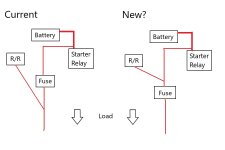
Jim also called the second issue as well. My R/R is not fused. Click on the pic below for current setup (which only fuses the battery) and my proposed changes. Should I be concerned about the lack of a fuse between the battery and R/R in the new setup?

positive wiring.jpg

I was concerned about damage on the positive side after the R/R since it's not fused in my current setup. As a test, I connected the B/W ground directly to battery. I get gauge lights and headlight when I turn the key on. This leads me to believe the damage is isolated to the SPG wire I found yesterday.

Thanks again for the help.
 
I noted the sequence and when the smoke arrived. I think it's fair to say that wire is too small for the starter return current and that over time it was more than likely melting and degrading.
It may have gotten to the point that it was no longer able to handle the normal running current and just gave up hence the total power loss. You could check the continuity between the ring terminals.
The charging system may still be functional. I would check the stator output and check for continuity between legs and ground. As said it is only a matter of time before it fails and could take a good stator with it. Moving to a series type unit is a good move.
Your 'current' wiring should have fuse protection. You inject the r/r output into the harness where it takes off to the ignition switch and from there back to the fusebox where the supply splits to the individual circuits.
 
My GS750 only has a single fuse and single circuit. After the R/R and battery wires meet, they go to the ignition switch. Then power comes out of the orange wire and goes directly to coils (after kill switch), lights, and signals without additional fuses. I did sketch a plan to bring power back from the ignition switch to a 3 fuse block, then out to separate coils, lights, and signal circuits.

I now understand that the starter motor current needs to flow back to the battery directly. It's a huge current draw and it's always powered by the battery and never by the R/R.

I'll do a new SPG with one ring terminal with R/R -, B/W wire, and wire to battery -. This is what Jim recommended originally but didn't understand why. I now see removing the main grounding strap and running the ground through the case to the frame, then through a tiny wire to the SPG and finally to the battery negative was a horrible idea. And clearly I'll run a heavy gauge main earth strap from case to battery negative.

I'll certainly go ahead and get an SH775. I know the stator has been replaced since it's a 18 pole instead of stock 12 pole. I believe my issues were far downstream of it, but since I've never tested it, I'll add the new main earth strap from case to engine, temporarily replace the SPG to battery - cable, then do the stator tests.

My final dilemma lies in how to fuse the positive side. My primary understanding is a fuse close to the battery is best so that should remain, Even with a newer SH775, I still want fusing after the R/R output. Ideally, I'll do a 3 circuit layout, but I have to spend more time thinking about how to implement that.
 
Last edited:
The spg idea is quite simple. The r/r runs the bike like a small power station. It's important that it can see what is happening. For that reason it makes sense to collect the returning running currents and bring them to the r/r rather than the battery. The battery is then not the heart of the system but in parallel with it and gets charged better as as result. Some will argue that the benefits are marginal but 40 yr old machines with period electrics are living on the margin.
 
The spg idea is quite simple. The r/r runs the bike like a small power station. It's important that it can see what is happening. For that reason it makes sense to collect the returning running currents and bring them to the r/r rather than the battery. The battery is then not the heart of the system but in parallel with it and gets charged better as as result. Some will argue that the benefits are marginal but 40 yr old machines with period electrics are living on the margin.

I'm not sure the idea of the SPG is all that simple; it really seems to create confusion.

I like the "small power station" analogy becuase when I refer to a cut set across the output of the R/R it doesn't see to have much impact; I suspect it is well of over 50% of the people still think the battery is the source of all power.

In the simplest terms, the voltages applied to the battery for charging need to be within a very tight range (e.g. 13.0-14.5V). The R/R controls that voltage but not based on voltage sensed at the battery but rather at it's own terminals. So minimizing the current flow between the battery and the R/R with a clear non-circuitous path will minimize low side voltage drops (ground side)

Ironically, the SPG that I have promoted only adds one additional frame ground to the R/R that what is typical in the OEM configuration after you add the popular "battery to R/R" ground strap. Centralizing all the grounds (except starter returns :)) to a "single point" for return to the R/R(-) simply avoids circuitous groudn paths.
 
So in addition to the ground strap from case to battery negative, you recommend a frame to SPG ground as well?

Could you remind me where the main earth strap attached on the case? I guess any case bolt would work.
 
Last edited:
The SPG is indicated ; it collects currents from :
  • the B/W Harness ground
  • Battery
  • Frame

These currents then ;leave the SPG to go to R/R(-)

The schematic shows double R/R(-) wires (in parallel) ; just treat them as one wire.


picture.php
 
Jim also called the second issue as well. My R/R is not fused. Click on the pic below for current setup (which only fuses the battery) and my proposed changes. Should I be concerned about the lack of a fuse between the battery and R/R in the new setup?

View attachment 53145

I was concerned about damage on the positive side after the R/R since it's not fused in my current setup. As a test, I connected the B/W ground directly to battery. I get gauge lights and headlight when I turn the key on. This leads me to believe the damage is isolated to the SPG wire I found yesterday.

Thanks again for the help.

The current diagram is correct. The most likely failure more that would cause a major short is for your R/R to short out. In your current configuration the battery would blow the fuse. In the "proposed" the wires will melt.

remember that the R?R can not put out more than about 20 amps.

The battery on the other hand can be an arch welder with easily in excess of 100 amps.

From a safety perspective you have to insure that any direct path to ground for the battery is fused.
 
I hooked up a heavy gauge wire from case bolt to battery negative with the B/W harness ground, battery -, and R/R - at the SPG. I did NOT replace the frame to SPG wire yet. I started the motor and all seemed good.

I thought it was a good idea to check the voltage at the battery as a super quick test to see how the old R/R was doing. I saw 16.5V and shut it down. I'm pretty sure that means the R/R is dead as I had perfect results on the quick test a month ago. It only ran for 10-15 secs so I'm hoping I didn't hurt anything.

I ordered a SH775 yesterday and it should be arrive on Friday. Also ordered the Triumph R/R harness. I won't run the bike til I can replace the R/R and redo my SPG.
 
Your initial reading on your "good" test of almost 15 volts immediately threw up a red flag for me, that seems a bit on the high side, and would cause the demise of modern lightweight LiFePO4 (Lithium Iron Phosphate) batteries that are otherwise far more long lasting than lead acid, as long as they never get drawn down too low or overcharged excessively...
12.2 or 12.4 not runnimg, 13.0 - 14.4 running is where I feel a good system should be at. I am open to criticism from my wiser elders here, however
We all fully understand that the old regulators and rectifiers are quite archaic on today's standards, however!
 
Your initial reading on your "good" test of almost 15 volts immediately threw up a red flag for me, that seems a bit on the high side, and would cause the demise of modern lightweight LiFePO4 (Lithium Iron Phosphate) batteries that are otherwise far more long lasting than lead acid, as long as they never get drawn down too low or overcharged excessively...
12.2 or 12.4 not runnimg, 13.0 - 14.4 running is where I feel a good system should be at. I am open to criticism from my wiser elders here, however
We all fully understand that the old regulators and rectifiers are quite archaic on today's standards, however!

13.0V is OK just above idle but it will not charge a battery.

Running at 3K RPM you should be above 14.0V. Most modern R/Rs are trimmed to be close to 14.25 or 14.5V so if you are lower than that it is because of poor connections. They don't get any better with time.
 
Bad starter?

Bad starter?

I didn't want to start a new thread so I'll continue here. I hooked up the SH775 temporarily with spade connectors and added the main earth strap from case to battery negative. The bike ran fine with 14V at ~2000rpm (I was letting the motor warm up). I saw 14.9V from 3500rpm and up but never passed 15V. I felt this was good since it charges at 14-15V anywhere above idle and I swear the stator cover feels cooler to the touch.

My Triumph harness ($9.65 at Motorcycles of Dulles and most OEM online sources) came in so I headed out to the burbs to pick it up. Everything ran smoothly until it stalled as came to a stop in heavy traffic. Pulled onto the shoulder and couldn't get the starter to spin. I think the stalling is related to the carbs but that's another story. Something similar happened on the way to work a few days earlier. It stalled so I pulled over and hit the start button and it wouldn't spin. By the time I opened the seat, checked wiring, and tried the button again, it turned over like normal.

In each no start situation, I get a click from the relay when I press the button. Battery voltage is fine (12.4V with key and run switch on). I get continuity between relay input and output terminals when I hit the button. But bridging the terminals doesn't spin the starter or even spark. I pulled the starter out this evening and hooked it up directly to my battery charger with ground on the starter mounting flange and positive on the terminal. No spin.

I'm guessing this means my starter is dead. I sprayed the 2 long bolts with PB Blaster and I'm waiting to open it up and inspect it. Does this sound like I'm on the right path?


Btw, I've concluded the Polaris R/R 4012941 is labelled SH775BA while the Seadoo R/R 710001103 is labelled SH775AA. And when I called Triumph of Dulles to ask them to ship me the R/R harness, they said they'd send it without charging me the $10 shipping charge. Great business!
 
Last edited:
Should that be Polaris # 4012941? Or 9012941? The 4 is what I always find. Perhaps that is not the BA, but rather a B? I wonder what the difference is?
 
Back
Top