• Required reading for all forum users!!!

    Welcome!
    Register to access the full functionality of the GSResources forum. Until you register and activate your account you will not have full forum access, nor will you be able to post or reply to messages.

    A note to new registrants...
    All new forum registrations must be activated via email before you have full access to the forum.

    A Special Note about Email accounts!
    DO NOT SIGN UP USING hotmail, outlook, gmx, sbcglobal, att, bellsouth or email.com. They delete our forum signup emails.

    A note to old forum members...
    I receive numerous requests from people who can no longer log in because their accounts were deleted. As mentioned in the forum FAQ, user accounts are deleted if you haven't logged in for the past 6 months. If you can't log in, then create a new forum account. If you don't get an error message, then check your email account for an activation message. If you get a message stating that the email address is already in use, then your account still exists so follow the instructions in the forum FAQ for resetting your password.

    Have you forgotten your password or have a new email address? Then read the forum FAQ for details on how to reset it.

    Any email requests for "can't log in anymore" problems or "lost my password" problems will be deleted. Read the forum FAQ and follow the instructions there - that's what we have one for...

  • Returning Visitors

    If you are a returning visitor who never received your confirmation email, then odds are your email provider is blockinig emails from our server. The only thing that can be done to get around this is you will have to try creating another forum account using an email address from another domain.

    If you are a returning visitor to the forum and can't log in using your old forum name and password but used to be able to then chances are your account is deleted. Purges of the databases are done regularly. You will have to create a new forum account and you should be all set.

Multiple Carbs: advantage?

  • Thread starter Thread starter XL-erate
  • Start date Start date
X

XL-erate

Guest
I'm in the planning stages of a bike project. I am a firm believer in the KISS principle, of Keep It Sweet & Simple. In the big picture I'd give up some performance in return for much increased reliability along with ease of roadside or trailside repairs. Go fast is bunches of fun, but no go at all means no go fast!

One of my first questions of doubtless many: Why not a single carb on a multi-cylinder engine?

With proper tuned length intake, rocket science plenum, and high performance carburetor it seems that very high levels of efficiency are possible. The aircraft world offers some very high performance carbs, typically applied to single carb multi-cylinder apps. Also some of the largest racing carbs for multi-cyl/multi-carb M/C applications might be used as a single on smaller displacement engines.

Just off the top of my head, no real engineering applied: seems like a single carb with plenum would experience far less pulsing and disruptions of flow than one per cylinder. One of the cylinders would be using full carburetor A/F flow continuously at all engine speeds. This would be true all the way from outermost intake opening to inlet valve face of each cylinder. If using ram air intake that higher presure would be more constant and unchanging down to plenum area.

The possibillity of forced induction through turbocharging or supercharging would be far simpler and likely more efficient. Fuel pressures/flow would be more constant overall. Cold weather starting would be simpler, choking but one universal carburetor bore. Throttle & choke linkage is far simpler. Carburetor mounting is potentially much simpler.

Very few motorcycles since about 1960 use single carbs. Is there THAT MUCH more power to be gotten from one-per-cylinder carbs than a single? Some hidden advantage that I'm missing? Thanks....
 
It is my impression that besides the potential for increased power, the main reason for individual carbs was to get it to fit in the smaller confines of a motorcycle frame. If you are considering changing yours to a single carb setup, take a look at the turbo manifolds like the one from Mr. Turbo. You would have to contact them to see if you could get just the manifold as they don't price it separately on the website. It's not the tuned, equal-length runner manifold that you described, but this is designed for forced induction, where operational requirements change just a bit.

.
 
I'l take a swag

I'l take a swag

>>>>With proper tuned length intake,

It would seem that this would be the biggest technical issue within the space constraint. Here is how Turbo is doing a turbo on his project bike. Of course he has boosted feed with the turbo

http://www.thegsresources.com/_forum/showthread.php?t=94468

No expert but for NA, you would want a tuned and equal length compact design. CV's with Pods are probably Ideal for these aspects, the stock configuration of the dual air boxes gets pretty close while achieving cyl to cyl mixing before the carbs.

I guess if you were willing to place the carburetors much further aft you would have more room to get the lengths the same, get a ram effect and have room for filters. Dropping from 4 to 2 carbs would still maintain all symmetry cylinder to cylinder and not require the lateral balancing across 4 cylinders. So 2 v.s .1 carbs would probably be preferable for 4 cyl (i.e. 2 mini Y's rather than single 1 into 4 pitchfork with plenum).

On the flip side, the carbs are relatively simple CV's and are compact in their positioning behind the motor compared to most car intakes. (less manifold is less weight) Also aesthetically it is really cool (of course this is non technical, but bikes just would not be as technically interesting without the beautify symmetry of the inline 4. Also the bigger the engine the more unwieldy the bike. Compactness is I'm sure one of the major drives you just don't have to deal with on a car for example.

Posplayr

imuk2.jpg
 
Steve

Steve

I was more long winded :oops: and you beat me to it.
:-D
Posplayr
 
Thanks for the responses.

The tuned length is measured from the outermost lip on intake horn or velocity stack and of course includes the entire carb/plenum length. I see that on many bikes the air cleaner is as much as maybe 12" away from carb, way up under seat. Much of that could be used for ram tuned length.

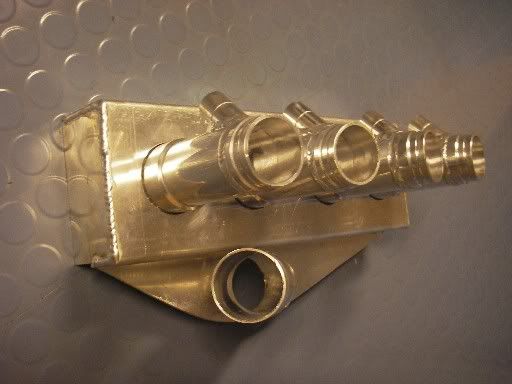
The plenum design, like that one pictured, can take a whole bunch of the headaches out of fitment. Connecting with standard rubber connectors should be pretty easy. Looking at that manifold pictured, if the tubes coming off it went to carb boots on cylinders, and the back side was enclosed with a plate and that with a carb mounting flange that about covers it.

So I guess what's left is the question of performance with a single carb as opposed to multi-carb setups.
 
bump

bump

Interesting reading. I've seen CB750's done with two carbs/Y's and it looks pretty trick. I used to own a Vstar, and went from dual carbs to a single stock carb rejetted, and it was WAY better performance. I love the plenum idea with a single carb/ forced induction.

Come on...somebody try it!

Scott
 
Thanks for the responses.

The tuned length is measured from the outermost lip on intake horn or velocity stack and of course includes the entire carb/plenum length. I see that on many bikes the air cleaner is as much as maybe 12" away from carb, way up under seat. Much of that could be used for ram tuned length.

The plenum design, like that one pictured, can take a whole bunch of the headaches out of fitment. Connecting with standard rubber connectors should be pretty easy. Looking at that manifold pictured, if the tubes coming off it went to carb boots on cylinders, and the back side was enclosed with a plate and that with a carb mounting flange that about covers it.

So I guess what's left is the question of performance with a single carb as opposed to multi-carb setups.

I can't speak so much for bikes, but I know in automotive applications, the biggest concern is to not have the fuel fall out, puddle on the lower portion of the intake runners.

Roughening up the inside of the tubes helps to prevent the fuel from falling out of the air. It's like mini venturis, on a microscopic level, keeping the fuel suspended.

Now, on a fuel injected unit, a polished runner will increase power, but not on a carbed set up; it's been dyno proven several times.


With a single carb mounted in the center of the plenum, the two outer runners would still be off set compared to the two inner runners. I believe this was the idea behind using four separate carbs---equal runners synch'd to so-called perfection for smooth power/performance.
 
I agree with you

I agree with you

just wondering if it would work. If there would be any surprises. Maybe someday when I some "spare" time.:-D

retro%20filters%201.JPG
 
Goodness gracious, ain't that purty! Thanks, that picture says a lot.

RE: intake runner length. I was cogitatin' the other night and realized that if the outer runners were crossed over the inner runners and a plenum used it would be a fairly easy matter to attain equal lengths. That is #2 takes position of #1, #1 reaches over to where #2 was, #3 takes position of #4, and #4 takes position of #3 somewhat like a pair of X's feeding from plenum. With carb located over intake area of what is now #1 & #4 the lengths should be close. Depth of plenum would be a factor also, along with shape. Possibly a shape like a squarish funnel but nicely contoured for optimum flow, with large end toward cylinders as a collector box and distribution chamber.
 
One of my first questions of doubtless many: Why not a single carb on a multi-cylinder engine?

I think you will find more mixture problems and resonance issues with a single carb and common intake plenum than 4 individual carbs. With 4 carbs you essentially have 4 singles ganged together on a single crank and this is much easier to tune than a 4-1 intake manifold.

Really, they are only CV carbs. Nothing too spooky or tricky. Take care of them and they will work for many years. If you want to worry about reliability, use a single cylinder engine to cut the number of valves and other moving pieces down.

Mark
 
Of course, there are the most famous of single carb bikes...longer runner on one cylinder gave them a famous sound...POOP. poop pop poop poppooooop opop poop..heh. Though, Eric Buell made it work. I do believe he made the runners the same length tho, no? Anyone?

I get what XL was saying too, but i still think you would end up with two runners longer than the others.
 
I have to assume there is some advantage to multi's somewhere; if not ALL the bike manufacturers wouldn't use them?

Reasonance might be an issue, don't know. I do know that on automotive V8's the same basic problems of runner length/balance are there and part of the answer is plenum design, combined with runner length. Looking at 1/2 of a V8, or an inline 4, we have an identical configuration to a M/C 4 cylinder. I never had any problem getting jawdrop performance out of either of those, but that's only to maybe a 6,500 rpm redline.

I'm sure that tractability, if that's the right word, is more important with a bike. With 4 wheels the handling might not be so severely effected with a minor hiccup as it would on a bike with the footpegs sparking.

This thought started for the simple reason I have a GS550 engine with no carbs. Happened to have one 42mm Tillotson sitting on my desk and said, "Hey, wait a minute..." and then got to thinking about the BSA 500 with a single carb and etc.
 
I have to assume there is some advantage to multi's somewhere; if not ALL the bike manufacturers wouldn't use them?

Reasonance might be an issue, don't know. I do know that on automotive V8's the same basic problems of runner length/balance are there and part of the answer is plenum design, combined with runner length. Looking at 1/2 of a V8, or an inline 4, we have an identical configuration to a M/C 4 cylinder. I never had any problem getting jawdrop performance out of either of those, but that's only to maybe a 6,500 rpm redline.

I'm sure that tractability, if that's the right word, is more important with a bike. With 4 wheels the handling might not be so severely effected with a minor hiccup as it would on a bike with the footpegs sparking.

This thought started for the simple reason I have a GS550 engine with no carbs. Happened to have one 42mm Tillotson sitting on my desk and said, "Hey, wait a minute..." and then got to thinking about the BSA 500 with a single carb and etc.

For a street intake, it would be dual plane, 4 long runners four short with a stepped plenuim.

With my 4cyl in my nissan I used to have, they used dual runners modulated by a butterfly/vacuum controled system.


The pretty picture had one issue, one runner off of each carb was pretty much a straight shot while the other runner had to move air/fuel around a corner before entering the cylinder.
 
Ahh, so that picture wasn't as pretty as it looks!?

There may be much more to this than is worth the hassles. Seems like a reasonable idea but the engineering could get a little complicated. Okay, back to the drawing board, but I'll keep the sheet of paper just in case! Thanks, guys!!
 
Short runners are better suited for the horsepower end of the equation. Long runners give you a better balanced torque curve. In my opinion...it all depends on what you're trying to do. I chose to drop the twin carbs (v- twin bike) in favor of longer intake runners and a single carb set-up. I want the torque as the bike has more than enough horsepower.

The main thing to keep in mind (and I think that someone already mentioned it here) is that you need to have enough volume and velocity within the intake runners, to keep the fuel from dropping out of suspension and therefore, creating droplets on the runners. This causes nasty tuning problems and is one of the many reasons that "highly tuned engines", run like crap around town, at slower RPM's - there are too many other factors like lift, duration, jetting, ignition advance/retard, and a whole handfull of other reasons, but you get the idea.
 
Runners

Runners

If you think about the mixture traveling through you intake tract, there are pressure variations that occur because of the opening and closing of the valves. These varations are essentially waves (sinusoidal for you math types). What happens when you vary the length of the intake tube is that the peak of the wave hits the intake opening at different RPMs. When the peak hits, it is just like what happens when the waves come in on the beach, they slamm forward with force.

What this means for the bike is a ram-air effect and better cylinder filling. Basically, you can tune your intake manifold to give the most punch for whatever RPM you want; for instance, mayber right before a shift point, or the hot spot on a cam. Ideally, all intake runners should be the same because all cylinders have the same need volumetrically. Ther are tons of formulas out there for this and it really isn't a big deal to design. BMW actually has a design where the intake length varies according to RPM so that it is optimized over the whole RPM range.

So, there's the theory. What about reality? How much difference does it make? Well, the difference will show up on a dyno. Will you feel it in the seat of your pants? Probably not. If you are racing, could it be the differnce between a win and a loss? Maybe. Honestly, I think the system that BMW has is really about novelty. BMW owners are snobs (no offense, but that's how they market their cars). They want the latest and the greatest, even if it really doesen't matter much overall. Many older cars had different intake tract lengths. This is especially true for the inline cylinder cars. Look at a straight six. There are three different intake lengths because the intake hole is in the middle of the manifold. Those run just fine and it used to be very common to race (and win) running those mills.

People regularly post here asking about making an intake manifold to run a single carb. Nobody ever comes back saying that they have tried it. Give it a shot. Unless you're racing, you probably won't care much about the losses that you encounter and it will make for a simpler system.
 
Thanks drhach!

I've researched ram tuning/tuned length intake & exhaust & have some good formulas. I'm familiar with sinusoidal wave harmonics and wave reversions etc. What I've found agrees with what you suggest and also, yes, probably not a real noticeable difference if done right.

Kind of funny when a guy finally decides his bike is running lousy and time to take a look, only to find carbs a mess, ignition hanging by a thread, clogged filters etc. Seems the old beasties are more user friendly than we usually give them credit for.
 
Carbs

Carbs

I'll admit, upfront, I haven't read any of the posts. But....having multiple carbs is kind of like having multiple wives; it allows you a great deal of fun, at times, but is often more trouble than you'd like.:-D
 
Hah! No doubt a good point there, brother, but may I add: like an only wife, one single carb can be plenty of trouble to deal with all by itself too....
 
Back
Top