• Required reading for all forum users!!!

    Welcome!
    Register to access the full functionality of the GSResources forum. Until you register and activate your account you will not have full forum access, nor will you be able to post or reply to messages.

    A note to new registrants...
    All new forum registrations must be activated via email before you have full access to the forum.

    A Special Note about Email accounts!
    DO NOT SIGN UP USING hotmail, outlook, gmx, sbcglobal, att, bellsouth or email.com. They delete our forum signup emails.

    A note to old forum members...
    I receive numerous requests from people who can no longer log in because their accounts were deleted. As mentioned in the forum FAQ, user accounts are deleted if you haven't logged in for the past 6 months. If you can't log in, then create a new forum account. If you don't get an error message, then check your email account for an activation message. If you get a message stating that the email address is already in use, then your account still exists so follow the instructions in the forum FAQ for resetting your password.

    Have you forgotten your password or have a new email address? Then read the forum FAQ for details on how to reset it.

    Any email requests for "can't log in anymore" problems or "lost my password" problems will be deleted. Read the forum FAQ and follow the instructions there - that's what we have one for...

  • Returning Visitors

    If you are a returning visitor who never received your confirmation email, then odds are your email provider is blockinig emails from our server. The only thing that can be done to get around this is you will have to try creating another forum account using an email address from another domain.

    If you are a returning visitor to the forum and can't log in using your old forum name and password but used to be able to then chances are your account is deleted. Purges of the databases are done regularly. You will have to create a new forum account and you should be all set.

New Member - GS750

  • Thread starter Thread starter afraziaaaa
  • Start date Start date
A

afraziaaaa

Guest
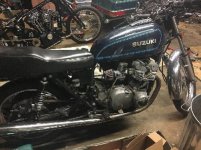
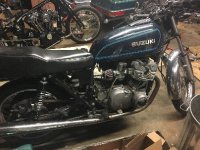
Just picked up a '78 GS750 here in New Jersey. Frame number 43501 with 31k miles. It even runs and stops! Almost all original except for pod filters, rear shocks and updated turn signals.

Never owned a suzuki before, much less a vintage one. Looking forward to riding it!
 

Attachments

  • gs7570.jpg
    gs7570.jpg
    79 KB · Views: 0
Last edited:
Welcome. Cool that you got a runner, but it will still likely need some going over to be fully reliable and safe.
I spy a couple other bikes in the shop as well.... Where at in Jersey are you?
 
Thanks all. I am in Hunterdon county, close to Flemington. It will definitely need some work. Brand new plugs are fouled already. Think it's gas.

The other bikes are a 1985 Honda Goldwing and a 2003 HD Sportster chopper, both in varied stages of repair/assembly.
 
Fixed pic.

Fixed pic:

attachment.php
 
Welcome to the GS family!

One thing you'll really want to do is pick up a new top cover gasket, & a $20 GS/Suzuki valve shim tool (OEM or Motion Pro), & a set of thin feeler gauges from .001" - .003" / .02mm - .08mm, & check the valve clearances, as they usually get substantially neglected over the years and they will tighten up the clearance to the camshafts due to the valves wearing, to the point where the valves won't fully close tightly onto their seats because they can't come up any higher due to the cam, hence they wont fully seal. If any are too loose, measure how loose they are, then pull the shim out and look at the size Inked on the underside of it (or measure with calipers if someone installed it upside down and wiped out the size markings from camshaft contact), add the shim height plus the extra clearance together, then subtract the factory clearance spec .02mm - .08mm, & that is the size shim you need. There are videos on YouTube to help. Read the factory manual. Cam lobe position is critical when measuring (refer to manual),
On the ones that are too tight, you will probably want to do a similar process by taking the thinnest shim in the whole engine and installing it on each cylinder that is too tight, and measuring the clearance and figuring out how much thicker than that shim that you need to purchase.

There is a GS valve shim exchange club on here, I think you just pay for shipping if you send your old shims in. Before I got a full factory valve shim kit, I liked having a half a dozen or a dozen spares so that it would make calculating additional sizes needed a lot easier, and some I would already have.


Beyond that, do you know what the condition of the carburetors is? Have they had a good cleaning recently and a new o-ring kit and top and bottom gaskets?
A member here named Robert Barr has a site called cycleo-rings.com that has all the GS carburetor O-rings sold in kits. As well as the intake boot O-rings and stainless steel fasteners for the intake boots, which should be replaced at the same time because they lose their seal as well.
One last thing to check would be that the fuel petcock is not ruptured and leaking gas back in on the vacuum line, which would foul the number 3 cylinder spark plug substantially more than the others
Also a weak ignition could make the bike look like it is running rich among other symptoms


The other critical thing that you need to know is that the original Factory regulator rectifiers on every GS model made in the 70s and 80s is absolute garbage. And often the stator gets fried because of it.
The best thing to do is get a $45 used unit from a Polaris side by side ATV, part number 4012941 I believe is the most common one. There is also another part number for Can-Am models, and another one for Sea-Doo models. They are all shindingen sh775 regulator rectifiers, but you need to search the OEM manufacturer part number that I listed to find them used on eBay. Then there are a ton of listings for all sorts of different models of bikes and ATVs for the wiring plug kit that is really nice to have for these but not necessary. It's around 13 or 14 dollars. Just a quarter inch crimp on female blade connector will do, but the watertight connector kit is really nice

Those regulator rectifiers are leaps and bounds better than most everything else on the market, as they are not a shunt style, they are a more complex series style regulator unit which lets the stator run much cooler so much that the engine oil temperature overall is slightly cooler.

There is some basic rewiring that GS owners do to upgrade power distribution, this is nice to do at the same time. Also adding an ignition relay for about $15 in parts is a really beneficial upgrade, all of the old wiring, connectors, ignition switch, kill switch, Etc really drop the voltage substantially between the battery, all that wiring and connections and switches, and the actual ignition components. A 2 volt loss is typical, but I have seen as much as 5 volts less at the ignition coils vs battery, which causes very poor running conditions. Test this with the bike running and the gas tank off, it will run about 30 to 45 seconds without the gas tank on just from the gas in the carb bowls.


Then onto performance upgrades!!!!!
Look up the twinpot brake mod to get substantially better front brakes...
Avon am26 roadrider tires are decent cornering tires with pretty good grip for the mileage that they get, around 8,000 for the rear, 10 or 12 for the front. Bridgestone Battlax BT 45 V Tires are even better grip, but rear only lasts 5000mi.
Shinko 230 Tour Master are the budget soft sticky good grippers. 4,000 - 5,000 miles for the rear, 10,000 front.
Heavier riders or carrying a passenger will wear out the rear much faster, which is where I would recommend the Avon especially. Or for higher mileage long road trip riding, the Avon would be the best choice. For ultimate cornering, the Bridgestone or Pirelli sport demon. 90/90-19 or 100/90-19 front or inch equivalent (4.25 - 19? 4.00-19?), 110/90-18 rear or 120/90-18 in some will work as a listed okay fit if you want a fatter look (the 110 will give a bit quicker lean-in and better acceleration due to less weight and shorter diameter to quicken the gearing final ratio). 4.50-18 rear I think is the inch size that fits.

These are the upgrades that I highly recommend for any stock gs750, 550, Etc... these will all make the bike either more reliable or substantially better handling and stopping. I love my 750's!
 
Last edited:
Welcome to the GS family!

One thing you'll really want to do is pick up a new top cover gasket, & a $20 GS/Suzuki valve shim tool (OEM or Motion Pro), & a set of thin feeler gauges from .001" - .003" / .02mm - .08mm, & check the valve clearances, as they usually get substantially neglected over the years and they will tighten up the clearance to the camshafts due to the valves wearing, to the point where the valves won't fully close tightly onto their seats because they can't come up any higher due to the cam, hence they wont fully seal. If any are too loose, measure how loose they are, then pull the shim out and look at the size Inked on the underside of it (or measure with calipers if someone installed it upside down and wiped out the size markings from camshaft contact), add the shim height plus the extra clearance together, then subtract the factory clearance spec .02mm - .08mm, & that is the size shim you need. There are videos on YouTube to help. Read the factory manual. Cam lobe position is critical when measuring (refer to manual),
On the ones that are too tight, you will probably want to do a similar process by taking the thinnest shim in the whole engine and installing it on each cylinder that is too tight, and measuring the clearance and figuring out how much thicker than that shim that you need to purchase.

There is a GS valve shim exchange club on here, I think you just pay for shipping if you send your old shims in. Before I got a full factory valve shim kit, I liked having a half a dozen or a dozen spares so that it would make calculating additional sizes needed a lot easier, and some I would already have.


Beyond that, do you know what the condition of the carburetors is? Have they had a good cleaning recently and a new o-ring kit and top and bottom gaskets?
A member here named Robert Barr has a site called cycleo-rings.com that has all the GS carburetor O-rings sold in kits. As well as the intake boot O-rings and stainless steel fasteners for the intake boots, which should be replaced at the same time because they lose their seal as well.
One last thing to check would be that the fuel petcock is not ruptured and leaking gas back in on the vacuum line, which would foul the number 3 cylinder spark plug substantially more than the others
Also a weak ignition could make the bike look like it is running rich among other symptoms


The other critical thing that you need to know is that the original Factory regulator rectifiers on every GS model made in the 70s and 80s is absolute garbage. And often the stator gets fried because of it.
The best thing to do is get a $45 used unit from a Polaris side by side ATV, part number 4012941 I believe is the most common one. There is also another part number for Can-Am models, and another one for Sea-Doo models. They are all shindingen sh775 regulator rectifiers, but you need to search the OEM manufacturer part number that I listed to find them used on eBay. Then there are a ton of listings for all sorts of different models of bikes and ATVs for the wiring plug kit that is really nice to have for these but not necessary. It's around 13 or 14 dollars. Just a quarter inch crimp on female blade connector will do, but the watertight connector kit is really nice

Those regulator rectifiers are leaps and bounds better than most everything else on the market, as they are not a shunt style, they are a more complex series style regulator unit which lets the stator run much cooler so much that the engine oil temperature overall is slightly cooler.

There is some basic rewiring that GS owners do to upgrade power distribution, this is nice to do at the same time. Also adding an ignition relay for about $15 in parts is a really beneficial upgrade, all of the old wiring, connectors, ignition switch, kill switch, Etc really drop the voltage substantially between the battery, all that wiring and connections and switches, and the actual ignition components. A 2 volt loss is typical, but I have seen as much as 5 volts less at the ignition coils vs battery, which causes very poor running conditions. Test this with the bike running and the gas tank off, it will run about 30 to 45 seconds without the gas tank on just from the gas in the carb bowls.


Then onto performance upgrades!!!!!
Look up the twinpot brake mod to get substantially better front brakes...
Avon am26 roadrider tires are decent cornering tires with pretty good grip for the mileage that they get, around 8,000 for the rear, 10 or 12 for the front. Bridgestone Battlax BT 45 V Tires are even better grip, but rear only lasts 5000mi.
Shinko 230 Tour Master are the budget soft sticky good grippers. 4,000 - 5,000 miles for the rear, 10,000 front.
Heavier riders or carrying a passenger will wear out the rear much faster, which is where I would recommend the Avon especially. Or for higher mileage long road trip riding, the Avon would be the best choice. For ultimate cornering, the Bridgestone or Pirelli sport demon. 90/90-19 or 100/90-19 front or inch equivalent (4.25 - 19? 4.00-19?), 110/90-18 rear or 120/90-18 in some will work as a listed okay fit if you want a fatter look (the 110 will give a bit quicker lean-in and better acceleration due to less weight and shorter diameter to quicken the gearing final ratio). 4.50-18 rear I think is the inch size that fits.

These are the upgrades that I highly recommend for any stock gs750, 550, Etc... these will all make the bike either more reliable or substantially better handling and stopping. I love my 750's!

Thank you so much. Let me bookmark this!

I bought the bike from a very young man who was obviously in a bit over his head. He had done no work to the carbs, though he did add the pod filters --> No tuning done after addition of pods.

I am definitely rich, or at least seems rich. The bike bogs pretty badly when I open the throttle at idle. The spark is much stronger when the bike has been sitting and the plugs are dry. I am in doubt about the condition of the petcock as well, so I think rebuilding it is a good idea.

My thinking is to try and do some tuning with the a/f ratio and maybe the points as well...get the bike running well enough to ride before I really tear into it. Does this make sense?
 
With adding pods, the jets would need to go larger, hence richer. 3 to 4 sizes up on nains, possibly one up on pilot but should be able to tune fuel and air screws with 15 pilots as stock still. Slide needle may need shimmed up with a .020" radio shack washer from their popular washer assortment grab bag.
If aftermarket exhaust, needle Ned's raised to 1 full clip position lower. Mains would need to go perhaps slightly bigger, 4 sizes most likely. They are sized in increments of 2.5.
If you are running too rich, you have other issues. Most likely the float height is off and the needle and seat (fuel metering valves in each carb) are filthy, gummed up, and probably have a groove worn into them, so it won't seal and your carbs are flooding.
Could be over-oiled pod filters as well. They appear to be the tall oval pods, so that makes me think they may be nicer than the crappy Emgo/etc Chinese ones, but the Chinese factories could be cloning the aesthetic of the good ones now, too.

You can buy petcock rebuild kits, but I would not recommend it. The OEM parts are generally not available, and the aftermarket parts are not of exact spec. Too many rebuild petcocks have failed because of this. I would buy a new one from Z1 Enterprises or try to find an oem for a decent price, but they are expensive. $50 for an after-market of decent quality through Z1 Enterprises, or $90 if you are lucky for OEM.

Ignition, valve clearances, and all carb and intake boot o-rings need to all be in perfect spec before you start adjusting the carbs. Get it running better, and do a compression test on each cylinder once you've ridden it a bit and done a second valve clearance check. The valves being too tight at the cam will lead to a lot of carbon buildup on them, so they need to be run a little on the looser side in my opinion for a while to try and get all the carbon off the sealing surfaces.

These engines are generally very user/mechanic friendly. Complete top end rebuilds may seem intimidating to a new mechanic, but they are really pretty straight forward aside from cam timing being a bit tricky on this style of engine.

Best luck, you have a good support community here for assistance in reviving these old classics!
 
With adding pods, the jets would need to go larger, hence richer. 3 to 4 sizes up on nains, possibly one up on pilot but should be able to tune fuel and air screws with 15 pilots as stock still. Slide needle may need shimmed up with a .020" radio shack washer from their popular washer assortment grab bag.
If aftermarket exhaust, needle Ned's raised to 1 full clip position lower. Mains would need to go perhaps slightly bigger, 4 sizes most likely. They are sized in increments of 2.5.
If you are running too rich, you have other issues. Most likely the float height is off and the needle and seat (fuel metering valves in each carb) are filthy, gummed up, and probably have a groove worn into them, so it won't seal and your carbs are flooding.
Could be over-oiled pod filters as well. They appear to be the tall oval pods, so that makes me think they may be nicer than the crappy Emgo/etc Chinese ones, but the Chinese factories could be cloning the aesthetic of the good ones now, too.

You can buy petcock rebuild kits, but I would not recommend it. The OEM parts are generally not available, and the aftermarket parts are not of exact spec. Too many rebuild petcocks have failed because of this. I would buy a new one from Z1 Enterprises or try to find an oem for a decent price, but they are expensive. $50 for an after-market of decent quality through Z1 Enterprises, or $90 if you are lucky for OEM.

Ignition, valve clearances, and all carb and intake boot o-rings need to all be in perfect spec before you start adjusting the carbs. Get it running better, and do a compression test on each cylinder once you've ridden it a bit and done a second valve clearance check. The valves being too tight at the cam will lead to a lot of carbon buildup on them, so they need to be run a little on the looser side in my opinion for a while to try and get all the carbon off the sealing surfaces.

These engines are generally very user/mechanic friendly. Complete top end rebuilds may seem intimidating to a new mechanic, but they are really pretty straight forward aside from cam timing being a bit tricky on this style of engine.

Best luck, you have a good support community here for assistance in reviving these old classics!

Thanks so much. I have done a couple top end rebuilds before. Harley Davidson which are very simple, and Ford which was also a DOHC inline 4. I'm not a professional or anything, but I'm not averse to it either. My hope is to get running decently enough to putt around on it for as little $ as possible. Currently stock exhaust, and the filters are K&N.

I do have the original air box.

Here's my list, based on your recommendations, in order:

1. Top cover gasket, shim tool, feeler gauges --> Valve adjustment (looks like page 60 of manual for tappet clearance)
2. New petcock, clean gas tank while off (some rust, but not terrible).
3. Polaris type regulator
4. Carb/intake boots
5. Clutch adjustment
6. Ignition timing (manual calls for special tool, but is it really necessary? Can I just use a regular old light?)
7. Adjust carburetor --> If no good, remove and service.
 
4 - carb/intake boots should mean:
Rebuild carb
New needles and seats
Float adjustment
Dismantle and Chem dip or ultrasonic clean carbs
New carb o-ring kit (each carb - pilot air screw, pilot fuel screw, choke plunger, fuel bowl drain screw)
Fuel bowl and top cover gaskets
New intake boot o-rings
Inspect intake boots
Reassemble and bench syncronize carbs
Fuel screws (on bottom) around 7/8 to 1 turn out. Too far and you'll never get a good idle or off-idle transition. Adjust air screws (on side) to the highest idle method.

You just use a standard strobe timing light for the ignition, but a fresh set of points and condensers is probably warranted.
Dyna-S ignition is $115-120 depending on which brand ignition advance yours uses. You really should do the ignition coil relay mod (all bikes of all makes without one) if installing electronic ignition.

I also always like to replace the stock plug wire resistor caps with new NGK 5000 ohm pieces. And new NGK B8ES spark plugs.
I'll have to dig up the part numbers, I've got them home on the shelves deeply stocked for future bikes. 2 angled, 2 straight. There are several variants of the angled type. It's the medium sized ones for the outside cylinders I believe.
Cut the plug wires back a little bit, 1/4" or so, if you can. Gets you a good fresh connection for the stab-in thread-in type connection.

Carb WILL need serviced. That should almost be #1 on the list really. Tie with valve adjust.
 
4 - carb/intake boots should mean:
Rebuild carb
New needles and seats
Float adjustment
Dismantle and Chem dip or ultrasonic clean carbs
New carb o-ring kit (each carb - pilot air screw, pilot fuel screw, choke plunger, fuel bowl drain screw)
Fuel bowl and top cover gaskets
New intake boot o-rings
Inspect intake boots
Reassemble and bench syncronize carbs
Fuel screws (on bottom) around 7/8 to 1 turn out. Too far and you'll never get a good idle or off-idle transition. Adjust air screws (on side) to the highest idle method.

You just use a standard strobe timing light for the ignition, but a fresh set of points and condensers is probably warranted.
Dyna-S ignition is $115-120 depending on which brand ignition advance yours uses. You really should do the ignition coil relay mod (all bikes of all makes without one) if installing electronic ignition.

I also always like to replace the stock plug wire resistor caps with new NGK 5000 ohm pieces. And new NGK B8ES spark plugs.
I'll have to dig up the part numbers, I've got them home on the shelves deeply stocked for future bikes. 2 angled, 2 straight. There are several variants of the angled type. It's the medium sized ones for the outside cylinders I believe.
Cut the plug wires back a little bit, 1/4" or so, if you can. Gets you a good fresh connection for the stab-in thread-in type connection.

Carb WILL need serviced. That should almost be #1 on the list really. Tie with valve adjust.

Duly noted, thanks again. Looks like there's no delaying it!
 
You will be so much better off, and any older bike of unknown carb condition that's not running properly, to just rebuild the carbs right off the bat, as well as valve adjustment

EDIT - I forgot to mention the fuel tube o-rings that connect the carbs, IF you are lucky enough to have the all-alloy type with replaceable o-rings, vs the type coated with a permanent viton/neoprene o-ring sleeve which are often just worn out & will no longer seal. Z1 Enterprises sells reproductions of these if you search for VM26/VM28 carb parts in their database. Not all are listed for Suzuki GS750/850/1000, but they list dimensions and also KZ1000/Z1/KZ900 VM's are identical.
 
Last edited:
Good to know. I will look out for that when I pull the carbs. While on the bike, the carbs look very clean.

D9619AFF-DD1C-4FA1-9E74-73AEC2F84AEE.jpg
 
Back
Top