• Required reading for all forum users!!!

    Welcome!
    Register to access the full functionality of the GSResources forum. Until you register and activate your account you will not have full forum access, nor will you be able to post or reply to messages.

    A note to new registrants...
    All new forum registrations must be activated via email before you have full access to the forum.

    A Special Note about Email accounts!
    DO NOT SIGN UP USING hotmail, outlook, gmx, sbcglobal, att, bellsouth or email.com. They delete our forum signup emails.

    A note to old forum members...
    I receive numerous requests from people who can no longer log in because their accounts were deleted. As mentioned in the forum FAQ, user accounts are deleted if you haven't logged in for the past 6 months. If you can't log in, then create a new forum account. If you don't get an error message, then check your email account for an activation message. If you get a message stating that the email address is already in use, then your account still exists so follow the instructions in the forum FAQ for resetting your password.

    Have you forgotten your password or have a new email address? Then read the forum FAQ for details on how to reset it.

    Any email requests for "can't log in anymore" problems or "lost my password" problems will be deleted. Read the forum FAQ and follow the instructions there - that's what we have one for...

  • Returning Visitors

    If you are a returning visitor who never received your confirmation email, then odds are your email provider is blockinig emails from our server. The only thing that can be done to get around this is you will have to try creating another forum account using an email address from another domain.

    If you are a returning visitor to the forum and can't log in using your old forum name and password but used to be able to then chances are your account is deleted. Purges of the databases are done regularly. You will have to create a new forum account and you should be all set.

No lights fixed - clean fuse box contacts

  • Thread starter Thread starter subforry
  • Start date Start date
S

subforry

Guest
Just posting for future knowledge. My lights went out, no brake, turn, head lights - nothing. I checked the fuses with and multimeter and they seemed fine. After searching the forum, most threads solution was about poor ground and dirty contacts.

The fuse block was a little melted at the head light fuse. I pulled the fuse block and found nothing, but I did clean the fuse contacts for the lights and replaced the fuses. Now the lights work. I notice that other fuse contacts were warm after only a short time. I cleaned all the fuse contacts and now they are cool.

In short clean your fuse box contacts today, it is easy. Lights are brighter as well.
 
Yes a dirty fuse box is the source of many problems. After cleaning you should treat it with either DeOxit or dielectric grease. If it has crimps you should solder them. I recommend you do a Quick Test and then the Phase A tests to see what else you have that is dirty that will affect charging.

There are bigger problems with SHUNT R/R and high resistance on the primary DC wires. As you probably remember, the current running between the R/R and the battery causes voltage drops if there is any resistance at all. (that is what the Phase A tests are measuring). Basically the battery voltage is always less than the R/R output reference that is 14.25-14.5V. The difference between battery and R/R is a function of how much resistance. Remember when teh R/R's reach their setpoint they start to regulate. The SHUNT SHORTS and the SERIES OPENS. So when there is high resistance with a SHUNT it tends to start SHORTING immediately as it thinks that there is a high voltage at teh battery that needs to be regulated. This can leave the SHUNT on all the time which will heat up both R/R and the stator and drain the battery. With a SERIES R/R the R/R will just open but it will still drain the battery.

Regardless of the theory, all connections between the battery and R/R need to be cleaned. And the stator should be connected direct to the R/R. If a connector is used, tin all of the contact/crimps to make sure that corrosion does not get into the crimps and use some anti corrosion product to make sure contacts stay in good shape. I recommend a chemical clean with Naval jelly(or similar) and the treatment with DeOxit. You can also use dielectric grease instead of DeOxit.

The SPG is the most direct way of guaranteeing that all of the return currents get to the R/R while minimizing the current flow between the battery(-) and the R/R(-).It should be obvious that for a given resistance in the connections, the less current on this wire the the less voltage drop and the closer the battery voltage will track the R/R output setpoint. That is the reason for different wires going to the SPG.

For example if you have a Dyna-S, the coil return currents now ground out through the Dyn-S to the engine block. From the engine block the currents most likely path is to go from the battery grounding strap to the battery(-) and then travel back to the R/R(-). That means that teh current on this battery ground wire is about twice what it would be if the Dyna-S was not grounding through the engine. If fact from a grounding perspective, it would be best to run a ground from the Dyna-S all the way back to the SPG. Of course nobody does this. So as a compromise, I suggest the frame ground so in the event that the frame and battery strap ground get dirty, you can hope to pick up Dyna-S ground through the frame and pull those currents away from the Battery(-) post.
 
Solder those crimps

Solder those crimps

Yes a dirty fuse box is the source of many problems. After cleaning you should treat it with either DeOxit or dielectric grease. If it has crimps you should solder them. I recommend you do a Quick Test and then the Phase A tests to see what else you have that is dirty that will affect charging.

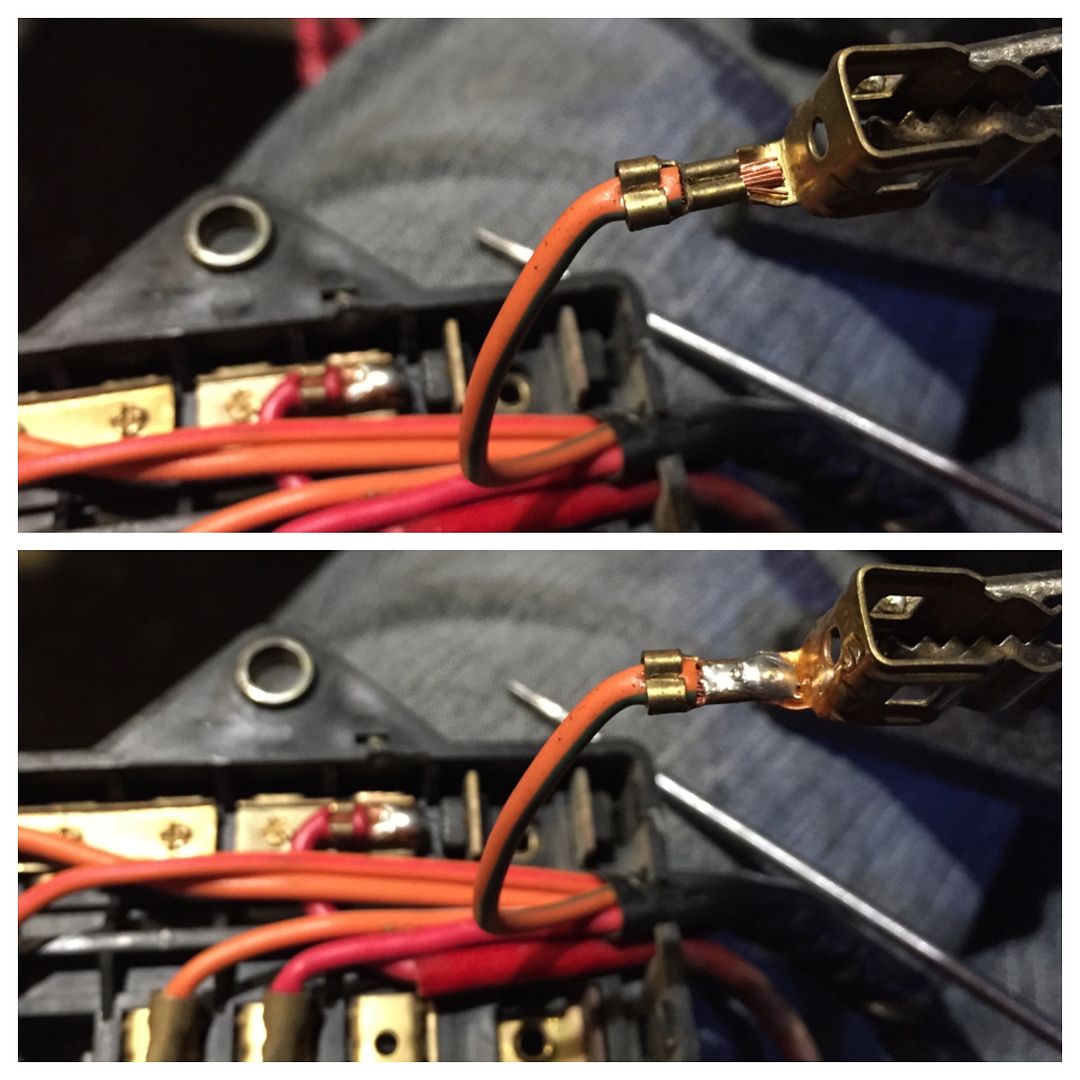
Pos is the champion of all things electrical here, heed his words people. I cleaned, treated and flowed solder into my crimped fuse box on a bike I am restoring just last night:
21EC41E2-B799-4FC1-A05F-8047A6E7604B.jpg


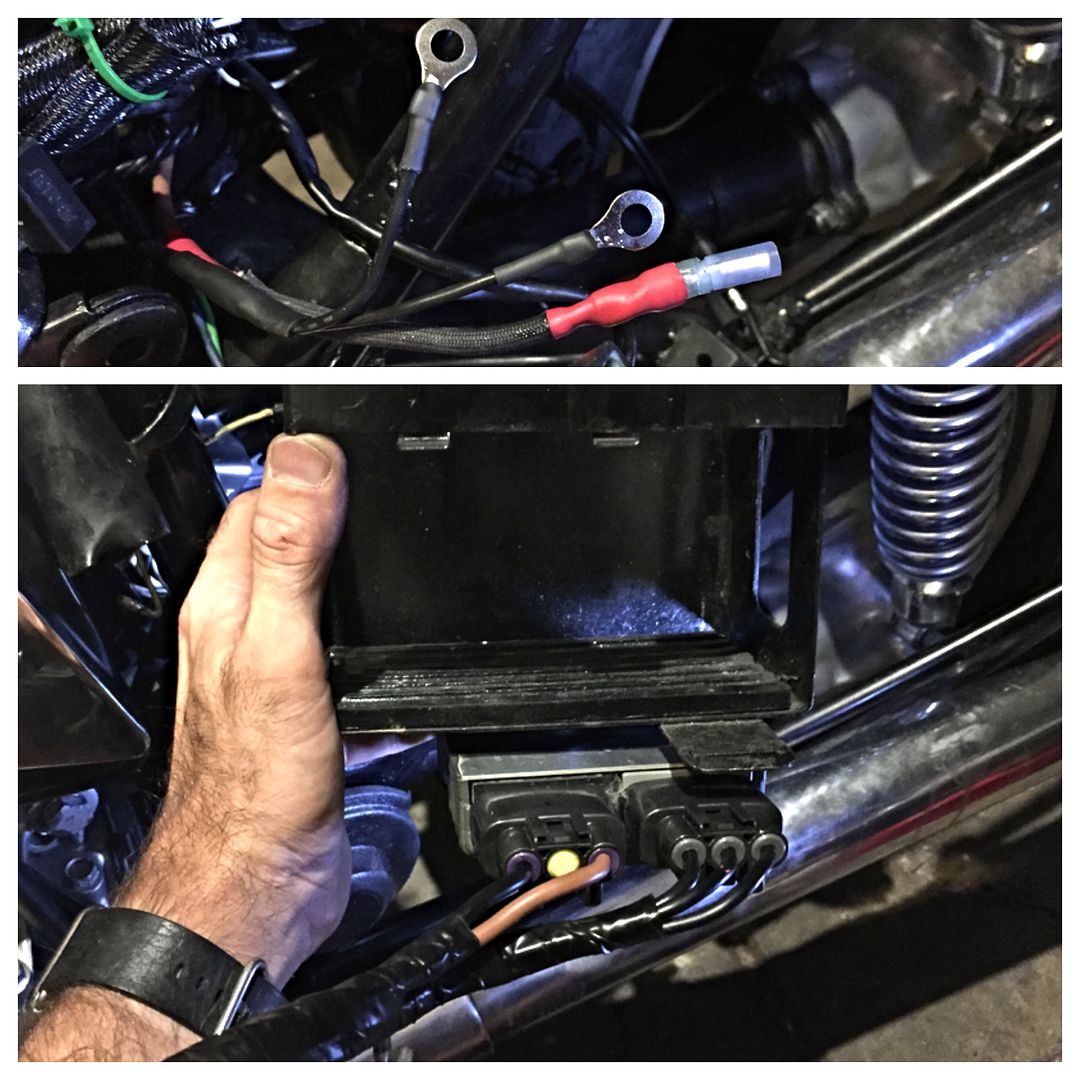
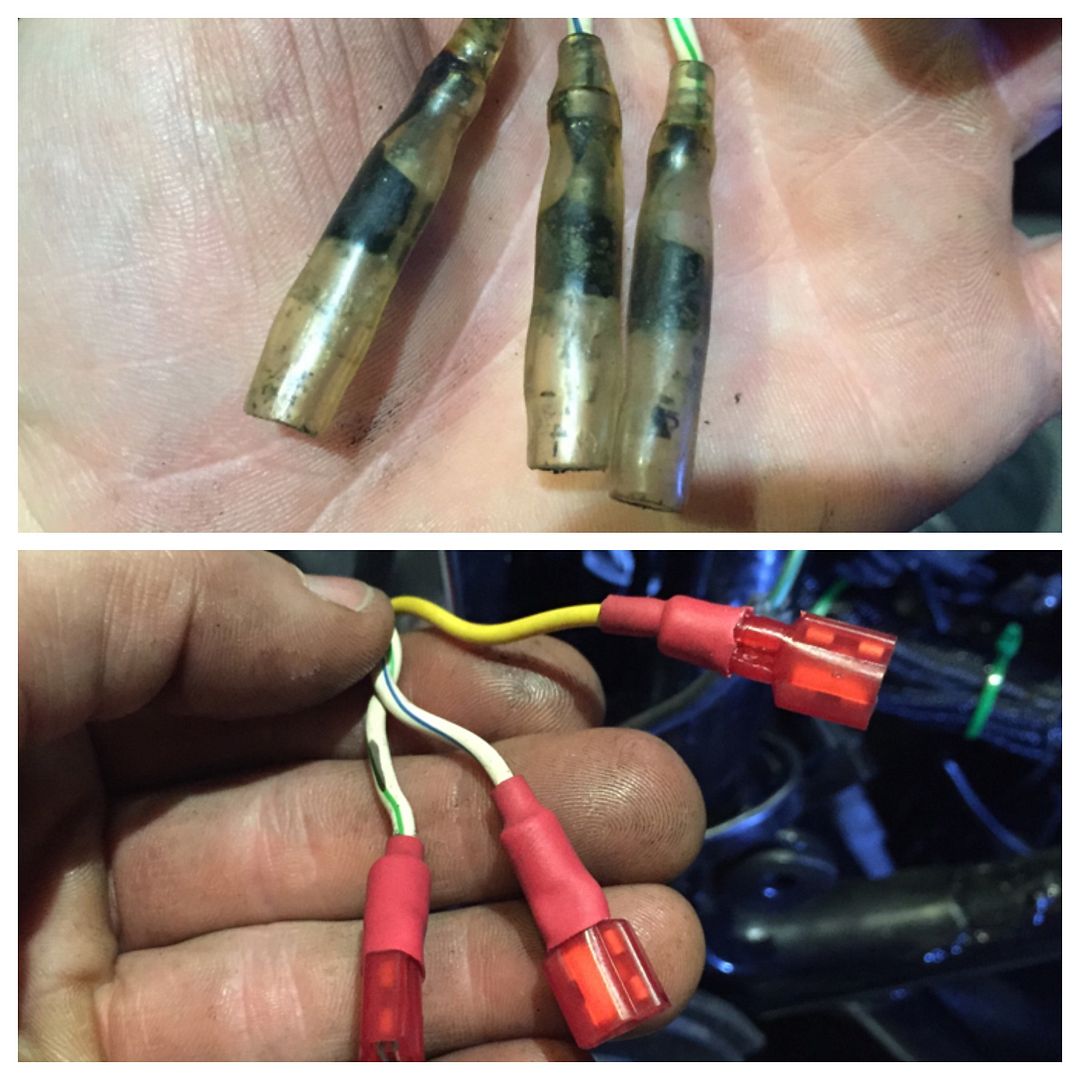
I also did the SPG while wiring in an SH-775 in directly to the stator and replaced those nasty BLACKENED bullet connectors with spades, glue heat shrink tubed and dielectric greased all the connections:

EAA95D4D-845C-472A-93B6-D9B77676D6CC.jpg

88AF368A-5281-41D9-83F2-42F2CAE93C67.jpg

Charging at 14.4v now, sorry for the square collages, the only collage editor I have on my phone is intended to be for Instagram.
 

Looks like you are doing a great job Mike :)

What is important to note here is that Mike only soldered the conductor to get it to bond the the contact. There is no evidence of solder flowing back up into the wire(a good thing). The insulation crimp also acts like heat sink and pulls heat away from the conductor inside helping to prevent the solder from wicking into the strands beyond the crimp. Many times I put a metal tweezer on this insulation crimp to help pull heat away and help from melting the insulation. See how the insulation only got a little heat (some of teh shine came off) and it did not melt so much to distort heavily.

I would have put the soldering tip right on the bare strands to get the contact heated up. It has a lot of area and it will pull heat away. So there is the risk of heat going up the wire while trying to get that big contact heated. That is why getting the contact clean and the flux is best. It gets that solder to flow with the least amount of heat.

To be clear about someone talking about how in aerospace they NEVER solder wires they only used "professional" or "proper" crimps, they are talking about a different world. As long as you do not over heat the conductor and get solder to wick way up into teh wire you will be much better off with a barrier that prevents the corrosion from creating a high resistance inside the crimps.

Having said this, I should mention that you probably need to clean these contacts before you even try and solder them. If they are dirty the solder will not flow (it just beads into a ball) and that is what flux is for. Sometime you just can't get the crimp really clean especially if it is old and got hot previously. If the wire is stiff it is best to cut it back. However, it also helps to have a little flux and teh solder will flow much easier much less heat and the wicking will be minimized.

This is good stuff I use anytime I have a wire of any substantial size.

http://www.amazon.com/gp/product/B005DNR01Q?psc=1&redirect=true&ref_=oh_aui_detailpage_o04_s00

In theory you don't have to clean off the residue, but I use this to get that off as well before treating with DeOxit.

http://www.amazon.com/gp/product/B005T8L4V2?psc=1&redirect=true&ref_=oh_aui_detailpage_o05_s00
 
Last edited:
Looks like you are doing a great job Mike :)

What is important to note here is that Mike only soldered the conductor to get it to bond the the contact. There is no evidence of solder flowing back up into the wire(a good thing). The insulation crimp also acts like heat sink and pulls heat away from the conductor inside helping to prevent the solder from wicking into the strands beyond the crimp. Many times I put a metal tweezer on this insulation crimp to help pull heat away and help from melting the insulation. See how the insulation only got a little heat (some of teh shine came off) and it did not melt so much to distort heavily.

I would have put the soldering tip right on the bare strands to get the contact heated up. It has a lot of area and it will pull heat away. So there is the risk of heat going up the wire while trying to get that big contact heated. That is why getting the contact clean and the flux is best. It gets that solder to flow with the least amount of heat..

This is good stuff I use anytime I have a wire of any substantial size.

http://www.amazon.com/gp/product/B005DNR01Q?psc=1&redirect=true&ref_=oh_aui_detailpage_o04_s00

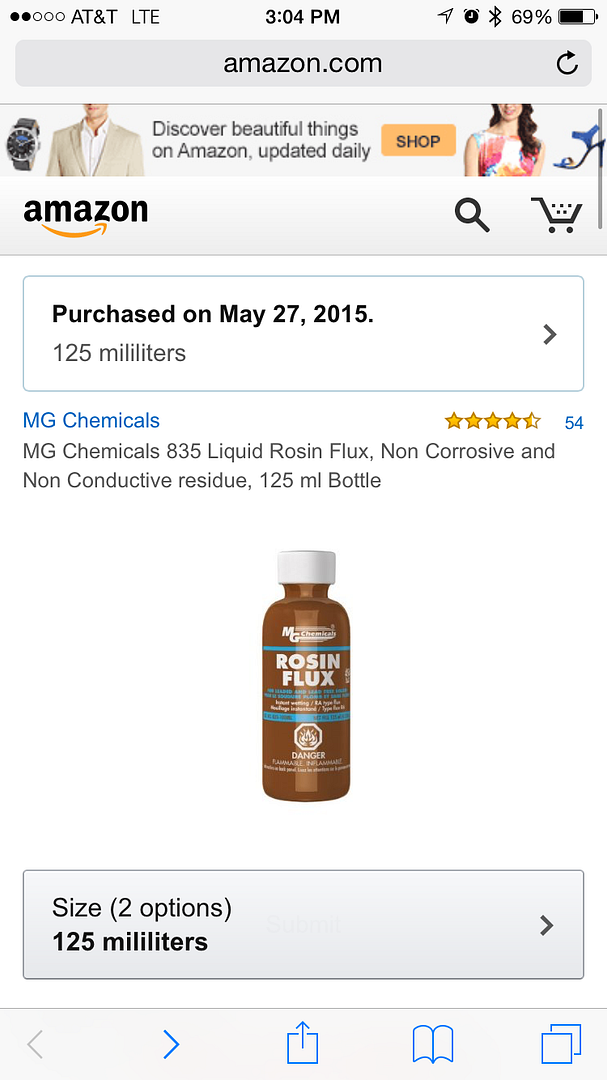
Thanks Pos - I've learned a lot from you, in fact I'm pretty sure it was you that suggested the MG chemicals flux on Amazon, when I clicked your link it took me here and sure enough that's the same stuff I purchased back in May:

AB0D5788-07CE-4A93-8C23-273AC4804988.png


I just wish it had a small brush connected to the lid, so I dip the wires I solder into the bottle or use a red spray "straw" off a can of carb cleaner dipped in with my finger on the tip to them wet the contact, wire or terminal I'm soldering. Works great, I soldered for a long time without using good flux, but just like sweating copper pipe, good flux makes all the difference in the world. Smells nice too!

I actually did just place my soldering iron tip on the wire strands (after properly tinning, of course) but some solder gets on the crimp when feeding it in through the gap/valley of the crimp and I'm OCD so I add a little more and smooth it out purely for aesthetic purposes which is silly because no one will ever see it but me!

Great point about not getting solder and heat up into the wires and adding resistance - I've done that in the past and love your tip about the metal tweezers, I'll have to try that, I have a few pairs of hemostats that may even clamp on, worst case an alligator clip should do nicely.
 
Didn't even think of that - I have one of those syringe type squeeze bottles that I use to cement acrylic together, the tip is so small that I think the flux might gel up.

But I've seen larger gauge needled ones for $4 locally at a plastics supply house - yet another great tip Pos, thanks!
 
Back
Top