• Required reading for all forum users!!!

    Welcome!
    Register to access the full functionality of the GSResources forum. Until you register and activate your account you will not have full forum access, nor will you be able to post or reply to messages.

    A note to new registrants...
    All new forum registrations must be activated via email before you have full access to the forum.

    A Special Note about Email accounts!
    DO NOT SIGN UP USING hotmail, outlook, gmx, sbcglobal, att, bellsouth or email.com. They delete our forum signup emails.

    A note to old forum members...
    I receive numerous requests from people who can no longer log in because their accounts were deleted. As mentioned in the forum FAQ, user accounts are deleted if you haven't logged in for the past 6 months. If you can't log in, then create a new forum account. If you don't get an error message, then check your email account for an activation message. If you get a message stating that the email address is already in use, then your account still exists so follow the instructions in the forum FAQ for resetting your password.

    Have you forgotten your password or have a new email address? Then read the forum FAQ for details on how to reset it.

    Any email requests for "can't log in anymore" problems or "lost my password" problems will be deleted. Read the forum FAQ and follow the instructions there - that's what we have one for...

  • Returning Visitors

    If you are a returning visitor who never received your confirmation email, then odds are your email provider is blockinig emails from our server. The only thing that can be done to get around this is you will have to try creating another forum account using an email address from another domain.

    If you are a returning visitor to the forum and can't log in using your old forum name and password but used to be able to then chances are your account is deleted. Purges of the databases are done regularly. You will have to create a new forum account and you should be all set.

Painting my 83 gs1100e

To answer GK Dad will be using 400 for the final sanding before putting on the base. He does not sand between coats. As for orange peel he says there can be several reasons...temp, quality of paint (we are using RM) or mixed not properly...and he says a lot of people get nervous putting on clear coat and as a result don't enough on because it's hard to see.

I've never had any training--just trial and error and research. I do get nervous with clear because just when I think I have it--there appears a sag. I'm thinking about setting up a rotisserie to hold the tank!

The only way to get the finish glass smooth is by a systematic sanding process and a systematic polishing process. If you can lay down the clear coats wet enough that it flows out well, you can attain a nice enough finish for most people, but if you want zero orange peel, it has to be sanded and polished.

OK that makes me feel a little better but it never seems to get back to that really wet look from before the sanding. Is there a tutorial somewhere for the "systematic process" of getting that level of finish? (Assuming you've sanded down to 2000 grit)
 
The only way to get the finish glass smooth is by a systematic sanding process and a systematic polishing process. If you can lay down the clear coats wet enough that it flows out well, you can attain a nice enough finish for most people, but if you want zero orange peel, it has to be sanded and polished.

I must get awfully lucky then. I can lay down clear coat with zero orange peel.

I final sand with 600, base coat then clear coat. No sanding in between, it comes out glass smooth. I spray with a high end devilbiss gun in a proper booth. I put on about 4-6 coats of clear.

here is a sample. http://www.thegsresources.com/_forum/showthread.php?204001-Gs500/page23&highlight=Fjbj40
 
Last edited:
attachment.php


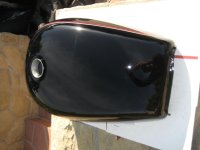
This is PPG clear that flowed out very well. However it is still not as smooth as it turns out after 2000 grit sanding polishing.
 

Attachments

  • IMG_4629.jpg
    IMG_4629.jpg
    58.7 KB · Views: 0
This is PPG clear that flowed out very well. However it is still not as smooth as it turns out after 2000 grit sanding polishing.

That looks great. I would be very happy with that as a pre-sanding polishing result. I've been using PPG's Omni. It's not their best but I wouldn't expect it to be the problem for me. What air pressure do you shoot with?
 
That looks great. I would be very happy with that as a pre-sanding polishing result. I've been using PPG's Omni. It's not their best but I wouldn't expect it to be the problem for me. What air pressure do you shoot with?

I shot with this gun. The reason it works so well is that the tip is only 0.7 as I recall so it takes a bit longer to spray but there is less chance of runs. You have to try to make it run. As long as you have the correct activator for your weather the stuff flows out so well :).

I'm guessing I used a regulator at the gun to about 35-40 psi with the trigger pulled.

http://www.harborfreight.com/adjustable-detail-spray-gun-92126.html


Before anybody starts to naysay, look at the HF review at 4.1 of 5.0!!! And if this black tank is proof enough, then my other GS750E was also painted the same way without any polishing.


IMG_6401.jpg

The funny part about this is that when I last sprayed by ED, I had bought a $100 "nice gun" and I sprayed it in the colder winter months with teh case activator as you would use for summer. It laid out beautifully, but when I came back 5 minutes later there were runs everywhere because it just didn't go off fast enough to avoid the runs.

I have 5-6 of the HF guns and keep them clean but keep the older ones for primer, the next for he color layers and the newest and cleanest for the clear. This gun is really pretty fool proof and it does NOT require a lot of volume and a 220V air compressor. The pros might wince , but if you have never painted before or have a small compressor this thing works very well.

The only thing I have had to do is wrap two large rubber bands around the cap to cover the small vent hole. One would be OK but two is insurance in case one breaks.
 
Last edited:
I shot with this gun. The reason it works so well is that the tip is only 0.7 as I recall so it takes a bit longer to spray but there is less chance of runs. You have to try to make it run. As long as you have the correct activator for your weather the stuff flows out so well :).

I'm guessing I used a regulator at the gun to about 35-40 psi with the trigger pulled.

http://www.harborfreight.com/adjustable-detail-spray-gun-92126.html


Before anybody starts to naysay, look at the HF review at 4.1 of 5.0!!! And if this black tank is proof enough, then my other GS750E was also painted the same way without any polishing.


The funny part about this is that when I last sprayed by ED, I had bought a $100 "nice gun" and I sprayed it in the colder winter months with teh case activator as you would use for summer. It laid out beautifully, but when I came back 5 minutes later there were runs everywhere because it just didn't go off fast enough to avoid the runs.

I have 5-6 of the HF guns and keep them clean but keep the older ones for primer, the next for he color layers and the newest and cleanest for the clear. This gun is really pretty fool proof and it does NOT require a lot of volume and a 220V air compressor. The pros might wince , but if you have never painted before or have a small compressor this thing works very well.

The only thing I have had to do is wrap two large rubber bands around the cap to cover the small vent hole. One would be OK but two is insurance in case one breaks.

For $13 who's going to argue. I'm going to go buy a couple of them tomorrow. However, I don't understand why you cover the vent hole since that prevents vacuum from building in the reservoir and interrupting the flow to the nozzle. (Is this considered hijacking)?
 
For $13 who's going to argue. I'm going to go buy a couple of them tomorrow. However, I don't understand why you cover the vent hole since that prevents vacuum from building in the reservoir and interrupting the flow to the nozzle. (Is this considered hijacking)?

The paint would spill out when turned upside down. Must have been old cracked 1/4" wide rubber bands that did not really seal. Never had any issues with spraying. Just clean well and follow other recommendations with respect to moisture control.


Yes we probably are jacking Trevor's thread by now :o
 
Last edited:
Here is another hint, that you would rather not find out the Hard Way. You need to pay attention to the paint in the area of the neck. While there is debate about how to fix the problem, there is not much debate that there is a problem to be dealt with.

NVR2Old is an impeccable painter and his recommendation is to fillet the gas filler neck with JB weld. IIRC, he applies color leaving a portion of the JB Weld Fillet exposed and then clears over the color and JB Weld fillet, presumably he masked off the JB weld where it tappers into the metal neck.

I did not go to this length instead relied on the adhesion properties of the PPG to bare metal. I mask off the neck twice. The first time is for the primer and color. Then before shooting the clear I pull that tape and then mask off further onto the bare metal. The protects the edge of the color.

The main thing is you have to seal the neck seam or gas can get under the clearcoat and does wonders for the color. But also it is best to prevent the gas from getting under to the color as well. If you end the color and the clear at the same place the gas has a pretty good opportunity to get in. So you need two separate boundaries. One where the color ends ,and one where the metal starts. How you do that can be the subject of much debate.

NVR2OLD has a JB Weld to metal boundary that prevents gas from getting under teh JB Weld. I use a PPG Clear to Metal boundary to presumable achieve similar results in allowing gas into the Clear to metal boundary. The benefit is I don't have a "Tan Line" on my tank.

More here.

http://www.thegsresources.com/_foru...s-filler-seal-for-paint&highlight=filler+Neck

Here is a picture of mine. What is a little hard to tell, but my main paint line for masking (i.e. the end of the color) is well above the filler neck seam. Before clearing I removed that masking tape and moved the next mask like to teh top of the filler where it rolls over and goes into the tank. This gives me about 1/8" of clear over metal that with a clear to metal boundary at the highest point on the neck where there can be no standing gas. Make sure there is plenty of clear in this area ; as much as you can pool without running.

My tank was also coated with Por-15 and if you do that make sure to keep that little hole you see open and clear. It is a vent hole and your gas will certainly come out if it is plugged. In fact that is how I learned so much about this subject :(


This is the first time the tank was painted and that time I taped to the seam (bad mistake)
IMG_2919_zpszmdvdrgx.jpg

This tanks was painted in about summer 2011 after my get off but the Por-15 tank liner was done back in Summer 2008. which is about 5 years ago now.

IMG_83381_zpso5mdiqpo.jpg
 
Last edited:
Well Posplayr, am I ever glad I read your post! We are getting ready to paint tomorrow and your tip on the tank neck was great. We will be tapping and spraying accordingly. Thanks again. And my Dad bought me the hf gun. He says the same thing about the gun as you do...and great with my small compressor.
We got the paint booth finished today and painted my exhaust.
Bought a heavy gauge plastic in a roll that was more than I needed but that was how it came.
Plastic $32
Fan I got a t a yard sale $5.
Furnace filter (3) $7.
Total cost $44...
It worked out great having the windows right there allowing natural light.


Lol...


Little test run with my exhaust...Fan worked great!


Front fender jig


tank jig

 
Last edited:
Looks like you are in good hands. (working alone) I would probably want an extra set of work lights. I had overhead florescent in mine. They provided excellent light but were also a dust collector so I had to make sure I washed them down good before each paint job.

With two people , you can be standing outside on light duty and move the lamps around depending upon what you Dad need.
 
Following with interest, looks like you're in good hands and spending some quality time with your Pops, that's great!

A little jealous, I've often wondered what it would be like...
 
Thanks guys, really enjoying spending time with my Dad...

Ready for paint.


My dad put on a couple of coats of paint and a couple coats of clear...in a few days he will sand with 1500 (maybe wet sand) and lay the decals down and a couple more coats of clear. Got some dust in the paint (I guess I need to stay away form the booth lol) Sanding will take care of that and we will make sure no air will be coming through my garage when we do the final clear coats.
Very happy with the way the blue is coming down and it looks very close to the original colour.


Last edited:
You want to be very careful sanding anything on the decals. The procedure is a light dusting to build a barrier then get enough clear over the decals s othat you can rough them up again (but the barrier prevents a bleed through which lifts the decal) without going through (ask me how I know). If unsure barely touch the decals. IIRC I might have used a 600 instead of a 1500. 1500 is pretty fine for getting good adhesion of the clear.
 
Stopped by today to make sure Trevor was doing a stand up supervisor job, he was as usual..;) The paint is uncannily close to the original if not a perfect match. Unfortunately Trevor's going to have to do a frame up rebuild to get the rest of the bike looking as good as the paint job! Good work 'Dad'!!
 
Stopped by today to make sure Trevor was doing a stand up supervisor job, he was as usual..;) The paint is uncannily close to the original if not a perfect match. Unfortunately Trevor's going to have to do a frame up rebuild to get the rest of the bike looking as good as the paint job! Good work 'Dad'!!

Good idea Rob! When can you make it happen??:p
 
You want to be very careful sanding anything on the decals. The procedure is a light dusting to build a barrier then get enough clear over the decals s othat you can rough them up again (but the barrier prevents a bleed through which lifts the decal) without going through (ask me how I know). If unsure barely touch the decals. IIRC I might have used a 600 instead of a 1500. 1500 is pretty fine for getting good adhesion of the clear.

So we have two coats of clear on the paint now and will sand with 1000, then apply decals and then two more coats of clear. Does that sound right?
Is it ok to put the decals on after a few days of the clear coat curing and a light sanding?
 
WOW , looking real good Trevor ,would love to have mine look that good .
 
So we have two coats of clear on the paint now and will sand with 1000, then apply decals and then two more coats of clear. Does that sound right?
Is it ok to put the decals on after a few days of the clear coat curing and a light sanding?


Yes Sandy mentioned this a couple of days ago. You want to let the clear outgas for a while before applying the decals.

When painting the decals you want to start with a very light fog over the decal to seal it. Let it dry for 5-15 minutes (depending on your weather; it should be beyond the tacky stage when you resume) before putting on the next layers of clears. That builds a barrier to prevent the decal from lifting. So unless you really hose down the next layers of clear (and reflow the fogged layer), the decal will not lift as it is encased in that first layer of fogged clear.

I would wait to sand the day you put on the decals. That will help remove anything that might have gotten on.

I'll leave it up to your dad to decide how many coats of clear to use. I would do at least those last 2.
 
Yes Sandy mentioned this a couple of days ago. You want to let the clear outgas for a while before applying the decals.

When painting the decals you want to start with a very light fog over the decal to seal it. Let it dry for 5-15 minutes (depending on your weather; it should be beyond the tacky stage when you resume) before putting on the next layers of clears. That builds a barrier to prevent the decal from lifting. So unless you really hose down the next layers of clear (and reflow the fogged layer), the decal will not lift as it is encased in that first layer of fogged clear.

I would wait to sand the day you put on the decals. That will help remove anything that might have gotten on.

I'll leave it up to your dad to decide how many coats of clear to use. I would do at least those last 2.
Yes we are going to apply the decals on the day we sand. Planning on doing that on Sunday. If we are applying decals over sanded clear would that not ilinamate the "outgas"?
 
Back
Top