• Required reading for all forum users!!!

    Welcome!
    Register to access the full functionality of the GSResources forum. Until you register and activate your account you will not have full forum access, nor will you be able to post or reply to messages.

    A note to new registrants...
    All new forum registrations must be activated via email before you have full access to the forum.

    A Special Note about Email accounts!
    DO NOT SIGN UP USING hotmail, outlook, gmx, sbcglobal, att, bellsouth or email.com. They delete our forum signup emails.

    A note to old forum members...
    I receive numerous requests from people who can no longer log in because their accounts were deleted. As mentioned in the forum FAQ, user accounts are deleted if you haven't logged in for the past 6 months. If you can't log in, then create a new forum account. If you don't get an error message, then check your email account for an activation message. If you get a message stating that the email address is already in use, then your account still exists so follow the instructions in the forum FAQ for resetting your password.

    Have you forgotten your password or have a new email address? Then read the forum FAQ for details on how to reset it.

    Any email requests for "can't log in anymore" problems or "lost my password" problems will be deleted. Read the forum FAQ and follow the instructions there - that's what we have one for...

  • Returning Visitors

    If you are a returning visitor who never received your confirmation email, then odds are your email provider is blockinig emails from our server. The only thing that can be done to get around this is you will have to try creating another forum account using an email address from another domain.

    If you are a returning visitor to the forum and can't log in using your old forum name and password but used to be able to then chances are your account is deleted. Purges of the databases are done regularly. You will have to create a new forum account and you should be all set.

Plain weird behavior

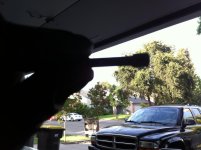
IMG_0613.jpgGotta say--it pays to follow instructions. A terrible picture I know but you should be able to see light coming through four little holes in this needle jet--but you can't because they are plugged. The guy who "rebuilt them" skipped this step. So no, you can't tell for sure unless you do it yourself and yes, I'm ready to hear a stream of I-told-you-so's. Odd thing is the #1 cylinder would not fire unless choked--but it's needle jet was the cleanest of the four.

As far as the plug wires, I think I'll just go ahead and order replacements. They are too cheap to ignore.
 
View attachment 35629Gotta say--it pays to follow instructions. A terrible picture I know but you should be able to see light coming through four little holes in this needle jet--but you can't because they are plugged. The guy who "rebuilt them" skipped this step. So no, you can't tell for sure unless you do it yourself and yes, I'm ready to hear a stream of I-told-you-so's. Odd thing is the #1 cylinder would not fire unless choked--but it's needle jet was the cleanest of the four.

As far as the plug wires, I think I'll just go ahead and order replacements. They are too cheap to ignore.

That's almost as bad a picture as mine. As far as told-you-so's go well, that's a 'cast the first stone' type of thing :)
When the carbs are back on I like to open the drains and run fuel through on prime with the odd tap of a rubber mallet. It seems to be a law of nature that no matter how well you clean things there is always something still in there on the first run through.
I would hold on the ht leads unless you have hard evidence that they are at fault. It's not a trivial job to replace them and you could up end up becoming an expert on something you wish you hadn't. I would wipe them clean, apply WD-40 and take it from there. I can't see them getting better of their own accord to let the bike run unless there was a significant difference in weather i.e. misfiring in the rain.
 
Last edited:
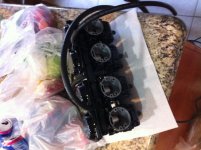
OK, did the carburetors very thoroughly AND put the original jets back in. I did leave in the float valve from the previous rebuild because the old needles were clearly worn. Freshly rebuilt and painted .jpgHere is a picture of the carbs after paint and pretty enough to be on the kitchen counter--at least IMO. I started the bike and rode it around the neighborhood. Very smooth. Main concern at the moment is that the exhaust temperatures vary widely at idle--from 200 degrees to over 500. I guess the adjustment screws may make a difference but I'm not really clear on dialing them in. Initially I thought they were adjusted with the vacuum gauges but then I saw where they are adjusted based on the engines reaction to "flipping" the throttle and all four should be the same.
 
Describe "very thoroughly". Did you take them all apart and dip them in carb dip?
 
Thoroughly in this case means I followed the instructions for dis-assembly, dip (jets and bodies), and reassembly checking the tiny passages for flow. They are truly clean.
 
OK, did the carburetors very thoroughly AND put the original jets back in. I did leave in the float valve from the previous rebuild because the old needles were clearly worn. View attachment 35669Here is a picture of the carbs after paint and pretty enough to be on the kitchen counter--at least IMO. I started the bike and rode it around the neighborhood. Very smooth. Main concern at the moment is that the exhaust temperatures vary widely at idle--from 200 degrees to over 500. I guess the adjustment screws may make a difference but I'm not really clear on dialing them in. Initially I thought they were adjusted with the vacuum gauges but then I saw where they are adjusted based on the engines reaction to "flipping" the throttle and all four should be the same.

Now might be a good time to swap the ht leads around and see if the temperatures follow them
 
Maybe I don't understand the suggestion. If swapping the "ht leads" requires removing them from the coils, wouldn't it be just as easy to replace them with new? I believe the four are only $20.
 
Maybe I don't understand the suggestion. If swapping the "ht leads" requires removing them from the coils, wouldn't it be just as easy to replace them with new? I believe the four are only $20.

Each coil drives a pair of plugs. I think the left coil does 1&4 and the right one 2&3 If you swap over the leads without removing them from the coils it would show up any defects in the leads themselves or the plug caps.
 
That's the idea. If the temps don't change it eliminates the leads and plug caps from the equation. It doesn't eliminate the coils but you have your min and max temps on 1&4 which is one coil. It's an easy way to try and make the defect move, a lot easier than tearing into carbs.
 
Did not try the swap yet--but now number one is firing fine but number two is not firing unless the choke is on. I could see that the plug was black but I didn't know from when so I checked the compression and it was down to 75. I put some Lucas fuel treatment in the cylinder to see if the compression would come up and it did. I changed the plug and checked for spark but it still would not fire. So I loosened the choke connector from the rod so that I could actuate the choke for just the number two cylinder and when I did, it fired. I checked the number two exhaust temp while holding the choke on and it came up to the 250 range. When I let go of the choke it dropped back down. So I guess I missed something in the number two carb but I don't know how. Everything was dipped and checked for flow. Even if there was a speck blocking something, would it block everything but the choke? If so, where would it be? Also, the choke only makes it fire if it is pulled out at least 3/8 inch.
 
Last edited:
It's possible you have stuck rings in that cylinder. I would take it for a good hard test drive and see if your compression improves. If the engine had been sitting a while it is common for rust to form on the rings and it prevents them from expanding out and sealing on the cylinder wall when the engine is running. You should be able to see into that cylinder if you remove the spark plug and shine a bright light in there. You need to check and see if the cylinder is scored at all or if the piston is damaged at all. Pouring oil into the cylinder seals up the gap between the rings and the cylinder wall temporarily and will increase compression only for a short time. That is about the most surefire way to tell if you have bad rings causing low compression.
 
I pulled the carbs back out and opened up #2 and the pilot jet was totally clogged. I stuck a needle down it and blew through it and white powder blew out. I can't believe I missed that. Really disgusted. Also, I am wondering if there is a technique to get the carbs in and out of the bike without distorting the airbox boots. It is such a tight fit.
 
Last edited:
Yes. Used a very sharp needle for a sewing machine. Blew through it to make sure. I just thought I had done that before but I obviously missed this one.
 
SWEET VICTORY! Perfect idle, no miss, smooth acceleration, power like I remembered. It is so worth it to clean the carbs properly when you get to hear and feel the results.

And I figured out how to get them in without such a wrestling match--make sure all the hose clamps are pulled back from their normal position so the boots can flex without resistance and without bending the clamps. Then gently wiggle the carbs over the boots as much as possible and once they are through, work them down into the stiffer head boots first and then line up the airbox boots and pull them on.

It's a good morning! Thanks for all the help gentlemen.
 
SWEET VICTORY! Perfect idle, no miss, smooth acceleration, power like I remembered. It is so worth it to clean the carbs properly when you get to hear and feel the results.

And I figured out how to get them in without such a wrestling match--make sure all the hose clamps are pulled back from their normal position so the boots can flex without resistance and without bending the clamps. Then gently wiggle the carbs over the boots as much as possible and once they are through, work them down into the stiffer head boots first and then line up the airbox boots and pull them on.

It's a good morning! Thanks for all the help gentlemen.

Also, a heat gun will soften the rubber and dry silicone spray makes them slippery without damaging them.
 
Just one more thing to keep in your mind. Fuel or no fuel to a cylinder won't effect the compression. You still have a pretty serious compression issue. Like jbthomp said, it's possible to get stuck ring to seal again, but it's not certain. Personally I would run a can of Seafoam through it. Half can (in the gas tank) per tank full. And keep checking the comp. on that cylinder. Good luck, I hope it frees up for you...
 
Just one more thing to keep in your mind. Fuel or no fuel to a cylinder won't effect the compression. You still have a pretty serious compression issue. Like jbthomp said, it's possible to get stuck ring to seal again, but it's not certain. Personally I would run a can of Seafoam through it. Half can (in the gas tank) per tank full. And keep checking the comp. on that cylinder. Good luck, I hope it frees up for you...

Already bought the Seafoam and a big bottle of Lucas fuel system cleaner for maintenance. It ran very smoothly this morning but I'll check the compression after I've ridden it some.
 
Back
Top