• Required reading for all forum users!!!

    Welcome!
    Register to access the full functionality of the GSResources forum. Until you register and activate your account you will not have full forum access, nor will you be able to post or reply to messages.

    A note to new registrants...
    All new forum registrations must be activated via email before you have full access to the forum.

    A Special Note about Email accounts!
    DO NOT SIGN UP USING hotmail, outlook, gmx, sbcglobal, att, bellsouth or email.com. They delete our forum signup emails.

    A note to old forum members...
    I receive numerous requests from people who can no longer log in because their accounts were deleted. As mentioned in the forum FAQ, user accounts are deleted if you haven't logged in for the past 6 months. If you can't log in, then create a new forum account. If you don't get an error message, then check your email account for an activation message. If you get a message stating that the email address is already in use, then your account still exists so follow the instructions in the forum FAQ for resetting your password.

    Have you forgotten your password or have a new email address? Then read the forum FAQ for details on how to reset it.

    Any email requests for "can't log in anymore" problems or "lost my password" problems will be deleted. Read the forum FAQ and follow the instructions there - that's what we have one for...

  • Returning Visitors

    If you are a returning visitor who never received your confirmation email, then odds are your email provider is blockinig emails from our server. The only thing that can be done to get around this is you will have to try creating another forum account using an email address from another domain.

    If you are a returning visitor to the forum and can't log in using your old forum name and password but used to be able to then chances are your account is deleted. Purges of the databases are done regularly. You will have to create a new forum account and you should be all set.

Question about Float Height

danny01975

Forum Mentor
Super Site Supporter
Past Site Supporter
I'm a little confused on how exactly to measure the float height. The manual that Nessism put together show the measurement is taken from the gasket surface to the top of the rounded part of the float. My service manual shows the measurement should be from the bottom edge of the carb body to the very top of the float. Which is the correct way? Or is it the same difference?

Here's the pic from my manual.
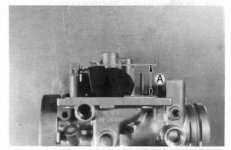
Screenshot 2024-12-26 at 5.41.37 AM.jpg


Also, about checking the fuel level in the bowls. I see lots of people checking the float level with the carbs on a bench. Nessisnm's guide says the same thing. But the manual says to check it with the bike running. The manual says the measurement should be 5mm. Nessismm's guide says 2.89. I'm guessing if you check it while it's running the other 2.1mm is being actively sucked up into the engine.
 
Fuel level should be 5.0mm +/- 0.5

The photo in the tutorial is just an example on how to measure.

Measuring with the engine running is difficult, plus you can't easily change the level without taking the carbs back off. It's easier to test with the carbs on the bench. The result may not be perfect, but it's close enough. And speaking of close enough, it's difficult to hit an exact fuel level. I'm generally happy to see the fuel below the gasket surface anywhere from 2 - 5mm. If I can verify this, I don't mess with it any further.

Lastly, the diagram from the 1100G manual is wrong. The lines are shifted upwards. Should be to the gasket surface, and the notch in the float. Not to the top of the float as shown. You can't adjust the top of the float anyway.
 
Fuel level should be 5.0mm +/- 0.5

The photo in the tutorial is just an example on how to measure.

Measuring with the engine running is difficult, plus you can't easily change the level without taking the carbs back off. It's easier to test with the carbs on the bench. The result may not be perfect, but it's close enough. And speaking of close enough, it's difficult to hit an exact fuel level. I'm generally happy to see the fuel below the gasket surface anywhere from 2 - 5mm. If I can verify this, I don't mess with it any further.

Lastly, the diagram from the 1100G manual is wrong. The lines are shifted upwards. Should be to the gasket surface, and the notch in the float. Not to the top of the float as shown. You can't adjust the top of the float anyway.

I did think measuring the fuel level on the bike, with the engine running would be a challenge. Especially on the two inner carbs. The bench method sure seems easier.

Thank you for the explanation!
 
So using your advice, I was able to get the float heights spot on. Especially the part in your guide about the floats compressing the needle valve. All of mine did this so I had to carefully find the point where the float just touched the needle. Once I did that I took a measurement, made an adjustment, and re-measured. Rinse and repeat.

In your guide you say if this is occurring then to hold the float up or replace the needle. Why would replacing the needle solve this? Wouldn't the spring be what letting the needle compress? Do the needles get "worn down" over time and become shorter?
 
So using your advice, I was able to get the float heights spot on. Especially the part in your guide about the floats compressing the needle valve. All of mine did this so I had to carefully find the point where the float just touched the needle. Once I did that I took a measurement, made an adjustment, and re-measured. Rinse and repeat.

In your guide you say if this is occurring then to hold the float up or replace the needle. Why would replacing the needle solve this? Wouldn't the spring be what letting the needle compress? Do the needles get "worn down" over time and become shorter?

With new float valves, either Mikuni or Keyster, the weight of the float won't compress the needle spring. I can only assume that means the springs sag with age. And speaking of that, never just replace the needle; both the seat and needle are matched together as a set. And don't use K&L, those have weak springs. Mikuni or Keyster is all I use.
 
Here's a handy trick. Scribe a mark 5 mm down from the mating surface of each float bowl. Then use a sight tube. This gives you the real world static fuel height.
IMG20210118223750.jpg
 
Here's a handy trick. Scribe a mark 5 mm down from the mating surface of each float bowl. Then use a sight tube. This gives you the real world static fuel height.

That’s a good idea. I was measuring with my calipers each time. This would have been easier. Will do this next time.
 
Using the sight glass method, how did you connect the tube to the bottom of the float bowl?

You can buy a screw-in adapter. I was given the one pictured below. I prefer the 'given to me' method. The top graduated indicator insert has disintegrated but it's not needed.

Some have made various types - do a search. I made one from stuff lying around, using small metal tubing and a silicone plug. I drilled a hole in the plug and jammed the metal tube through, and fitted the clear tubing, and 'screwed it in'. It wasn't great but worked. I binned it when I was given this one.

Z1 Enterprises may sell them, and I see this example on eBay, but be sure to check the thread diameter and pitch for your application. I have used mine on quite a variety of carbs, maybe I'm just lucky.

https://www.ebay.com/itm/394929839520

kRn5PGe.jpg
 
Last edited:
You can buy a screw-in adapter. I was given the one pictured below.

This is what I did. Mine didn't have the marks on the end but it's essentially the same. I would have made my own but I don't have any spare bowl plug bolts. And finding a bolt the right size AND thread pitch seemed impossible. All of the hardware stores around here either had the right thread pitch but wrong size, or right size and wrong pitch. So I bought one off of eBay. Works perfectly.

I put a longer tube on it so I could set the float height on each carb without splitting the rack. Using one carb on the end to check the height. Just make sure the carbs are absolutely level on both axis. I made a jig to hold the rack level as a whole assembly.
 
Reviving this thread for an additional question..

I've been having some issues with a "stutter" between 1/8 and 1/4 throttle, only after warmed up. When cruising around 3200 rpms in 3rd or 4th gear, when I apply the throttle the bike will, for lack of a better word, hiccup for a second then accelerate as normal. It only happens in that rpm range, in those gears. What I suspect is occurring is the vacuum conditions are just right so that when I apply the throttle I get a momentary lean condition, which is immediately resolved by the larger throttle opening and the engine pulling more vacuum. This is likely right between the pilot to needle jet transition.

I read that there are two ways to remedy this. Raise the needle, or raise the fuel level in the bowl. Raising the fuel height, while tedious and not fun, is easier and non-destructive. So I tried that first. I had it in my head that the range was 2.5 - 3mm so I dialed them all in between 2.5 and 2.9 mm. They were between 4 and 5 mm before adjustment. Now I realize it's actually supposed to be 5mm. However.. It DOES seem to have improved the stutter greatly. It's still there but the window of conditions in which it occurs, and frequency, is significantly smaller.

My question is, the way Nessism explains it above, I just need to get it around 5mm and call it good. How important is this tiny difference in float height, what is going on here, and is it all in my head?
 
Back
Top