• Required reading for all forum users!!!

    Welcome!
    Register to access the full functionality of the GSResources forum. Until you register and activate your account you will not have full forum access, nor will you be able to post or reply to messages.

    A note to new registrants...
    All new forum registrations must be activated via email before you have full access to the forum.

    A Special Note about Email accounts!
    DO NOT SIGN UP USING hotmail, outlook, gmx, sbcglobal, att, bellsouth or email.com. They delete our forum signup emails.

    A note to old forum members...
    I receive numerous requests from people who can no longer log in because their accounts were deleted. As mentioned in the forum FAQ, user accounts are deleted if you haven't logged in for the past 6 months. If you can't log in, then create a new forum account. If you don't get an error message, then check your email account for an activation message. If you get a message stating that the email address is already in use, then your account still exists so follow the instructions in the forum FAQ for resetting your password.

    Have you forgotten your password or have a new email address? Then read the forum FAQ for details on how to reset it.

    Any email requests for "can't log in anymore" problems or "lost my password" problems will be deleted. Read the forum FAQ and follow the instructions there - that's what we have one for...

  • Returning Visitors

    If you are a returning visitor who never received your confirmation email, then odds are your email provider is blockinig emails from our server. The only thing that can be done to get around this is you will have to try creating another forum account using an email address from another domain.

    If you are a returning visitor to the forum and can't log in using your old forum name and password but used to be able to then chances are your account is deleted. Purges of the databases are done regularly. You will have to create a new forum account and you should be all set.

R/R Wiring

80's Guy

Forum Newbie
Hello!

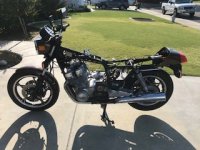
I have a 1980 1100ET. In one of the post, the writer says to connect all 3 yellow wires from the stator to the R/R. Do they all connect to the yellow wire on the R/R? Also, on my R/R there is a white wire with a blue stripe. This was not connected. should it be?
 

Attachments

  • 1980 GS1100ET under construction.jpg
    1980 GS1100ET under construction.jpg
    31.6 KB · Views: 0
If your bike has a rectifier/regulator combined there should be 4 wires from it one of them should be red that red would be connected into the bikes harness, the other 3 would connect to the yellows from the stator it does not matter which goes to which as there is no polarity. This would eliminate what is know as thee handle bar loop.
However if you are running a shunt rec/reg then it may be prudent to wire it using the handle bar loop.
if you are using a series rec/reg then wiring it with the stator wires going directly to the rec/reg.
The handle bar loop ( if you have one I could not see a diagram for yours) takes one wire from the stator and goes to the lighting switch then back to the reg/rec. so with no lights on the stator is running on 2 of the three legs and when the light switch is on it runs on all three legs.
 
When someone says "connect the three wires from stator to the R/R"... what they are implying without specifically saying is:

- connect the 3 stator wires directly to the three respective wires of the R/R, dont bother with the original loop of wiring that went up to the headlight bucket to non-existant headlightswtich and back down to the R/R.

- connect the three wires from stator to the three respective wires of the R/R.... no need to say which of the three wire to which of the three wires, doesnt matter, the stator wires are all the same, and without the headlight swtich loop it doesnt matter which of the RR input wires you use for which stator wire.

- stock stators have wire colors that match the colors of the bikes wring harnerss with the headlight switch loop. But aftermarket stators (and RRs) just have 3 yellow wires or 3 black wires, again, since it doesnt matter if not using the headlight swtich loop,

- if do connect the 3 wires of the stator directly to the three wires of the R/R, will then have a couple wires leftover not connected to anytthng, and those are the two wires in the bikes harness that go up to the non-existent headlight switch.

- and once you understand all that, then you will know that you didnt really need to understand all that, just connect the three wires of the stator each to the three respective wires of R/R. But, yah, is good that you understand that.
 
Last edited:
Let's try that again. Same idea, different words.

No, you do not connect all three yellow stator wires to one yellow R/R wire. Your R/R should have three input wires. The colors may be different, depending on whether it is a stock or aftermarket R/R, but there are always three input wires. Colors don't matter, just connect each of the three stator wires to each of the three R/R wires.

The output wire of the R/R should connect to the red wire on the bike, not the battery + terminal. The ground wire of the stock R/R is usually attached to the battery box, but that needs to have an additional wire to the battery - terminal.

There is a concept that is often mentioned on the forum called "Single-Point Ground" or "SPG". The ground wire of the R/R should connect there, along with all the other ground wires from the bike. There should also be a wire from the SPG to the - terminal on the battery.

This helps to keep wiring congestion at the battery to a minimum. There will be ONE large wire at the + terminal that goes to the starter solenoid. The smaller red wire that goes to the fuse box could be at the solenoid end of that large wire. There will TWO wires at the - terminal. One large wire will go to the back of the crankcase to ground the starter, the smaller one will go to the SPG to ground everything else.

.
 
Can someone please explain why the red + wire from an SH775 should not go direct to battery +.(with an inline fuse)
I have had mine wired up this way for a few years now and it seems to work fine, i am just wondering if there is a technical reason why this is incorrect.
 
It'll work fine -it's an extra wire on the battery to bolt on so I don't like it for convenience.Stacking terminals on a bolt gets ugly and is not elegant..But, if it's more convenient for you, or you like it better than tapping into the original that taps to the red wire in the harness, or even (stacked-ugh) at the solenoid's battery terminal, sure. Be happy.

Mind you,
...I'm not seeing why you actually need a fuse specifically for the R/R anyways. What do you suppose it's protecting? The main Red has a fuse -the bike's master fuse -so a fuse on the output of the R/R is a duplication of a function you already had, using the original wiring.
but, if the extra fuse doesn't corrode, fall out, cause problems...it does no harm.
 
Last edited:
Very clear!

Very clear!

Thank you Steve/All,

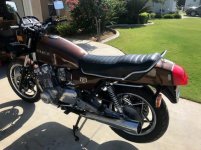
I am a newbie navigating the GS world. There was some questionable wiring. I think have it all cleaned up, used the single point ground. I have rebuilt carbs, new fuel petcock, new plugs, new spark plug wire ends, oil filter, oil, good used starter (two of the mounting ears were gone on my starter), misc. bolts/nuts/washers that were missing, new battery cables, new fuse box, and all new bulbs. I followed the newbie cheat sheet. Next is brakes (stopping is good). I have countless hours detailing, painting, and polishing. I am very excited to get it back on the street!

Thank you all again!
 

Attachments

  • 1980 GS1100ET Almost done.jpg
    1980 GS1100ET Almost done.jpg
    55.5 KB · Views: 0
Can someone please explain why the red + wire from an SH775 should not go direct to battery +.(with an inline fuse)
I have had mine wired up this way for a few years now and it seems to work fine, i am just wondering if there is a technical reason why this is incorrect.
It might help to look at the wiring as a block diagram with some general numbers.

When you turn the key ON, power flows from the battery, through the MAIN fuse, to the ignition switch, then back to supply the other three fuses. Between the MAIN fuse and the ignition switch, the red wire from the R/R joins the harness.

When you turn the key ON, the lights and coils will draw just over 10 amps. The 15 amp MAIN fuse is there to protect things just in case something is accidentally drawing too much.

When the engine is started, the stator and R/R start to work. As the engine speed rises, the output will be more than the battery has been supplying, so the R/R output starts feeding the bike.

The stock charging system is capable of just over 20 amps. The bike draws just over 10 amps while running, so any excess from the R/R goes backward through the MAIN fuse to charge the battery. The only section of wire that is going to carry a lot of current is the section from the R/R to the main harness. After the red wire meets the main harness splits the output to what the bike needs and battery charge. As the battery nears full charge and the R/R does its regulating thing, there is less current going through the MAIN fuse.

If you move the R/R output directly to the battery, all the current to run the bike must also go through the MAIN fuse all the time. Because the current in the output wire has to run the bike AND charge the battery, it should have a fuse that is at least 20, if not 25 amps.

Other than the fact that you are re-routing current through the fusebox, there is nothing really wrong with connecting the R/R output directly to the battery, as long as you know what's going on downstream.

.
 
It might help to look at the wiring as a block diagram with some general numbers.

When you turn the key ON, power flows from the battery, through the MAIN fuse, to the ignition switch, then back to supply the other three fuses. Between the MAIN fuse and the ignition switch, the red wire from the R/R joins the harness.

When you turn the key ON, the lights and coils will draw just over 10 amps. The 15 amp MAIN fuse is there to protect things just in case something is accidentally drawing too much.

When the engine is started, the stator and R/R start to work. As the engine speed rises, the output will be more than the battery has been supplying, so the R/R output starts feeding the bike.

The stock charging system is capable of just over 20 amps. The bike draws just over 10 amps while running, so any excess from the R/R goes backward through the MAIN fuse to charge the battery. The only section of wire that is going to carry a lot of current is the section from the R/R to the main harness. After the red wire meets the main harness splits the output to what the bike needs and battery charge. As the battery nears full charge and the R/R does its regulating thing, there is less current going through the MAIN fuse.

If you move the R/R output directly to the battery, all the current to run the bike must also go through the MAIN fuse all the time. Because the current in the output wire has to run the bike AND charge the battery, it should have a fuse that is at least 20, if not 25 amps.

Other than the fact that you are re-routing current through the fusebox, there is nothing really wrong with connecting the R/R output directly to the battery, as long as you know what's going on downstream.

.
That makes sense now, thanks Steve. The wiring on my GS1000 is quite "modified". I no longer have an ignition switch, as such, i have a remote ignition switch, which powers a relay, which then feeds the fuse box.
I have effectively eliminated the original ignition switch wiring, so the red and orange wires in the harness are redundant. There is also a relay to supply the coils, using the well documented "coil relay mod".
Both the relays get their "hot" 12v supply from a terminal on the starter solenoid battery side.
Would i be better runnig the R/R + to the same + terminal that feeds the relays, or just stick with what i have and run it straight to the battery?
 
It might help to look at the wiring as a block diagram with some general numbers.

When you turn the key ON, power flows from the battery, through the MAIN fuse, to the ignition switch, then back to supply the other three fuses. Between the MAIN fuse and the ignition switch, the red wire from the R/R joins the harness.

When you turn the key ON, the lights and coils will draw just over 10 amps. The 15 amp MAIN fuse is there to protect things just in case something is accidentally drawing too much.

When the engine is started, the stator and R/R start to work. As the engine speed rises, the output will be more than the battery has been supplying, so the R/R output starts feeding the bike.

The stock charging system is capable of just over 20 amps. The bike draws just over 10 amps while running, so any excess from the R/R goes backward through the MAIN fuse to charge the battery. The only section of wire that is going to carry a lot of current is the section from the R/R to the main harness. After the red wire meets the main harness splits the output to what the bike needs and battery charge. As the battery nears full charge and the R/R does its regulating thing, there is less current going through the MAIN fuse.

If you move the R/R output directly to the battery, all the current to run the bike must also go through the MAIN fuse all the time. Because the current in the output wire has to run the bike AND charge the battery, it should have a fuse that is at least 20, if not 25 amps.

Other than the fact that you are re-routing current through the fusebox, there is nothing really wrong with connecting the R/R output directly to the battery, as long as you know what's going on downstream.

.

Good explanation. :encouragement:
 
If you move the R/R output directly to the battery, all the current to run the bike must also go through the MAIN fuse all the time. Because the current in the output wire has to run the bike AND charge the battery, it should have a fuse that is at least 20, if not 25 amps
.

Umm. I'll repeat the question: what do you think the fuse (between your r/r and bat) is there for?

all the current to run the bike must also go through the MAIN fuse all the time.
which shouldn't hurt anything.... This fuse is called upon frequently when starting the bike-coils, headlamp,solenoid. The other fuses have current all the time and it doesn't hurt them.

Don't make it "bigger" is all. It's there to protect the bike's wiring and components from the one thing that can supply enough current to cause a fire- the battery.
Simplest is the way Suzuki had it. But, be happy. If it works ok your way that's fine.

....actually though there is one imortant difference...if the "Main" fuse blows or becomes disconnected, in "your" system the bike will quit. While with the original Suzuki setup, the bike will continue to run but with an unregulated supply.
 
Last edited:
Back
Top