• Required reading for all forum users!!!

    Welcome!
    Register to access the full functionality of the GSResources forum. Until you register and activate your account you will not have full forum access, nor will you be able to post or reply to messages.

    A note to new registrants...
    All new forum registrations must be activated via email before you have full access to the forum.

    A Special Note about Email accounts!
    DO NOT SIGN UP USING hotmail, outlook, gmx, sbcglobal, att, bellsouth or email.com. They delete our forum signup emails.

    A note to old forum members...
    I receive numerous requests from people who can no longer log in because their accounts were deleted. As mentioned in the forum FAQ, user accounts are deleted if you haven't logged in for the past 6 months. If you can't log in, then create a new forum account. If you don't get an error message, then check your email account for an activation message. If you get a message stating that the email address is already in use, then your account still exists so follow the instructions in the forum FAQ for resetting your password.

    Have you forgotten your password or have a new email address? Then read the forum FAQ for details on how to reset it.

    Any email requests for "can't log in anymore" problems or "lost my password" problems will be deleted. Read the forum FAQ and follow the instructions there - that's what we have one for...

  • Returning Visitors

    If you are a returning visitor who never received your confirmation email, then odds are your email provider is blockinig emails from our server. The only thing that can be done to get around this is you will have to try creating another forum account using an email address from another domain.

    If you are a returning visitor to the forum and can't log in using your old forum name and password but used to be able to then chances are your account is deleted. Purges of the databases are done regularly. You will have to create a new forum account and you should be all set.

ram air/ direct flow air

  • Thread starter Thread starter Reaper0001
  • Start date Start date
Hi bob,

I'm not sure where to start with Dave's assertions. Let's just say I do not agree.

Bob, what are those 2 holes below the headlight on the 2001 Triumph TT600?

I am not sure what peeves me so much about that quote. It just does.

Richard

Richard's explanation is just one of many. Google up ram air and you'll find page after page of facts that explain how and why it doesn't work, (unless your bike can reach Mach 0.3;)).

I've been down this road many times in car forums and it's just science.

And the two air intakes on the TT600? Just common cold air intakes...because cooler air DOES make a difference.
 
picture #2 on the first post is a perfect example of all of the intake criteria that you explained
 
Ram air is only really active or effective at speeds higher than say 100mph or more, is what I have been told by a couple of knowledgeable people I know in the field of motorcycle engine building. One in particular has worked for team Youshimura on there race team back in the 90's when ram air[ Suzuki's SRAD---Suzuki ram air direct]was the thing to have , and that was on both carb bikes as well as injected.
 
WS-6 IS A SUSPENSION PACKAGE ! ! ! Has absolutely NOTHING to do with exhaust or horse power or ram air ! ! ! People KILL me with this assumption that WS-6 is faster or more powerful.

That aside, I think this Dave guy is way to smart for his own good. I completely disagree with his theory's. ANY increase in air velocity, no matter how it gets there, belt, exhaust driven "pump" (which is what a supercharger, and a turbo is) the increase in pressure from a ram air WILL increase air velocity in the intake system. Therefore increasing the need for fuel. Thus, in his own words creates more power. Of course a forced induction (turbo, supercharger) will create much higher intake pressures than ramair, but still does not make it a "myth".
 
Hi spydie,

Amen brother.

We're not talking about generating 15lbs of boost, rather we are generating intake waves to harness to increase efficiency. Much like harnessing the exhaust waves in a ''tuned'' system.

Over to you reaper.

Richard
 
Hi spydie,

Amen brother.

We're not talking about generating 15lbs of boost, rather we are generating intake waves to harness to increase efficiency. Much like harnessing the exhaust waves in a ''tuned'' system.

Over to you reaper.

Richard

I get it. I'm just not convinced it would work well on a street bike. Talk about what a pain in the a$$ it is to dial in pods? Idk, maybe it'll work great and add some power. Time will tell, The Reaper seems very motivated. I'm looking forward to seeing the results.

Hey Reaper, anything I can do to help just ask...
 
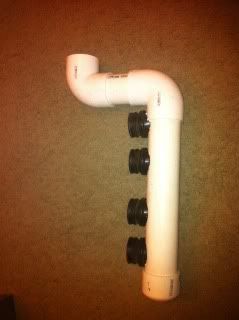
what kind of plumbing should i use
i was thinking of using stainless steel tubing and welding them together
then making 2 carbon fiber molds of the intake and bolting the two intakes together and then seeing how well the power changes for stock to pods to the new idea!

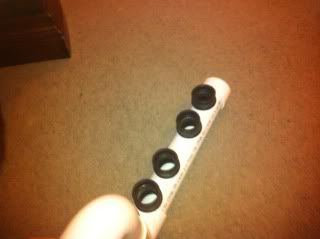
the idea is to make the 4 intake tubes the exact same legnth then bending them and welding them together in a 4 way then adding an extra short length of tubing to attach the cone filter to
anyone have any experience with carbon fiber?
 
I believe it was stated once that 160mph got you 0.5psi pressurization on a Kawasaki ZX11 air intake.
 
lol .5 positive psi
ram air is almost ineffective
to get good boost you need a minimum of 4.0 lol
but everything helps
i seriously doubt that a suzuki gs 1000 will ever go 160 mph
but i aim to hit 140 XD
 
Wouldn't ram air be really hard to tune for? It would lean out the faster you went...

Btw am I the only one who chuckled at this? :o
screenshot20120817at409.png
 
Wouldn't ram air be really hard to tune for? It would lean out the faster you went...

According to an old motorcycle mag, Honda tried this before ram-air was in vogue (for motorcycles, anyway), with exactly that result. I recall the article included a pic of Freddie Spencer aboard a race CB750 OR 900, featuring two ducts that ran from the intake to the front of the bike, underneath the tank.
They finally got the bike to run acceptably (in true Honda fashion:rolleyes:) by running tubing from the carb bowls, to the mouth of the air intake scoops.....then scrapped the idea altogether.
 
Wouldn't ram air be really hard to tune for? It would lean out the faster you went...

Btw am I the only one who chuckled at this? :o
screenshot20120817at409.png
no, I saw it and had to do a double take to make sure what I was seeing! ha ha funny stuff:D
 
Ram Air Myths?

Ram Air Myths?

The Brit 1327 cc old skool gs bike at Speedweek had to yank off the the ram air tubes and air box sides last week.Couldn't get enough air for the 44 mm lectrons to work properly!180 hp on the chassis dyno,but not on the great white dyno?
We experience 3 to 4 psi of ram air boost,depending on temp and air density.This is with an 280 mph belly tank(maybe mach .3 to .4)Inlet size and air box design pretty important,and maybe running FI simplifies air density issues at 4400 ft elevation with a density altitude of over 7000 ft.
Thinking about trying to pickup scooped up air under motor and routing it towards SA then up to an stockish size air box.Nice radiused 2-3 inch alm tube with a automotive style rect. air filter inline at entrance to air box.Thinking this for my miler bike (Wilmington Oh).;) Rich


Technical errors abound in this article. I'm a fluid power engineer, this guy doesn't know what he's talking about. He's read some articles and is trying to regurgitate them to "prove" his assertion.

I'll list the most blatant and easiest to understand error here:

A good example of this is Newton’s famed “law of action and reaction”, the mathematical expression of which is a succinct F=MA.


Uh.....no. F = ma is Newton's second law of motion (he doesn't even have the commonly accepted upper and lower cases of the symbols correct). That law is stated as:


"The measured net force on an object is equal to the mass of the object multiplied by the acceleration of the object through space."


He's referring to Newton's third law of motion, which is stated:

"All forces in the universe occur in equal but oppositely directed pairs. There are no isolated forces; for every external force that acts on an object there is a force of equal magnitude but opposite direction which acts back on the object which exerted that external force."


Unfortunately, the rest of the article has several other inaccuracies as well. I won't get into a dissertation about fluid dynamics at low pressures, but I will ask one thing:

Why do motorcycles equipped with "Ram Air" make more horsepower going down the road at speed than they do when strapped to a dyno?

For those who don't believe that an air intake pressure increase of 0.5 psig can make a large difference in the fuel to air mixture, you're wrong. Modern air filters are considered clogged when the differential pressure across them reaches about 15-20" H2O (which converts to 0.5-0.7 psig). If you start out with higher static pressure on the inlet of a filter, you will have higher static pressure at the filter's outlet (carb intake), with essentially the same differential pressure across the element.

Which is why racers forgo intake filters for "velocity stacks". They gain an additional 4-8" H2O inlet pressure by doing so. They can then rejet the carbs (or reprogram the fuel injection program) for the proper air/fuel mixture for the higher intake pressure.

For most vehicles ridden/driven on the street, "Ram Air" is indeed a gimmick. The intakes aren't designed correctly, and the vehicles don't travel fast enough to build enough static pressure at the intake to affect the air/fuel mixture to any noticeable extent. However, high performance motorcycles and race cars with properly shaped intakes can benefit from it at high speeds, so long as they have electronic fuel injection with sensors adjusting the fuel feed rate to match the air intake to achieve a proper air/fuel mixture.

And no, they do not need to achieve "mach 0.3" (Which is 228 mph at sea level. The author uses the "mach" term to make it seem unreachably fast.) to see an increase in static intake pressure that is needed to gain a benefit. The air in the throat of the ram air intake needs to achieve that velocity, which is doable at somewhat lower ground speeds than "mach 0.3" if the intake is designed correctly. One other thing to consider. Ram air ducts draw in cooler, denser air from the front of the bike, which is better than airboxes located behind and over engines. That alone will aid in increasing static pressures at the intake.

For example, Kawasaki has succeeded in attaining a noticeable ram air effect on their ZX12 and 14 motorcycles once they attain about 160-170 mph.

The GS1000 that this whole thread started about will see no benefits of a ram air system. If it did attain higher intake pressures at speed, it would not run properly throughout the speed range due to a changing air/fuel misture with essentially no way to "tune it on the fly".
 
Last edited:
This may fall into the "common sense" school of thought (which was shot down in that linked article), but my thinking is that any increase of "ram air" effect would be dependant on the size of the intake.

For example: let's say you have a nine square inch opening (a 3" by 3" square) that feeds your tube that goes to the airbox. This is going to provide a certain amount of air flow at a given speed. If it happens to gather exactly as much air as the engine is pumping, the pressure in the tube will basically be "atmospheric" (OK, it's going to be a little bit less because it's moving, but you get the idea). If you were to enlarge the opening to a 4" by 4" square, it would try to force a bit more air through the tube. If the engine could not handle any more air (due to obstructions elsewhere), would the pressure in the tube not be just a little bit higher?

Yeah, the added airflow might push a little more through the engine and pressure might not go up, but more airflow through the engine is more power, right? And wasn't that the point of this whole exercise? Not necessarily to increase pressure in the intake, but to enhance airflow through the engine.

Or we could just stick with the larger-bore, higher-compression pistons. :p

.
 
This may fall into the "common sense" school of thought (which was shot down in that linked article), but my thinking is that any increase of "ram air" effect would be dependant on the size of the intake.

For example: let's say you have a nine square inch opening (a 3" by 3" square) that feeds your tube that goes to the airbox. This is going to provide a certain amount of air flow at a given speed. If it happens to gather exactly as much air as the engine is pumping, the pressure in the tube will basically be "atmospheric" (OK, it's going to be a little bit less because it's moving, but you get the idea). If you were to enlarge the opening to a 4" by 4" square, it would try to force a bit more air through the tube. If the engine could not handle any more air (due to obstructions elsewhere), would the pressure in the tube not be just a little bit higher?

Yeah, the added airflow might push a little more through the engine and pressure might not go up, but more airflow through the engine is more power, right? And wasn't that the point of this whole exercise? Not necessarily to increase pressure in the intake, but to enhance airflow through the engine.

Or we could just stick with the larger-bore, higher-compression pistons. :p

.

Steve, what you're trying to accomplish is an increase in the velocity of the air going through the intake, then dead head the air into the airbox for an increase in pressure [cramming 5 lbs. of poop into a 3 lb. box]. Using a smooth, rounded edge orifice in front will create increased laminar flow, cause less turbulence, and therefore more air molecules will make it ''into the tunnel''. The tunnel then needs to narrow down to increase velocity [think of a narrow river channel and how the current increases], then open into an expansion chamber where the air molecules deadhead against the air filter itself, causing an increase in pressure.

Larger bore, higher compression pistons obviously are a simple way to increase horsepower. But modern bike engines that could benefit from ram air are designed much closer to the limits on bore and compression than our GSes were. In the modern day horsepower wars, even a 2 percent increase at the upper, unusable end of the spectrum can give one manufacturer bragging rights for the year, and increase sales.
 
now yall are catching on this thread is to figure out exactly what needs to happen to the air box to make more power without super or turbos
4 1 inch pipes on the carbs is stock and one 11/4 inch filter
im looking at puting a 2' filter on a 2 inch pipe that conects the 1 inch carbs together
i have another drawing for you all that yall might like even better than the first few
 
Since the whole idea here is to increase power, what are you using as your comparison tool?

Do you have a chassis dyno available or are you going to the dragstrip? :-k

.
 
Back
Top