• Required reading for all forum users!!!

    Welcome!
    Register to access the full functionality of the GSResources forum. Until you register and activate your account you will not have full forum access, nor will you be able to post or reply to messages.

    A note to new registrants...
    All new forum registrations must be activated via email before you have full access to the forum.

    A Special Note about Email accounts!
    DO NOT SIGN UP USING hotmail, outlook, gmx, sbcglobal, att, bellsouth or email.com. They delete our forum signup emails.

    A note to old forum members...
    I receive numerous requests from people who can no longer log in because their accounts were deleted. As mentioned in the forum FAQ, user accounts are deleted if you haven't logged in for the past 6 months. If you can't log in, then create a new forum account. If you don't get an error message, then check your email account for an activation message. If you get a message stating that the email address is already in use, then your account still exists so follow the instructions in the forum FAQ for resetting your password.

    Have you forgotten your password or have a new email address? Then read the forum FAQ for details on how to reset it.

    Any email requests for "can't log in anymore" problems or "lost my password" problems will be deleted. Read the forum FAQ and follow the instructions there - that's what we have one for...

  • Returning Visitors

    If you are a returning visitor who never received your confirmation email, then odds are your email provider is blockinig emails from our server. The only thing that can be done to get around this is you will have to try creating another forum account using an email address from another domain.

    If you are a returning visitor to the forum and can't log in using your old forum name and password but used to be able to then chances are your account is deleted. Purges of the databases are done regularly. You will have to create a new forum account and you should be all set.

Recommend a Noob Soldering Kit

Rich82GS750TZ

Forum Guru
Super Site Supporter
Past Site Supporter
Ideally looking for a kit I can buy on Amazon or at Harbor freight. I’ve been looking but getting confused. Wattage, max temperature, type of solder, etc. No mention on any of the kits on what type of solder they include. Lead, lead free. Rosin core is a term I’ve seen. Would ideally be nice to find a kit with everything I would need for light soldering jobs in the bike, other projects. for around $30?

I have a soldering gun, but don’t think it’s precise enough (fine enough point?). I’ve used it only a few times to fix some various electronics but really have no idea what I’m doing. Think it was my dads. Don’t remember buying it. Watched some videos but found none that mention wattage and temp, etc.

Looking to learn.

Help a noob out? Links most appreciated.

TIA
 
I'm a long-time user of Antex irons, but there's a flood of cheap'n cheerful irons on the market now, most of which won't electrocute you.
For fine stuff, a 15w iron, for normal sized automotive soldering, a 25 to 30w one is what you need.
When soldering joints that you've crimped just make sure that solder doesn't creep up the strands of the cable, as it will fail through vibration later.
Oh yeah, avoid lead-free - it's crap and harder to work with. Plenty of sources of the older standard 60/40 rosin cored stuff around if you look on ebay.
 
60 Sn and 40 Pb works well. Rosin core.

Can't help you with what soldering iron but I can say I used a $30 weller for years and it was a POS. Just got a Hakko and it was some of the best money I've ever spent on a tool. It literally heats up fully in about 10 seconds. https://www.amazon.com/gp/product/B00ANZRT4M/ref=ppx_yo_dt_b_asin_title_o09_s00?ie=UTF8&psc=1

Ed, you?re stretching my memory of HS Chemistry periodic table Sn=Tin60%/Pb=lead 40%. Rosin Core. Got it. Not sure if I can swing the Hakko, bit it does seem like top of the line. Father?s Day is coming up, so just maybe.

I'm a long-time user of Antex irons...
When soldering joints that you've crimped just make sure that solder doesn't creep up the strands of the cable....

Dave, the Antex irons look good too, some come without tips, I think I?m seeing?
How does one keep the solder from creeping past the end of the insulation? Is this a result of temp too high/low, or wattage too high/low, too much solder?
 
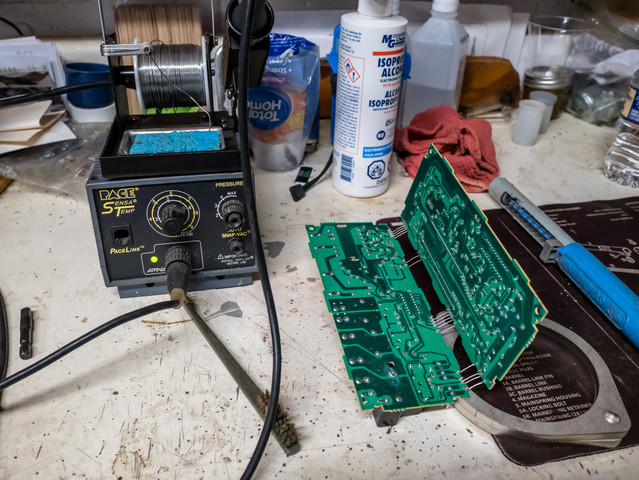
We used Pace equipment where I worked. (Circuit board assembly for over 30 years). I salvaged a broken station years ago out of the trash, and fixed it.
Anyway, if you are searching eBay, look at the Pace stuff also. Very solid, although maybe too costly.

Keep in mind, a good station, will heat up faster, have adjustable temps, and will just plain works better, than a pencil type.

And yes, 60/40 or 63/37 works. Rosin is OK, but I prefer a good no clean flux for long term use.
 
Dave, the Antex irons look good too, some come without tips, I think I’m seeing?
How does one keep the solder from creeping past the end of the insulation? Is this a result of temp too high/low, or wattage too high/low, too much solder?

The basic Antex (of whatever size) usually comes with a general slash-cut tip, but there's a range of other tips available.
To avoid solder creep, it's essential to have a clean surface/wire, and just dab the joint with just the right amount for just long enough.
That last part doesn't come in a box. Don't worry, you'll get the hang of it soon enough - it's not rocket surgery.
A seperate flux can be useful, again easy to garner the experience.
For practice, I'd recommend rummaging around some old car harnesses and try cleaning and soldering some manky connectors.
My personal preference is just crimping, no soldering - a proper crimp with the right tool is all you need. However, I'll solder where necessary.
 
And yes, 60/40 or 63/37 works. Rosin is OK, but I prefer a good no clean flux for long term use.

What is "no clean flux?" Are you suggesting that rosin core flux needs to be cleaned off after soldering? I realize that's ideal but is is necessary?
 
What is "no clean flux?" Are you suggesting that rosin core flux needs to be cleaned off after soldering? I realize that's ideal but is is necessary?
Short answer: It depends.

For long term reliability of circuit boards, yes. For large, electrical connectors on old motorcycles, probably not. And crimping alone is generally going to be fine.

When we used rosin core flux, both in wire core, and wave soldering, we cleaned all the assembles in a vapor degreaser, or by hand with alcohol. The rosin remains active, and can cause issues over time, especially on intricate pc boards. "No clean" doesn't do that.

But....No clean doesn't work near as well on old wires and connectors, unless they are new or really clean. Rosin is much better for that. I use no clean because I am usually using new components.
 
...if you think you'll use a soldering iron a lot, get spare tips. They wear out..they can be filed once or twice before they do, though.

.


I also prefer a crimp alone-very few car/bike manufacturers solder anything so I take my cue from them.

Grimly's recco per 2 speed irons is a good one (15 and ~35 watt).

i use a butane soldering iron occassionally..hard to control heat but in cold weather these can be the thing that works if you can get em lit on a windy day!

Look for a longish cord. Perhaps cheapos are worse. Electrical ones are also awkward with their heavy stiff cord.


more than you need know but...Possible to MAKE tips too, if you have some copper rod, a file, and a die to thread them(they often unscrew)...sources of round hardened copper rod is hydro wires from pole- scraps from torn down houses, lightning rods, even near the bottom of a pole where they have been repaired or ask the lineman maybe
Bronze boat rivets are another possible but -they are bronze- an alloy and I'm not sure about heat transference...should be good enought though.
 
I have had the worst luck with soldering irons from big box stores (Weller etc) so I have to agree with Nessism. I have resorted to using a butane torch for joining wires, that works fine but not precise. I use a wet rag as a guard so as not to melt anything nearby, and wrap ends with wet paper towels.
 
I'll throw in my 1/50th of a dollar and I'm quite sure there are those that won't like it. Put some solder in an alligator clip with the other end of it clipped to the positive terminal of your battery. Clip another one to somewhere down the line in the piece you're trying to solder and clip that one to the negative side of the battery. Use it like an arc welder, touch the solder to what you want joined. It works, been doing it for years.
 
LAB3, I applaud your input and ingenuity. That sounds terrifying. Like half MacGuyver/half Red Green. I would definitely hurt myself.
 
I'll throw in my 1/50th of a dollar and I'm quite sure there are those that won't like it. Put some solder in an alligator clip with the other end of it clipped to the positive terminal of your battery. Clip another one to somewhere down the line in the piece you're trying to solder and clip that one to the negative side of the battery. Use it like an arc welder, touch the solder to what you want joined. It works, been doing it for years.

Interesting idea for a field repair...
 
Interesting idea for a field repair...

Learned that one in electronics tech school in the 70's, our instructor was a young idealistic guy who liked to go out for a smoke and hid in the process of doing so. Like I said, it was the 70's.
 
I'll throw in my 1/50th of a dollar and I'm quite sure there are those that won't like it. Put some solder in an alligator clip with the other end of it clipped to the positive terminal of your battery. Clip another one to somewhere down the line in the piece you're trying to solder and clip that one to the negative side of the battery. Use it like an arc welder, touch the solder to what you want joined. It works, been doing it for years.

My 'gator clips might have more resistance than the solder's contact point. Tiny little wires. I still want to try it though...
 
Yes that's cute tip. But I'd probably just use a western union wire slice or twist in a nice eye to any place I needed an emrg wiring. Maybe just wrapping the solder around a piece of wire would work where clips weren't available?

off the subject but..I met a guy haywire welding with car batteries 2x12+6 (30vdc) was his "perfect" combo he said. I never tried it but someday...
 
The one thing that nobody has addressed so far is your expected purpose/use of the soldering iron. If doing fine work on printed circuits you need a very different iron than if you're purpose is large diameter wire or areas that have a large mass like ground planes. Can you give us a basic idea of what you purpose is and were you intend to use it. I use a Metcal SP-200 for most of my interior work. Expensive but simply one of the best. For outside work and large wire I use a Butane driven soldering iron. Can be used anywhere since no electricity is required and generates enough heat to solder most anything large. You can pick them up at your local big box store like HD and Lowes. Here's the one I have from HD.

Bernzomatic Soldering Iron

As for solder, it's a no brainer. The best electronics solder is simply old school 60/40 rosin core. As for the size of the solder, again, that depends on it's purpose. Very fine pitch surface mount components or larger components. Thinner solder for fine pitch items and thicker for larger items.
 
Last edited:
Specifically relative to the bike, so that’s my main focus. PCBs would be a secondary use, if ever. Thank you for your input.
 
When I'm working on the bike it's usually for soldering wires so the butane unit I posted a link to world best for me. Easy to use, no electrical needs and heats well for larger diameter wires and mechanical connections.
 
Back
Top