• Required reading for all forum users!!!

    Welcome!
    Register to access the full functionality of the GSResources forum. Until you register and activate your account you will not have full forum access, nor will you be able to post or reply to messages.

    A note to new registrants...
    All new forum registrations must be activated via email before you have full access to the forum.

    A Special Note about Email accounts!
    DO NOT SIGN UP USING hotmail, outlook, gmx, sbcglobal, att, bellsouth or email.com. They delete our forum signup emails.

    A note to old forum members...
    I receive numerous requests from people who can no longer log in because their accounts were deleted. As mentioned in the forum FAQ, user accounts are deleted if you haven't logged in for the past 6 months. If you can't log in, then create a new forum account. If you don't get an error message, then check your email account for an activation message. If you get a message stating that the email address is already in use, then your account still exists so follow the instructions in the forum FAQ for resetting your password.

    Have you forgotten your password or have a new email address? Then read the forum FAQ for details on how to reset it.

    Any email requests for "can't log in anymore" problems or "lost my password" problems will be deleted. Read the forum FAQ and follow the instructions there - that's what we have one for...

  • Returning Visitors

    If you are a returning visitor who never received your confirmation email, then odds are your email provider is blockinig emails from our server. The only thing that can be done to get around this is you will have to try creating another forum account using an email address from another domain.

    If you are a returning visitor to the forum and can't log in using your old forum name and password but used to be able to then chances are your account is deleted. Purges of the databases are done regularly. You will have to create a new forum account and you should be all set.

Replacement 1st Gen Turn signal controller

rustybronco

Forum Guru
Past Site Supporter
TGSR Superstar
Past Bard Award Winner
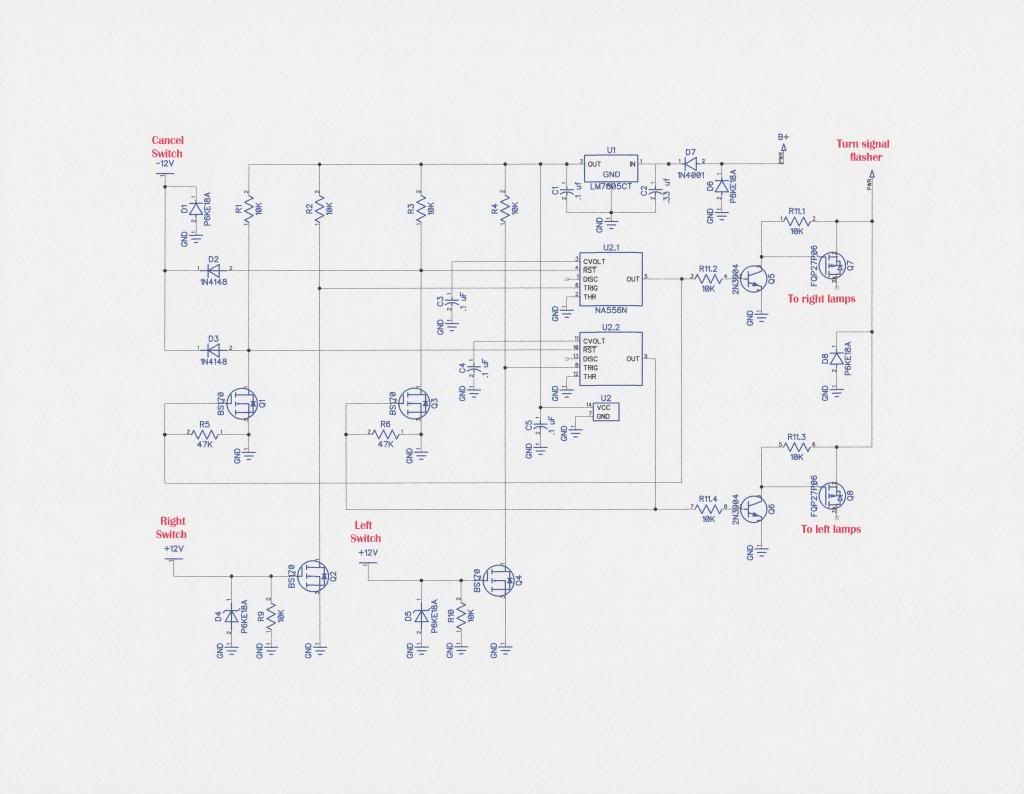
Schematic for a replacement 1st gen TSCU.

***NOTE*** Not production ready.

Updated 5-12-14 to reflect changes.

Auto cancel TSCU now in full swing. :)

Attempted to remove the potted board from an original TSCU leaving the plastic housing intact. Not going to happen.:(

http://www.thegsresources.com/_forum/showpost.php?p=1471427&postcount=6
Noise in the system was the worst problem causing false triggers, the wiring from the switch on the handlebar typically runs right through where all the high voltage switching's going on at the coils. Not insurmountable but took a while to figure out though.


OSHpark has a nice low cost PCB program. https://oshpark.com/)


http://i32.photobucket.com/albums/d44/rustybronco/P_20140510_112013.jpg
 
Last edited:
Sorry Eric, I edited my comments about letting the smoke out. I plan on ordering a few 'extras' in case I do... :eek:
 
One thing I'm 'trying' to do a bit differently from the way the factory did it, is use the brake light to reset the timer as opposed to using the speedometer reed switch to hold off or delay the timer.

If it works as I hope it will, when you 'push the button' for the left or right signals, the timer starts counting down, but as soon as you actuate the brakes and the stop lamp turns on, the timer 'should' reset to zero. I chose to do it this way to allow the rider to change lanes and still have the signals cancel and also to allow a infinite length of time delay when slowing down and while sitting at a stop light waiting for traffic to clear. As soon the rider releases the brake the timer starts counting again, but if you were to apply the brake again after releasing it, the timer should reset, say if you were to 'modulate' the brakes during stopping.

Manual signal cancellation is still available at any time during the process.

The way I've designed it also allows you to use the signals as four way flashers. For those of you that don't like that option, you can add an 'AND' gate connected to the bases of T1 and T2 with the output tied to the reset pins of IC2 and IC3 to inhibit four way flashers.
 
Last edited:
I'm rooting for success. I have already converted my '78, but there are two other bikes that I could use it on if it is successful. Personally I like the self canceling controller better than a manual only detente switch, one that is reliable, of course.
 
I just got my dual-PICAXE prototype working this afternoon. It's really satisfying to conjure up something like this and have it work the very first time around. It's not perfect, and it's kinda fun being able to tweak things programmatically, but it works just like I wanted it to. The nice part is that I can easily change the program to alter any parameter -- flash rate, delay, speed necessary to keep the timer running, etc. I have the code pretty full of comments, and I'll expand on that further so that just about anyone could follow what I'm doing and why.

This is surely a one-off, with no intention of producing multiple copies, but I can sketch the diagrams and make the code available to anyone who wants it. Like some of the aftermarket boxes I've seen, it requires momentary contact switches at the bar control. The easy way to do this is, just buy a used bar control from a '78 or '79 and adapt it. These were (IMHO) the most intuitive signal controls I've ever used, and I'll never understand why they changed them in '81 (or was it '80?). The so-called '4-way' controls that replaced them are awkward even when they work correctly, and it goes downhill from there.

Next step is to get it onto a perfboard and get the terminal strips in place, so I can set the components in epoxy. From there, it's going to be an afternoon of modifying the bike wiring, and I'm set.

Now that the code is mostly done, I think it should take about two hours to produce a copy of this creature, with a cost of roughly $20, depending on how involved the builder wants to get in the area of appearance. For me, I haven't picked a container yet, but since my self-cancelers don't work anyhow, I might gut the box that came with the bike.

If I feel ambitious I'll post a photo of the confused mess it appears to be at present, on my trusty Radio Shack protoboard.
 
Robert, I hope I'm as lucky as you were the first time around.

The original 78-79's with self cancelling signals used a momentary contact left hand control. I guess I'm confused a bit. Are you replacing a later model setup with this early style TSCU?

I just ordered a breadboard with leads so I can prototype up my replacement earlier today. Some time tomorrow I'll put together a shopping list of what I need to order and get them ordered the first of the week, and yes, lets see a picture or two of the unit you built up. :)
 
As long as someone gets one working that all I need to do is thumb the lever down and all the signals work I am all in for 5 units. The auto cancel is of no real value to me anyway.
 
Robert, I hope I'm as lucky as you were the first time around.

I will concede that luck was a definite factor!

The original 78-79's with self cancelling signals used a momentary contact left hand control. I guess I'm confused a bit. Are you replacing a later model setup with this early style TSCU?

I'm replacing the awkward 4-way thingy on my '81 with one from a '78 thousand with self-cancel. The 'box', of course, will be the 'roll-my-own'.

I just ordered a breadboard with leads so I can prototype up my replacement earlier today. Some time tomorrow I'll put together a shopping list of what I need to order and get them ordered the first of the week,

That's actually one of the fun parts of the project...
and yes, lets see a picture or two of the unit you built up. :)

Here ya go. It is a mess, but it's a functional mess:

selfcancel.JPG


There's actually a third PICAXE in there at the left. It supplies the simulated pulses from the speedo reed switch, to more accurately emulate riding conditions.

If you press right or left while the signal is already flashing, it resets the timer. If your speed drops below the threshold for more than 4 seconds, it sets your time back to at least 8 seconds.

If (without flashers operating) you press and hold CANCEL for four seconds (continuously), it begins the 4-way flasher mode. To cancel that, just press (obviously) CANCEL again.

When you first turn the ignition on, it lights all four signals for 1.5 seconds -- to give you a chance to see that they're functioning before you start the bike & ride away.

There are endless other options available, as long as the basics are solid. I still need to handle power conditioning and packaging.
 
Robert, Your parts count looks extremely low that's for sure. Your design might be the way to go rather than what I have sketched up. I'm still going to build mine to see if it works or not, but I may pare it down to just the 2 flip-flops and the finals after all is said and done.
 
Last edited:
Any progress gents? I would prefer one of these solutions working rather than the chop and two flasher relays.
 
As long as someone gets one working that all I need to do is thumb the lever down and all the signals work I am all in for 5 units. The auto cancel is of no real value to me anyway.

Same here.
I can switch the darn thing much faster/better than any self-cancelling gizmo.

Eric
 
Yes, progress has been delayed by some bouts of really nice weather. I expect to solder mine up sometime next week, but I'm not sure how much use it'll be to an average shadetree user; it'll require a bit of careful assembly & some modification of the bike's wiring.

I'll post the schematic & the code, as well as a parts list, and anyone who wants it is welcome to help him/herself. You don't have to be an electronics geek -- you just have to know one!
 
In my case it's almost a plug and play. You would need to run one additional wire to the stop lamp circuit.
 
Awoken from a deep slumber

Awoken from a deep slumber

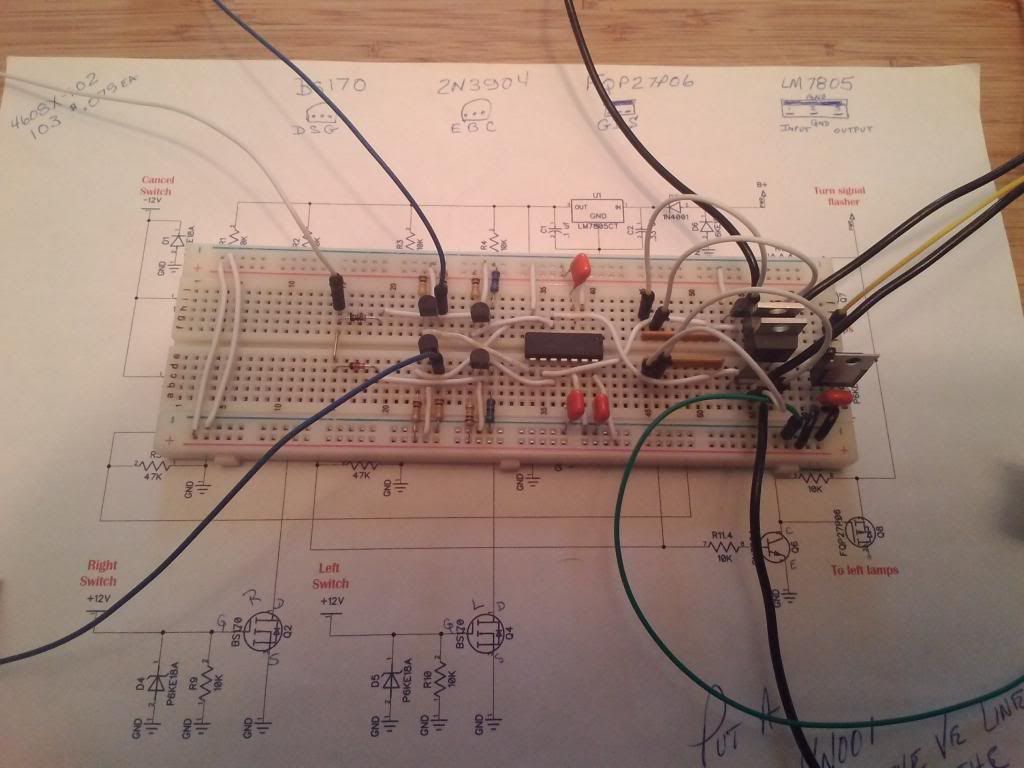
TSCU V1 manual operation only.
V2 with auto cancel to follow as time permits.

I had the triggers wired up incorrectly today but I ran out of time with all the other gongs on to give it a second try. I will fire it up again in a day or two and see if it works as I think it should.

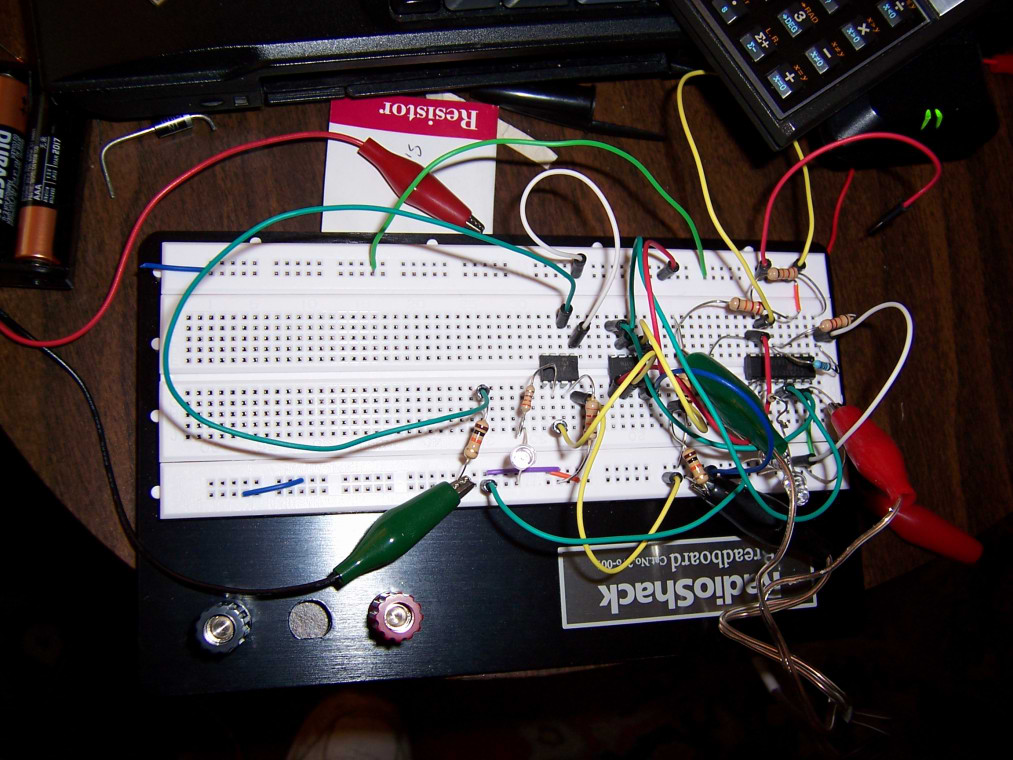
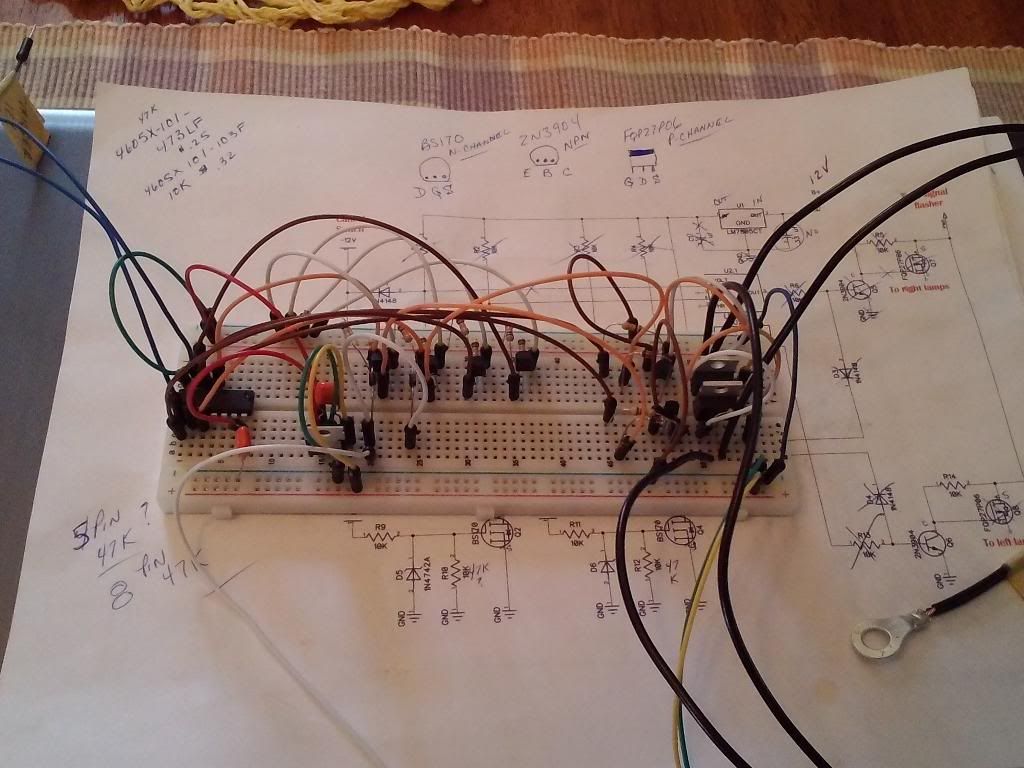
Basically it's a LM556 (dual 555 timer) operating as a bi-stable flip-flop and driving P-channel MOSfets used as a high side switch for the turn signal lamps. N-channel MOSfets are used to trigger and cancel the LM556.

P_20140420_134323.jpg
 
Last edited:
I still need to wire up the two diodes that inhibit operating both side turn signals at once. Other than that she's a working example of a manually operated replacement TSCU.

The diagram for this is close to being complete. I still need to finalize a few pads, purchase a couple different resistor networks (10 pin bussed-8 pin isolated), some .33?F mylar caps then I can finalize the PCB layout.


More is in process... Stay tuned. ;)

 
Last edited:
I still need to wire up the two diodes that inhibit operating both side turn signals at once. Other than that she's a working example of a manually operated replacement TSCU.

The diagram for this is close to being complete. I still need to do is finalize a few pads, purchase a couple different resistor networks (10 pin bussed-8 pin isolated), some .33?F mylar caps then I can finalize the PCB layout.


More is in process... Stay tuned. ;)


Good job Rusty. Looks like you have been busy.:)
 
Back
Top