• Required reading for all forum users!!!

    Welcome!
    Register to access the full functionality of the GSResources forum. Until you register and activate your account you will not have full forum access, nor will you be able to post or reply to messages.

    A note to new registrants...
    All new forum registrations must be activated via email before you have full access to the forum.

    A Special Note about Email accounts!
    DO NOT SIGN UP USING hotmail, outlook, gmx, sbcglobal, att, bellsouth or email.com. They delete our forum signup emails.

    A note to old forum members...
    I receive numerous requests from people who can no longer log in because their accounts were deleted. As mentioned in the forum FAQ, user accounts are deleted if you haven't logged in for the past 6 months. If you can't log in, then create a new forum account. If you don't get an error message, then check your email account for an activation message. If you get a message stating that the email address is already in use, then your account still exists so follow the instructions in the forum FAQ for resetting your password.

    Have you forgotten your password or have a new email address? Then read the forum FAQ for details on how to reset it.

    Any email requests for "can't log in anymore" problems or "lost my password" problems will be deleted. Read the forum FAQ and follow the instructions there - that's what we have one for...

  • Returning Visitors

    If you are a returning visitor who never received your confirmation email, then odds are your email provider is blockinig emails from our server. The only thing that can be done to get around this is you will have to try creating another forum account using an email address from another domain.

    If you are a returning visitor to the forum and can't log in using your old forum name and password but used to be able to then chances are your account is deleted. Purges of the databases are done regularly. You will have to create a new forum account and you should be all set.

RRR R/Rs

Today 02:01 PM bwringer Of course, a bad ground connection between the battery and engine could do much the same thing. Just throwin' that out there.

Today 02:21 PM mriddle That is what I was sayin' too.

+3, I always clean & grease the main ground wire to motor connection every chance I get. As I recall when I reached under the airbox to find your bolt the top of it has some crappola on it. (Technical Term)
 
I finally had a minute to pause in the garage long enough to do a little poking. The most favorable measurement I could get between the positive battery connector and the R/R + output connector was 0.4 Ohm. That was with scratching the connectors with the multimeter leads. I tried about a dozen different ways and usually read about 1 Ohm. This is less than a foot of wire, total. I think I found the immediate problem.

Clearly there's more to be done in the way of preventive maintenance. I'm off to get some chemicals and easy-wrap.
 
I finally had a minute to pause in the garage long enough to do a little poking. The most favorable measurement I could get between the positive battery connector and the R/R + output connector was 0.4 Ohm. That was with scratching the connectors with the multimeter leads. I tried about a dozen different ways and usually read about 1 Ohm. This is less than a foot of wire, total. I think I found the immediate problem.

Clearly there's more to be done in the way of preventive maintenance. I'm off to get some chemicals and easy-wrap.

I never recommend using an ohm meter to make those measurements. You are looking for somewhat less than 0.1 ohms and most meters dont even have that kind of resolution. This is also the resistance with milli amps of current which is not reliable when actually charging (10+ amps are flowing at 14.5V).

In a gross situation in can provide a measurement indicative of issues but not effective in insuring good connections.
 
I finally had a minute to pause in the garage long enough to do a little poking. The most favorable measurement I could get between the positive battery connector and the R/R + output connector was 0.4 Ohm. That was with scratching the connectors with the multimeter leads. I tried about a dozen different ways and usually read about 1 Ohm. This is less than a foot of wire, total. I think I found the immediate problem.

Clearly there's more to be done in the way of preventive maintenance. I'm off to get some chemicals and easy-wrap.

Did you zero the meter by touching the leads together and noting what the starting value is? My meter (a Fluke 8060a) allows the display to be set to zero when the leads are connected, allowing more precise measurements.
 
Well, Pos, that's all I can do for now. Even if I had another regulator free to install, I'm not doing that until I do some wiring overhaul. Once things are close enough to nominal to not eat components, I'll check for voltage drop under a real load. Well, I guess I could set up some power resistors with a battery to get some current going, but I figure the measured values are enough to warrant a cleaning. Not that you hadn't guessed the need already.

Duanage, my meter isn't fancy enough for such a function, as far as I know. I did happen to touch them together just to see what would happen. I was curious what it would read since I rarely use that setting on the meter, but it made no indication of the contact.

Considering what this thing is doing to R/Rs, the charging system wiring is getting an overhaul anyway. The measurements were sorta superfluous. Time to go read more about ground loops.
 
I have an R/R from a CBR1000RR, non fet, on my bike. It's wired the way Suzuki did, two legs split off the red R/R wire. One going straight to the battery and the other to the ignition switch then back to the main fuse. It runs through the ignition switch unfused then back to the fuseblock. So far so good.
 
John,

It's the positive battery wire that had the odd connector. It's also black. This is the one I measured a high resistance on, but I don't remember that we tried to measure it at the rally.

The fuses didn't show any corrosion the last time I had the side cover off. The rally is the first time it had been rained on that hard/that much humidity. I don't know if that's a relevant factor. I should have looked at them more closely. When I replaced them with Rob's fuses, I noticed they were 20A fuses.

There was no separate frame ground for the R/R. It was simply joined up with everything else at the negative battery post. I hadn't seen any discussion of doing otherwise until I started studying my current issues. After I finish digesting the ground loops thread, I'll figure out what needs to be done about that.

By the time your heard the bike crank, the battery was already pretty tired. GSs spin over very easily though, long after the spark is too weak to start.

The coil relay mod has not been done because I had measured sufficient voltage at the coils when I worked on the wiring under the tank.

I'm thinking pretty seriously about replacing the fuse block. We'll see if I can't get it cleaned up and behaving again.

What's striking to me is how quickly everything can turn to poo when it was working reasonably well 6 weeks before. I never saw a need to go past the first test of the stator papers, because it simply passed the test. It's seems I need to be more diligent about protecting connections (and switches) after cleaning them. Which means that all the work I did before needs doing again.
 
OK, I've finished the Ground Loops thread. It seems which wiring scheme one chooses (of approximately three discussed there) is a matter of personal preference. That is, all of them will work if everything is clean. The principal result of my study is this: while I have taken a questionable measurement of resistance on the + side of the charging wiring, I can tell you all that the - side is indeed a mess. I think I remember now that Steve made some recommendations when he helped me get it charging in the first place. Recommendations I forgot due to lack of time and understanding. The most thorough examination I remember anyone made of my grounds at the rally was Tim finding out that my engine ground was covered in something gooey. Folks would be excused for thinking that I had a reasonable grounding scheme after learning that I had moved the R/R ground to the battery, but they were all wrong. The subject did come up after the last spare regulator was gone. The first lesson I've learned from all of this is the same we preach for intake and brake systems and any other system. Make sure the baseline stuff is right before diagnosing problems. The second lesson is not to make a mod to a system you don't understand.

The key issue of the whole ground loops thread is whether the connectors are all clean and corrosion free. Folks talk about cleaning grounds and whatnot every chance they get. For me, that's not going to be good enough. My charging system went from functioning to consuming expensive parts in 2 months or less. I can't be bothered to wash my bike that often, much less reexamine my wiring. (Perhaps folks only mean to emphasize the importance of grounds rather than recommend that level of vigilance.) It seems that in lieu of connections that can stay corrosion free for decades without intervention, I need a way to monitor the health of the charging system so I know when it's turning green. I'm thinking that part of the overhaul of my wiring should include a permanent battery voltage gage. Not that I won't make the effort to get connections that last decades. It's just that I would take great comfort in being able to examine the health of my battery and charging system every time I start the bike.
 
Last edited:
OK, I've finished the Ground Loops thread. It seems which wiring scheme one chooses (of approximately three discussed there) is a matter of personal preference. That is, all of them will work if everything is clean. The principal result of my study is this: while I have taken a questionable measurement of resistance on the + side of the charging wiring, I can tell you all that the - side is indeed a mess. I think I remember now that Steve made some recommendations when he helped me get it charging in the first place. Recommendations I forgot due to lack of time and understanding. The most thorough examination I remember anyone made of my grounds at the rally was Tim finding out that my engine ground was covered in something gooey. Folks would be excused for thinking that I had a reasonable grounding scheme after learning that I had moved the R/R ground to the battery, but they were all wrong. The subject did come up after the last spare regulator was gone. The first lesson I've learned from all of this is the same we preach for intake and brake systems and any other system. Make sure the baseline stuff is right before diagnosing problems. The second lesson is not to make a mod to a system you don't understand.

The key issue of the whole ground loops thread is whether the connectors are all clean and corrosion free. Folks talk about cleaning grounds and whatnot every chance they get. For me, that's not going to be good enough. My charging system went from functioning to consuming expensive parts in 2 months or less. I can't be bothered to wash my bike that often, much less reexamine my wiring. (Perhaps folks only mean to emphasize the importance of grounds rather than recommend that level of vigilance.) It seems that in lieu of connections that can stay corrosion free for decades without intervention, I need a way to monitor the health of the charging system so I know when it's turning green. I'm thinking that part of the overhaul of my wiring should include a permanent battery voltage gage. Not that I won't make the effort to get connections that last decades. It's just that I would take great comfort in being able to examine the health of my battery and charging system every time I start the bike.

I'm actually using two volt meters a VDO analog and a Showchrome digital. The digital seem to be more useful as it has 0.1V resolution.

If I had use for another gauge I would probaly just swap out the VDO volt meter; I hardly look at it.

There are some subtle and not so subtle differences in R/R to battery conenctiosn. Probably most important is to clean teh conenctiosn and use some dielectric grease to stop corrosion. Solder what crimps you can or shrink wrap them with dielectric grease.
 
I'm actually using two volt meters a VDO analog and a Showchrome digital. The digital seem to be more useful as it has 0.1V resolution.

If I had use for another gauge I would probaly just swap out the VDO volt meter; I hardly look at it.
On the other hand, ...

I have a VDO analog guage on my Wing. Yeah, I don't need to look at it very often, and I don't really think a drop from 14.2 to 14.1 volts would alarm me. It's more of a concern for me if I see it dipping more than a needle-width below the 14 mark, as the only time that usually happens is right after it is started, as the ALTERNATOR is bringing the battery back up to snuff.

Yeah, I like "toys" on my toys, but sometimes the precision of a digital meter might be a bit too distracting. That being said, I do have a digital guage on my wife's bike and will likely end up with one on "Junior", simply because it's easier and cheaper. :D

.
 
Er, um, using two on the same bike?

I added two VDO gauges at first :
Oil pressure and Volts as I already had Oil Temp and Fuel as part of stock cluster.

As an after though also added the Showchrome and was not sure if it would last or if I would keep it. Since voltage range is normally 12.8v to 14.2v that is only about a 1.4V total range. Having the showchrome 0.1v resolution gives some visibility into variations

gauges.jpg
 
I have had three of these bikes give me "charging problems" and every time the problem has been connector voltage drop causing problems. You don't need to clean them much, just need to check the voltages each year or if you have hard starting problems.
 
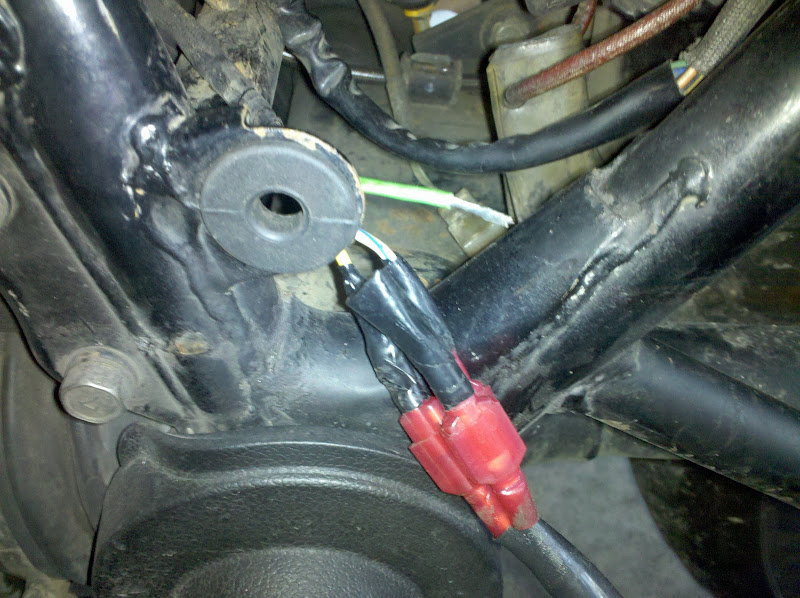
Well, in the process of removing the wiring harness tonight, this happened:

2010-07-26%2020.46.21.jpg


I don't think that was helping. The crimp on the spade completely failed to grab the wire. I don't think I'll be using those connectors again. In fact, I was planning to solder the next R/R anyway. Is it conceivable that the 3rd R/R survived? It passed the diode/continuity tests.
 
The crimp on the spade completely failed to grab the wire. I don't think I'll be using those connectors again. In fact, I was planning to solder the next R/R anyway. Is it conceivable that the 3rd R/R survived? It passed the diode/continuity tests.

A lot of people on the GSR advocate soldering harness wires, but I advocate against it.

My reasoning is that the solder flows into the wire and stiffens it for some distance past where the strain relief protects it. So in a year or two or ten, you face the possibility of the wire being broken INSIDE the insulation. Have fun troubleshooting that situation ... :(

For a PROPERLY crimped connection, the problem is rarely the crimp itself, its the connector to connector conection that can degrade ... and dielectric grease pretty much prevents that. Some go even farther and use special crimp connectors made for boats, which are designed to seal out water.

To get a good crimp you need a couple of things:
Good non-corroded wire to crimp to.
Reasonable quality connectors (not the dolllar store specials)
AN ACTUAL CRIMPING TOOL ... not vise-grips or needle nose pliers ... and for Gawds sake not those crappy things that come with 100 assorted crimps for $9.99.

If you search you will find a fairly big thread a year or two ago where a bunch of us beat the subject to death and then beat the corpse for a while longer.

-----

If a R/R passes all the diode tests, it will usually charge (since it will Rectify completely correctly)
Note however, the diode tests tell you nothing about whether it will regulate, so it could overcharge ...

-----

One further point ... in your first post you said your stator tested marginal ... but in fact, you only tested at 3500 RPM ... the stator test is supposed to be at 5000 ... since voltage is proportional to RPM, that means that you could expect to get about 85 volts at 5000 ... so the stator is not just marginal but probably good.
 
Back
Top