• Required reading for all forum users!!!

    Welcome!
    Register to access the full functionality of the GSResources forum. Until you register and activate your account you will not have full forum access, nor will you be able to post or reply to messages.

    A note to new registrants...
    All new forum registrations must be activated via email before you have full access to the forum.

    A Special Note about Email accounts!
    DO NOT SIGN UP USING hotmail, outlook, gmx, sbcglobal, att, bellsouth or email.com. They delete our forum signup emails.

    A note to old forum members...
    I receive numerous requests from people who can no longer log in because their accounts were deleted. As mentioned in the forum FAQ, user accounts are deleted if you haven't logged in for the past 6 months. If you can't log in, then create a new forum account. If you don't get an error message, then check your email account for an activation message. If you get a message stating that the email address is already in use, then your account still exists so follow the instructions in the forum FAQ for resetting your password.

    Have you forgotten your password or have a new email address? Then read the forum FAQ for details on how to reset it.

    Any email requests for "can't log in anymore" problems or "lost my password" problems will be deleted. Read the forum FAQ and follow the instructions there - that's what we have one for...

  • Returning Visitors

    If you are a returning visitor who never received your confirmation email, then odds are your email provider is blockinig emails from our server. The only thing that can be done to get around this is you will have to try creating another forum account using an email address from another domain.

    If you are a returning visitor to the forum and can't log in using your old forum name and password but used to be able to then chances are your account is deleted. Purges of the databases are done regularly. You will have to create a new forum account and you should be all set.

SH775 and Headlight bypass

  • Thread starter Thread starter Guest
  • Start date Start date
G

Guest

Guest
1981 GS650GL, stock

I have my SH775 R/R ready to go and will be installing it sometime this week. I understand that most people bypass the headlight loop because it's unnecessary. But how do I physically go about this? Is it just a matter of disconnecting the wires in that loop and away you go, or is there more to it? Do I have to open up the headlight switch or is it all done from the stator end of things? Electrical is not my strong point so please bear with me if it's a dumb question. My thought is that if I eliminate the loop then how does the headlight continue to function? Anyhow, please shed some light on this for me.

Thanks!
K
 
Tom,

Just to make sure I understand correctly - the stator wire that runs to the headlight will be cut and connected directly to the R/R, bypassing the headlight circuit.

And I did read that link and many others. Information overload!

Thanks for your help.
 
Keep in mind the following:


  1. three wires from the stator go to the three stator pins on the R/R;
  2. nothing else, forget about everything else, ignore everything else.
  3. Did I mention W/G and W/R wires? Ignore them from now on.
 
Just run all 3 stator wires direct to R/R. On stock setup, one went up to headlight switch and returned- just ignore them and leave them hanging in space.
 
Keep in mind the following:


  1. three wires from the stator go to the three stator pins on the R/R;
  2. nothing else, forget about everything else, ignore everything else.
  3. Did I mention W/G and W/R wires? Ignore them from now on.
This is good - I think that I will save it for the next time this question is asked!
 
Keep in mind the following:


  1. three wires from the stator go to the three stator pins on the R/R;
  2. nothing else, forget about everything else, ignore everything else.
  3. Did I mention W/G and W/R wires? Ignore them from now on.

So what are you trying to say? ;)

Thanks!
 
This is good - I think that I will save it for the next time this question is asked!

I never realized what an art it was to teach........

Requires just the right balance SRD of:


  • Just enough Shock value to get the subjects attention,
  • Just enough Redundancy so that it sinks in
  • Just enough Detail to quell the quickly fading curiosity of the subject.

Fortunately by the time you get to Grad School, the "teacher" don't give a rat's a$$ so dont expect much SRD.
 
Last edited:
I never realized what an art it was to teach........

Requires just the right balance SRD of:


  • Just enough Shock value to get the subjects attention,
  • Just enough Redundancy so that it sinks in
  • Just enough Detail to quell the quickly fading curiosity of the subject.

.

Sounds just like my sex education class!
 
Yup, count me guilty of not understanding what was already said may times before. "Connect the 3 stator wires directly to the R/R".
What wasn't said is and what was baffling to some of us is that we have to cut one wire that is not going to the R/R (original OE design)
and then not use the wire from the harness that was going to the OE R/R (original OE design). And then, no mention of where to connect
the remaining cut wires? (I know, its a dead loop now!) As novices in electrical, we are all the more cautious of wiring something wrong, given
the many disaster stories and cautions we have read on here about smoke, fire, and toasted stators. Also, I did read the link, Tom, which was
understandable and does a good job of showing why we shouldn't circumvent the OE wiring design in connecting the R/R directly to the battery,
(A win for the OE design, but evidently there is room for improvement when wiring in the R/R)

A final question, if I may, on completing the wiring of the SH 775. I have read one of Posplayer's posts that he addresses the grounding issue.

posplayr
user-online.png
Senior MemberGSResource Superstar
Super Site Supporter


Join DateDec 2007LocationSanta Barbara CAPosts12,965​


icon1.png


quote_icon.png
Originally Posted by RobG1970
Thanks Poslayr - may I confirm my wiring with you>? My large #8 black ground wire comes from my batteries -Neg side and bolts to a engine bolt. (please picture) so this is not part of the ground loop that we are trying to isolate the battery from>??? Sorry for all the questions, electrical is not my thing, in fact I WOULD RATHER tare the motor apart then chase down a short :(...LOLOLOL again, thank you GREATLY for you help...
Rob

leave that #8 wire in (call it GROUND WIRE A).

If you only run an additional (GROUND WIRE B) from the Battery(-) to the R/R(-) then any frame return currents will get picked up by this #8 wire (GROUND WIRE A) and allow current to flow past the negative battery post and through to the R/R(-). So all frame return currents as well as the battery charging current will be carried on the GROUND WIRE B.

However if you run yet another ground wire (GROUND WIRE C ) from the frame to the R/R(-), then current can flow straight throught to the R/R(-) without going through engine mounts, #8 GROUND WIRE A, and B. So provided you have good "frame ground" connections, the only current on GROUND WIRE C will be the current used to charge the battery.
That will minimize the voltage drops between the battery and R/R.


So, you would recommend 3 grounds for proper charging.
1. Negative Battery to common frame ground.
2. R/R negative lead to battery negative.
3. R/R negative lead to common frame ground.

Previously, with the OE R/R I added (advice from this forum) two additional grounds.
R/R mounting post to common frame ground.
R/R mounting post to negative post of battery.

So if I do all, will I have everything covered?

Its OK to take your shots! I'm a big boy.
 
Yup, count me guilty of not understanding what was already said may times before. "Connect the 3 stator wires directly to the R/R".
What wasn't said is and what was baffling to some of us is that we have to cut one wire that is not going to the R/R (original OE design)
and then not use the wire from the harness that was going to the OE R/R (original OE design). And then, no mention of where to connect
the remaining cut wires? (I know, its a dead loop now!) As novices in electrical, we are all the more cautious of wiring something wrong, given
the many disaster stories and cautions we have read on here about smoke, fire, and toasted stators. Also, I did read the link, Tom, which was
understandable and does a good job of showing why we shouldn't circumvent the OE wiring design in connecting the R/R directly to the battery,
(A win for the OE design, but evidently there is room for improvement when wiring in the R/R)

A final question, if I may, on completing the wiring of the SH 775. I have read one of Posplayer's posts that he addresses the grounding issue.

posplayr
user-online.png
Senior MemberGSResource Superstar
Super Site Supporter


Join DateDec 2007LocationSanta Barbara CAPosts12,965​


icon1.png

quote_icon.png
Originally Posted by RobG1970
Thanks Poslayr - may I confirm my wiring with you>? My large #8 black ground wire comes from my batteries -Neg side and bolts to a engine bolt. (please picture) so this is not part of the ground loop that we are trying to isolate the battery from>??? Sorry for all the questions, electrical is not my thing, in fact I WOULD RATHER tare the motor apart then chase down a short :(...LOLOLOL again, thank you GREATLY for you help...
Rob

leave that #8 wire in (call it GROUND WIRE A).

If you only run an additional (GROUND WIRE B) from the Battery(-) to the R/R(-) then any frame return currents will get picked up by this #8 wire (GROUND WIRE A) and allow current to flow past the negative battery post and through to the R/R(-). So all frame return currents as well as the battery charging current will be carried on the GROUND WIRE B.

However if you run yet another ground wire (GROUND WIRE C ) from the frame to the R/R(-), then current can flow straight throught to the R/R(-) without going through engine mounts, #8 GROUND WIRE A, and B. So provided you have good "frame ground" connections, the only current on GROUND WIRE C will be the current used to charge the battery.
That will minimize the voltage drops between the battery and R/R.


So, you would recommend 3 grounds for proper charging.
1. Negative Battery to common frame ground.
2. R/R negative lead to battery negative.
3. R/R negative lead to common frame ground.

Previously, with the OE R/R I added (advice from this forum) two additional grounds.
R/R mounting post to common frame ground.
R/R mounting post to negative post of battery.

So if I do all, will I have everything covered?

Its OK to take your shots! I'm a big boy.


I'm sorry if my descriptions have not been clear enough. What you describe is not a single point ground and you did not even mention the harness ground. I can only suggest doing two things.

#1 Decide where your Single Point Ground(SPG) is going to be(Decide means make a conscious decision to Pick one).

  • at the R/R mounting bolt
  • at the side plate (some bolt)
  • on the frame
  • AND PLEASE DO NOT PICK THE BATTERY (-) as the SPG; if you need to know why, go re-read the posts on grounding.

#2 Follow the diagram below; If you pick your frame ground as SPG then redraw the drawing below so you don't get confused. In the end if you use big wires on all of it and clean connections it will not matter much. The problem starts when the corrosion comes back.


At the risk of making this complicated

You want to collect all return currents to the SPG.
  • Frame Ground wire
  • Harness ground Wire
  • Battery Ground wire

Once they are all collected (i.e. into a single point), then run a single wire to the R/R(-). If the R/R has two black grounds then double them up by running in parallel as shown.

picture.php
 
Last edited:
Wow! Wow! Wow! And no need to apologize!
Admittedly, there has been so much posted on this one topic on the forum(s) that the "nuggets"
are hard to find!

Honestly, I really appreciate your latest attempt to make it clear to me. I got it. I am so amazed at the depth
of knowledge possessed by the members of this forum. Kudo's to all of you who make the GSResources
stand apart from other forums of a similar genre!:o
 
Wow! Wow! Wow! And no need to apologize!
Admittedly, there has been so much posted on this one topic on the forum(s) that the "nuggets"
are hard to find!

Honestly, I really appreciate your latest attempt to make it clear to me. I got it. I am so amazed at the depth
of knowledge possessed by the members of this forum. Kudo's to all of you who make the GSResources
stand apart from other forums of a similar genre!:o

Part of the problem is mis information which adds to the confusion. One of the biggest mistakes people make is not knowing how to find an answer. They think that if they take a poll they will get the right answer :(. If you are not capable of determining what is right or wrong on your own, you need to determine who you can believe and just follow them as closely as you can, without question as you probably are not going to understand anyway. Also that is the best chance that all parts of the problem are done in a reasonable way. If you start picking and choosing without any way of knwoing,...... well that is not an intelligent approach.
 
I never realized what an art it was to teach........

Requires just the right balance SRD of:


  • Just enough Shock value to get the subjects attention,
  • Just enough Redundancy so that it sinks in
  • Just enough Detail to quell the quickly fading curiosity of the subject.

Fortunately by the time you get to Grad School, the "teacher" don't give a rat's a$$ so dont expect much SRD.
I have heard that an effective presentation is comprised of three parts:
1. Tell the audience what you are going to tell them.
2. Tell the audience what you are going to tell them.
3. Tell the audience what you told them.

In other words, "intro", "presentation" and "recap".

.
 
Wow! Wow! Wow! And no need to apologize!
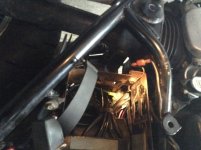
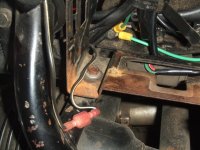
Well, you said you could take it. Here's my setup. Note the green wires that light is sorta pointing to.The Bolt that holds airfilterbox and ignitor/reg plate to frame is my common grounding point- another wire runs from here up to battery negative.one of the green wires goes direct to R/R negative.

Edit: pic is upside down. New forum software is taxing my computer skills

image.jpg
 
Last edited:
So for a SGP, in the context of this discussion, should it be on the
actual frame, or would a bolt on the back center of the engine qualify?
 
So for a SGP, in the context of this discussion, should it be on the
actual frame, or would a bolt on the back center of the engine qualify?

Frame is better- here's mine in better pic (ipad didn't like dark garage). There are multiple ways to do it
 

Attachments

  • grondpoint.jpg
    grondpoint.jpg
    94.2 KB · Views: 0
Back
Top