• Required reading for all forum users!!!

    Welcome!
    Register to access the full functionality of the GSResources forum. Until you register and activate your account you will not have full forum access, nor will you be able to post or reply to messages.

    A note to new registrants...
    All new forum registrations must be activated via email before you have full access to the forum.

    A Special Note about Email accounts!
    DO NOT SIGN UP USING hotmail, outlook, gmx, sbcglobal, att, bellsouth or email.com. They delete our forum signup emails.

    A note to old forum members...
    I receive numerous requests from people who can no longer log in because their accounts were deleted. As mentioned in the forum FAQ, user accounts are deleted if you haven't logged in for the past 6 months. If you can't log in, then create a new forum account. If you don't get an error message, then check your email account for an activation message. If you get a message stating that the email address is already in use, then your account still exists so follow the instructions in the forum FAQ for resetting your password.

    Have you forgotten your password or have a new email address? Then read the forum FAQ for details on how to reset it.

    Any email requests for "can't log in anymore" problems or "lost my password" problems will be deleted. Read the forum FAQ and follow the instructions there - that's what we have one for...

  • Returning Visitors

    If you are a returning visitor who never received your confirmation email, then odds are your email provider is blockinig emails from our server. The only thing that can be done to get around this is you will have to try creating another forum account using an email address from another domain.

    If you are a returning visitor to the forum and can't log in using your old forum name and password but used to be able to then chances are your account is deleted. Purges of the databases are done regularly. You will have to create a new forum account and you should be all set.

Sh775 charging problems

  • Thread starter Thread starter Guest
  • Start date Start date
G

Guest

Guest
[FONT=&quot][FONT=&quot]I recently bought a genuine used sh775 and installed it today. The charging doesn?t seem to be any better than what it was before. I tested the stator on all three legs and measured ~70 volts at 5k rpm. Resistance is .6 ohms across all 3 legs as well. The voltage on the battery at idle is like 12 volts with the lights off and with the lights on 11.5 volts. Is there a way I can test the regulator?[/FONT][/FONT]
 
You may be unlucky and got a dud although unlikely, make sure you have connected it correctly and have a good earth and all connections are sound and clean.
Just how have you installed it regarding the wiring?
what voltage are you getting at 5000 rpm measuring across the battery terminals
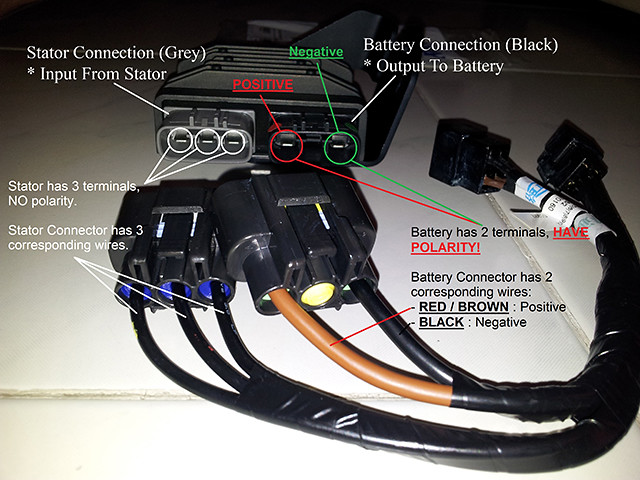
the picture below shows the connections using the triumph harness it does show the correct connections.

 
Check the voltage at the regulator output terminals.
The check the positive line drop from the regulator positive to the battery positive and likewise from the regulator negative to the battery negative terminal.
You are looking for a few tenths at most.
If the rectifier has blown a leg it can allow AC ripple to appear at the battery.
Put the meter on a low AC setting and check across the battery. A volt might be ok but 20 is not.
 
Ohm testing is inconclusive...please do a running test on same meter scale that you got the 70 volt readings

with all three stator leads disconnected from the r/r, measure AC voltage lead to ground. You want a very low reading here
 
Ohm testing is inconclusive...please do a running test on same meter scale that you got the 70 volt readings

with all three stator leads disconnected from the r/r, measure AC voltage lead to ground. You want a very low reading here
I have seen this advice more than once here, so I thought I would test my bike, which happens to charge quite well.

At 5000 RPM, the voltage between the stator legs was roughly 85 VAC. Checking each leg individually to ground, I got about 40 VAC. I found this to be a bit curious, so I checked another bike here and found the same thing. I installed a new stator (Electrosport), tested it and found the same numbers and it did not charge any better (or any worse).

I understand the concept, but don't know why my bike charges as well as it does with that 40 volts reading from stator lead to ground. :-k

.
 
(per steve) Hmm. I'm going to make some stuff up (little knowledge being a dangerous thing ) but :

seeing that 40v is about half your 85v itfirstly suggests that rest of the circuit has the same resistance as your meter that is, very high resistance and thereby very low current.

I'm reaching again here, but being half of your 85vac might also suggest your meter is showing a dc component... perhaps a leaky diode?

Wherever the stray is coming from, it's likely a very high resistance circuit...
To be sure you have no "real" problem, can you discover any amps in this circuit?
 
Last edited:
I have seen this advice more than once here, so I thought I would test my bike, which happens to charge quite well.

At 5000 RPM, the voltage between the stator legs was roughly 85 VAC. Checking each leg individually to ground, I got about 40 VAC. I found this to be a bit curious, so I checked another bike here and found the same thing. I installed a new stator (Electrosport), tested it and found the same numbers and it did not charge any better (or any worse).

I understand the concept, but don't know why my bike charges as well as it does with that 40 volts reading from stator lead to ground. :-k

.

It is dependent on the phase angle between the two separate phases. They are not at max/min at the same time, therefore you will not see exactly half of the phase voltage measuring from one wire to ground. This works exactly the same in three phase industrial electrical. If you are measuring between any two wires in a 3 phase 600VAC system, you will read 600V (or near about depending on power quality, and transformer wiring scheme). If you measure from one wire to ground you will get ~347VAC. not 300VAC. This does not jibe exactly with your example since the power mains are at a fixed 60Hz and not dependent upon motor rpm like a bike alternator. I imagine the frequency of the AC at 5000rpm is quite a bit higher than 60Hz.
 
Did you bypass the factory wiring and install it like this?

SH775 Install by nessism, on Flickr

yes the 3 stator wires are fed directly into the R/R. I’ll try running the ground directly to the negative post of the battery. I tested the out put from the R/R and it was 12.3 volts at idle. I’ll clean the connections better, do a stator to ground test and see if there’s any ac ripple.
 
I just did a positive and reverse bias test on my old rectifier. It passed. I’m thinking I’ll put it back in temporarily to limit the chance of damage to the SH775.
 
Regarding Steve's post....
very strange readings... obviously,insulation in motors and generators is there to isolate windings from ground- often tested with mega ohm meters. Only a tiny bit of current is needed to activate meter during this lead to ground test,while during normal charging output 6+ amps plus is flying around stator windings. Hard to see why this larger current wouldn't find the same path to ground.
My previous stator (6 years ago) had a poor ,but steady, output of about 13 volts. It had a 20 volt lead to ground test if I remember correctly.
 
Charging voltage should be tested at 5000 rpm, not idle. A properly functioning system will make 14 volts or more at the battery but the bike will get down the road okay with 13.7+ or so.
 
Charging voltage should be tested at 5000 rpm, not idle. A properly functioning system will make 14 volts or more at the battery but the bike will get down the road okay with 13.7+ or so.

I moved the ground of the sh775 to the negative terminal of the battery. The voltage at the battery is now topping out at 13.5 volts with the lights on and 14 volts with the lights off. It tops out at around 3k rpm. I?m thinking I?ll clean all the grounds as well replacing the main fuse with a waterproof blade fuse. Does this sound like a reasonable plan of attack?
 
I moved the ground of the sh775 to the negative terminal of the battery. The voltage at the battery is now topping out at 13.5 volts with the lights on and 14 volts with the lights off. It tops out at around 3k rpm. I’m thinking I’ll clean all the grounds as well replacing the main fuse with a waterproof blade fuse. Does this sound like a reasonable plan of attack?

Did you follow the tutorial provided and check for voltage drop in the + circuit between the R/R and the battery? That will tell you if you have voltage loss going back to the battery. Don't guess, measure.
 
Did you follow the tutorial provided and check for voltage drop in the + circuit between the R/R and the battery? That will tell you if you have voltage loss going back to the battery. Don't guess, measure.

Thanks Ed. I’ll go through the connections tomorrow most likely and go from there. I’ll report back.
 
Back
Top