• Required reading for all forum users!!!

    Welcome!
    Register to access the full functionality of the GSResources forum. Until you register and activate your account you will not have full forum access, nor will you be able to post or reply to messages.

    A note to new registrants...
    All new forum registrations must be activated via email before you have full access to the forum.

    A Special Note about Email accounts!
    DO NOT SIGN UP USING hotmail, outlook, gmx, sbcglobal, att, bellsouth or email.com. They delete our forum signup emails.

    A note to old forum members...
    I receive numerous requests from people who can no longer log in because their accounts were deleted. As mentioned in the forum FAQ, user accounts are deleted if you haven't logged in for the past 6 months. If you can't log in, then create a new forum account. If you don't get an error message, then check your email account for an activation message. If you get a message stating that the email address is already in use, then your account still exists so follow the instructions in the forum FAQ for resetting your password.

    Have you forgotten your password or have a new email address? Then read the forum FAQ for details on how to reset it.

    Any email requests for "can't log in anymore" problems or "lost my password" problems will be deleted. Read the forum FAQ and follow the instructions there - that's what we have one for...

  • Returning Visitors

    If you are a returning visitor who never received your confirmation email, then odds are your email provider is blockinig emails from our server. The only thing that can be done to get around this is you will have to try creating another forum account using an email address from another domain.

    If you are a returning visitor to the forum and can't log in using your old forum name and password but used to be able to then chances are your account is deleted. Purges of the databases are done regularly. You will have to create a new forum account and you should be all set.

Solder vs. Butt Connector on hot for Coil Mod

  • Thread starter Thread starter jswhite
  • Start date Start date
Did you let the gun heat up first before starting on it or just go straight at it?
Yea I let it heat up enough to have the solder melt when it hit the gun. Maybe its just that its harbor freight? next project I can mess around more. I kinda have a timeline for the bike and this one unfortunately.
 
Do we have GS bat-signal somewhere? Anyone in IL who can help?
 
Do we have GS bat-signal somewhere? Anyone in IL who can help?

hahahha yes.
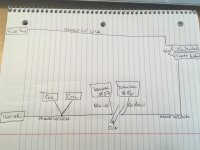
Well since I'm going to go with crimping for this project, all I need now is someone to confirm the diagram I drew up and I should be able to get this thing finished. The write ups are super helpful, but when ripping apart my own, there are always other questions that pop up.
I'll have to mess around with the solder iron and wire after too see what I'm doing wrong.
IMG_7068.jpg
 
Yes, the diagram looks good, as long as you don't forget terminals 30 and 85. :-k

You keep saying "gun" when referring to your soldering tool. Which model do you have?

Most "guns" are rather powerful, at least 100 watts or more. You should only need a 25-40 watt IRON to do those wires.
Yeah, it might take about 5 minutes for the iron to heat up, but once it is up to temperature, it won't even take 5 SECONDS of contact time to get the solder to flow. By the way, what solder are you using?

.
 
Probably because in a production line scenario it's far easier / quicker / safer to crimp connections than to solder them.

And, more reliable, less prone to failure, lighter, cheaper, the list is long. The most important thing is high quality tooling to ensure the proper crimp. I use some manual crimpers at work that cost close to $1000, including support tooling such as different jaws and etc.
 
I got some 16G wire and wrapped it together per the video and it took 5 min of holding the solder gun to the wire to get this result. The solder just wouldnt melt. Since soldering isnt too successful, I'm thinking at this point I will just butt splice ( I have good crimp pliers) the wires and wrap well in electrical tape. Dont want to screw up the wiring with a bad solder job.
View attachment 54533

What brand of solder and type are you using? I’ve bought auto parts store solder that was stating it was 60/40 (insert generic auto store brand name) but WOULD NOT melt. I only use this brand and type now https://www.homedepot.com/p/Bernzomatic-4-oz-Leaded-Rosin-Core-Solder-327789/100494070

Im sure there are other trusted brands of solder but I found this to be the best I’ve used with this solder gun below.
”Weller D550PK 120-volt 260/200-watt Professional Soldering Gun Kit” (was cheaper at Home Depot, or was a comparable Weller Gun)

https://www.amazon.com/dp/B00002N7S1/ref=cm_sw_r_cp_api_cIcZAbN2MVCD2
 
Last edited:
Yes, the diagram looks good, as long as you don't forget terminals 30 and 85. :-k

You keep saying "gun" when referring to your soldering tool. Which model do you have?

Most "guns" are rather powerful, at least 100 watts or more. You should only need a 25-40 watt IRON to do those wires.
Yeah, it might take about 5 minutes for the iron to heat up, but once it is up to temperature, it won't even take 5 SECONDS of contact time to get the solder to flow. By the way, what solder are you using?

.

Thanks! I ended up finishing last night, checked the spark this morning. Very weak. Looks like I'm on the chase now to see whats going on.
 
After reading this entire thread I will make a few observations -

I think it is called a "Union Splice" - more indicative of the style of attachment than a wire company.
This type of splice is very solid when the solder is allowed to run into the joint AND then covered with a shrink tube tightly holding the wires from getting wet and corrosion. - I think sometimes we put too much emphasis on pretty rather than functional-- IF the splice is tight ; and the solder runs into the joint, and the shrink tube covers it nicely --- ;)

I have also used crimped connections on several bikes that lasted years with out issues - but my crimps are tight and covered in ..shrink tube. ..hmmm...?

In a few occasions I have used a crimp connector , and soldered it together , before I used ...shrink tube.... (again..?)

Last year I put new coils on my GS850GL due to it running SO poorly when wet outside (not even raining - just humid)
THAT was a worthy upgrade -- NEW COILS - NEW CRIMPED or SOLDERED connections, NEW WIRES and CAPS and PLUGS :) ..
(shrink tube?)

Keep asking questions - the tribal knowledge here will astound you - once you get it sorted out -
Remember everyone likes to do things THEIR way -- and it may not be right for you .
Strive to understand the WHY concept of the advice and you will learn how to do it YOUR way .

LUCK and SAFE RIDES in your future.

 
After reading this entire thread I will make a few observations -

I think it is called a "Union Splice" - more indicative of the style of attachment than a wire company.
This type of splice is very solid when the solder is allowed to run into the joint AND then covered with a shrink tube tightly holding the wires from getting wet and corrosion. - I think sometimes we put too much emphasis on pretty rather than functional-- IF the splice is tight ; and the solder runs into the joint, and the shrink tube covers it nicely --- ;)

I have also used crimped connections on several bikes that lasted years with out issues - but my crimps are tight and covered in ..shrink tube. ..hmmm...?

In a few occasions I have used a crimp connector , and soldered it together , before I used ...shrink tube.... (again..?)

Last year I put new coils on my GS850GL due to it running SO poorly when wet outside (not even raining - just humid)
THAT was a worthy upgrade -- NEW COILS - NEW CRIMPED or SOLDERED connections, NEW WIRES and CAPS and PLUGS :) ..
(shrink tube?)

Keep asking questions - the tribal knowledge here will astound you - once you get it sorted out -
Remember everyone likes to do things THEIR way -- and it may not be right for you .
Strive to understand the WHY concept of the advice and you will learn how to do it YOUR way .

LUCK and SAFE RIDES in your future.


This is helpful! Looks like my plug wires are epoxy'd into the coils so if I want to change the wires, the coils will have to be changed too. What kind of coils did you go with?

Thanks! I'm really excited for getting this thing on the road! First it needs to heat up a bit, this whole snowing in April thing, I am not a fan of. I'm assuming you are getting some of the same up in WI.
 
I solder nearly EVERYTHING, even connections that I have crimped with fancy crimping tools... solder with good soldering gun/iron and solder, clean clean clean, heat shrink (put that stuff on before you solder if you won't have an open end of the wire left to slide it on after!). I will double shrink wrap and sometimes even tape over top of that...

The Regulator Rectifier connectors or connector kits I ESPECIALLY solder...

Proper technique and proper soldering iron for the job and for the wire gauge are critical. too small of a gun and you will have to heat for too long, and the heat affected area will be substantially larger, either melting insulation further away from the joint, or wicking more solder and flux way back into the wire under the insulation.

Best of luck with your project!
 
I think it is called a "Union Splice" - more indicative of the style of attachment than a wire company
um, well, I don't know everything and a lineman would know better but just since it's mildly interesting and I've never heard of a "Union Splice", I'll stick with Western Union splice...
Western Union was a telegraph company. I imagine making repairs, to the very important telegraph while working up a pole in the rain wind, and dark .. I hae mae doots they would be using a soldering iron up there either. (The wire used was a single solid strand of copper by the way ..)
 
IN the interest of gaining more personal knowledge I did a quick google about the splice --
It seem either name is correct..

https://en.wikipedia.org/wiki/Western_Union_splice


The Western Union or Lineman splice was developed during the introduction of the telegraph to mechanically and electrically connect wires that were subject to loading stress. The wrapping pattern is designed to cause the termination to tighten as the conductors pull against each other.

I learn more everyday since buying this bike...
 
The problem with soldering is a COLD SOLDER JOINT. If the solder is not as shiny as it is while liquid when it cools and turns solid it is a bad or cold solder joint and clearly inferior to a properly crimped connection. Any movement in the wires before they solidify will result in a dull cold solder joint. It takes practice to get them right. Everyone can't do it properly, where everyone is capable of making a proper crimp with the proper tools.
 
^^ +1 I've done lots of bad soldering and have come to the conclusion that soldering is for circuit boards, tinsmiths and plumbers. A good crimp is like a good weld- it cannot be undone without destruction. A loose crimp filled with solder is second best.
All my soldering irons are for electronics. I'm going to over-emphasize the faults to make a point BUT; to heat a larger mass of copper and lug, they are going to overheat the copper locally and thereby anneal it-"brittle-ise" it in the attempt to heat the whole enough to "flow" solder in.. As well, they soften the wire insulation which cooled is then more brittle. Doing these in a cold garage in winter accentuates the flaws in the process.
That said, I've got a lot of nasty clumpy connections on my boat that were done ondeck in winterthat have lasted many years, but I know I could undo the globs of black tape, bend them backnforth a few times and they'll snap where the heavily oxidised copper leaves the powdery solder glob.
 
Everyone can't do it properly, where everyone is capable of making a proper crimp with the proper tools.

Well, that's a bit of a broad statement. I've cut through cables in the past with some rushed, over-exited crimping. It's certainly NOT out of the question that you can make a crap job of crimping just as easily as you can make a crap job of soldering.

There is also the element of the application to consider - if you are joining wires (like in a loom) and anything "loose" then it's soldering. If you are joining a wire to a hard mounted component, then a crimp connector is best as I think they are more reliable under continued vibration.

At the end of the day, for me, after years of tinkering with bikes, when it comes to joining wires, soldering is the most effective, reliable and simply the best option.

Your results may vary and that's fine :cool:


SOLDER --CRIMP -- SOLDER -- CRIMP
:boxing: :indecisiveness:

Back & forth ...how does a newbie know what to do ..?
:confused-new:

I refer back to my first post about do what you can- good enough is usually good enough if you have tried your best

Remember everyone likes to do things THEIR way -- and it may not be right for you .
Strive to understand the WHY concept of the advice and you will learn how to do it YOUR way .


Strive to understand the WHY concept of the advice and you will learn how to do it YOUR way .
absolutely.
...if I was stuck with a bad crimp tool or had none, or didn't want to buy a +$60 tool and the very best crimps for a single job and had room to get a decent soldering tool there, I'd work with solder and not think twice about it. Knowing the ins and outs of any way is good. Twisting pigtails and black tape will get ya home too.
 
Back
Top