
-
Required reading for all forum users!!!
Welcome!
Register to access the full functionality of the GSResources forum. Until you register and activate your account you will not have full forum access, nor will you be able to post or reply to messages.A note to new registrants...
All new forum registrations must be activated via email before you have full access to the forum.A Special Note about Email accounts!
DO NOT SIGN UP USING hotmail, outlook, gmx, sbcglobal, att, bellsouth or email.com. They delete our forum signup emails.A note to old forum members...
I receive numerous requests from people who can no longer log in because their accounts were deleted. As mentioned in the forum FAQ, user accounts are deleted if you haven't logged in for the past 6 months. If you can't log in, then create a new forum account. If you don't get an error message, then check your email account for an activation message. If you get a message stating that the email address is already in use, then your account still exists so follow the instructions in the forum FAQ for resetting your password.Have you forgotten your password or have a new email address? Then read the forum FAQ for details on how to reset it.
Any email requests for "can't log in anymore" problems or "lost my password" problems will be deleted. Read the forum FAQ and follow the instructions there - that's what we have one for...
-
Returning Visitors
If you are a returning visitor who never received your confirmation email, then odds are your email provider is blockinig emails from our server. The only thing that can be done to get around this is you will have to try creating another forum account using an email address from another domain.
If you are a returning visitor to the forum and can't log in using your old forum name and password but used to be able to then chances are your account is deleted. Purges of the databases are done regularly. You will have to create a new forum account and you should be all set.
You should upgrade or use an alternative browser.
Stupid question...
- Thread starter nutz4spd
- Start date

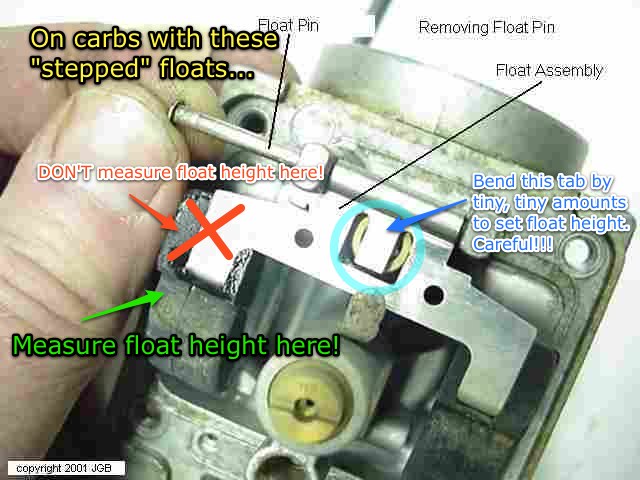
When measuring float height on the BS32 carbs are you supposed to measure to the very top of the float or just before the hump? One set of instructions I found on here shows before the hump. Every where else says the very top. Which one is correct??
The factory service manual for your bike, and the carb rebuild tutorial linked in my signature which uses a photo from the factory manual, shows the proper measuring method.

2BRacing
Forum Mentor
When measuring float height on the BS32 carbs are you supposed to measure to the very top of the float or just before the hump? One set of instructions I found on here shows before the hump. Every where else says the very top. Which one is correct??
Do not measure to the very top.
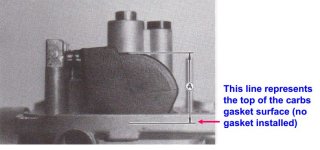
Edit: Picture courtesy of member Nessism from his excellent tutorial.

The bike will run, but it will run like poop.
As Ness stated, this is very clearly described and depicted in the manuals, so I don't know why this happens so often. Reading are hard, I guess.

...some surging at cruising speed.
According to Cycle World, some surging at cruising speed was normal for my 11E in '82.

nutz4spd
Forum Apprentice
A large percentage of BS carbs I encounter have the float levels set to the top instead of the step.
The bike will run, but it will run like poop.
As Ness stated, this is very clearly described and depicted in the manuals, so I don't know why this happens so often. Reading are hard, I guess.
Actually, the service manual I have does not show where to measure. Only what the measurement is supposed to be, break down of the system, etc, etc. You are right though, read IS hard but proper grammar is even harder! lol Just a little jab. Don't take it serious.

I reset the floats properly this time but now the bike pops on deceleration and doesn't seem to be as responsive. I was reading in the service manual where it showed how to sync the carbs using the old mercury style meter. It never said anything about a specific measurement though. Having said that, I had them all reading right at 7 or 8 mm Hg last time I synced them. Is this good enough to have them reading the same or should the values be higher/lower? I remember the manual said that carbs 2 and 3 should be slightly lower than 1 and 4 but that was using the mercury style gauge. Should I adjust the middle two the same way?
Brian (bwringer) probably won't take it seriously, but he IS very serious about his writing. Spelling, grammar and punctuation are nearly always perfect. After all, he writes for a living. Therefore, when you see something like that from him, it's all in jest. I have met the man and seen the twinkle in his eye, so I can see it again when I see stuff like this coming from his keyboard.You are right though, read IS hard but proper grammar is even harder! lol Just a little jab. Don't take it serious.

What manual do you have that does not show exactly where to measure float height? As far as I remember, the Haynes, Clymer, and factory manuals all show this pretty clearly. Of course, print quality is pretty variable, so maybe it's not as clear as I thought. And I'm familiar with the manuals for the shafties, so maybe the others skipped this.
Anyway, the actual vacuum readings don't matter, only that they're all the same. Most of us bump idle up a bit for syncing, maybe 2,000 rpm or so.
The manuals discuss setting the inner two vacuum readings slightly lower, but no one has ever been able to tell any difference, so most of us don't bother. And the actual spec for "half a ball" using the Suzuki gauge is not clear.
Long ago, someone did get their mitts on a Suzuki gauge that uses the steel balls, and came up with an actual measurement, but I don't remember what it was or where to find it. Perhaps one of the other GSR graybeards will remember.
As far as the popping, that's most commonly a fairly clear sign of an intake leak (could be a few other things). IIRC your bike has those rubber tubes and not the carb/head intake boots with o-rings. You also need to make sure the entire air path through the airbox and into the carbs is properly sealed, and the boots on both sides of the carbs are reasonably new, properly seated (getting a fold in a hidden spot on one of the inner carbs is common).
It's also pretty common for the plastic airbox to sort of cave in on the carb side, so that it's impossible for the inner two carbs to seal. With a heat gun to soften the plastic slightly, a wooden stick to push the plastic into place from the back, and plenty of patience and care, you can heat up the plastic and correct the U-shape.
Of course, maybe you've already done all that... a vintage GS is like an onion. Yes, it can make you cry and it's sometimes stinky, but what I mean is that there are always a lot of layers to peel back before everything is right. But when it's right, it's all worth it!
Some time ago, I thought I saw somebody mention that they had compared the two gauges and found that "half a ball" was about 2cm Hg.The manuals discuss setting the inner two vacuum readings slightly lower, but no one has ever been able to tell any difference, so most of us don't bother. And the actual spec for "half a ball" using the Suzuki gauge is not clear.
nutz4spd
Forum Apprentice
You are correct. My bike has the four rubber tubes in the motor side and really short ones on the air box side. I'll double check them for tightness and leaks. A friend of mine also mentioned that I could have leaned out the carbs just a little too much when I reset them and that I may be able to adjust the mixture to compensate. May take a look at that as well.
I'll be honest, I've always loved older motorcycles and vehicles in general. I don't mind getting frustrated and throwing a wrench now and then because in the end you have something unique that a lot of others don't. I get just as many looks and compliments on the old GS as I do on my new Indian.