• Required reading for all forum users!!!

    Welcome!
    Register to access the full functionality of the GSResources forum. Until you register and activate your account you will not have full forum access, nor will you be able to post or reply to messages.

    A note to new registrants...
    All new forum registrations must be activated via email before you have full access to the forum.

    A Special Note about Email accounts!
    DO NOT SIGN UP USING hotmail, outlook, gmx, sbcglobal, att, bellsouth or email.com. They delete our forum signup emails.

    A note to old forum members...
    I receive numerous requests from people who can no longer log in because their accounts were deleted. As mentioned in the forum FAQ, user accounts are deleted if you haven't logged in for the past 6 months. If you can't log in, then create a new forum account. If you don't get an error message, then check your email account for an activation message. If you get a message stating that the email address is already in use, then your account still exists so follow the instructions in the forum FAQ for resetting your password.

    Have you forgotten your password or have a new email address? Then read the forum FAQ for details on how to reset it.

    Any email requests for "can't log in anymore" problems or "lost my password" problems will be deleted. Read the forum FAQ and follow the instructions there - that's what we have one for...

  • Returning Visitors

    If you are a returning visitor who never received your confirmation email, then odds are your email provider is blockinig emails from our server. The only thing that can be done to get around this is you will have to try creating another forum account using an email address from another domain.

    If you are a returning visitor to the forum and can't log in using your old forum name and password but used to be able to then chances are your account is deleted. Purges of the databases are done regularly. You will have to create a new forum account and you should be all set.

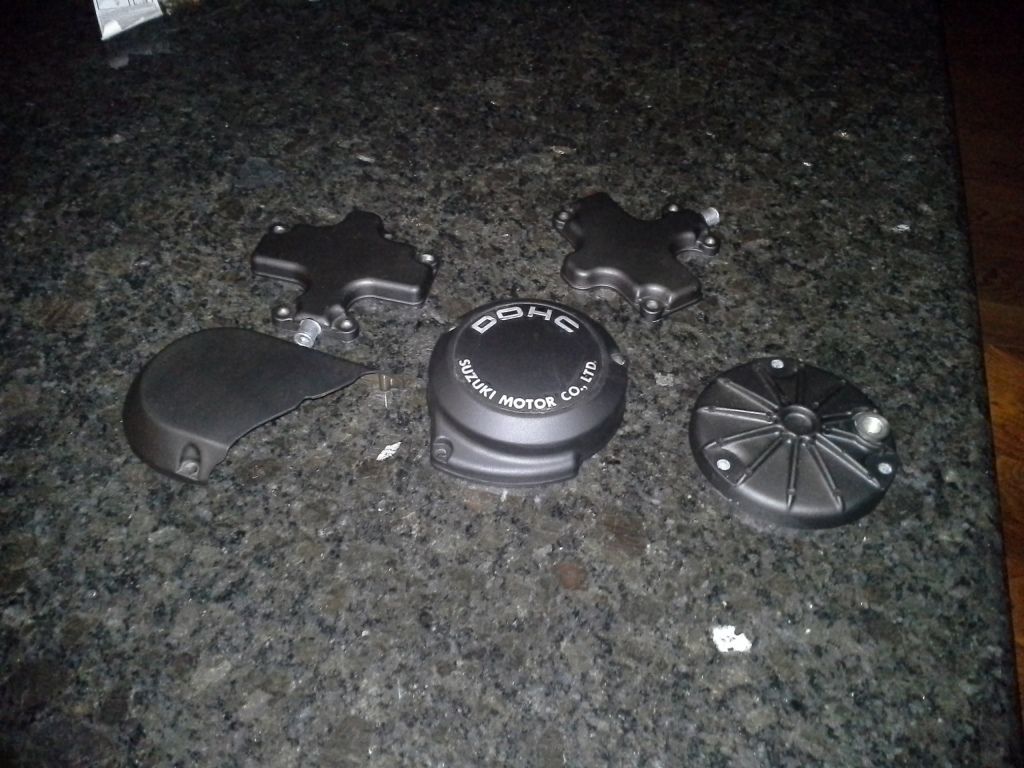
Those of you who do your own powder coating?.

Easy easy easy:

20140111_183041.jpg

Whats your address again.....

Those look great, the mate black would look great on my gloss black engine on my FZ project.....

did you mask off the lettering ?

what is your prep, just wire wheel, or sand blasting, or a combination..

.
 
Thanks for the info.. I'm picking up my powder coat kit next week.. only had a chance to use a friend's unit to see how it all worked.

On my GS650G engine, the valve cover doesn't fit by that -> <- much.. can't close the door.. but the side engine covers do well.. The oven I have is 12" deep, 13" wide and 7" high from the bottom most rack. Good for now.. Electric ovens are easy and cheap to come by around here, $10 or free will get you a decent one if you don't mind it not having working burners on top, just the working oven ;) Just need to find space to park it in the garage now..

I've been watching Craig's, there's a guy here that says he has a free one but I haven't heard from him for a few days. I'm parking the oven on the back porch of th bike garage, don't have space and don't need the fumes inside. I need to put in a 220 outlet for it too.

Did you go with the Eastwood kit?
 
Whats your address again.....

Those look great, the mate black would look great on my gloss black engine on my FZ project.....

did you mask off the lettering ?

what is your prep, just wire wheel, or sand blasting, or a combination..

.

Those I didn't prep at all, just wiped them down with Acetone and preheated to outgass any oils or anything in the pores of the metal. The lettering, didn't mask it at all, just wiped the powder off with a wet finger before curing it. That ignition cover is broken, we dropped the 550 engine on it last week. It has a big crack in the front of it. This is just practice. That technique seems to work, but it would be easier if the raised letters were higher.
 
I've been watching Craig's, there's a guy here that says he has a free one but I haven't heard from him for a few days. I'm parking the oven on the back porch of th bike garage, don't have space and don't need the fumes inside. I need to put in a 220 outlet for it too.
Did you go with the Eastwood kit?

Yes, found a dealer in New Brunswick that sells the kits cheaper than what I can buy it from Eastwood themselves in the USA (saves me the shipping and all the usually tax, free and duties) so it's a good deal. I'm picking up the kit that comes with all the fun stuff and three colours.. black and pick out another two standard colours.. a flat black and one of the brighter silver / alumimium colours I think.. Haven't decided what colours to do the engine in yet ;) Depends how well it cleans after I get it back from the machinist who's pulling out the broken exhaust bolts for me.

Would love to leave the oven stove outside (I have a 220 outlet on the garage) but it's way too wet around here for it to survive even one season outdoors..

I have my origami paint booth set up for typical paint that will work well for the powder.. Its 4x4x2 with a filter air system behind it, and folds up flat to a 2x4 and 6 inches for storage.
 
I have my origami paint booth set up for typical paint that will work well for the powder.. Its 4x4x2 with a filter air system behind it, and folds up flat to a 2x4 and 6 inches for storage.

I don't think you will even need it. I haven't even been rolling the bikes out, any "overspray" just falls on the cardboard box the parts are sitting on, I don't think any of it even gets to the floor. Maybe if you were coating a whole car or something, but for these little bike parts it's not a problem.
 
Tom...so this is just a spray and bake operation basically. Is it applied with air equipment or spray can? Not familiar with Eastwoods stuff.
 
It uses very low air pressure, 5 to 10 psi.. The thing they impress upon is 'clean dry' air..

This is one of the kits they push.. As Tom is indicating, it's rather easy to use, the prep work isn't too difficult either..

http://www.eastwood.com/hotcoat-deluxe-powder-coat-kit.html

there's quite a few Youtube videos about it, how to use it etc.. search them out, informative stuff..
 
The gun puts a positive electrical charge on the powder particles as they go out. It just kind of falls out in a cloud, not really shooting out like a paint gun. There is a negative lead you clip to the part. It electrically attracts the particles to the part like static in your hair. The stuff just gloms onto the part and stays there. There doesn't seem to be any problem with too much or too little powder, no orange peeling, no runs. It is much easier to get a nice looking part than using spray paint or a spray gun. Stick it in the oven or about 20 minutes or so, let it cool, done. Super super easy.
 
Yeah, Chuck you need just a tiny compressor, the smallest pancake ones are fine. There is an electrical box, a pushbutton switch on a cord, and the gun. The pushbutton turns on the electrical charge. If you don't push the button the powder just makes a cloud and doesn't really go to the part.
 
Make a small video and post a link...would like to see the process. thats something I would like to learn in the future. i was thinking take the element and controls out of a house oven and make your own insulated cabinet large enough for frames too.
 
Yeah, I'm thinking about that frame oven, not sure I want a big oven thing out in the yard. Maybe after a while. For now I just want a full sized oven so I can do the bigger engine parts and things.

Gatekeeper posted this a couple days ago…. It was helpful.

http://www.youtube.com/watch?v=T01zIKxP0Ms
 
I've seen industrial shops set up for powder coating and they typically use a phosphate etch tank to clean the parts prior to painting. Metal Prep as sold by places like Home Depot works well. These places also typically collect the overspray powder and some recycle it. Sometimes doing this causes painting problems though so experiment first.

Maybe a moot point but not all powders are equal. Polyester is cheaper and less durable than urethane. Not sure how important this detail is though when it comes to restoring a GS. Some food for thought if powder shopping though...
 
I've seen industrial shops set up for powder coating and they typically use a phosphate etch tank to clean the parts prior to painting. Metal Prep as sold by places like Home Depot works well. These places also typically collect the overspray powder and some recycle it. Sometimes doing this causes painting problems though so experiment first.

Maybe a moot point but not all powders are equal. Polyester is cheaper and less durable than urethane. Not sure how important this detail is though when it comes to restoring a GS. Some food for thought if powder shopping though...

Yeah Ed, I'm just learning, don't know about the phosphate wash. Wiping with Acetone sems to let the stuff work correctly. There are thousands of different colors and types of powders, maybe some of them are more finicky. Removing old paint and crud will be the hard part, I might need a better way of doing that. This is the Harbor Fright powder, at $4 a can I'm not going to bother catching the overspray. Most of them are under $20 a pound, still not worth recycling for the little bit I will be doing. There really isn't much overspray, and it wouldn't be clean anyway. One can will do a LOT of parts. Don't know about durability yet, but even the cheap powder I'm using seems very hard once it's cured.

If you want a few Kawasaki parts done, would be happy to trade for some shiny replated bolts.
 
Soda blasting the crud away works well, and sand blasting for the harder rusty parts. It had been mentioned to me before never to use glass beads to clean parts before powder coating but couldn't find out the why.. I'm guessing they worry the glass that gets pinged into the metal will adversely affect the powder bonding to the metal.. But the pre-heating to off gas and dry the parts should take care of that, I'm guessing. Always better to use soda or AlOx vice glass for powder coating process..?

Did you find that the powder flows enough to cover light defects or does it mirror the defects, say like wire wheel marks etc?
 
Did you find that the powder flows enough to cover light defects or does it mirror the defects, say like wire wheel marks etc?

So far it sems to cover very well. Haven't actually tested it on any really rough parts. You can put it on thicker, or do multiple coats too. I just used a magnifying glass to look at the ignition cover that was cracked when the engine hit the floor, you can see where it hit but if I had spent a moment with a file first you wouldn't be able to. It's not noticable at all. I'm sure it all depends on the powder you are using. This is matte black, probably covers defects as good as anything. I'm sure with one of the gloss or something fancy like candy colors the surface might be more critical.
 
Powder coating

Powder coating

I was a professional coater for many years...started off in industrial applications and then found my passion doing custom motorcycles and auto parts.
There are a lot of different powders for many different applications. Each one has different characteristics.The best overall is polyester...it has good flexibility,uv protection,and chemical resistance. Urethane is a little more brittle I guess you could say but is a lot nicer finish,smoother but does seem to scratch easier. Epoxy has the highest chemical protection but the lowest uv rating it chalks in the sun.
The cleaning is important.we use to have 50 percent of the parts sand blasted and the rest we use to hand scuff then use a Phosphate wash or bath. It's not an etch it actually puts a fine layer of phosphate on the part to help adhesion. Used all types of blast media including glass bead.
Precooking the part is not a science it all depends on the material. Cast is the worst as far as gassing out also the age of the piece, the older the metal the more problems we seem to have with pin holing and gas out
The one thing I don't see in a lot of DIY applications is the explanation that the part has to get to cure temp. and remain for the recommended time period.
For example :The powders recommended temp is 400 degrees for 20 mins. If you have a 1/4" piece of steel and put it in for only 20 mins it will not cure properly. The likelihood of failure is higher.
Powder is great and they have made a lot of improvements in the manufacture of it.
Less orange peel than in the past.
But Thicker is not better. It will lose the flexibility the thicker it is. Recommended mil thickness for most powders is 1.5 to 3.5 mils thick.
Well I've rambled on long enough :D I hope this helps some out there.
 
Please do go on, especially with the heating part.. I had read (and lost the link) about where you set a temp, watch for when the powder flows and then change the heat or set the timer.. something like that, but can't remember exactly what it was.. Thoughts?
 
I was a professional coater for many years...started off in industrial applications and then found my passion doing custom motorcycles and auto parts.
There are a lot of different powders for many different applications. Each one has different characteristics.The best overall is polyester...it has good flexibility,uv protection,and chemical resistance. Urethane is a little more brittle I guess you could say but is a lot nicer finish,smoother but does seem to scratch easier. Epoxy has the highest chemical protection but the lowest uv rating it chalks in the sun.
The cleaning is important.we use to have 50 percent of the parts sand blasted and the rest we use to hand scuff then use a Phosphate wash or bath. It's not an etch it actually puts a fine layer of phosphate on the part to help adhesion. Used all types of blast media including glass bead.
Precooking the part is not a science it all depends on the material. Cast is the worst as far as gassing out also the age of the piece, the older the metal the more problems we seem to have with pin holing and gas out
The one thing I don't see in a lot of DIY applications is the explanation that the part has to get to cure temp. and remain for the recommended time period.
For example :The powders recommended temp is 400 degrees for 20 mins. If you have a 1/4" piece of steel and put it in for only 20 mins it will not cure properly. The likelihood of failure is higher.
Powder is great and they have made a lot of improvements in the manufacture of it.
Less orange peel than in the past.
But Thicker is not better. It will lose the flexibility the thicker it is. Recommended mil thickness for most powders is 1.5 to 3.5 mils thick.
Well I've rambled on long enough :D I hope this helps some out there.
Good info, I can't tell exactly when the part gets to 400 degrees. What I have been doing is watch it until it looks wet all over, then start the clock. The directions on the powder say 400 for 15 - 20 mins, I go 20 from when it looks wet. It seems to work so far, but I know bigger pieces will take longer to heat up. Is there a problem with leaving it in longer to make sure, say 30 minutes or so?.
Also the phosphate bath, is this the last step before applying the powder? Is this something I can do at home?

Is the 400 degrees enough to alter the metal, like make the aluminum soft or brittle, or maybe change the temper of valve springs or other steel parts?

How hot before rubber oil seals start to get damaged? It would be nice to do without removing new seals and ruining them.
 
re

re

You can over cure a part....if you plan on doing doing it quite a bit I would invest in a lazer temp gun...like what they use to show you track temp at a NASCAR race.
The phosphate wash is the step right before precook and I don't think for home use would be necessary, Just have to make sure part is real clean,grease free and dry.
Yes 400 is more than enough to alter the metal if left in to long...we had to stop doing frames for the local super truck series because the heat effects the chrome moly tubing. If you stick to the temp range and time of cure it wont effect 99.9% of what you are curing.
I know all to well it is a pain to remove seals...but you have to because trapped oils will continuously cook out, and by the time all the oil is out the seals are ruined.
Its best to disassemble everything and don't put anything in the oven you are not actually coating ie: valve spring...seals and the like.

Seaking I think for the smaller parts or thinner gauges of metal setting the temp lets say recommended is 400 degrees at 15 min
When the powder flows or looks glossy then setting the timer to recommended...works.
They have put better flow factor in powder now and actually made curing a lot less trial and error.
There was a small writeup in a powder magazine about me and the shop and how we used a computerized system to monitor temp and cure cycle.
We were doing Hospital equipment using a Epoxy/Polyester hybrid.
The last thing a hospital or surgeon needs is powder flaking off into a patient.
We attached leads to dummy parts and ran them with the coated stuff and watched the temp of the metal and set the timer when it hit the mark.
I think they have tried to make it as easy and trouble free as possible with the at home versions.
The last point I think is that what ever you are using to cure the powder it has to remain a consistent temp from top to bottom and front to back to ensure even cure across the part.
Seen many a frame come in from another coater to be fixed because the front of the frame was peeling and the back was cured. They had hung the frame with neck facing down and the oven had a cool spot near the floor.
 
Mayhem63-----lots of great info in your above post.....I am sure this will help out many...
 
Back
Top