-
Required reading for all forum users!!!
Welcome!
Register to access the full functionality of the GSResources forum. Until you register and activate your account you will not have full forum access, nor will you be able to post or reply to messages.A note to new registrants...
All new forum registrations must be activated via email before you have full access to the forum.A Special Note about Email accounts!
DO NOT SIGN UP USING hotmail, outlook, gmx, sbcglobal, att, bellsouth or email.com. They delete our forum signup emails.A note to old forum members...
I receive numerous requests from people who can no longer log in because their accounts were deleted. As mentioned in the forum FAQ, user accounts are deleted if you haven't logged in for the past 6 months. If you can't log in, then create a new forum account. If you don't get an error message, then check your email account for an activation message. If you get a message stating that the email address is already in use, then your account still exists so follow the instructions in the forum FAQ for resetting your password.Have you forgotten your password or have a new email address? Then read the forum FAQ for details on how to reset it.
Any email requests for "can't log in anymore" problems or "lost my password" problems will be deleted. Read the forum FAQ and follow the instructions there - that's what we have one for...
-
Returning Visitors
If you are a returning visitor who never received your confirmation email, then odds are your email provider is blockinig emails from our server. The only thing that can be done to get around this is you will have to try creating another forum account using an email address from another domain.
If you are a returning visitor to the forum and can't log in using your old forum name and password but used to be able to then chances are your account is deleted. Purges of the databases are done regularly. You will have to create a new forum account and you should be all set.
You should upgrade or use an alternative browser.


 :boxing::applouse::dejection::monkey:
 nthego::sleeping:

If you're an experienced wrench with sparky tendencies and the question is "I'd like to treat myself", then fine. Get yourself a Fluke and make a spot in your $10,000 Snap-On tool cabinet, Mr. Rockefeller...

Least year, I really wanted an amp clamp type meter that worked with DC, so that I could read "live", real-world current draw on various motorcycle systems while the bike was running or the key on. This is astonishingly difficult to find -- 99.999% of amp clamps out there only work with AC. (Most meters can only read DC amps by being placed in series with the load, so they're limited to 10 amps -- not good for much.)
My only options were a $60 Craftsman meter from my not-so-friendly local Sears or blowing a couple hundred bucks on a Fluke or similar high-end industrial brand.
I bought the Craftsman. It works brilliantly, it reads quite accurately, durable, high quality, lots of convenient features, etc. and so on.
http://www.sears.com/craftsman-digital-clamp-on-ammeter/p-03482369000P
Sears also sells a "Pro" model that can read DC amps for $110.
Anyway, if someone works on motorcycles or cars and has progressed beyond the "I don't have a meter" phase, being able to read DC amps without opening a circuit is ridiculously useful. Most multimeters are intended more for HVAC or home/factory use.
I'd highly recommend the Craftsman meter I linked above. Or, get the Fluke equivalent if you want to spend some grown-up money.
barnbiketom
Guest
I agree that a clamp on DC meter is rare and would love to be able to see stuff like starter draw instantly!!
This one just moved up to #1 on my list if my Fleabay "fluke" watch list flukes out over a hundred bucks hahaha

 . Anyway having a clamp on DC amp meter is undoubtedly useful. What would you figure the minimum current is that you can see on the 20 amp scale (6 digits)? 1 mAmp?
The $60 Crafstman DC amp clamp reads to two decimal places in the low range (0-40 amps DC) and the specs say the accuracy is +-2.5% at 0-20 amps, +-3.0% at 20-40 amps. So no, the clamp won't give you laboratory precision in the milliamp range. I've tested with small light bulbs and similar small loads, and it gives exactly the expected readings.
Yea, I can read a spec sheet as well, but suppose the answer to my question is that there are only 4 digits on the display and with a 20 amp scale that gives 10 mAmp resolution.
jstewart
Guest
Still can't beat a properly calibrated Simpson 260 analogue meter for use around the house. It may not be as accurate as today's digital models but still extremely useful. Great for a visual capacitance check if you ever need it. You can pick up a good used one for $25 and get a fairly decent calibration on it using some 1% resistors.
Yes I have a digital, I just find myself using it more often than than the DVOM.
Same here, I have a Fluke 87 but for most electrical checks I fall back on my old analog Simpson 260. One task I always use the more accurate Fluke 87 for is resistance checks, particularly across connectors on these old bikes.

Steve
GS Whisperer
Least year, I really wanted an amp clamp type meter that worked with DC, so that I could read "live", real-world current draw on various motorcycle systems while the bike was running or the key on. This is astonishingly difficult to find -- 99.999% of amp clamps out there only work with AC. (Most meters can only read DC amps by being placed in series with the load, so they're limited to 10 amps -- not good for much.)
My only options were a $60 Craftsman meter from my not-so-friendly local Sears or blowing a couple hundred bucks on a Fluke or similar high-end industrial brand. ... I bought the Craftsman.
I was faced with a similar situation a couple of years ago. However, I found a similar meter at Radio Shack before I saw the one at Sears. It was $80, and the only apparent difference is a third amp scale that covers 800 amps.

The test equipment at work has to be calibrated every year (we verify accuracy on medical equipment). When the crew came through to do the shop equipment, I had them run the Radio Shack meter across their tester to see how it fared. I did not ask for a sticker that verified accuracy, so they did it at no charge. On the 40 amp scale, 30 amps showed on the meter as 28. On the 400 amp scale, 300 amps showed as 320. Those were the only two items that would have made it not earn a sticker, but they are close enough for the work that I do on the bikes. For the stuff at work, I use the 30 (or so) year old Fluke 77 that still passes calibration every year.
Since Radio Shack has all but gone under (no active website at the moment), the Craftsman meter is a good choice. :encouragement:
.
I was faced with a similar situation a couple of years ago. However, I found a similar meter at Radio Shack before I saw the one at Sears. It was $80, and the only apparent difference is a third amp scale that covers 800 amps.
The test equipment at work has to be calibrated every year (we verify accuracy on medical equipment). When the crew came through to do the shop equipment, I had them run the Radio Shack meter across their tester to see how it fared. I did not ask for a sticker that verified accuracy, so they did it at no charge. On the 40 amp scale, 30 amps showed on the meter as 28. On the 400 amp scale, 300 amps showed as 320. Those were the only two items that would have made it not earn a sticker, but they are close enough for the work that I do on the bikes. For the stuff at work, I use the 30 (or so) year old Fluke 77 that still passes calibration every year.
Since Radio Shack has all but gone under (no active website at the moment), the Craftsman meter is a good choice. :encouragement:
.
I have two Flukes, a 77 and a 73 both bought from ebay, the 77 is an ex military that cost me ?25 that has travelled the world and has had a really tough time but still works perfectly and I've had it 15 years or more, the 73 stays in my shed for shed stuff. I remember when I first saw Flukes back in the late seventies, I found that that the older Flukes go for reasonable money. I also have a clamp meter that stays with my machines, that again was second hand but was quite expensive, it does the usual AC/DC and continuity but I got it because it measures current up to 1000 amps AC. Unless they get pinched there is no doubt these will see me out and have been real value for money.
Never be without your Fluke.
barnbiketom
Guest
Depending on meter resolution quiescent draw is useful when battery is being drawn down.Can I see some more examples of DC amps testing on motorcycles??? other than starter draw which I can 'sense' the starter is bad?
also measuring batt charging current vs total alternator current is interesting.
If you are going for LEDs then more interest.
Can I see some more examples of DC amps testing on motorcycles??? other than starter draw which I can 'sense' the starter is bad?
Anything where you need to test while the bike is running.
Diagnose bad coils -- see how much current each coil is drawing with key on and at various RPM. Sometimes bad coils will actually work for a while, but they'll draw a lot of current, heat up, and then fail while the bike is running.
Overall "sanity check" -- does the current draw with the key on make sense? You can also pull the fuses and replace one at a time to narrow down an issue.
I was chasing a very tricky issue that turned out to be a broken ground wire deep in the harness. The instrument bulbs worked, but they were actually grounding through the turn signal filaments, and the turn signals were acting strange. Measuring the amperage draw verified that they weren't drawing full current, and watching the readout while wiggling this and that finally located the problem area.
I've used it to verify which wire on electric grip heaters was low heat and which was high heat. Could have done the same thing with the ohm meter, but then I would have had to take apart a connector.
Verify how much current an ignitor or electronic ignition is drawing when the bike is running. Again, if it's drawing more (or less) than it should as it warms up, that may be the source of an intermittent problem.
Check how many amps your farkles (USB outlet, heated grips, LED lights, etc.) are drawing.
barnbiketom
Guest
very good stuff.Anything where you need to test while the bike is running.
Diagnose bad coils -- see how much current each coil is drawing with key on and at various RPM. Sometimes bad coils will actually work for a while, but they'll draw a lot of current, heat up, and then fail while the bike is running.
Overall "sanity check" -- does the current draw with the key on make sense? You can also pull the fuses and replace one at a time to narrow down an issue.
I was chasing a very tricky issue that turned out to be a broken ground wire deep in the harness. The instrument bulbs worked, but they were actually grounding through the turn signal filaments, and the turn signals were acting strange. Measuring the amperage draw verified that they weren't drawing full current, and watching the readout while wiggling this and that finally located the problem area.
I've used it to verify which wire on electric grip heaters was low heat and which was high heat. Could have done the same thing with the ohm meter, but then I would have had to take apart a connector.
Verify how much current an ignitor or electronic ignition is drawing when the bike is running. Again, if it's drawing more (or less) than it should as it warms up, that may be the source of an intermittent problem.
Check how many amps your farkles (USB outlet, heated grips, LED lights, etc.) are drawing.
I especially like the thoughts on battery drain, and being able to isolate circuits.
Also the AC side would be cool at home in the breaker box too...just to see if I'm pushing the envelope on certain branches!!!

Had it 30 years. It doesn't have current or diode function and it's two hands operation but gets straight into tricky places and great for quick tests.
Never seen anybody else with one. They have an assembly shop a mile from here.
barnbiketom
Guest
That's cool too. The last real meter I had was a Knight-Kit I made from a kit, but I lost it (misplaced) then after a year or so, found it on the ROOF where I'd been ohming CB cables to a tower. needless to say it no longer worked.I have an older non auto-range one of these http://www.ebay.de/itm/Digipol-Mult...-Spannungsmessgeraet-Bundeswehr-/311460858179
Had it 30 years. It doesn't have current or diode function and it's two hands operation but gets straight into tricky places and great for quick tests.
Never seen anybody else with one. They have an assembly shop a mile from here.
barnbiketom
Guest
87s working or not go for over 100 bucks, and even a 23 I bid on, not working , went for over 50!! I have researched lots on the flukes and non working ones usually need the rotary cleaned/lubed and or fuses replaced.
I even considered a NEW one, more of an automotive one rather 'electronic' and then another avenue is the 'overseas' ones made by FLUKE in china...http://www.ebay.com/itm/FLUKE-F101-Kit-Palm-sized-Digital-Multimeter-Meter-Smaller-Than-Fluke-17B-no-
Amp-/121679222862?hash=item1c54a5984e:g
 AsAAOSw~OdVf8VE
but I'm not going for those since they may be counterfeit or????
So for now I picked up a NEW SEARS cheepie.. 17 bucks and I'm kinda impressed. nice leads, nice probes and the low resistance range actually almost reads zero hahaha. .3 ohms is better than the 4 ohms all my crap HF meters read hahaha
still looking for that fluke hahah
Chris
Guest
) like this one?
These days I really don't need a good meter very often so I keep a semi-cheap Craftsman meter in the top of the tool chest and it's the one I grab for common automotive tasks like checking battery voltage and the one that gets handed to the kids when they need a meter.
More rarely used is a Simpson 467 (PSM-45) left over from my airplane fixer days.

I always liked the Simpson 260 family of meters (and analog meters in general which are much easier to use to find the peak when aligning a circuit) but they were just too fragile for anything but on the bench stuff. That bakelite case would break in heartbeat.
Like I said, a fun thread. Are we going to talk about smoking HP RF signal generators by inadvertently transmitting into them or the tricks a bored tech can get a Tektronix o'scope to do like Lissajous patterns?
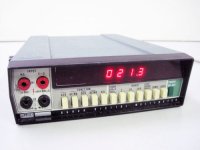
(NOTE: these photos are of generic examples of the meters under discussion and are not pictures of any old gov't test equipment in my possession. These are not the droids you're looking for.)