• Required reading for all forum users!!!

    Welcome!
    Register to access the full functionality of the GSResources forum. Until you register and activate your account you will not have full forum access, nor will you be able to post or reply to messages.

    A note to new registrants...
    All new forum registrations must be activated via email before you have full access to the forum.

    A Special Note about Email accounts!
    DO NOT SIGN UP USING hotmail, outlook, gmx, sbcglobal, att, bellsouth or email.com. They delete our forum signup emails.

    A note to old forum members...
    I receive numerous requests from people who can no longer log in because their accounts were deleted. As mentioned in the forum FAQ, user accounts are deleted if you haven't logged in for the past 6 months. If you can't log in, then create a new forum account. If you don't get an error message, then check your email account for an activation message. If you get a message stating that the email address is already in use, then your account still exists so follow the instructions in the forum FAQ for resetting your password.

    Have you forgotten your password or have a new email address? Then read the forum FAQ for details on how to reset it.

    Any email requests for "can't log in anymore" problems or "lost my password" problems will be deleted. Read the forum FAQ and follow the instructions there - that's what we have one for...

  • Returning Visitors

    If you are a returning visitor who never received your confirmation email, then odds are your email provider is blockinig emails from our server. The only thing that can be done to get around this is you will have to try creating another forum account using an email address from another domain.

    If you are a returning visitor to the forum and can't log in using your old forum name and password but used to be able to then chances are your account is deleted. Purges of the databases are done regularly. You will have to create a new forum account and you should be all set.

Torquing bolts

  • Thread starter Thread starter the1pig
  • Start date Start date
T

the1pig

Guest
OK here is another newbie question but thank you for your help. If there is not a Spec for certain bolts to be torqued what is the standard? Just hand tight?

Thanks again for all you help.

I will start putting her back together tomorrow baring any unforeseen difficulties.
 
Depends on the size of bolt & what it's going into... Can you be more specific?

Dan :)
 
not really it is more of a general question. i am doing a top end rebuild and getting ready to put it back together.

I noticed some bolts like the cam chain guides do not have recommended torque specs.
 
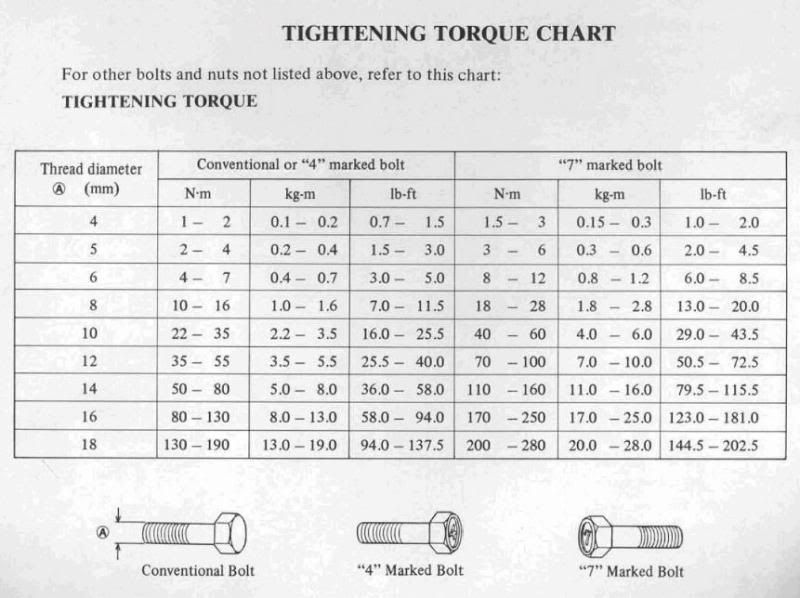
there should be a table of torque values listed in the manual as standard for each given diameter and thread pitch. these are the values to use when there isn't one called out for the specific location / application.
 
Here is a copy of the chart that 76FJ55 was talking about, taken from the factory 850 manual:

Torquechart.jpg


.
 
Do them up till they break or strip ,then back them off half a turn.:pCheers,Simon.
 
well the air impact is o.k. but a four foot torque wrnech is beettr. cause you know how much .. power your useing..for over tightening.. you know the ones they use on massive diesil ships..
 
Do them up till they break or strip ,then back them off half a turn.:pCheers,Simon.

:clap: That is why I love this site the years of personal experience is better then any other shop I could call or book I can read. Thanks for the information.
 
well the air impact is o.k. but a four foot torque wrnech is beettr. cause you know how much .. power your useing..for over tightening.. you know the ones they use on massive diesil ships..
Did you say "massive diesil ships"?
Here is an engine for one:
rta96c_crank.jpg


rta96c_cyldeck.jpg


Then it's time to dig out the 'liquid wrench'. AKA, oxy-acetylene torch!
"Liquid Wrench" is NOT the same as a torch.

LG_L106.JPG


By the way, the oxy-acetylene torch is more-commonly known as a "blue-tipped wrench". :D

.​
 
:clap: That is why I love this site the years of personal experience is better then any other shop I could call or book I can read. Thanks for the information.

I never back them off once stripped, no use. Spot weld them:p
 
Our fastener distributor put on a little symposium on nuts and bolts. Accd. to him, torque specs apply to NEW hardware only. Any anti-seize or loctite on the threads will give a false reading. Torquing old stuff will normally get you close.
 
I've got plans to pop one of these motors in my PC50 - she might make over 40mph then....
She might make over 40 mph, but not for long. You're gonna have to stop for fuel every so often too.

Check out the rest of the specs for the engine:

The Wartsila-Sulzer RTA96-C turbocharged two-stroke diesel engine is the most powerful and most efficient prime-mover in the world today. The Aioi Works of Japan's Diesel United, Ltd built the first engines and is where some of these pictures were taken.
It is available in 6 through 14 cylinder versions, all are inline engines. These engines were designed primarily for very large container ships. Ship owners like a single engine/single propeller design and the new generation of larger container ships needed a bigger engine to propel them.
The cylinder bore is just under 38" and the stroke is just over 98".
Each cylinder displaces 111,143 cubic inches (1820 liters) and produces 7780 horsepower.
Total displacement comes out to 1,556,002 cubic inches (25,480 liters) for the fourteen cylinder version.

Some facts on the 14 cylinder version:
Total engine weight:2300 tons (The crankshaft alone weighs 300 tons.)
Length:89 feetHeight:44 feet
Maximum power:108,920 hp at 102 rpm
Maximum torque:5,608,312 lb/ft at 102rpm
Fuel consumption at maximum power is 0.278 lbs per hp per hour (Brake Specific Fuel Consumption).
Fuel consumption at maximum economy is 0.260 lbs/hp/hour.
At maximum economy the engine exceeds 50% thermal efficiency. That is, more than 50% of the energy in the fuel in converted to motion.
For comparison, most automotive and small aircraft engines have BSFC figures in the 0.40-0.60 lbs/hp/hr range and 25-30% thermal efficiency range.
Even at its most efficient power setting, the big 14 consumes 1,660 gallons of heavy fuel oil per hour.

Let's assume a speed of 20 knots for the ship. That's just about 22 miles per hour.
Divided by 1660 gallons means that you will use about 75 gallons per mile. You will get about 70 feet per gallon.
Assuming about a 4-gallon tank on your bike, you will have to refill after travelling the length of a football field. :eek:

:D

.
 
She might make over 40 mph, but not for long. You're gonna have to stop for fuel every so often too.

Check out the rest of the specs for the engine:

The Wartsila-Sulzer RTA96-C turbocharged two-stroke diesel engine is the most powerful and most efficient prime-mover in the world today. The Aioi Works of Japan's Diesel United, Ltd built the first engines and is where some of these pictures were taken.
It is available in 6 through 14 cylinder versions, all are inline engines. These engines were designed primarily for very large container ships. Ship owners like a single engine/single propeller design and the new generation of larger container ships needed a bigger engine to propel them.
The cylinder bore is just under 38" and the stroke is just over 98".
Each cylinder displaces 111,143 cubic inches (1820 liters) and produces 7780 horsepower.
Total displacement comes out to 1,556,002 cubic inches (25,480 liters) for the fourteen cylinder version.

Some facts on the 14 cylinder version:
Total engine weight:2300 tons (The crankshaft alone weighs 300 tons.)
Length:89 feetHeight:44 feet
Maximum power:108,920 hp at 102 rpm
Maximum torque:5,608,312 lb/ft at 102rpm
Fuel consumption at maximum power is 0.278 lbs per hp per hour (Brake Specific Fuel Consumption).
Fuel consumption at maximum economy is 0.260 lbs/hp/hour.
At maximum economy the engine exceeds 50% thermal efficiency. That is, more than 50% of the energy in the fuel in converted to motion.
For comparison, most automotive and small aircraft engines have BSFC figures in the 0.40-0.60 lbs/hp/hr range and 25-30% thermal efficiency range.
Even at its most efficient power setting, the big 14 consumes 1,660 gallons of heavy fuel oil per hour.

Let's assume a speed of 20 knots for the ship. That's just about 22 miles per hour.
Divided by 1660 gallons means that you will use about 75 gallons per mile. You will get about 70 feet per gallon.
Assuming about a 4-gallon tank on your bike, you will have to refill after travelling the length of a football field. :eek:

:D

.

HAHAHAHAHAHAHAHAHAHAHAHAHAHAHAHAHAHAHAHAHAHAHAHAHAHAHAHAHAHAHAHAHAHAHAHAHAHAAH
that thing is so freakin sweet I want one so bad now.........HAHAHAHAHAHAHAHAHAHAHAHAHAHAHAHA
 
So what's the torque spec on the connecting rod bolts?

In all seriousness, if you have access to a machinery's handbook, there are formulas for computing torque required based on either common joint loading, or a specified joint loading. I'm sure you can look up all kinds of formulas for those calcs on the net as well. It all depends on base metal, bolt material, and assumed bolt condition (new vs old). You can spec it to be torqued to the limit of thread ripout of the weaker thread, or you can spec it to obtain a desired normal force on the joint.
 
Back
Top