• Required reading for all forum users!!!

    Welcome!
    Register to access the full functionality of the GSResources forum. Until you register and activate your account you will not have full forum access, nor will you be able to post or reply to messages.

    A note to new registrants...
    All new forum registrations must be activated via email before you have full access to the forum.

    A Special Note about Email accounts!
    DO NOT SIGN UP USING hotmail, outlook, gmx, sbcglobal, att, bellsouth or email.com. They delete our forum signup emails.

    A note to old forum members...
    I receive numerous requests from people who can no longer log in because their accounts were deleted. As mentioned in the forum FAQ, user accounts are deleted if you haven't logged in for the past 6 months. If you can't log in, then create a new forum account. If you don't get an error message, then check your email account for an activation message. If you get a message stating that the email address is already in use, then your account still exists so follow the instructions in the forum FAQ for resetting your password.

    Have you forgotten your password or have a new email address? Then read the forum FAQ for details on how to reset it.

    Any email requests for "can't log in anymore" problems or "lost my password" problems will be deleted. Read the forum FAQ and follow the instructions there - that's what we have one for...

  • Returning Visitors

    If you are a returning visitor who never received your confirmation email, then odds are your email provider is blockinig emails from our server. The only thing that can be done to get around this is you will have to try creating another forum account using an email address from another domain.

    If you are a returning visitor to the forum and can't log in using your old forum name and password but used to be able to then chances are your account is deleted. Purges of the databases are done regularly. You will have to create a new forum account and you should be all set.

Voltage Regulator Testing

  • Thread starter Thread starter HobieSun
  • Start date Start date
H

HobieSun

Guest
Hello,
I have a 1980 GS750L. It has a voltage regulator/rectifier as one unit. Is there a way to test it?

I have tested the alternator according to the clymer book and it checks out. I have checked all grounds and connections, followed all wires to there destination and have found no problems. I ordered a new regulator through Dennis Kirk and installed it. It still is not charging. With the bike running without a load (take a couple of fuses out) it is 12.6/12.8 volts. Doesn't really matter when the headlight is on or not, pretty much the same readings. I am an automotive tech, and I have gotten plenty of faulty new parts before, but I am just wanting to make sure that the regulator is bad before I decide to send it back. Thanks.
 
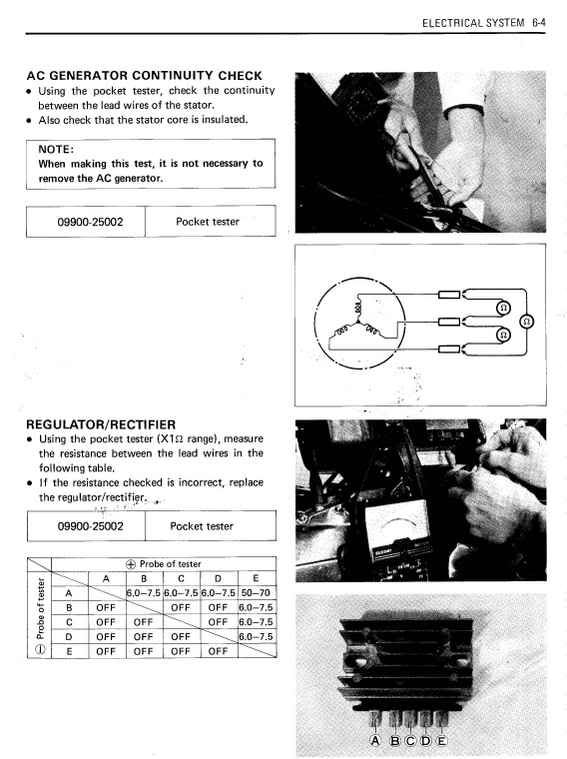
Here is Suzuki's prescribed method.

You can check you regulator/rectifier by following the Suzuki procedure below.

With the r/r removed from the bike, fins pointing up and terminals facing you, the terminals from left to right will be A, B, C, D, and E.
Negative probe on A and positive on B you should get 6-7.5 ohms.
Negative probe on A and positive on C you should get 6-7.5 ohms.
Negative probe on A and positive on D you should get 6-7.5 ohms.
Negative probe on A and positive on E you should get 50-70 ohms.

Then switch the negative probe to terminal B and place the positive probe on A, C, then D, you should get no reading. Positive on E should read 6-7.5 ohms.

Switch negative probe to C and positive to A, B, then D, you should get no reading. Positive on E should read 6-7.5 ohms.

Switch negative probe to D and positive to A, B, then C, you should get no reading. Positive on E should read 6-7.5 ohms.

Switch negative probe to E, positive to A, B, C, and D should give no reading.

The numbers have to be within range. It doesn't take much of an out of range reading to lead to the wrong output.
 
I did all that, and it seems like everything was wrong. The first wave of test was ok except for the c and d were way off. Then I switched negatives and had readings, all different range. Everything was basically off and telling me that this part is bad. Thanks a lot.\\:D/
 
HobieSun said:
Hello,
I have a 1980 GS750L. It has a voltage regulator/rectifier as one unit. Is there a way to test it?

I have tested the alternator according to the clymer book and it checks out. I have checked all grounds and connections, followed all wires to there destination and have found no problems. I ordered a new regulator through Dennis Kirk and installed it. It still is not charging. With the bike running without a load (take a couple of fuses out) it is 12.6/12.8 volts. Doesn't really matter when the headlight is on or not, pretty much the same readings. I am an automotive tech, and I have gotten plenty of faulty new parts before, but I am just wanting to make sure that the regulator is bad before I decide to send it back. Thanks.

The test that Billy has suggested may be a Suzuki test, but it is not in either my Suzuki shop manual or the Clymer's manual. It is a bench test, doesn't test the R/R under load and may go wrong if not done just right. The test method in both manuals is to run the engine at 5,000 RPM while checking that charging voltage is between 14 - 15.5 volts. This test is the proof of the pudding. If the voltage is below or above this range the regulator rectifier is bad. Actually, the recommended range is too wide, and the reading should be in the 14.4 - 14.8 range. If it were to continually charge at 15.5 volts, the battery would be overcharged and gassing would boil off the electrolyte water.
 
The test is from one of the last manuals Suzuki ever produced for GS models. Certainly after they realized the weak points of the charging system.
regulatortest.jpg
 
Boondocks said:
The test that Billy has suggested may be a Suzuki test, but it is not in either my Suzuki shop manual or the Clymer's manual. It is a bench test, doesn't test the R/R under load and may go wrong if not done just right. The test method in both manuals is to run the engine at 5,000 RPM while checking that charging voltage is between 14 - 15.5 volts. This test is the proof of the pudding. If the voltage is below or above this range the regulator rectifier is bad. Actually, the recommended range is too wide, and the reading should be in the 14.4 - 14.8 range. If it were to continually charge at 15.5 volts, the battery would be overcharged and gassing would boil off the electrolyte water.

I've been doing a lot of research on this myself. I could be wrong, but I think it was posted at one time that they are both valid tests. However, the R/R has the potential to fail the operational test even though it may pass the bench test.
 
smithbm said:
I've been doing a lot of research on this myself. I could be wrong, but I think it was posted at one time that they are both valid tests. However, the R/R has the potential to fail the operational test even though it may pass the bench test.
It's possible it could pass the bench test and still overheat under operating conditions. The test I posted has worked for me in the past though.
 
Well, I appreciate everyones input. Actually, I believe that the bench test was the final outcome. I had tested the alternator, checked all grounds and wiring connections, everything checked out. Installed a new R/R and it still wasn't charging. By doing the bench test it told the tale basically twice, since volts were around 12.6 and 12.8, and the POS had continuity in just about every which way possible (which is obviously a bad thing). Plus I know these guys are going to test it when they get it sent back to them and I needed to make sure. Thanks again \\:D/
 
HobieSun said:
Well, I appreciate everyones input. Actually, I believe that the bench test was the final outcome. I had tested the alternator, checked all grounds and wiring connections, everything checked out. Installed a new R/R and it still wasn't charging. By doing the bench test it told the tale basically twice, since volts were around 12.6 and 12.8, and the POS had continuity in just about every which way possible (which is obviously a bad thing). Plus I know these guys are going to test it when they get it sent back to them and I needed to make sure. Thanks again \\:D/

I doubt that Dennis Kirk is equipped to test bad electrical parts like a R/R. I would think that they will probably send it back to the supplier.

Unlike car alternators which use a field coil electromagnet and can charge at idle, your Suzuki has a permanent magnet alternator which doesn't put out much charging voltage until the RPMs are raised. 12.6 - 12.8 volts (no charging) is in the normal range at idle speed. That's why the 5,000 RPM test is specified. When you get the new alternator, test it for 14.4 - 14.8 volts at 5,000 RPM to ensure that it is working properly.
 
Back
Top